Archive for the 'In this week's New Yorker' Category

In this week’s New Yorker

May 30, 2013

Three very interesting complicated narratives dominate the issue:

* Nicholas Schmidle’s “In the Crosshairs” tells the compelling story of  Chris Kyle, the highly decorated military killing machine and co-author of the best-seller American Sniper, whose well-intentioned efforts to help Iraqi veterans suffering from PTSD brought him in contact with Eddie Ray Routh, with disastrous results.

* In “The Manic Mountain,” Nick Paumgarten writes about an intense fight on Mt. Everest between elite white European climbers and the local sherpas who make the slopes safe for commercial tourism.

* Jill Lepore’s sharply negative review of Neil Thompson’s new biography A Curious Man: The Strange and Brilliant Life of Robert “Believe It Or Not!” Ripley manages to achieve a capsule portrait of not only Ripley but also Goeffrey T. Hellman, who wrote many in-depth New Yorker profiles, including one of Ripley that ran in two successive issues in 1940.

I enjoyed reading Alex Halberstadt’s profile of Kim Gordon, even though I have never managed to get anything out of listening to Sonic Youth’s music. And I have to admit that I loved Emily Nussbaum’s review of Steven Soderbergh’s Liberace biopic, Behind the CandelabraI pretty much agree with everything she says about the movie.

Oh, and great timely cover by Marcellus Hall:

bicycle cover

In this week’s New Yorker

May 25, 2013

new yorker may 27
Some fascinating stuff in the issue, including Jane Mayer’s detailed account of how right-wing conservative zillionaire David Koch has poisoned the independence of public television with his tainted philanthropy, Jeffrey Toobin’s profile of New York City Judge Shira Scheindlin and what part she’s playing in opposing the police department’s stop-and-frisk policy, and George Packer (Silicon Valley native) on how newly rich tech-world giants are dipping their toes into politics.

penicillinBut nothing is more riveting than Tad Friend’s “Crowded House,” which reports one insane individual’s amazing ability to scam almost 100 different people into simultaneously subletting his apartment illegally in Manhattan.

martini

In this week’s New Yorker

May 19, 2013

new yorker innovators
At first glance, I didn’t think I had the time or interest to absorb the key features in the annual Innovators issue — but I did. They’re all worth it:

* Susan Orlean’s American Chronicles piece on treadmill desks, which made me want to buy one;

* Ian Frazier’s “Form and Fungus,” about a couple of dudes disturbed by all the crappy non-biodegradable Styrofoam in the world who figured out how to grow an all-natural substitute for plastic out of mushroom tissue;

* John Seabrook’s “Network Insecurity,” basically on the hopeless dream of cybersecurity;

* Michael Specter’s “Inherit the Wind,” about another pair of young guys who’ve figured out how to generate electricity from wind energy using kites, as opposed to the wind turbines that even green energy supporters like cartoonist Lynda Barry have catalyzed huge populist activism to oppose;

* Nathan Heller’s “Laptop U,” about the budding field of MOOCs (massive open online courses), which all the big schools are getting into — despite my instinctive revulsion against it, this phenomenon apparently does have some pedagogical advantages; and

* Rebecca Mead’s Reporter-at-Large story, “The Sense of an Ending,” which moved me to tears several times with its reporting on specialists at the Beatitudes Campus, a retirement community in Phoenix, who have found compassionate, humane ways to treat elderly patients with dementia and Alzheimer’s.

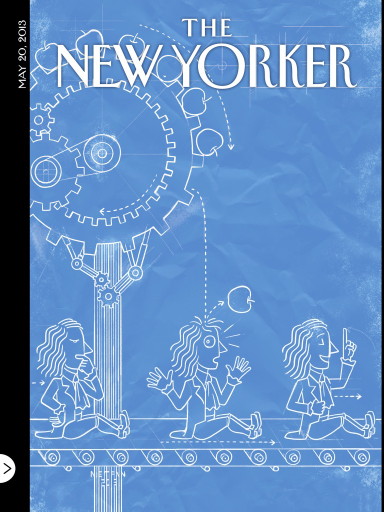
The iPad…excuse me, Tablet edition also features a hilarious interactive version of the Christoph Niemann cover illustration (above). And I’m going to let Ben Marcus read his story “The Dark Arts” aloud to me.

et tu killbot

In this week’s New Yorker

May 9, 2013

The best reading is “Every Disease on Earth,” Rivka Galchen’s piece on Elmhurst Hospital in Queens, which apparently serves the most ethnically diverse population of any in the world, and Dr. Joseph Lieber (below, photo by Stephanie Sinclair), a dedicated resident and ace diagnostician.

dr joseph lieber

Also of interest: Ryan Lizza’s profile of Colorado’s governor, John Hickenlooper, and the state’s political shift in recent years over issues of guns, gay marriage, and marijuana; Dexter Filkins’ “The Thin Red Line,” about the Obama Administration’s internal debate over what to do about Syria; Joan Acocella writing amusingly, as ever, about the new burlesque scene in downtown Manhattan (“Take It Off”); and Kelefa Sanneh’s Critic at Large essay on anarchism, reviewing a number of books inspired by the Occupy movement and explicating the crucial distinctions between vertical and horizontal movements.

bull in china shop

In this week’s New Yorker

April 26, 2013

Another week of exemplary reporting. Editor-in-chief David Remnick literally overnight called on his years of experience reporting from Russia to post on the magazine’s website his amazingly thorough, thoughtful, deep Talk of the Town piece on the Tsarnaev brothers and the Chechen culture they came from.

With his typically tenacious reporting and dry-eyed scrutiny, William Finnegan reports (“The Deportation Machine”) the horrific story of Mark Lyttle, a 35-year-old biracial mentally ill American citizen from North Carolina, who  — through a series of bureaucratic mishaps that even Kafka might have considered far-fetched — was deported, shoved across the Mexican border with three dollars in his pocket, and forced to spend four months wandering (sometimes on foot) through Central America until the American Embassy in Guatemala contacted his family and sent him home. Except that he was arrested at the airport in Atlanta under the assumption that his newly issued passport was a fake.

Then there’s Luke Mogelson’s “Letter from Aleppo,” a soul-wrenching dispatch from the bloody midst of Syria’s raggedy civil war. Mogelson’s piece focuses on the people who have assumed the task of burying the corpses that get pulled out of the River Queiq that runs through Syria’s largest city (234 in recent months) and the heavily-traveled bridge on which Syrian Army snipers shoot commuters “in order to bait rebel fighters and would-be rescuers,” except that most of the victims turn out to be women, children, and old men who can’t run fast enough to escape.

I confess that after reading Finnegan’s and Mogelson’s pieces, I was relieved to turn the page and read Ian Parker’s profile of filmmaker Noah Baumbach.

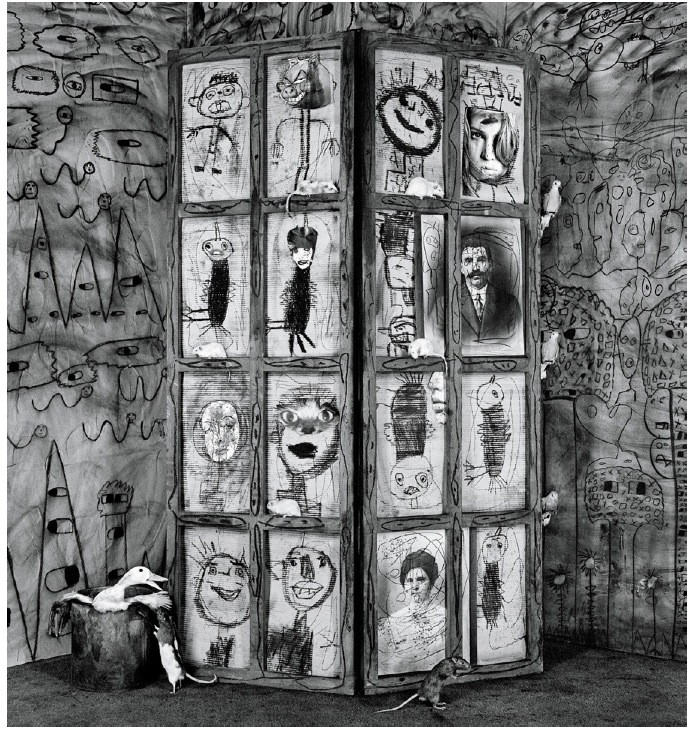
Also in the issue: excellent piece about writing by echt New Yorker staffer John McPhee, who makes a case for the dictionary being a writer’s best friend; a portfolio of pieces (including “Onlookers,” below) by photographer Roger Ballen, whose images fueled Die Antwood’s stunning music video “I Fink U Freeky”; and a column in the Current Cinema department that reminds me that the way to brighten anyone’s day is to read aloud Anthony Lane’s movie reviews out loud.

bollen onlookers