Quote of the day: VOICE

July 23, 2011

VOICE

Male logic, or a man’s voice, tends to be based on terms of autonomy, justice, and rights; whereas women’s logic or voice tends to be based on terms of relationship, care, and responsibility. Men tend toward agency; women tend toward communion. Men follow rules; women follow connections. Men look; women touch. Men tend toward individualism, women toward relationship. One of [Carol] Gilligan’s favorite stories: A little boy and girl are playing. The boy says, “Let’s play pirates!” The girl says, “Let’s play like we live next door to each other.” Boy: “No, I want to play pirates!” “Okay, you play the pirate who lives next door.” … Gilligan says that the boys will hurt feelings in order to save the rules; the girls will break the rules in order to save the feelings.

— Ken Wilber, summarizing Carol Gilligan’s In a Different Voice


Photo diary: July, mercy on Broadway

July 22, 2011

I love observing what goes on behind the facade of New York architecture -- check out this elegant (!) solution to rooftop drainage

headed to Sandy Hook on a perfect beach day

Andy's job these days includes writing photo captions, headlines, and subheds for the Sports section of the NY Times -- here's some that he was especially proud of (o, the many ways of playing one's trade as a scribe!)

screen cap of Joseph Mawle, who gives a compelling performance in a grim, poisonous made-for-British-TV gay movie called "Clapham Junction"


Quote of the day: PAIN

July 22, 2011

PAIN

Pain is weakness leaving the body.

— US Marine Corps saying


In this week’s New Yorker

July 21, 2011


An especially good magazine, starting with another delightful Barry Blitt cover, and a leading editorial in Talk of the Town by George Packer — about the budget battle in Congress — that I would like to copy and circulate to every member of the freshman Republican cabal. (Does that list exist somewhere close at hand?) Actually, every piece in Talk of the Town is pretty great this week, including a rare Gay Talese item about one of those Manhattan locations that are death to restaurants. But the best of the lot is Lauren Collins’ hilarious piece about Chris Bryant, a gay Member of Parliament previously unknown to me who was one of the first to directly challenge the Murdoch empire that is now crashing down:

At Westminster Hall, Chris Bryant indulged in a moment of goofy release when asked if Murdoch, after everything that had happened, would still be able to intimidate British politicians. He held two thumbs together, forefingers up, in a W shape, and then turned them upside down: “Frankly, now it’s like ‘Whatever, Mary.’ ”

Is it because I grew up in a trailer that I read every word of Alec Wilkinson’s piece about tiny houses, “Let’s Get Small”?

Paul Rudnick’s Shouts & Murmurs piece, “The Pope’s Tweets” is predictably LOL. Here are a couple of sample tweets from the Pontiff:
Michele Bachmann is not Satan. Satan doesn’t have split ends.

Someday I’d like to put on slacks, a cardigan, a little straw hat, and sunglasses, and go see “The Book of Mormon.”

Who knew that Calvin Trillin, mostly a food writer, covered the civil rights movements (“the Seg Beat”) for Time magazine once upon a time? His reminiscence of covering the Freedom Riders (“Back on the Bus”) moved me tremendously, as accounts of that historic struggle generally do.

I was mildly interested in Jane Kramer’s profile of contrarian French feminist Elisabeth Badinter, but early on it became clear that she’s one of those social critics who can dish it out but can’ t take it. Badinter refers to a talk she gave at Princeton as her “worst experience….a total execution.” But Kramer reports:

The American feminist scholar Joan Scott, at the Institute for Advanced Studies, heard the talk. She told me, ‘Badinter was saying all sorts of banal things about how the French were sexier than Americans, better at sex, how American women washed too much, how they were embarrassed by bodily odors, by oral sex. We asked hostile questions, like, ‘How can you say these things off the top of your head?’ That it was traumatic for her is very odd. We were simply distressed by her talk.”

I don’t know why, but I also ate up every word of John Cassidy’s piece about hedge fund billionaire Ray Dalio. The guy sounds like a dick, and yet I respect his hard-headedness and self-questioning: “I believe that the biggest problem that humanity faces is an ego sensitivity to finding out whether one is right r wrong and identifying what one’s strengths and weaknesses are.” His motto is “Pain + Reflection = Progress.”

Good piece by Paul Goldberger on Zaha Hadid, an architect whose work interests me. Check out her new Riverside Museum in Glasgow (photo by Iwan Baum):


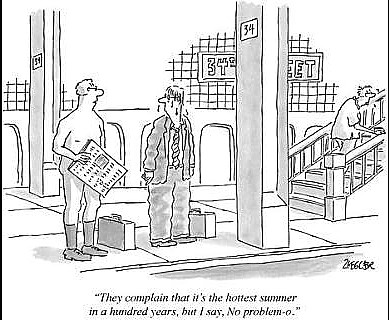
All told, a densely rewarding issue, anything but light midsummer reading. Although with a perfectly timed Jack Ziegler cartoon:


Quote of the day: GIVING AND RECEIVING

July 19, 2011

GIVING AND RECEIVING

How exactly do we give and receive? The first way is a simple/difficult technique: Ask for what you want and listen to your partner. Asking for what you want combines the most crucial elements of intimacy. It gives the other the gift of knowing you, your needs, and your vulnerability. It also means receiving the other’s free response. Both are risky, and therefore both make you more mature. You learn to let go of your insistence on a yes, to be vulnerable to a no, and to accept a no without feeling the need to punish.

To listen intimately to a partner asking for what he wants is to pick up on the feeling and need beneath the request. It is to appreciate where the request came from. It is to feel compassion for any pain that may lurk in the request. It is to give the other credit for risking rejection or misunderstanding. We hear with our ears; we listen with our intuition and our heart. Giving and receiving entail the ability to accommodate the full spectrum of a partner’s fears and foibles and to distinguish between needs we can and cannot expect to see fulfilled.

A second way intimate adults give and receive is through mutually chosen sex and playfulness: You make love when both of you want it, not when one of you push the other into it. You can be intimate without having to be sexual. You know how to have fun together. You play without hurting each other, without engaging in sarcasm or ridicule, without laughing at each other’s shortcomings.

Finally, we give and receive by granting equality, freedom from hierarchy, to our partner and ourselves. Only the healthy ego, and not another person, is meant to preside over your life. In true intimacy, partners have an equal voice in decision making. One partner does not insist on dominating the other.

— David Richo, How to Be an Adult in Relationships