Good stuff online

August 1, 2012


I’ve been loving New York magazine’s new “In Conversation” feature, which exudes ambitions to become the new version of Playboy magazine’s in-depth interviews. On the heels of rambling, riveting chats with Barney Frank and Spike Lee, last week there was Martin Amis — not one of my favorite writers ever, but someone I’m totally content to read a lengthy Q&A with. You can read the whole thing here. David Wallace-Wells conducted the interview. Some notable excerpts:

“In America, the policeman is a working-class hero. In En­gland, the policeman is a working-class traitor. That’s why there’s such violent names for the police in criminal England—they call them not only the filth, the filth, but also the puss. They’re the lowest of the low. When policemen go to prison in England, they have as bad a time as a pedophile. The police in America are quite, to my senses, fascistic—you know, an immediate end to all humor, end of all human contact. It’s a real assertion of authority in a way that’s very rare in England. In England, police are, softly, softly, Now sir, come on sir. It’s a humoring voice, not an authoritarian one. But when a riot starts, it’s all off—the law suspended. It’s just the sort of thing that happens every now and then. Very hard to see any kind of social protest in it.”

“It sounds schmaltzy to say, but fiction is much more to do with love than people admit or acknowledge. The novelist has to not only love his characters—which you do, without even thinking about it, just as you love your children. But also to love the reader, and that’s what I mean by the pleasure principle. The difference between a Nabokov, who in almost all his novels, nineteen novels, gives you his best chair and his best wine and his best conversation. Compare that to Joyce, who, when you arrive at his house, is nowhere to be found, and then you stumble upon him, making some disgusting drink of peat and dandelion in the kitchen. He doesn’t really care about you. Henry James ended up that way. They fall out of love with the reader. And the writing becomes a little distant.”


Photo diary: Colorado — the Hench/Willett clan

August 1, 2012

I flew into Denver, and Andy met me at the airport with his cousin’s daughter Melissa and his niece Avery — they were waiting by this amazing VW bug completely covered in beads.

We headed west up into the Rockies to the town of Dillon, where Andy’s family had found a gigantic VRBO (vacation rental by owner) with a beautiful view.

Unexpectedly, the lot next to the house was under construction, but it made to my eye a picturesque ruin.

The occasion for this gathering was to memorialize Andy’s Aunt Helen, who died earlier this year. I never met her, but this trip was a happy occasion to meet Andy’s mother’s other sister, Jean, whom I liked very much.

For Andy, family trips center on time spent with his beloved niece Avery…

…and equally beloved nephew Nathan, seen here in the embrace of Andy’s mom Brooke, aka GeeGee.

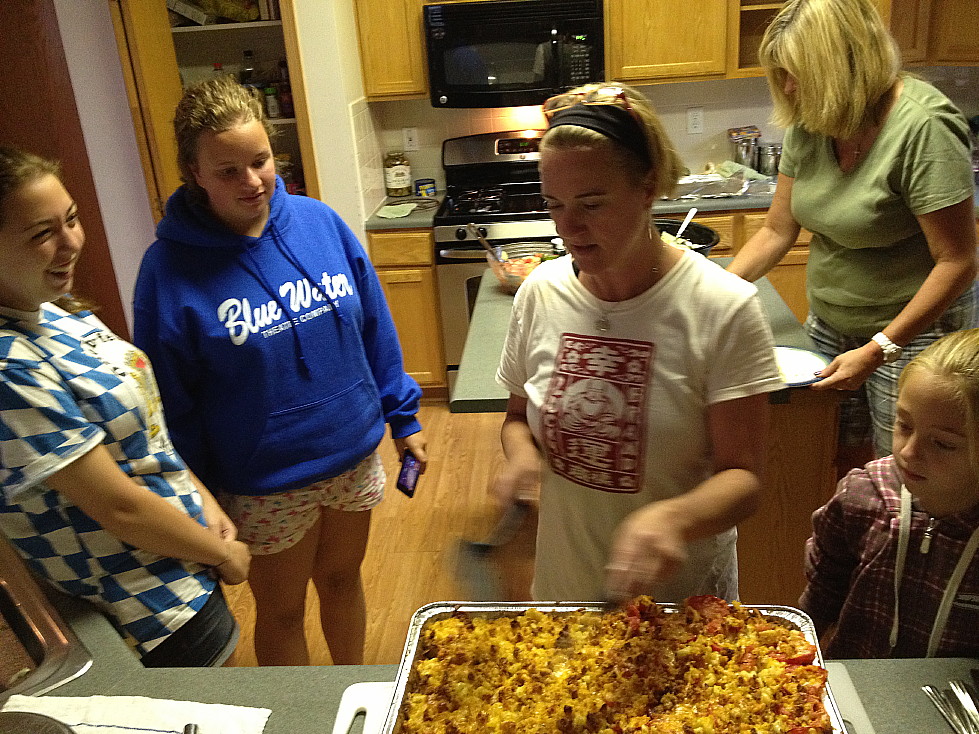
The kids’ mother is Andy’s sister Becky, who wowed the assembly with her killer mac-and-cheese whose secret ingredient was bacon. This was a crowd that loves its bacon. As who wouldn’t?

I got to meet almost all the relatives I hadn’t met before, including soulful young Preston, seven-year-old son of Andy’s cousin Heather

When we weren’t watching the Olympics, we headed out to the outlet mall, which was a lot less interesting than the farmer’s market in Dillon, where I picked up some fresh local peaches and tomatoes and a Greek olive with Thai curry tapenade (not pictured).


In this week’s New Yorker

August 1, 2012


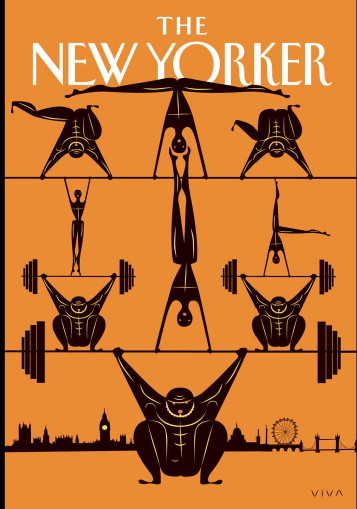
An engrossing issue to read on a three-hour plane ride. Having spent a good chunk of the weekend watching the Olympics, I enjoyed the cover, along with a string of engrossing articles I might not otherwise have devoured quite so closely:

Ryan Lizza’s informative and characteristically in-depth profile of Wisconsin Congressman Paul Ryan, he of the ostensibly sensible budget that barely conceals all kinds of ideological landmines. Obama’s budget director, as Lizza puts it, “dismantled Ryan’s plan, point by point.” Ryan’s proposal would turn Medicare “into a voucher program, so that individuals are on their own in the health-care market,” he said. Over time, the program wouldn’t keep pace with rising medical costs, so seniors would have to pay thousands of dollars more a year for health care. The Roadmap would revive Bush’s plan to privatize Social Security and “provide large tax benefits to upper-income households . . . while shifting the burden onto middle- and lower-income households. It is a dramatically different approach in which much more risk is loaded onto individuals.”

Lauren Collins’ piece on conceptual artist Tino Sehgal, whose work involves no objects whatsoever but focuses on personal interaction;

Mark Singer’s absolutely riveting story about a Michigan dentist who went to incredibly arduous lengths to present himself as a marathon champion without ever actually completing a race and in some cases inventing them (and their websites) from scratch — which falls into the Department of Ugly Truths, or How Fucked-Up Human Beings Can Be. It is essentially a sleuth job on a pathological liar, a mysterious breed of personality;

Evan Osnos on the curious case of Myanmar’s bloodless regime change; and

— a curious little previously unpublished story, “Thank You for the Light,” recently discovered among the papers of F. Scott Fitzgerald, which you can read in its (brief) entirety here. The evocative illustration (below) is by Owen Freeman.


While I’m at it, let me put in a word for two must-reads in the previous issue (cover date July 30): the long and terrific profile of Bruce Springsteen, all the more impressive for being written by New Yorker editor-in-chief David Remnick, who often surprises me with his choice of subjects; and Zadie Smith’s delightful story, “Permission to Enter,” an excerpt from her forthcoming novel NW.


Playlist: iPod shuffle, 7/31/12

July 31, 2012

“Etched Headplate,” Burial
“The Lord’s Graffiti,” Actress
“Hickory,” Iron & Wine
“Don’t You Want My Bad Romance (Lady GaGa vs. Human League),” A plus D
“Hundred Dollars,” Punch Brothers
“Shuffle a Dream,” Little Dragon
“The Two Cowboy Waltz,” Mark Weigle
“Horse Power,” Chemical Brothers
“Medicine,” Tindersticks
“Through the Storm,” Aretha Franklin & Elton John
“Somewhere,” Dionne Warwick
“The Moon is Made of Gold,” Rickie Lee Jones
“The Sire of Sorrow (Job’s Sad Song),” Joni Mitchell
“Date Line,” Loudon Wainwright III
“Lie Alone,” Adam Cohen
“Codex,” Radiohead
“Wolly Wolly Gong,” Tune-Yards
“Pieces of Dreams,” Barbra Streisand
“Another Day in America,” Laurie Anderson
“Aha!” Imogen Heap
“Falling,” Laurie Anderson
“Only God Can Save us Now,” Over the Rhine
“Looking for an Angel,” Kylie Minogue


“Gentleman,” Me’Shell NdegeOcello & Yerba Buena featuring Ron Blake (Red Hot + Riot)
“While You Wait for the Others,” Grizzly Bear
“Dreaming Wide Awake,” Lizz Wright
“Flower of the Mountain,” Kate Bush
“Army,” Ben Folds Presents the University of Rochester Midnight Ramblers
“The Luckiest,” Ben Folds Presents: The Washington University in St. Louis Amateurs
“Under My Thumb,” Rolling Stones
“Oh, the Divorces!” Tracey Thorn
“Belles,” Andrew Bird
“Every Single Night,” Fiona Apple
“Kingfisher,” Joanna Newsom


Quote of the day: ROCK MUSIC

July 25, 2012

ROCK MUSIC

For an adult, the world is constantly trying to clamp down on itself. Routine, responsibility, decay of institutions, corruption: this is all the world closing in. Music, when it’s really great, pries that shit back open and lets people back in, it lets light in, and air in, and energy in, and sends people home with that and sends me back to the hotel with it. People carry that with them sometimes for a very long period of time….

T-Bone Burnett said that rock and roll is all about “Daaaaddy!” It’s one embarrassing scream of “Daaaaddy!” It’s just fathers and sons, and you’re out there proving something to somebody in the most intense way possible. It’s, like, “Hey, I was worth a little more attention than I got! You blew that one, big guy!”

— Bruce Springsteen, interviewed by David Remnick in the New Yorker