Archive for the 'In this week's New Yorker' Category

In this week’s New Yorker

August 14, 2011


The highlights begin with Christoph Niemann’s timely cover illustration entitled “S.O.S.” (above) and continue with the issue’s centerpiece, a long definitive take-out on Michele Bachmann by political reporter Ryan Lizza. Certainly for anyone who suspects that the Minnesota Congresswoman who wants to be president is an intellectual lightweight unafraid to lie, inflate her credentials, commune with racist ideologues and right-wing nutjobs, and shove her conservative brand of Christian proselytizing down anyone’s throat, Lizza delivers the confirmation in calm, well-researched detail.

There’s also a fascinating article by Tom Bissell about Jennifer Hale, an actress whose vast experience doing voice-overs for video games has led people to regard her as the Meryl Streep of her field.

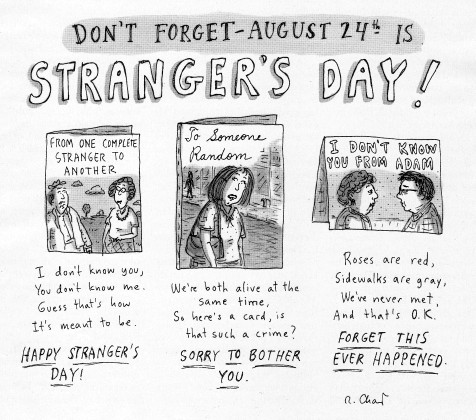
And then of course, the cartoons, including this one by Roz Chast. I love her greeting cards!

Plus, did you know she’s designed a drinking glass for Fishs Eddy??? You can get a look at them online here.

In this week’s New Yorker

August 3, 2011

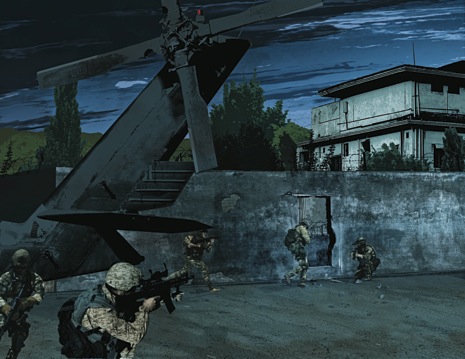
Lots of good stuff in the magazine this week, starting with Nicholas Schmidle’s riveting, moment-by-moment account of the raid in Abbottabad that resulted in the death of Osama bin Laden — a story I can’t quite get enough of, which surprises me. It reads like the treatment for the first of many Hollywood movies dramatizing this mission we’re going to be seeing in the next five years.

Equally exciting to me, if not more, is Stephen Greenblatt’s news from first century B.C. Rome, in the form of a succinct, comprehensive essay about Lucretius, a poet and philosopher previously unknown to me but clearly a kindred spirit in his devotion to the Epicurean philosophy of pleasure and beauty. His magnum opus, “On the Nature of Things (De Rerum Natura),” helped Renaissance thinkers and artists emerge from the brutal theology of the Dark Ages, which Greenblatt summarizes thusly: “human beings were by nature corrupt. Inheritors of the sin of Adam and Eve, they richly deserved every miserable catastrophe that befell them. God cared about human beings, just as a father cared about his wayward children, and the sign of that care was anger. It was only through pain and punishment that a small number could find the narrow gate to salvation. A hatred of pleasure-seeking, a vision of God’s providential rage, and an obsession with the afterlife: these were death knells of everything Lucretius represented.” The whole piece is dazzling and worth reading.

An especially juicy Talk of the Town section: Hendrik Hertzberg’s trenchant examination of the 14th Amendment and how it’s being stupidly betrayed in the current debt ceiling debacle (“With compromises like these, who needs surrender?”); Nick Paumgarten on clearing out the storage space in the basements of StuyTown; Rebecca Mead on who gets bitten by mosquitoes; Michael Schulman on the props list for the Royal Shakespeare Company’s run at the Park Avenue Armory.

I’m not a big shopper, but I’ve gotten addicted to Patricia Marx’s “On and Off the Avenue” columns, just because her prose is hilarious.

In this week’s New Yorker

July 27, 2011

Some highlights: “Hack Work,” Anthony Lane’s cheerfully knowing survey of the Murdoch empire and its influence on British life and “The Asylum Seeker,” Suketu Mehta’s matter-of-fact, dismaying report on asylum coaches who teach refugees how to embellish their stories of torture and abuse in order to stay in the U.S.

But more than anything else, I was mesmerized by Platon’s portfolio featuring the gleaming, gnarly, life-worn faces of Egyptians involved in this year’s uprising, such as 23-year-old Sarrah Abdel Rahman, an aspiring television journalist who made online videos from Tahrir Square:


And I must admit I was even more taken with Autumn Whitehurst’s illustration for Justin Torres’s surprising short story, “Reverting to a Wild State”:

In this week’s New Yorker

July 21, 2011


An especially good magazine, starting with another delightful Barry Blitt cover, and a leading editorial in Talk of the Town by George Packer — about the budget battle in Congress — that I would like to copy and circulate to every member of the freshman Republican cabal. (Does that list exist somewhere close at hand?) Actually, every piece in Talk of the Town is pretty great this week, including a rare Gay Talese item about one of those Manhattan locations that are death to restaurants. But the best of the lot is Lauren Collins’ hilarious piece about Chris Bryant, a gay Member of Parliament previously unknown to me who was one of the first to directly challenge the Murdoch empire that is now crashing down:

At Westminster Hall, Chris Bryant indulged in a moment of goofy release when asked if Murdoch, after everything that had happened, would still be able to intimidate British politicians. He held two thumbs together, forefingers up, in a W shape, and then turned them upside down: “Frankly, now it’s like ‘Whatever, Mary.’ ”

Is it because I grew up in a trailer that I read every word of Alec Wilkinson’s piece about tiny houses, “Let’s Get Small”?

Paul Rudnick’s Shouts & Murmurs piece, “The Pope’s Tweets” is predictably LOL. Here are a couple of sample tweets from the Pontiff:
Michele Bachmann is not Satan. Satan doesn’t have split ends.

Someday I’d like to put on slacks, a cardigan, a little straw hat, and sunglasses, and go see “The Book of Mormon.”

Who knew that Calvin Trillin, mostly a food writer, covered the civil rights movements (“the Seg Beat”) for Time magazine once upon a time? His reminiscence of covering the Freedom Riders (“Back on the Bus”) moved me tremendously, as accounts of that historic struggle generally do.

I was mildly interested in Jane Kramer’s profile of contrarian French feminist Elisabeth Badinter, but early on it became clear that she’s one of those social critics who can dish it out but can’ t take it. Badinter refers to a talk she gave at Princeton as her “worst experience….a total execution.” But Kramer reports:

The American feminist scholar Joan Scott, at the Institute for Advanced Studies, heard the talk. She told me, ‘Badinter was saying all sorts of banal things about how the French were sexier than Americans, better at sex, how American women washed too much, how they were embarrassed by bodily odors, by oral sex. We asked hostile questions, like, ‘How can you say these things off the top of your head?’ That it was traumatic for her is very odd. We were simply distressed by her talk.”

I don’t know why, but I also ate up every word of John Cassidy’s piece about hedge fund billionaire Ray Dalio. The guy sounds like a dick, and yet I respect his hard-headedness and self-questioning: “I believe that the biggest problem that humanity faces is an ego sensitivity to finding out whether one is right r wrong and identifying what one’s strengths and weaknesses are.” His motto is “Pain + Reflection = Progress.”

Good piece by Paul Goldberger on Zaha Hadid, an architect whose work interests me. Check out her new Riverside Museum in Glasgow (photo by Iwan Baum):


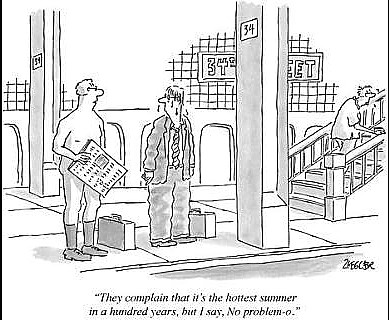
All told, a densely rewarding issue, anything but light midsummer reading. Although with a perfectly timed Jack Ziegler cartoon:

In this week’s New Yorker

July 6, 2011

The article that most grabbed me was “A Woman’s Place,” Ken Auletta’s profile of Sheryl Sandberg, the chief operating officer of Facebook. It’s a fascinating portrait of a really smart, successful manager (Sandberg is credited for making Facebook financially profitable for the first time) and of a new kind of businesswoman. I love the basic attitude she brings to both women and men, employees and colleagues: “What would you do if you weren’t afraid?”

Sandberg is a protege of Larry Summers, her professor when she majored in economics at Harvard. I was struck by this passage: “At her Phi Beta Kappa induction, there were separate ceremonies for men and women. At hers, a woman gave a speech called ‘Feeling Like a Fraud.’ During the talk, Sandberg looked around the room and saw people nodding. ‘I thought it was the best speech I’d ever heard,’ she recalls. ‘I felt like that my whole life.’ At every stage of her time in school, Sandberg thought, I really fooled them. There was ‘zero chance,’ she concluded, that the men in the other room felt the same.” Actually, in my experience, PLENTY of men live with the exact same existential experience, which has even been named “impostor syndrome.”

Speaking of management styles, there’s also this cartoon by Bruce Eric Kaplan:

I haven’t finished Ruth Prawer Jhabvala’s short story, “Aphrodisiac,” but I look forward to it. Something else I look forward to reading is Rob Young’s book Electric Eden, of which there’s a short unsigned review in the New Yorker. It’s a study of the quirky British pop-folkies that proliferated in the late ’60s and early ’70s such as Fairport Convention and the Incredible String Band. Can I just say, though, that this book starts by focusing on Vashti Bunyan, whom historical revisionism has given prominence — but I was around back then and listened avidly to all this music, and I never heard of Bunyan until a few years ago when “freak-folkie” Devendra Banhart cited her as an influence. Clearly, she was around but had nowhere near the profile of people like the late great Sandy Denny. Just sayin’.

I will never watch the movie Transformers: Dark of the Moon, but I loved reading Anthony Lane’s review of it. Among other things, I learned that the cast of this cretinous movie includes John Turturro, Frances McDormand, and John Malkovich, “hardly the first to burnish their status, and please their accountants, by putting a hand to the Transformers plow,” Lane notes. He also says,”The real [Buzz] Aldrin, now eighty-one, shows up int he film, to make nice to Optimus Prime — the toughest and most pompous of the Autobots. These, despite sounding like a new range of self-applying diapers, are well-intentioned metal dunderheads, residing here on Earth, and promising, ‘The day will never come when we forsake this planet and its people.’ Oh, God. Never?”