Archive for the 'In this week's New Yorker' Category

In this week’s New Yorker

August 22, 2012

Some amazing stuff, starting with the cover, a characteristically dense, witty Bruce McCall special called “A Greener, Greater New York” (see above). Four pieces stand out for me in particular:

* Leo Carey’s biographical essay on Stefan Zweig, the once-famous Austrian writer and biographer whose name I’ve heard but never knew much about (he and his second wife committed suicide together in Brazil in 1942, in despair over the future of Europe);

* Alice Munro’s “Amundsen,” long, slow, and satisfying as her stories usually are;

* Jon Lee Anderson’s harrowing “Letter from Syria” (I hope he didn’t have to witness first-hand all the brutality he reports in the story); and most of all,

* “Altered States,” Oliver Sacks’s astonishingly candid Personal History essay (an excerpt from his forthcoming book Hallucinations) about his personal use of LSD, peyote, morphine, amphetamines, and other recreational drugs, which ranged from loosely controlled scientific research to the kind of self-isolating absorption that worried his closest friends.


In this week’s New Yorker

August 11, 2012

By far the most compelling reading in this issue is Atul Gawande’s long fascinating study of how chain restaurants manage to produce tasty food — he uses the Cheesecake Factory as his case study — and the ways in which hospitals would benefit from reproducing such systems. If you’re like me, you probably think you don’t want to know too much about what happens in restaurant kitchens, fearing the worst. But Gawande’s account surprised and impressed me — of course, it makes sense for there to be strong accountability in restaurant management, otherwise they wouldn’t stay in business. And it’s accountability in several directions — to proper health standards; to the customer; to keeping costs affordable and waste to a minimum — that the author sees as key and makes a persuasive case for. As a physician employed by a hospital himself, he acknowledges the resistance that doctors have to systematizing procedures, but he also reports on several cases where hospitals have adopted these systems successfully. His article makes me realize that we, the public, have gotten accustomed to healthcare (the scheduling, the costs, the recommendations) running for the convenience of the doctors, when it should be the other way around.

Another healthcare-related high point in the issue: James Surowiecki’s Financial Page column, “Downsizing Supersize,” a very sensible analysis of Mayor Bloomberg’s effort to limit the size of sodas for sale. Some express outrage and consider this a form of governmental micro-managing, but I have to say I support the idea 100%, and Surowiecki lays out the case superbly.

What else? Having gotten caught up in various Olympics dramas, I found Ben McGrath’s report from London to be entertaining. I have a strange ambivalence about Lena Dunham — I can’t tell if she has real talent, or just a high tolerance for self-exposure — but I read her Personal History essay on “First Love” anyway. I’m intrigued with those writers who are managing to incorporate up-to-the-minute social media in their stories — Justin Taylor’s “After Ellen” is nominally fiction, and narrated by a man, but otherwise it’s in the same category as Dunham’s piece.
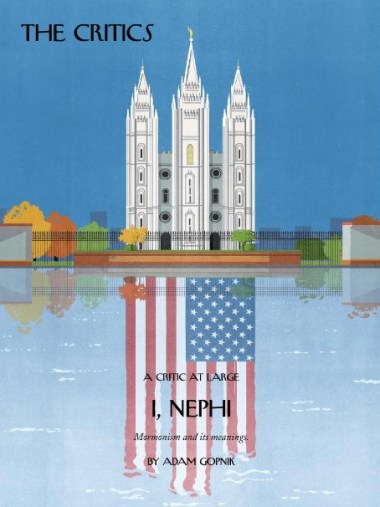

Steve Coll’s profile of Imran Khan, former cricket star now running for top office in Pakistan, gives me some hope that that country can avoid falling completely under the sway of Islamist fundamentalists. And Adam Gopnik’s book review/essay, “I, Nephi,” proves that no matter how intelligently you’re willing to discuss Mormonism, there’s no way that the religion doesn’t come off as absolutely crazy-pants.

And now that Mitt Romney has named his running partner, you may want to go back and read Ryan Lizza’s recent profile of Paul Ryan — yes, he’s handsome and well-spoken, but like Romney committed to economic policies that unavoidably benefit the 1% more than the rest of us folks.

In this week’s New Yorker

August 1, 2012


An engrossing issue to read on a three-hour plane ride. Having spent a good chunk of the weekend watching the Olympics, I enjoyed the cover, along with a string of engrossing articles I might not otherwise have devoured quite so closely:

Ryan Lizza’s informative and characteristically in-depth profile of Wisconsin Congressman Paul Ryan, he of the ostensibly sensible budget that barely conceals all kinds of ideological landmines. Obama’s budget director, as Lizza puts it, “dismantled Ryan’s plan, point by point.” Ryan’s proposal would turn Medicare “into a voucher program, so that individuals are on their own in the health-care market,” he said. Over time, the program wouldn’t keep pace with rising medical costs, so seniors would have to pay thousands of dollars more a year for health care. The Roadmap would revive Bush’s plan to privatize Social Security and “provide large tax benefits to upper-income households . . . while shifting the burden onto middle- and lower-income households. It is a dramatically different approach in which much more risk is loaded onto individuals.”

Lauren Collins’ piece on conceptual artist Tino Sehgal, whose work involves no objects whatsoever but focuses on personal interaction;

Mark Singer’s absolutely riveting story about a Michigan dentist who went to incredibly arduous lengths to present himself as a marathon champion without ever actually completing a race and in some cases inventing them (and their websites) from scratch — which falls into the Department of Ugly Truths, or How Fucked-Up Human Beings Can Be. It is essentially a sleuth job on a pathological liar, a mysterious breed of personality;

Evan Osnos on the curious case of Myanmar’s bloodless regime change; and

— a curious little previously unpublished story, “Thank You for the Light,” recently discovered among the papers of F. Scott Fitzgerald, which you can read in its (brief) entirety here. The evocative illustration (below) is by Owen Freeman.


While I’m at it, let me put in a word for two must-reads in the previous issue (cover date July 30): the long and terrific profile of Bruce Springsteen, all the more impressive for being written by New Yorker editor-in-chief David Remnick, who often surprises me with his choice of subjects; and Zadie Smith’s delightful story, “Permission to Enter,” an excerpt from her forthcoming novel NW.

In this week’s New Yorker

July 3, 2012


Not the most exciting issue in recent history. I’m not sure why, but I read every word of Dexter Filkins’ depressing forecast of Afghanistan after American troops pull out, Mavis Gallant’s diaries from May and June of 1950 (when the 28-year-old writer sat around in Spain working on a novel and starving while waiting for checks to arrive from selling two stories to The New Yorker), Nathan Heller’s openly snarky feature on the TED talk phenomenon, Anthony Lane’s hilarious review of The Amazing Spider-Man, and enough of Emily Nussbaum’s rave review of the new season of Louie to know that I can’t wait to see it. Joel Stein’s Shouts & Murmurs piece takes a dubious cliche of a joke idea (the pretentious waiter-spiel) and makes something pretty funny out of it.

But I’d like to take a moment to point out the almost ridiculously hip and knowing, expertly succinct good writing that shows up in the New Yorker’s music listings. Prime example:

Glasslands Gallery
289 Kent Ave., between S. 1st and S. 2nd Sts., Brooklyn, N.Y. (No phone) — TJ Cowgill is the heavily tattooed founder and creative director of Actual Pain, a voguish Seattle clothing label that fuses urban streetwear aesthetics with vaguely pagan symbols: upside-down crosses, pentagrams, or any non-threateningly occultish emblem that will force a reaction from the wearers’ parents. Cowgill also leads two bands, the death-metal outfit Book of Black Earth and King Dude, a slightly more accessible (though similarly bleak) neo-folk solo project, which is here on July 5. Opening for Cowgill, with his brand of stark, haunting Americana, is Røsenkøpf, a promising local trio that layers screeching, wounded vocals atop cold, industrial electronica.”

Almost sounds like a parody itself, doesn’t it?

In this week’s New Yorker

June 28, 2012

Quirky fun issue that centers on four very detailed fact pieces: Patricia Marx on scavenger hunt mania at the University of Chicago; John McPhee gleefully cycling into print a long string of obscenity-laden passages that previous editors (including the famously squeamish Mister Shawn) deemed “not for us,” including a bravura extended account by McPhee of what goes on at a stud farm; William Finnegan making sense while writing about the ultra-complicated interplay of drugs and politics in Guadelajara; and Calvin Tomkin masterfully profiling Nick Serota, director of the Tate Modern museum in London. Louis Menand also contributes a very fine piece on the art of writing biographies of James Joyce. (See Quote of the Day.)