Archive for the 'Culture Vulture' Category

Culture Vulture/Photo Diary: Taylor Mac at St. Ann’s Warehouse

October 4, 2016

(click photos twice to enlarge)

I loved seeing Act VII of Taylor Mac’s epic 24-Decade History of Popular Music at St. Ann’s Warehouse, which covered 1956-1986, though it’s hard to describe exactly what I saw. Judy (Taylor Mac’s preferred pronoun) called it “a performance art concert,” which gave judy license to do pretty much whatever the hell judy and judy’s collaborators cared to dream up. This show has been developed in bits and pieces all over the country for several years, and diehard fans had been reporting day-by-day on Facebook as the production rolled out its first and probably only complete performances, which will culminate October 8-9 in a continuous 24-hour marathon. Let’s just say it’s a highly subjective queervisionist history of the United States steeped in the political ferment of this minute.

10-1-mirror-with-aaron-schloff10-1-sweatshop10-1-typewriter-with-white-trash10-1-white-trash-detail
The show began in the lobby, which may have been the only but definitely the best place to store the costumes that Taylor would wear for the 24 decades, all of them meticulously designed and built by the fiendishly brilliant Machine Dazzle. Those in the know explained to newbies whatever they could: “Oh, that was the white trash segment, with the potato chip bags and the gay porn. And that was for The Mikado performed on Mars.” Machine Dazzle sauntered by for a photo op, chewing gum and looking all yeah-yeah-I-did-all-this-no-big-deal.
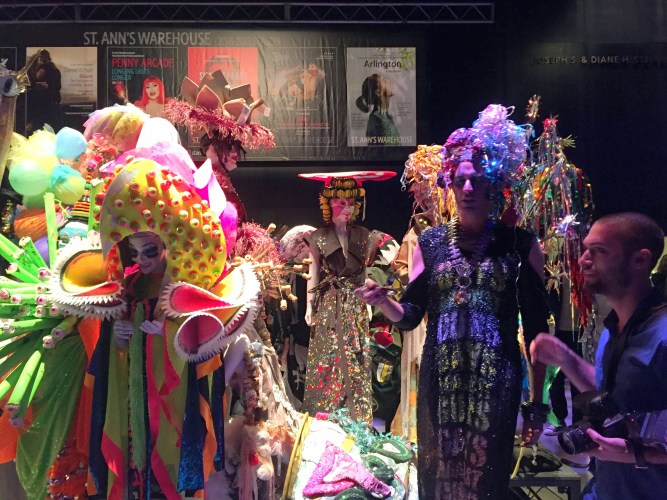
10-1-machine-photo-op
At showtime Taylor blazed onstage (in a Pop Art mashup outfit topped with a shawl of Campbell’s Soup cans) crooning an almost unrecognizable speed-rock version of “Turn! Turn! Turn!” Judy prefaced the evening with a slight recap of the previous episode, which required segregating the audience, a witty way to theatricalize 1950s America. Taylor designated the section right in front of the stage (prime VIP seating) as “inner city” and the side sections as “the suburbs.” On cue, the white people in that section were instructed to enact (in slow motion) “white flight” by surrendering their seats and moving to “the suburbs.” Meanwhile, the people of color in the audience were invited to move to the “inner city.” This was not optional. Taylor enforced the rules quite strictly. This may have happened to the tune of “I Put a Spell on You.”

The rest of the first hour revolved around the 1963 March on Washington – getting on the bus and riding the “Freedom Highway.” A show of hands brought out two audience members who had been on the march. Taylor did some very humorous yet savvy “calling in,” inviting white people to “Think” (“like maybe thinking about working for the movement rather than leading, listening rather than talking…”). The Supremes’ “You Keep Me Hanging On” gave Taylor a moment to introduce two terrific backup singers judy had collected while working on the piece in Detroit (well, judy admitted, Ann Arbor), Stephanie Christian and Thornetta Davis. The set also included “Don’t Let Me Be Misunderstood,” “Mississippi Goddam,” and a beautifully earnest down-in-one version of Bob Dylan’s “A Hard Rain’s Gonna Fall.”

10-1-marching-band

The Brooklyn United Marching Band provided an ecstatic transition (“Movin’ On Up”) to the next section, in which Taylor – wearing a crazy glittering disco-ball of a headdress, sparkly hot pants, and a giant peace sign strapped to Judy’s back like wings or a crucifix – focused on the Stonewall Riots as the centerpiece of the decade 1966-76. “Every song in this section was on the jukebox at the Stonewall,” judy lied, seguing into an amazing if out-of-context rendition of Patti Smith’s “Birdland.” Taylor’s posse of Dandy Minions passed out ping-pong balls for the audience to pelt judy with, representing homophobia as judy passed through the house singing “Born to Run” (oh, THAT gay anthem….). In honor of Judy Garland, he sang Elton John’s “Goodbye Yellow Brick Road,” with a smidge of “Over the Rainbow” at the end. “Gimme Shelter” factored in there somewhere, too.
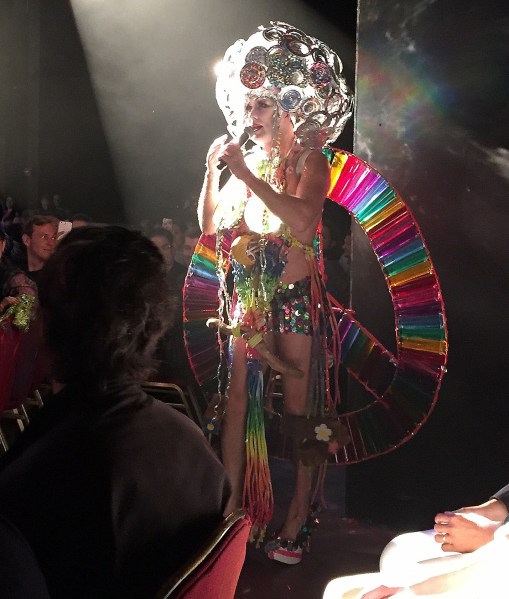
10-1-born-to-run

One of my favorite parts of the whole show was watching the intimate spectacle of Taylor Mac changing costumes onstage between decades – stripping down to flesh-colored briefs and then rebuilding the next vision with the help of Machine Dazzle, who didn’t stint on his own amazing costumes. For this transition he wore most of Taylor’s glam-rock costume and feathery Mohawk headdress onto the stage and transferred it all to the star, though keeping for himself the Mapplethorpian bullwhip-up-the-ass tail. I took all the other pictures I’m posting here except for these two, which are by Jackie Rudin, who has done an amazing job documenting this performance.

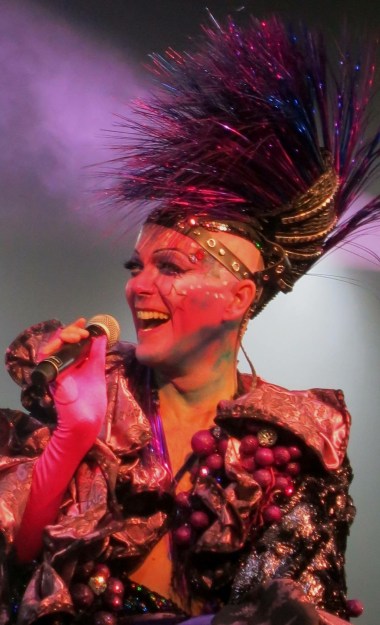
10-1-costume-change-by-jackie-rudin10-1-fauxhawk-by-jackie-rudin

The 1976-86 section perversely turned the entire theater into an imaginary backroom sex bar, with Taylor perhaps paying homage to Torch Song Trilogy with judy’s own detailed reminiscences of The Cock and The Slide and The Hole, to the tune of Laura Branigan’s “Gloria.” During “Heroes” the balcony became a curtained-off orgy space (with the Dandy Minions putting on a filthy shadow play). Taylor had the audience pair up into same-sex duos for a middle-school slow dance to Ted Nugent’s “Snakeskin Cowboys.” (In case it’s not clear, this show was ALL about audience participation, some of it simple hand gestures developed in collaboration with choreographer Jawole Jo Willa Zollar. But the alter kocker sitting in front of us would have none of it – he slept through the first hour and spent most of the rest of the evening playing bridge on his phone while his long-suffering wife and daughter seemed to enjoy themselves.) “Purple Rain” became a rousing singalong, while a giant inflatable American flag phallus balloon bounced over our heads. And the decade ended with a remarkable version of Laurie Anderson’s “O Superman,” an endurance test for the audience to supply the ah-ah-ah-ah-ah rhythm track.

I would love to have seen the last act, whose themes were Direct Action (the AIDS/ACT UP years), Radical Lesbians (with guest appearance by Sarah Schulman), and Originals (for the last hour, it’s just Taylor onstage singing judy’s own songs), but c’est la vie. Big props to the incredible team of artists who made this show a memorable spectacle, including music director and arrange Matt Ray, the sizzling band (led by guitarist Viva DeConcini), and – as the pictures can attest – lighting designer John Torres. Not to mention the conceptual genius, stamina, vocal talent, political savvy, goodheartness, and generosity of Taylor Mac.


Culture Vulture: Holy Body Tattoo’s MONUMENTAL and nora chipaumire’s portrait of my father

September 18, 2016

I love artwork that shows me things I’ve never seen before. It’s why I’ve always been drawn to the downtown and other-borough venues that showcase emerging and experimental performance. The BAM Next Wave Festival began with a solid commitment to that realm of contemporary live art, and I’ve seen tremendous stuff there over the years. Inevitably, as the festival has become an international institution, there has been a drift toward brand names and sure-fire programming. But every so often BAM makes a new effort to tune into cutting-edge work, most recently by introducing the new cozy BAM Fisher (Fishman Space). This week I saw two shows by artists completely new to me (endorsed by my friend Keith Hennessy, himself a cutting-edge performance-maker/curator/teacher/scenester) and came away challenged and invigorated.

The Holy Body Tattoo is a Vancouver-based dance company that formed in 1993 and in 2006 morphed into a new entity called Animals of Distinction. In 2005, the company created monumental with choreography by company founders Dana Gingras and Noam Gagnon, poetic films by William Morrison, texts by Jenny Holzer, and recorded music by Montreal emo band Godspeed You! Black Emperor. Last year the bright idea emerged to revive the piece and tour it around to festivals with the band (who recently regrouped after being on hiatus for several years) playing live. I had no file on any of these artists except for Holzer, whose work with soulful/philosophical aphorisms I adore. When I arrived at the BAM Opera House, the ushers were handing out earplugs to nervous middle-aged patrons, which alerted me that it was going to be THAT kind of show, which usually thrills my rock-n-roll heart. The show was indeed a  multimedia spectacle with separate movement, sound, and visual tracks intertwining in provocative and compelling ways.

monumental-with-band-visible
For the first half of the 85-minute piece, the nine dancers confined themselves to standing on boxes (or plinths, as they call them in the program) — for my taste, they ran out of interesting things to do up there pretty quickly so this section ran long for me. But after that, when they left the boxes, the dancing/movement/choreography kept transforming itself in ways that I could never pin down and mostly found exciting to watch.

monumental_adelaide_festival_banner_2monumental-hb-van1-078

The Holzer texts were longer than her usual one-liners and faded in and out unpredictably, forming chapters in a non-linear narrative. And the music was indeed monumental, droney and sweet and slow-building at times and then sometimes dense waves of squalling sound as three electric guitarists at high volume generated spooky crying overtones. Not quite like anything I’ve seen before, which is always high praise in my book.

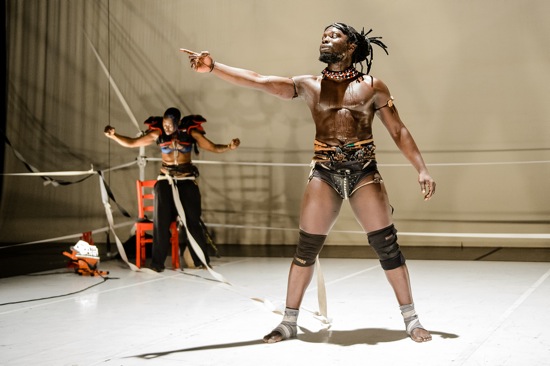
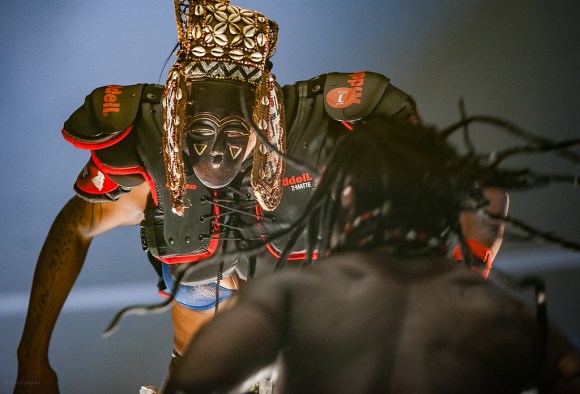
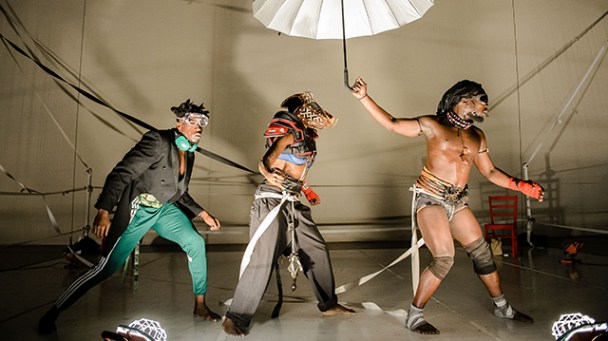
Same went, only double, for nora chipaumire’s portrait of my father at the BAM Fisher.  It was ostensibly an exploration of black African masculinity centering on the father she never had any real relationship with. But from the minute you walk in the door this is an extremely layered piece in a space that is highly alive in every way. The stage is set up as a boxing ring with chipaumire and Pape Ibrahimas Ndiaye (representing her father/sparring partner) continuously connected via lengths of stretchy straps with Shamar Watt circulating as referee/cheerleader/stage-manager, constantly rearranging the portable floodlights that serve as the show’s only lighting. (A witty touch: instead of earplugs, the audience is issued cheap sunglasses in case the glare gets to be too much — a courtesy never offered at Richard Foreman shows.)

041316_0303_Nora's Dress Rehearsalportrait-of-myself-as-my-father-nora-chipaumire-nyc-march-2016-5917-2-xlportrait-of-myself-as-my-father-_640x359
But the activities, the costumes, the gestures, the masks, the soundscore, and the movement pile onto the boxing metaphor numerous other frameworks: hiphop concert, voodoo ritual, club performance, shamanic trance ceremony, and Wooster Group-style mediated theater. There’s a lot of movement that rarely looks like dancing, speech that rarely emerges as coherent sentences let alone narrative, sound that almost never sounds like music — and the whole thing is pretty riveting. The three performers push themselves to extremes of physical ability, gender identification, and cultural cross-reference.  I was dazzled. 


Culture Vulture/Photo diary: ART AIDS AMERICA at the Bronx Museum

September 16, 2016

(click photos twice to enlarge)

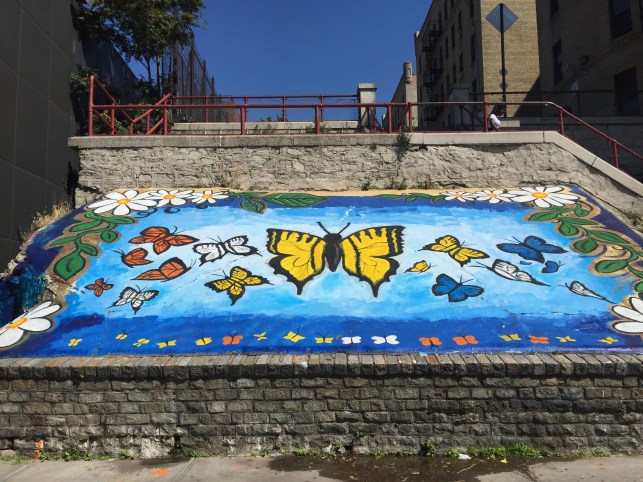
I wanted to reconnect with my old friend and colleague Jeff Weinstein, and we made a plan to take in the “Art AIDS America” show at the Bronx Museum. It amazes me that for all the time I’ve lived in New York City  (36 years), I’ve visited the Bronx only three or four times. The previous time was a revelation — the Foundry Theatre’s The Provenance of Beauty consisted of a bus tour of the South Bronx, with a poetic voiceover (text by Claudia Rankine) pointing out how vastly the neighborhood has changed and grown since the late ’70s when it was a virtual war zone. This expedition built on that impression. I enjoyed checking out the street art nearby as well as having lunch afterwards (spicy jerk chicken) at a Jamaican joint on Gerard Avenue called the Feeding Tree.

9-14-bronx-mural-rest-in-peace-digga 9-14-bronx-mural-robot-love 9-14-bronx-altar 9-14-bronx-butterfly-mural
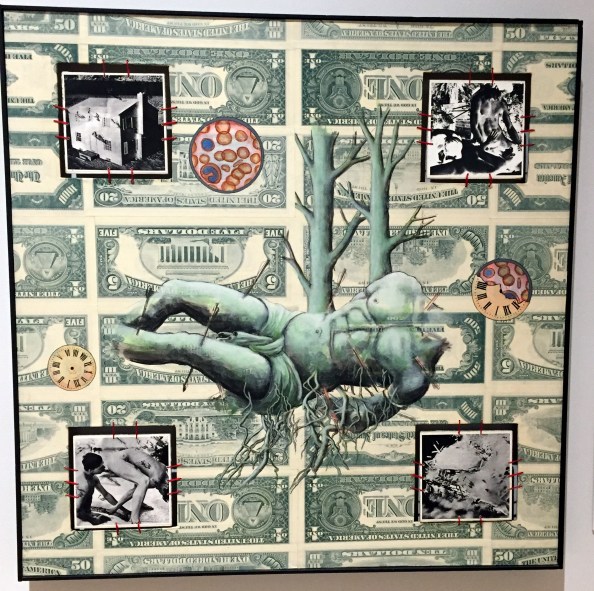
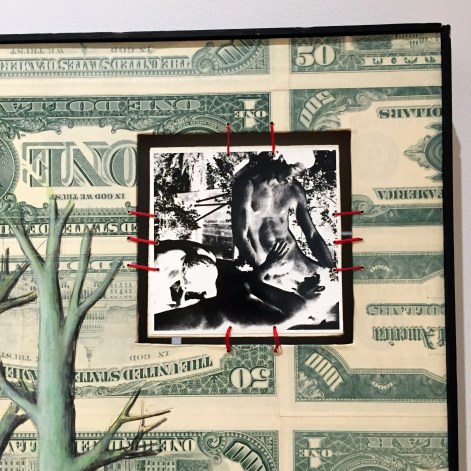
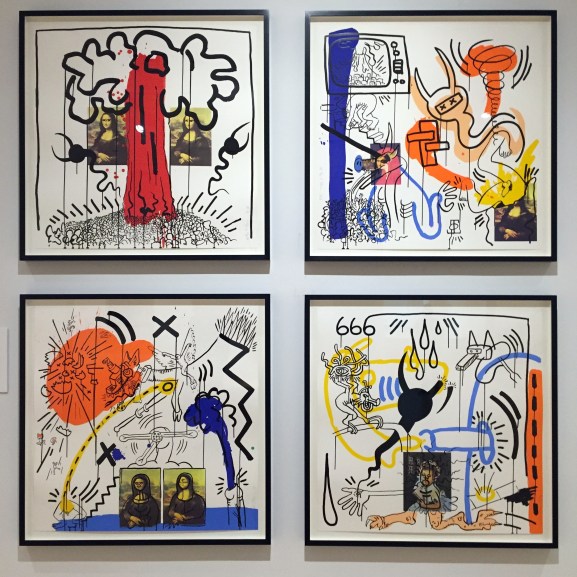
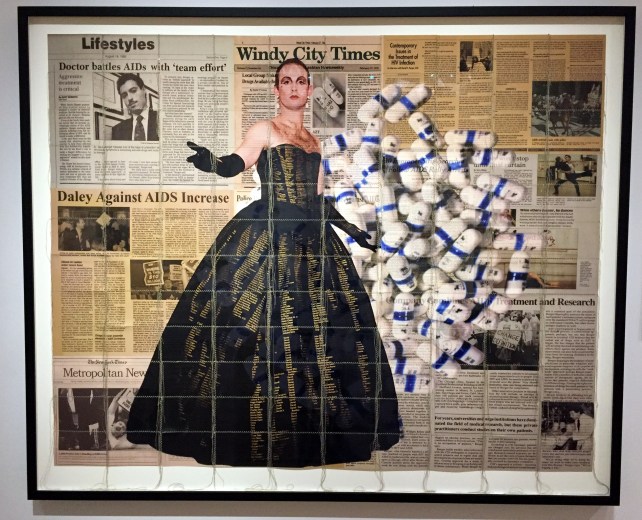
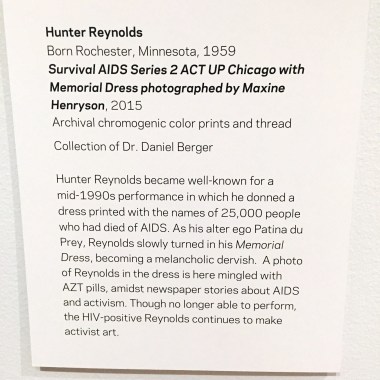
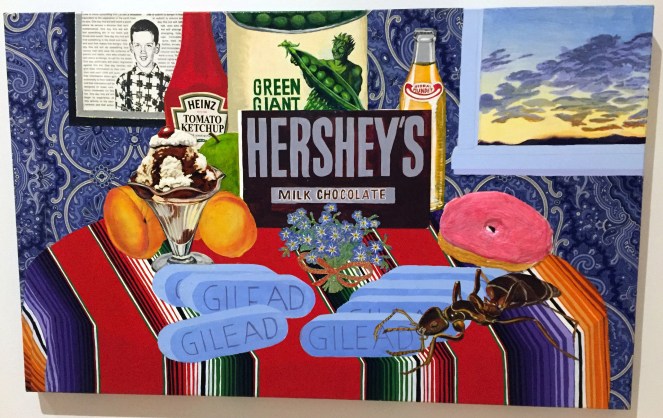
The exhibition, co-curated by Jonathan David Katz and Rock Hushka, was a bit smaller than I expected and lived up to the mixed word-of-mouth regarding the choice of art and artists. Probably anyone who’s interested in this subject matter lives with a platonic ideal of such a show that no actual selection could match. Nevertheless, I was glad to see work by artists I admire, some of which I’d seen before (David Wojnarowicz’s intricate collage painting Bad Moon Rising), some I hadn’t (four panels from a series by Keith Haring called Apocalypse), as well as pieces by artists I’d heard of but never seen (Hunter Reynolds, whose Memorial Wedding Dress is a centerpiece of the show) and some completely new to me (Joey Terrill, whose witty canvas invites a game of spot-the-references while also being the first artwork I know of to depict Truvada, the anti-HIV medication that has revolutionized gay men’s sexual experience).

9-14-wojnarowicz-bad-moon-rising 9-14-bad-moon-rising-detail 9-14-keith-haring-apocalypse-series 9-14-haring-apocalypse-detail9-14-hunter-reynolds-survival-aids 9-14-reynolds-memorial-dress-plaque 9-14-joey-terrill-one-week-of-truvada 9-14-joey-terrill-wall-placque

Culture Vulture/Photo diary: Roz Chast and September 11 in the park

September 11, 2016

(click photos twice to enlarge)

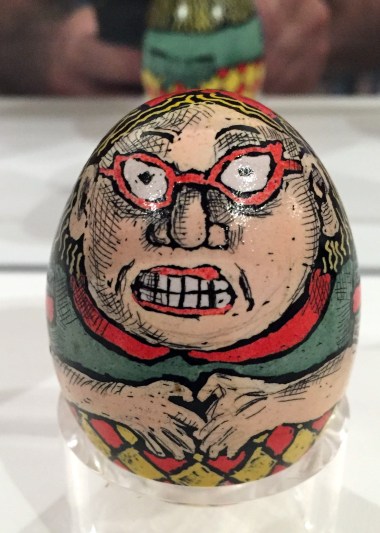
A gorgeous Sunday afternoon. After brunch at the Shady Lady in Astoria, we made an expedition to the Museum of the City of New York at 104th Street and Fifth Avenue to check out the exhibition of Roz Chast’s “Cartoon Memoirs,” a wonderful array of her published “illustrations” (we call them cartoons) for the New Yorker and miscellaneous other artworks, including her pysanky (painted eggshell art) and many pages from her memoir about her parents, Can’t We Talk About Something More Pleasant?

9-11-andy-don-chasting-couch9-11-chast-new-restaurants-19-11-new-restaurants-in-midtown9-11-barry-like-pysanky9-11-playing-cards-pysanky9-11-riding-the-unknown-x-train
Neither of us had ever been to the museum and enjoyed reading the quotes about New York City in the stairwells, including this one with its curious bracketing. Turns out in the original quote the word for “toilet” that Jefferson used was the archaic “cloacina.”

9-11-jefferson-on-nyc
Afterwards we strolled through the Observatory Garden directly across the street in Central Park and walked home sharing what we remembered about how we spent September 11, 2001.

9-11-deep-purple-leaves9-11-birthday-cake-flowers


CULTURE VULTURE: Jacob Colliter

September 10, 2016

Jacob Collier is a 22-year-old black British wunderkind who recorded his first album in three months alone in his home studio. In My Room is a remarkable piece of work — amazingly diverse and sophisticated, conjuring any number of artists you might be familiar with but never in this mash-up: Brian Wilson and the Beach Boys and Take 6 and Stevie Wonder, for sure, but also traces of Van Dyke Parks, Laura Mvula, Philip Glass.  You can check out his website here.