Posts Tagged ‘george packer’

In this week’s New Yorker

November 27, 2011


An especially good issue of the magazine, starting with the cover (“Promised Land” by Christoph Niemann), a reminder that the first European settlers on this continent arrived uninvited, and not too many of them bothered to learn the language(s) the Natives spoke.

By design or happenstance, this issue is anchored by three strong reporting pieces about renegades and innovators having a big impact.

Mattathias Schwartz’s piece on Occupy Wall Street goes beyond anything I’ve read in pinpointing the key individuals responsible for launching and maintaining a nascent grass-roots movement that profoundly eschews the notion of leaders. Not only does it shed light on Kalle Lasn and Micah White, the unlikely duo at the heart of the Canadian-based anti-consumerism publication Adbusters, but the article name-checks a couple of people crucial to putting OWS in gear: 26-year-old Justine Tunney (one of several transgender anarchist activists who collectively responded to Lasn’s now legendary call for the occupation) and Marisa Holmes, a 25-year-old anarchist and filmmaker to whom people listen when she speaks.

George Packer contributes a fascinating profile of Peter Thiel, the super-smart, disturbingly cute (to ginger fans) entrepreneur who created PayPal in 2002 with his friend Elon Musk and two years later loaned Mark Zuckerberg half a million dollars to crank up Facebook. Thiel turns out to be, among other things, a devout gay Christian, a serious Ayn Radian libertarian, and an unapologetic Republican who voted for John McCain in 2008. The mind boggles. It is clear that Packer, one of the New Yorker’s hotshot reporters these days, is both intrigued and appalled by Thiel and his friends. He’s invited to a dinner party where “the two subjects of conversation were the superiority of entrepreneurship and the worthless of higher education.”

[Biotech specialist Luke] Nosek argued that the best entrepreneurs devoted their lives to a single idea. Founders Fund [an investment group co-founded by Thiel with Napster’s Sean Parker] backed these visionaries and kept them in charge of their own companies, protecting them from the meddling of other venture capitalists, who were prone to replacing them with plodding executives.
Thiel picked up the theme. There were four places in America where ambitious young people traditionally went, he said: New York, Washington, Los Angeles, and Silicon Valley. The first three were used up; Wall Street lost its allure after the financial crisis. Only Silicon Valley still attracted young people with big dreams — though their ideas had sometimes already been snuffed out by higher education. The Thiel Fellowships
[which award 20 $100,000 two-year grants to brilliant people under the age of 20 to enable them to quit college and start up business] would help ambitious young talents change the world before they could be numbed by the establishment.
I suggested
that there was something to be gained from staying in school, reading great works of literature and philosophy, and arguing about ideas with people who have different views. After all, this had been the education of Peter Thiel. In The Diversity Myth,” he and Sacks wrote, “The antidote to the multiculture is civilization.” I didn’t disagree. Wasn’t the world of liberatarian entrepreneurs one more self-enclosed cell of identity politics?
Around the table, the response was swift and negative. [Artificial-intelligence researcher Eliezer] Yudowsky reported that he was having a “visceral reaction” to what I’d said about great books. Nosek was visibly upset: in high school, in Illinois, he had failed an English class because the teacher had said that he couldn’t write. If something like the Thiel Fellowships had existed, he and others like him could have been spared a lot of pain.
Thiel was smiling at the turn the conversation had taken. Then he pushed back his chair. “Most dinners go on too long or not long enough,” he said.

The third innovator featured is the 28-year-old French artist who goes by the initial JR, who has orchestrated large-scale guerrilla photo installations in the slums of Southern Sudan, Kenya, Cambodia, India, and Brazil. Raffi Khatchadourian’s article follows him as he creates an art project empowering regular people in the Hunts Point neighborhood of the Bronx.

Then there’s Ariel Levy’s piece on Rita Jenrette, former Congressman’s wife now turned Italian principessa — nutty piece but worth reading just because Levy is such a fine, entertaining writer.

While I’m at it, I want to mention a couple of pieces from last week’s Food Issue worth going back and reading. First and foremost is Eric Idle’s hilarious Shouts & Murmurs piece, “Who Wrote Shakespeare?” There’s also a fascinating piece by John Seabrook about apples, specifically the breeding of a new hybrid apple called the SweeTango. And Judith Thurman contributes a delicious and inspiring little meditation on pine nuts.

In last week’s New Yorker….

September 12, 2011

Last week’s New Yorker, like all other magazines on the newsstand, devoted itself almost entirely to the manufactured media event known as “the 10th anniversary of 9/11.” No one needed this whoop-de-do, and many of us seethed all week long with a barely suppressed, barely understood sense of rage about being coerced into this Orwellian ritual of remembrance of SOMETHING NOBODY HAS FORGOTTEN.

The streets were full of policemen and firemen from all over the country, who seem to have taken this day on the calendar as a national holiday commemorating those brave public servants who risk their lives every day and occasionally lose them. They deserve their honor. The families of people who died are completely justified in mourning and remembering however they see fit. I’m certain that I’m not alone, though, in feeling a deeply sinister force afoot in the energy around the 9/11 industry, a force that sacralizes the names of the people who died in the attacks that day and obsessively replays the details of the event…as if nothing of consequence has happened since then. This particular event over the weekend registered for me not as sorrow but as outrage.

You want me to remember? By all means! I remember the unnecessary wars that were launched in reaction to 9/11, the hundreds of thousands of military and civilians from many nations who have died in those ill-conceived, ill-managed wars, the obscene amount of money both spent and wasted in those wars, how the US Treasury (riding on a historic surplus at the end of Bill Clinton’s presidency) got virtually emptied into the pockets of the war-profiteer friends of Dick Cheney — AND NONE OF THEM HAS BEEN HELD ACCOUNTABLE for any of this, least of all the one man who is personally responsible for the state this country, its raggedy-ass politics, and its economy on the brink of collapse, namely George W. Bush.

I think the smartest and most cogent article I read all week was George Packer’s essay “Coming Apart,” subtitled “After 9/11 transfixed America, the country’s problems were left to rot.” Here’s a key passage:

“No one appeared more surprised on September 11th, more caught off guard, than President Bush. The look of startled fear on his face neither reflected nor inspired the quiet strength and resolve that he kept asserting as the country’s response. In reaction to his own unreadiness, Bush immediately overreached for an answer. In his memoir Decision Points, Bush describes his thinking as he absorbed the news in the Presidential limousine, on Route 41 in Florida: ‘The first plane could have been an accident. The second was definitely an attack. The third was a declaration fo war.’ In the President’s mind, 9/11 was elevated to an act of war by the number of planes. Later that day, at Offutt Air Force Base, in Nebraska, he further refined his interpretation, telling his National Security Council by videoconference, ‘We are at war against terror.’

“Those were fateful words. Defining the enemy by its tactic was a strange conceptual diversion that immediately made the focus too narrow (what about the ideology behind the terror?) and too broad (were we at war with all terrorists and their supporters everywhere?). The President could have said, ‘We are at war against Al Qaeda,’ but he didn’t. Instead, he escalated his rhetoric, in an attempt to overpower any ambiguities. Freedom was at war with fear, he told the country, and he would not rest until the final victory…His entire sense of the job came to depend on being a war President.

“What were the American people to do in this vast new war? In his address to Congress on September 20, 2001 — the speech that gave his most eloquent account of the meaning of September 11th — the President told Americans to live their lives, hug their children, uphold their values, participate in the economy, and pray for the victims. These quiet continuities were supposed to be reassuring, but instead they revealed the unreality that lay beneath his call to arms. Wasn’t there anything else? Should Americans enlist in the armed forces, join the foreign service, pay more taxes, do volunteer work, study foreign languages, travel to Muslim countries? No — just go on using their credit cards…Never was the mismatch between the idea of the war and the war itself more apparent. Everything had changed, Bush announced, but not to worry — nothing would change.”

In this week’s New Yorker

July 21, 2011


An especially good magazine, starting with another delightful Barry Blitt cover, and a leading editorial in Talk of the Town by George Packer — about the budget battle in Congress — that I would like to copy and circulate to every member of the freshman Republican cabal. (Does that list exist somewhere close at hand?) Actually, every piece in Talk of the Town is pretty great this week, including a rare Gay Talese item about one of those Manhattan locations that are death to restaurants. But the best of the lot is Lauren Collins’ hilarious piece about Chris Bryant, a gay Member of Parliament previously unknown to me who was one of the first to directly challenge the Murdoch empire that is now crashing down:

At Westminster Hall, Chris Bryant indulged in a moment of goofy release when asked if Murdoch, after everything that had happened, would still be able to intimidate British politicians. He held two thumbs together, forefingers up, in a W shape, and then turned them upside down: “Frankly, now it’s like ‘Whatever, Mary.’ ”

Is it because I grew up in a trailer that I read every word of Alec Wilkinson’s piece about tiny houses, “Let’s Get Small”?

Paul Rudnick’s Shouts & Murmurs piece, “The Pope’s Tweets” is predictably LOL. Here are a couple of sample tweets from the Pontiff:
Michele Bachmann is not Satan. Satan doesn’t have split ends.

Someday I’d like to put on slacks, a cardigan, a little straw hat, and sunglasses, and go see “The Book of Mormon.”

Who knew that Calvin Trillin, mostly a food writer, covered the civil rights movements (“the Seg Beat”) for Time magazine once upon a time? His reminiscence of covering the Freedom Riders (“Back on the Bus”) moved me tremendously, as accounts of that historic struggle generally do.

I was mildly interested in Jane Kramer’s profile of contrarian French feminist Elisabeth Badinter, but early on it became clear that she’s one of those social critics who can dish it out but can’ t take it. Badinter refers to a talk she gave at Princeton as her “worst experience….a total execution.” But Kramer reports:

The American feminist scholar Joan Scott, at the Institute for Advanced Studies, heard the talk. She told me, ‘Badinter was saying all sorts of banal things about how the French were sexier than Americans, better at sex, how American women washed too much, how they were embarrassed by bodily odors, by oral sex. We asked hostile questions, like, ‘How can you say these things off the top of your head?’ That it was traumatic for her is very odd. We were simply distressed by her talk.”

I don’t know why, but I also ate up every word of John Cassidy’s piece about hedge fund billionaire Ray Dalio. The guy sounds like a dick, and yet I respect his hard-headedness and self-questioning: “I believe that the biggest problem that humanity faces is an ego sensitivity to finding out whether one is right r wrong and identifying what one’s strengths and weaknesses are.” His motto is “Pain + Reflection = Progress.”

Good piece by Paul Goldberger on Zaha Hadid, an architect whose work interests me. Check out her new Riverside Museum in Glasgow (photo by Iwan Baum):


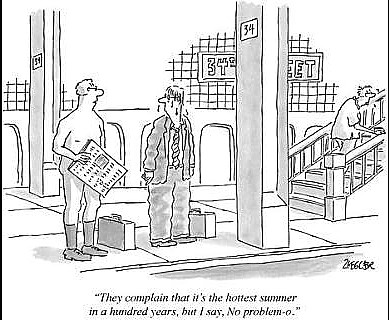
All told, a densely rewarding issue, anything but light midsummer reading. Although with a perfectly timed Jack Ziegler cartoon:

Quote of the day: THE MYTH OF BIPARTISANSHIP

March 9, 2010

THE MYTH OF BIPARTISANSHIP

Obama’s quest for bipartisanship, in the face of exceedingly discouraging facts, has been so relentless that it suggests less a strategy than a core conviction: reasonable people can be civil, exchange ideas, and, eventually, find points of agreement. But shortly after the Inauguration, when Obama went to Capitol Hill to discuss his stimulus bill with house Republicans, party leaders, informed him before negotiations had even begun that Republicans would vote against it as a bloc. And, within weeks after [Virginia congressman] Tom Perriello took office, freshman Republicans in the House had already stopped returning his phone calls, presumably on instructions from their leadership. Nevertheless, the White House continued to bargain for Republican toes throughout 2009, as if the two sides were negotiating in good faith. Last fall, a Republican senator was invited to discuss health care in the oval office. Obama went a long way toward meeting the senator’s wishes and objections, and then asked, “Now can you support the bill?” The senator said, “Unless I can get ten other Republicans to stand with me, I can’t do it.” In the end, one Republican in the House, and none in the Senate, voted for health-care reform…

Shortly before the 2008 Presidential election, [Obama’s top political advisor David] Axelrod told me that the country’s problems were too grave for Republicans not to cooperate in solving them. When I reminded him of this recently, he said, “Republicans made a very cynical judgment. And that judgment was that no matter what we did, given the depths of the crisis that we were inheriting, that it was going to be a long, hard slog for a while, and there was greater political advantage in standing in opposition, so that the President and the Democrats in Congress would have to take sole authorship of recovery efforts, than to pitch in and help solve the problem. That’s about as blunt an assessment as I can give you.”

Tom Perriello, typically, was even more blunt. He described conservative intransigence, in the face of critical national problems that were the legacy of Republican rule, as “unprecedented soullessness.”

— George Packer, “Obama’s Lost Year,” in this week’s New Yorker