Posts Tagged ‘gamelan kusuma laras’

Events: Gamelan Kusuma Laras at Riverside Church June 1

May 22, 2014

IMGP4398
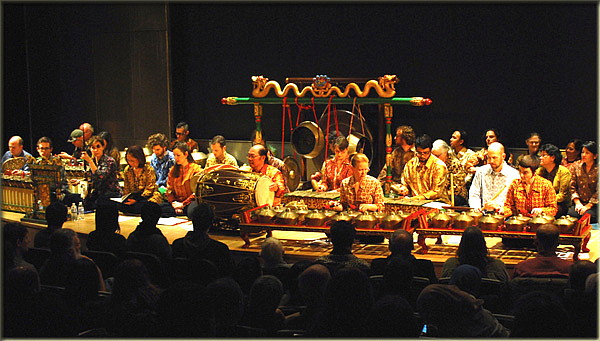
The music group that I play with, Gamelan Kusuma Laras, will give a concert of classical Javanese music as part of the Christ Chapel Chamber Series at The Riverside Church.

WHEN: Sunday, June 1, 2014, 3:00 – 5:00 pm

WHERE: Riverside Church, 490 Riverside Drive, New York, NY 10027 (@122nd Street)

WHO: Gamelan Kusuma Laras is a classical Javanese gamelan orchestra based in New York City that performs music, dance, and theatre from the classical repertoire of the courts of Central Java. Created especially for the Indonesia Pavilion at the World’s Fair of 1964-65, the gamelan has the honor of being housed at the Indonesian Consulate in New York City. The ensemble is led by artistic director I.M. Harjito and director Anne Stebinger.

IMGP4545

WHAT: The repertoire for this concert will be:
* Ladrang Singa-Singa (laras pelog pathet barang)
* Ketawang Larasmaya (laras pelog pathet barang)
* Gendhing Tejaningsih minggah Ladrang Playon Bedhayan (laras pelog pathet lima)
* Gendhing Onang-Onang, Ladrang Wirangrong (laras pelog pathet nem)
* Ladrang Kutut Manggung, Lancaran Kuda Nyongklang (laras pelog pathet barang)

ADMISSION: suggested donation at the door.

Follow us on Facebook and find us on the web: www.kusumalaras.org
 

Performance diary: Javanese Wayang Kulit at Asia Society

March 18, 2012
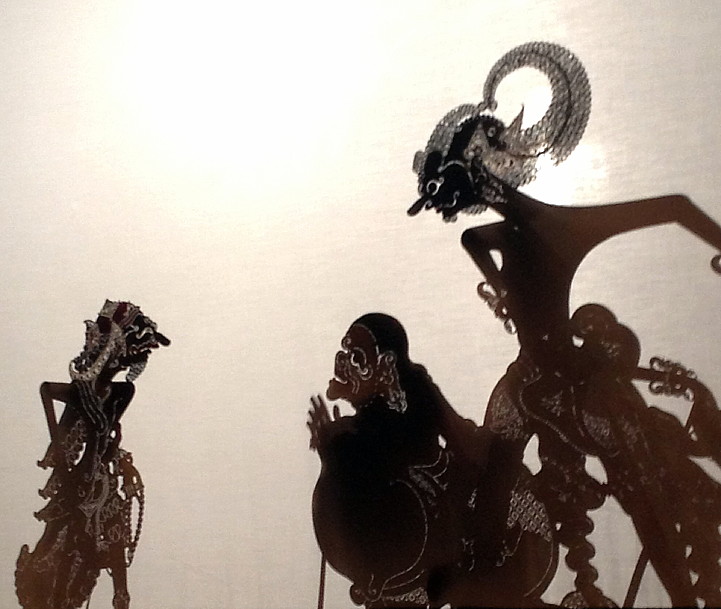
Gamelan Kusuma Laras, the Javanese percussion orchestra that I’m part of, presented a wayang kulit (shadow-puppet play) at Asia Society last Friday night featuring famous dhalang Ki Purbo Asmoro and members of his company Mayangkara (from Solo, Java). Originally I was supposed to perform in the show with the gerongen (chorus), but I had to miss a bunch of rehearsals so at a certain point I realized I wasn’t going to be able to learn the music well enough, so I decided to sit it out. Much as I love playing and have enjoyed being in concerts in the last couple of years, I’m really glad that circumstances were such that I got to sit out front and enjoy the show this time.


For me, it was an opportunity to revisit the experience of falling in love with gamelan the first time I saw a wayang (performed by the Royal Court Gamelan of Yogyakarta at the 1990 Los Angeles Festival). Certainly, for a Westerner, you start out paying close attention to every single thing, trying to “make sense” of the gestures, each puppet, each sound, each word on the screen, each song that is sung… Watching wayang as if it’s a play in the theater and trying to tune out everything else pretty quickly becomes exhausting, confusing, and frustrating. Somehow, slowly, imperceptibly, you give that up, and the whole thing takes over, and you realize that you’ve entered another world, a kind of trance state, where no single element is primary, but hundreds of little tiny elements are adding up to a whole experience. Extraordinary! Then everything becomes completely engrossing and enjoyable, including the movements of people in the audience coming and going, people taking pictures, musicians laughing and joking among themselves (and yes, even making “mistakes”!).


Typically for wayang, Dewa Ruci (Bima’s Spiritual Enlightenment) is based on an episode from the Mahabharata and follows one of the five Pandawa brothers on his quest for perfection in life. He undergoes two big adventures, one in the forest and one in the sea. In between these parts of the tale, there was a comic interlude, which is the part of the show which the dhalang improvises at every performance, tailoring his remarks to current events and the particular audience he’s playing to. In this case, President Obama made a surprise appearance among the various wayang characters (wise men and ogres and mothers and brothers, etc.), and Ki Purbo invited (or should I say commanded?) Kitsie Emerson, who had been sitting at her laptop skillfully providing translations for the English-speaking audience, to play kendhang (the drum that leads the gamelan). Here’s a small, sort of random excerpt from that passage of the performance:

The singer, Yayuk Sri Rahayu, was fantastic. Andy and I watched most of the show from the auditorium, where you could see all the musicians and the dhalang and his puppets as he manipulated them, while off to the side was a video screen showing what the shadows looked like. As is traditional for wayang, the audience was invited to go up onstage and sit behind the screen and watch the show from there, so we sampled that perspective as well. It was hard to read the translations (projected onto a screen over the stage) from there, but the detail of the puppets (carved into thin buffalo hide) was the reward for sitting here.


Good show, gamelanistas!

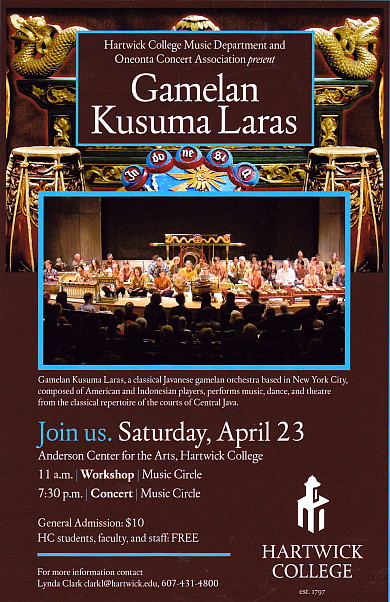
Concert: Gamelan Kusuma Laras in Oneonta, NY, Saturday April 23

April 17, 2011


Gamelan Kusuma Laras
, the Javanese music group that I play with, will be giving a concert at Anderson Center for the Arts at Hartwick College in Oneonta, NY, next Saturday April 23. If you’re in that neck of the woods, or know someone who lives around there, feel free to come and spread the word. Tickets are cheap: $10.

Javanese gamelan is strange and lovely music. Laurie Anderson came to our concert in December and e-mailed me afterwards to say it was “beautiful — meditative but with a lot of detail.” Good description! For more information, contact Lynda Clark at 607-431-4800 or clarkl@hartwick.edu.

Performance diary: Rufus Wainwright at Carnegie Hall and the Juilliard Orchestra at Alice Tully Hall

December 23, 2010


December 6 –
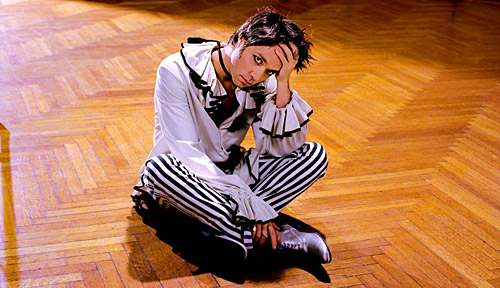
I’d heard in advance that Rufus Wainwright was making a strong request to audiences for his current concert tour that they hold their applause during the first half of the show, while he plays the song cycle that makes up his most recent record release, All Days Are Nights: Songs for Lulu. I didn’t realize until seeing the show at Carnegie Hall that he was treating this song cycle as a kind of theater piece. He makes a dramatic entrance in silence, processing slowly across the bare stage wearing a thick black cape with a 20-foot train. He sits at the grand piano and proceeds to perform the album’s dozen songs, while video plays of a gigantic blinking blue eye smeared with too much dark eye shadow.  (Visuals by Douglas Gordon, whose photography also graces the cover of the album.) Three of the songs are adaptations of Shakespeare sonnets; the others are somber, dark, and sad, reflecting as they do on his feelings during the final days of Kate McGarrigle, his beloved mother. They’re not his best songs, not especially melodic, rather monotonous in fact, with florid show-offy piano arrangements and lyrics that sound like hasty blog entries. At Carnegie Hall, with its billowing acoustics, many of the lyrics were as difficult to hear as they are to read in the liner notes of the album, where they are written out in Rufus’s flourish-crazy handwriting. When the set was over, he got up and processed offstage as slowly as he arrived. Many of his diehard fans found this act a little hard to swallow, including me, but it certainly showed off the many sides of Rufus: the self-indulgent narcissist, the diva, the ambitious artist always wanting to stretch himself, the little kid playing dress-up, the grieving son.

After intermission he came back onstage dressed more casually in sweat pants (“don’t worry, they’re very expensive!”) to do a another set of favorites for the fans, again with only piano accompaniment. By himself he did “Grey Gardens,” “Memphis” (his tribute to “another New York legend, Jeff Buckley”), “Going to a Town,” “Cigarettes and Chocolate Milk,” and “Dinner at Eight,” a song about him and his father, Loudon Wainwright III, who was in the audience. Rufus brought out Stephen Oremus, the music director for his remake of Judy at Carnegie Hall, to accompany him on a bunch of Garland standards: “Do It Again,” “A Foggy Day,” “If Love Were All,” and “The Man That Got Away.” And he brought out his sister Martha (who looked fabulous in spangly tights and super-high heels) to sing with him on “Moon Over Miami,” “Complainte pour La Butte” (from the Moulin Rouge movie), and “Hallelujah.” And then of course there were tons of encores, beginning with “Poses,” for which Martha came back onstage, this time with her infant son Arcangelo. “We start ‘em young in the Wainwright/McGarrigle tribe,” Rufus cracked. And then a couple more Judy Garland numbers, “Alone Together” and “You Made Me Love You/Me and My Gal.”

It was a celebratory and fun evening, but I was very aware that Rufus started the second half with “Beauty Mark,” his great zesty song about his mother, and ended with one of hers, “The Walking Song,” about the early days of her courtship with Loudon: in its own way a sweet memorial tribute to a wonderful musician and Rufus’s best friend.

Lots of famous fans showed up for the concert. I saw Antony Hegarty (of Antony and the Johnsons), who was sitting in front of Stephen and Alvaro. I spied Frances MacDormand with her Coen Brother, and I chatted with Laurie Anderson, who was there with Lou Reed. Laurie looked great and remarkably relaxed, considering that she’s been on tour much of the year with three different shows. She told me she just performed at a benefit concert with her dog Lolabelle. I was trying to track Lou’s possible connection to Rufus, and then I remembered that Kate and Anna sang the odd little “Balloon” song on his Edgar Allen Poe album, The Raven.

December 11-12: I got behind on blogging because I had a couple of performances of my own with Gamelan Kusuma Laras at the Indonesian Consulate. It was a long and somewhat challenging program. I wasn’t surprised that several of my friends who came to the concerts had their fill and left at intermission. It was a gas for me. I got to play kethuk on one number (the welcoming music, “Clunthang/Kasatriyan”), and then I sang with a chorus of other folks on three other numbers (in ancient Javanese!). It’s been decades since I did so much singing in such a short amount of time. I was a little hoarse afterwards. And then for days I could not get some of this music out of my head….!

December 13: Thanks to my friend Roman, I found myself sitting sixth row center at Alice Tully Hall for a concert by the Juilliard Orchestra, playing two pieces new to me: Prokofiev’s Piano Concert No. 3 and Ravel’s Daphnis and Chloe. Both were fantastic. The Prokofiev turns out to be one of those fiendishly difficult show-offy vehicles for a virtuosic pianist, like Rachmaninoff’s Piano Concert No. 1. In this case, the performer was an unbelievably talented 19-year-old Juilliard student from Virginia named Julian Woo with impossibly long fingers, all the better to play long stretches of crazy cross-handed piano, his fingers literally tickling the ivories, diddlly-diddly-dee. The orchestra, of course, includes basically the cream of the crop of young musicians, passionate and confident and highly attentive, dreamy to hear. And the conductor for the evening is some kind of rising star, Yannick Nézet-Séguin, the Quebecois music director of the Rotterdam Philharmonic who will take over the Philadelphia Orchestra in 2012. He’s a Leonard Bernstein-like dynamo, fantastically expressive, at times leaping off the floor, other times caressing his own cheek to cue the string section. The Ravel was equally exciting and exacting. The excellent programme notes by James M. Keller informed me that Daphnis and Chloe, commissioned by Diaghilev for the Ballets Russes, is Ravel’s longest composition ever with the largest orchestral accompaniment as well, including such rarities as celeste and wind machine. The Dessoff Choirs, which Andy sings with, provided the choral contribution, which consisted entirely of swoony non-verbal aah-ing and oo-ing that at times sounded like the music accompanying certain kaleidoscopic Busby Berkeley dance routines. I’m laughably uneducated at the history and appreciation of the classical repertoire, so I’m glad to get exposed to such treasures, however that happens.
Event: Gamelan Kusuma Laras, December 11 & 12

November 29, 2010


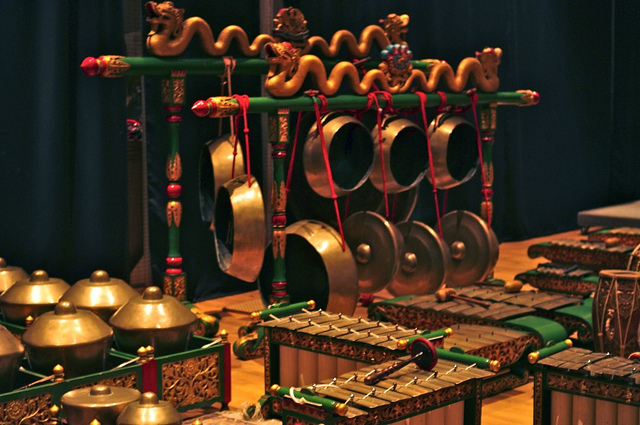
Several months ago, I finally got up the nerve to seriously pursue my interest in learning to play gamelan, which is a kind of Indonesian percussion ensemble that makes a distinct and hauntingly beautiful music. By great good fortune (thanks to Rachel Cooper, director of programming at the Asia Society), I found my way to Gamelan Kusuma Laras (above) and have been studying and rehearsing with this group, which takes its repertoire from Javanese gamelan (specifically from Solo in Central Java). And now I’m getting the chance to perform with the group in two concerts at the Indonesian Consulate on East 68th Street. As a beginner, I will be playing on only one number but singing on three others (in a large chorus — in ancient Javanese!). Please come!

Gamelan Kusuma Laras
New York City’s Premier Javanese Gamelan Ensemble
Presents Music and Dance of Central Java

Directed by I.M. Harjito
with Triwik Harjito and Shoko Yamamura, Guest Dancers

Saturday, December 11 at 8 pm
Sunday, December 12 at 3 pm

Consulate General of the Republic of Indonesia
5 East 68th Street, between Fifth and Madison Avenues
Suggested Donation: $20

Tickets may be reserved by contacting nygamelan@gmail.com

Originally formed 26 years ago, Gamelan Kusuma Laras has entranced audiences in the United States and  Indonesia with its authentic performances of music, dance and theater from the classical repertoire of the courts of Central Java.

The ensemble has been active in the New York City cultural scene since its inception, performing at the Arts at St. Ann’s in Brooklyn, the American Museum of Natural History, the Metropolitan Museum of Art, the Whitney Museum, Symphony Space, Brooklyn Academy of Music, the Bronx Zoo of the Wildlife Conservation Society, Bard College, Vassar College, Wesleyan University, Princeton University, the Cathedral of St. John the Divine, Cooper Hewitt Museum, Lincoln Center Out-of-Doors Festival, and the Jogjakarta International Gamelan Festival, to name a few.

For this concert, Triwik Harjito and Shoko Yamamura will be performing Adaninggar Kelaswara, a Javanese dance that depicts a duel between two female warriors: Adaninggar, a Chinese princess, and Kelaswara, a Javanese princess.

“…shifting timbres that floated and surged in a mesmerizing flow”
-The New York Post

“…a skilled ensemble…a treat to watch.”
-The New York Times