R.I.P.: Sam Shepard

August 10, 2017

It’s a very strange experience to write a biography of someone who’s still alive, as I did in 1984 when Sam Shepard was 41 and I was 30 (we were kids! I can say in retrospect). And then it’s even weirder when that person dies. I’ve been tracking Shepard’s artistic career and personal life with varying degrees of intensity for more than three decades, so his death July 27 hit me hard. Like his colleagues and fans, I mourn the world’s loss of an epochal original writer. On a personal level I wasn’t prepared for how keenly I feel the loss of…not so much My Subject but a kind of alter-ego.


When I was asked to write a quickie bio by Dell Books, to capitalize on his Hollywood celebrity (the Oscar nomination for The Right Stuff, the tabloid interest in his nascent affair with Jessica Lange), I took the assignment for two reasons: 1) because I admired the crazy rock-n-roll energy and poetic theatricality of his plays (like The Tooth of Crime) and 2) because I identified with him personally as a guy with a tempestuous relationship with his alcoholic military-veteran father. I didn’t meet him in the course of writing the book nor while revising the biography for a second edition, published in 1997 when the Broadway debut of his Pulitzer-winning Buried Child dangled the promise of some new attention to the now-certified movie star’s theatrical body of work.

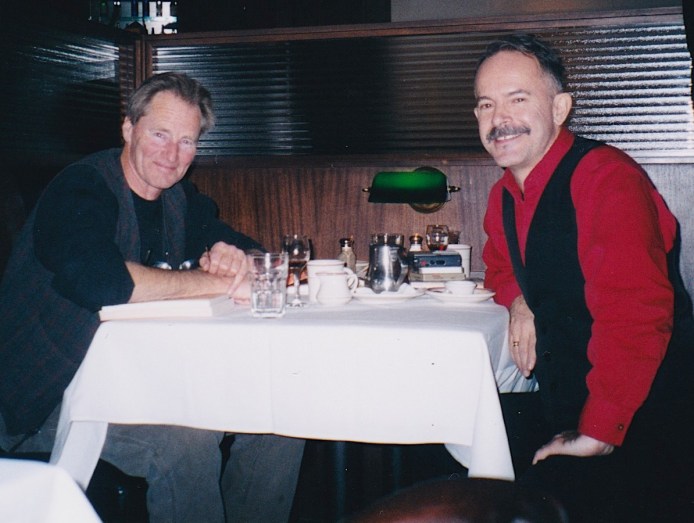
It wasn’t until 2003 until I finally got to sit down with him in St. Paul, MN, for a nuts-and-bolts interview for American Theater magazine; we talked again the following year in New York when I interviewed him for the Village Voice about his 2004 play The God of Hell. I feel like I know more about his personal life than anyone who’s not a friend needs to know (he was pretty private, and I respect that). I feel like I know a lot about him as an artist, which matters a lot more to me, and what I relate to most is his profound understanding of being psychically split between what happens outside and what happens inside.
In films Shepard reliably represented the many faces of craggy masculinity. It’s no disrespect to say he wasn’t a great actor – he was an economical performer and an iconic presence, which suited most of his film roles. His most memorable performance, for me, was playing the ghost of Hamlet’s father in Michael Almereyda’s 2000 film. I weep just thinking about the way he pulled Ethan Hawke into his arms and growled into his ear “Remember me!” His best-known stage plays (Curse of the Starving Class, Buried Child, True West, Fool for Love, A Lie of the Mind) revolve round the relatable subject of family life, presented in all its combative, hilarious, ridiculous mythological depth.


I always preferred his quirkier, stranger, more poetic and absurdist work because I felt him exercising his deepest passions there. (His 2012 play Heartless, above, produced by Signature Theater, is right up there with the wildest and craziest of his plays.) What I learned from meeting and writing about him was that he was profoundly a man of letters, extremely knowledgeable about certain pockets of poetry and international literature. He cared shockingly little about contemporary theater and only late in life delved into Shakespeare and the Greeks. It’s not surprising that Shepard had a lifelong love for horses (raising them and riding them). Much less known is his deep engagement with spirituality and philosophy, especially the teachings of Gurdjieff, a subject so close to his heart that when I interviewed him it was the one thing he wouldn’t discuss. These are the layers and flavors of Shepard’s work that I think will reveal themselves more as time goes by.

Quote of the day: TEENAGERS

August 3, 2017

TEENAGERS

In your work, you mention seven transitions teenage girls need to make as they enter adulthood. What are they?
I’ve boiled it down to parting with childhood, joining a new tribe, harnessing emotions, contending with adult authority, planning for the future, entering the romantic world, and caring for herself.

How did you come up with these?
I supervise the adolescent cases for graduate students in the psychodynamic course at Case Western Reserve University, and often very green graduate students are required to take on vastly more chaotic and underresourced kids than I see in my cozy little private practice. Because the cases were so overwhelming for them, I started to create a checklist of the challenges teenagers are likely to face in their development. The checklist became a way to organize myself to help the graduate students, and for the graduate students to orient themselves to the work.

How did you and your grad students use this tool?
As a student presented a case, we might say, “This kid has parted with childhood: she has friends—a tribe—but she has no affect regulation, so harnessing emotions is one thing we’ll work on. She gets along okay with adults, but has no plans for the future and is making no progress toward achievement in school. We’re hearing nothing about a romantic life, but that doesn’t seem to be a problem area either. And she’s taking decent care of herself.” This evaluation of those major transitions leads the therapist to focus on the areas of affect regulation and planning for the future. Viewing these cases through a clear model helps the therapist not to get overwhelmed while also helping the parents make sense of the chaos that’s often just normal development.

–Lisa Damour, interviewed by Ryan Howes for Psychotherapy Networker


Playlist: iPhone shuffle, 7/27/17

July 27, 2017

“War on the East Coast,” the New Pornographers
“Me the Machine,” Imogen Heap


“Reaching Out,” Kate Bush
“See it All,” Fink
“Wildflower,” Sheryl Crow
“This Is the Dream of Win and Regine,” Final Fantasy
“One More Round,” Bette Midler
“Bird,” Panda Valium
“Spectacularly,” Matt Alber
“Cycle Song,” Imogen Heap
“Black Friday,” Steely Dan
“I Don’t Know What the Weather Will Be,” Laura Mvula
“Intro,” the XX
“Cranes in the Sky,” Solange
“Should Have Known Better,” Sufjan Stevens
“The Beatitudes,” Kronos Quartet (La Grande Bellezza OST)
“Man & Dog,” Loudon Wainwright III
“Riot Act,” Elvis Costello
“Geranium,” Jane Siberry
Pebarongan,” OOIOO


“When Love Explodes (Love Theme from “Hurt Locker: The Musical”), Hedwig and the Angry Inch OCR
“I Love You But I Don’t Know What to Say,” Ryan Adams
“Nothing Good Ever Happens at the Goddamn Thirsty Crow,” Father John Misty
“She,” Laura Mvula
“The Night and the Liquor,” Elvis Perkins
“Shiverman,” Fat Freddy’s Drop
“Chicago,” Sufjan Stevens
“Remade Horizon,” Dirty Projectors
“Opposite House,” Cass McCombs
“From This Moment On,” Jimi Somerville (Red Hot + Blue)


Quote of the day: ADDICTION

July 26, 2017

ADDICTION

Addiction is a complex psychophysiological process, but it has a few key components. I’d say that an addiction manifests in any behavior that a person finds temporary pleasure or relief in and therefore craves, suffers negative consequences from, and has trouble giving up. So there’s craving, relief and pleasure in the short term, and negative outcomes in the long term, along with an inability to give it up. That’s what an addiction is. Note that this definition says nothing about substances. While addiction is often to substances, it could be to anything—to religion, to sex, to gambling, to shopping, to eating, to the internet, to relationships, to work, even to extreme sports. The issue with the addiction is not the external activity, but the internal relationship to it. Thus one person’s passion is another’s addiction.

Okay, but the whole subject of addictions is shrouded in a certain amount of controversy these days. What do you think is the most common misconception about addictions?

Well, there are a number of things that people often don’t get. Many believe addictions are either a choice or some inherited disease. It’s neither. An addiction always serves a purpose in people’s lives: it gives comfort, a distraction from pain, a soothing of stress. If you look closely, you’ll always find that the addiction serves a valid purpose. Of course, it doesn’t serve this purpose effectively, but it serves a valid purpose.

Lots of people believe that the term addiction has become too loosely applied. So what’s the difference between saying “I have an addiction” and “I have bad habits that give me short-term satisfaction, but don’t really serve me in the long term?”

The term addiction comes from a Latin word for a form of being enslaved. So if it has negative consequences, if you’ve lost control over it, if you crave it, if it serves a purpose in your life that you don’t otherwise know how to meet, you’ve got an addiction…

The notion of trauma is closely tied into your conception of addiction. Why is that?

If you start with the idea that addiction isn’t a primary disease, but an attempt to solve a problem, then you soon come to the question: how did the problem arise? If you say your addiction soothes your emotional pain, then the question arises of where the pain comes from. If the addiction gives you a sense of comfort, how did your discomfort arise? If your addiction gives you a sense of control or power, why do you lack control, agency, and power in your life? If it’s because you lack a meaningful sense of self, well, how did that happen? What happened to you? From there, we have to go to your childhood because that’s where the origins of emotional pain or loss of self or lack of agency most often lie. It’s just a logical, step-by-step inquiry. What’s the problem you’re trying to resolve? And then, how did you develop that problem? And then, what happened to you in childhood that you have this problem?

All we know about the advances in addiction treatment arises out of our understanding of trauma. People often think that trauma is the bad things that happen to someone: trauma is that you were sexually abused, or that you were beaten, or your parents abandoned you, or died, or something like that. But trauma is the internal impact, which is fundamentally a disconnection from the self and from our bodies and our gut feelings. And the trauma is the discomfort, the inability to be in the present moment because the present moment is too painful.

If, as I argue, addiction is rooted in trauma, then the treatment of addiction has to aim beyond just stopping the behavior. That’s where the addiction treatment falls down so miserably. Too often it’s all aimed at behavioral regulation or behavior reform, with the thought that if people stop the behavior, then they’re going to be okay. No, they’re not—and they won’t be fully okay until they deal with the fundamental issues. So the treatment has to aim at nothing less than the restoration of the individual to themselves and to their capacity to be with the present moment, whether the present moment is pleasant or not. That’s what’s too often missing from addiction treatment.

–Gabor Maté, interviewed in Psychotherapy Networker


Quote of the day: AL-ANON

July 25, 2017

AL-ANON

I once heard a member of Al-Anon, a world-wide group for the family and friends of alcoholics, boil it down like so: “I didn’t cause my mother’s drinking problem; I can’t control it; and I can’t cure it.” But by focusing on our own behavior and feelings – instead of the alcoholic’s, for a change – we may find a healthy path forward. Just walking into an Al-Anon meeting helps break down the secrecy and shame that so often surround addiction. You are not alone. You may not change the alcoholic, but you can certainly improve the way you deal with him.

–Philip Galanes, New York Times “Social Q’s” columnist