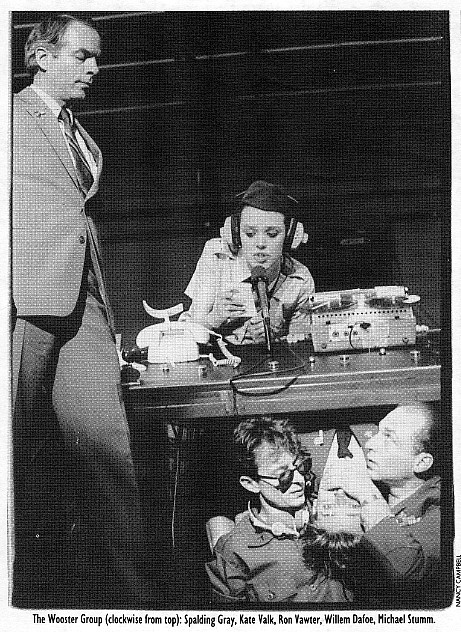
March 18 – The Wooster Group’s North Atlantic at the Baryshnikov Arts Center. Fantastic show! When the Wooster Group first mounted North Atlantic in 1984, it was an anomaly among their works – an actual complete play, as opposed to the multimedia spectacles they’d previously done that included fragments of classic plays exploded and Woosterized. At the time, it was primarily a genre piece playing off clichés of old war movies funneled through author Jim Strahs’ machine-gun-rapid, energetically obscene, imaginatively free language. Commissioned as a collaboration with a Dutch company (Globe Theater in Eindhoven), it began as a very, very loose adaptation of South Pacific. (And I use the term “loose” purposely as an excuse to quote one of my favorite lines from the play: BENDERS: Now, don’t tease me, Ann. Is she really that way? Is she really that loose? ANN Loose! Why my goodness, General, you could drive a dump-truck down that alley and K-turn without even using the rear-view mirror.) Aboard an aircraft carrier off the coast of Europe, a crew of male navy intelligence officers and female “nurse/word-processors” are engaged in some elaborate activity having to do with coding and decoding military messages…or maybe they’re a decoy operation trying to draw enemy attention away from the real operation. But of course they spend most of their time trying to entertain themselves telling filthy jokes, plotting sexual intrigues, fighting, singing, dancing, and planning a Wet Uniform Contest. The original cast featured the founding Woosters in their glory: Spalding Gray, Kate Valk, Ron Vawter, Willem Dafoe, and Peyton Smith, with Nancy Reilly, Michael Stumm, Anna Kohler and Jeff Webster. It was revived in 1999 with a cast that included Steve Buscemi and new Wooster stars Ari Fliakos and Scott Shepherd.

Steve Cuiffo, Zachary Oberzan, Ari Fliakos, Kate Valk, and Paul Lazar
Now the play takes on a whole other currency, since we’re in the midst of a war where intercepting and interpreting terrorist communications is front and center, not to mention interrogating suspects and sexual politics within the military. But just in case that sounds like some kind of straightforward earnest plot-oriented gritty realistic play, rest assured that it’s still classic Wooster Group: high-powered acting and exquisitely choreographed theatrical chaos. The cast is fantastic: Ari Fliakos as Chizzum, the hot-headed, unbelievably fast-talking captain (originally the Ron Vawter role), Kate Valk as the goofy, sexy Ensign Ann Pusey, Paul Lazar as the creepy General Benders (originally played by Spalding Gray), Scott Shepherd as visiting hot-shot Lud (the Willem Dafoe role), Frances MacDormand as Master Sergeant Mary Bryzynsky (Peyton’s role), and a bunch of terrific young new Wooster-ites, including Steve Cuiffo and Zachary Oberzan who are hilarious and wonderful as two doofy Marines under Chizzum’s command. Typical for the Wooster Group, even though they’ve done the show a couple of times before, it never looks exactly the way it did before – there’s always tweaking and adapting to the space, the actors, and to the visual/theatrical whims of genius director Elizabeth LeCompte. The final tableau is one I didn’t remember – maybe it was always there, but it’s amazing to encounter. And the performed version differs quite a bit from the published version of the play, which you can download from Strahs’ website along with his other plays and his fiction.
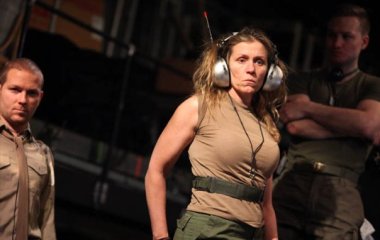
Ari Fliakos and Frances MacDormand
This show inaugurates the Wooster Group’s residency at the Baryshnikov Arts Center – a step up from their original home base, the Performing Garage, in terms of capacity and room to maneuver. Weirdly, though the seats look plush, they’re not so comfortable – my butt never falls asleep at the theater but it was uncomfortably numb before the 90-minute intermissionless show was over. Excited crowd in the house, a lot of press. I chatted beforehand with filmmaker Michael Almereyda – good to catch up – and I brought with me a posse of 8, some Wooster Group veterans, and some virgins, including Andy, whose brains were absolutely fried by the show, and Marta, who was super-thrilled to be sitting a few feet away from Frances MacDormand, whom she idolizes. Then when we went to Market Café for dinner afterwards, MacDormand and two friends plunked down at the table next to us, and Marta went into fits of fangirl frenzy. I emboldened myself to chat MacDormand up — she was annoyed by the interruption but patiently indulged me as I showed her pictures on the Harry Kondoleon website of her in a blond wig in the Yale Repetory Theatre production of Harry’s play Rococo, back in 1981.