The best thing is this week’s issue is the very first thing: Hendrik Hertzberg’s editorial in Talk of the Town analyzing the results of this year’s midterm election.
As for “the American people” themselves, it seems clear enough that their rejection of the Democrats was, above all, an expression of angry anxiety about the ongoing economic firestorm. Though ignited and fanned by an out-of-control financial industry and its (mostly) conservative political and intellectual enablers, the fire has burned hottest since the 2008 Democratic sweep. By the time the flames reached their height, the arsonists had slunk off, and only the firemen were left for people to take out their ire on. The result is a kind of political cognitive dissonance. Frightened by joblessness, “the American people” rewarded the party that not only opposed the stimulus but also blocked the extension of unemployment benefits. Alarmed by a ballooning national debt, they rewarded the party that not only transformed budget surpluses into budget deficits but also proposes to inflate the debt by hundreds of billions with a permanent tax cut for the least needy two per cent. Frustrated by what they see as inaction, they rewarded the party that not only fought every effort to mitigate the crisis but also forced the watering down of whatever it couldn’t block.
Part of the Democrats’ political problem is that their defense, confusingly, depends on counterfactuals (without the actions they took in the face of fierce Republican opposition, the great slump would have metastasized into a Great Depression), deferred gratification (the health-care law’s benefits do not kick in fully until 2014), and counterintuitive propositions (the same hard times that force ordinary citizens to spend less money oblige the government—whose income, like theirs, is falling—to spend more). Another part of the problem, it must be said, is public ignorance. An illuminating Bloomberg poll, taken the week before the election, found that some two-thirds of likely voters believed that, under Obama and the Democrats, middle-class taxes have gone up, the economy has shrunk, and the billions lent to banks under the Troubled Asset Relief Program are gone, never to be recovered. One might add to that list the public’s apparent conviction that illegal immigration is skyrocketing and that the health-care law will drive the deficit higher. Reality tells a different story. For ninety-five per cent of us, taxes are actually lower, cut by around four hundred dollars a year for individuals and twice that for families. (The stimulus provided other tax cuts for people of modest means, including a break for college tuition.) The economy has been growing, however feebly, for five straight quarters. Most of the TARP loans have been repaid and the rest soon will be, plus a modest profit for the Treasury. And the number of illegal immigrants fell by close to a million last year, thanks in part to more energetic border enforcement. The health-care law, the nonpartisan Congressional Budget Office says, will bring the deficit down.
But why don’t “the American people” know these things? Could it be because the President and his party did not try, or try hard enough, to tell them?
Hmmm…are “the American people” ignorant because the President hasn’t properly educated them? Isn’t it much more likely that they’ve been successfully fear-mongered by Fox News into believing falsehoods and overlooking truths they don’t want to see? Fear creates more biochemical reaction in the body than appeals to calm and rationality do — that’s just survival, and that’s how demagogues and screamers get their way over the steady-speakers. Depressing.
Alec Wilkinson writes terrific profiles of musicians for the New Yorker. This week we read his report on Bettye Lavette, a minor soul singer overlooked for decades who’s had a resurgence of critical acclaim in recent years. I’m not a big fan of her singing, and the article makes her sound quite unpleasant to be around. But I had to chuckle at the frankness of this particular self-assessment: “I really don’t have a lot of talents. I can cook, and I can fuck, and I can sing. And I’m proud of all of them.”
I doubt if I would like Lena Dunham’s feature film debut as writer/director/star, Tiny Furniture, but I enjoyed reading Rebecca Mead’s profile of Dunham and her description of the movie. “In its merciless investigation of its creator’s character flaws, Tiny Furniture resembles Larry David’s Curb Your Enthusiasm mashed up with Whit Stillman’s Metropolitan, or Manhattan if it had been directed by Mariel Hemingway rather than by Woody Allen.”
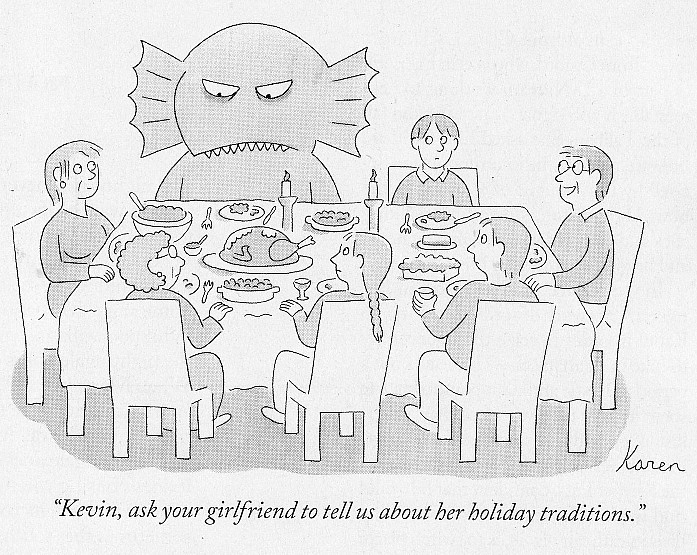
And then there’s this delightful cartoon by Karen Sneider: