Theater review: THE MARRIAGE OF MARIA BRAUN

November 21, 2010

My review of The Marriage of Maria Braun at the BAM Next Wave Festival is available for reading on CultureVulture.net.

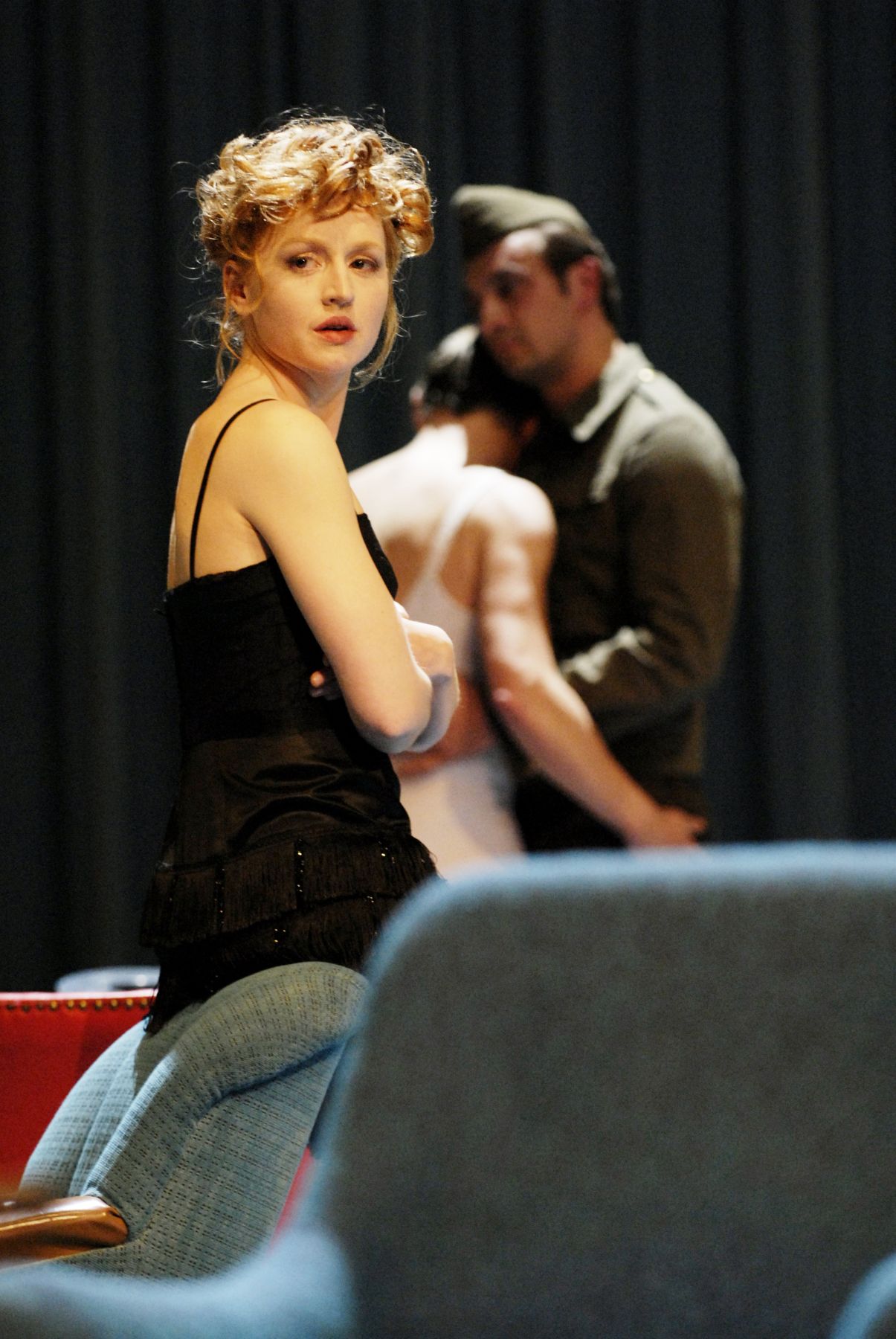
“Perhaps taking a page from Flemish director Ivo van Hove…Thomas Ostermeier has stripped the Fassbinder film down to its essential narrative and staged it with five actors on a set full of mismatched armchairs and tables that looks vaguely like a hotel lobby or airport lounge….Ultimately, the piece seemed dry, visually drab, and perversely stingy. I think I’m most grateful to the production for encouraging me to go back and look at Fassbinder’s film on DVD, which also includes fascinating commentary by fellow director Wim Wenders and cinematographer Michael Ballhaus as well as a 2003 interview with Hannah Schygulla.”

You can read the whole review online here.


Performance diary: The Dessoff Choirs at St. James’ Church

November 21, 2010


November 20
The Dessoff Choirs, which Andy sings with, have spent all fall rehearsing with their new conductor, Christopher Shepard, for a concert of French choral music. The concert, titled “In Paradisum: French Masters from Josquin to Duruffle,” was sublime. I’m no expert on the history of choral music, but I love a lot of French impressionist music (Faure and Debussy), and this concert turned me on to a lot more. It opened gorgeously with Faure’s “Cantique de Jean Racine” and closed with Duruffle’s “Requiem,” which is sterner, less lush than Faure’s famed Mass but exquisitely performed. Poulenc’s “Four Motets for Christmastime” were spectacular – for one thing, the acoustics at St. James’ Church gave unaccompanied voices an almost perfect environment. The church was chosen partly to show off its new organ, and keyboardist Christopher Jennings got a slot to play something without the singers. I’m no fan of organ music, but he plays Saint-Saens’ “Prelude and Fugue in B Major,” which was beautiful and weirdly made me to understand that Brian Wilson must have looked to Saint-Saens as an inspiration. The most ambitious and thoroughly successful segment of the program was Shepard’s selection of Madrigals and Chansons, alternating between Renaissance church music and modern art songs. Out of eight pieces, two struck me particularly: Vincent d’Indy’s “Madrigal dans le style ancient” and Faure’s “Madrigal.” The latter had a text by Armand Silvestre so deep and wise that it made me cry. The English translation by Miriam Lewin goes:

You should know, o cruel Beauties,
That the days for loving are numbered.
You should know, fickle gents,
That the fruits of love are fleeting.
Love when someone loves you,
Love when someone loves you!

The same destiny awaits us
And our folly is the same:
To love the one who flees us,
And to flee the one who loves us!

The Dessoff were supposed to be spending next week accompanying Ray Davies on his East Coast tour, singing choral arrangements of classic Kinks songs. But Herr Davies fell ill and had to cancel. So their next performance will be Ravel’s Daphnis et Chloé with the Julliard Orchestra December 13 at 8:00 pm at Alice Tully Hall.


Photo diary: non-traditional marriage

November 21, 2010


In this week’s New Yorker

November 21, 2010

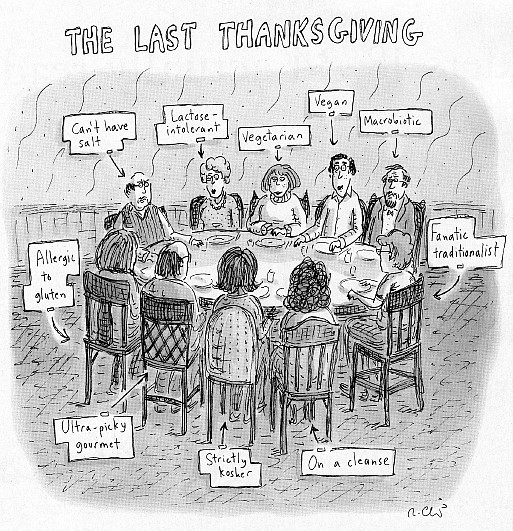
In the Thanksgiving-related Food Issue, Burkhard Bilger writes a fascinating long article about a culinary trend new to me, fermented foods. I was fascinated to see that the article centers on an old acquaintance of mine from ACT UP and Radical Faeries, Sandy Katz, author of “The Revolution Will Not Be Microwaved.” (Go, Sandy, aka Sanderkraut, aka Sandorfag!). Besides providing a glimpse of life at a pseudonymous Radical Faerie sanctuary in Tennessee, the article definitely speaks to my own sentiments about the silliness of modern-day germ-phobia:

“In the past decade, biologists have embarked on what they call the second human-genome project, aimed at identifying every bacterium associated with people. More than a thousand species have been found so far in our skin, stomach, mouth, guts, and other body parts. of those, only fifty or so are known to harm us, and they have been studied obsessively for more than a century. The rest are mostly new to science…Given how little we know about our inner ecology, carpet-bombing it might not always be the best idea. ‘I would put it very bluntly,’ [UMass Amherst biologist Lynn] Margulis told me. ‘When you advocate your soaps that say they kill all harmful bacteria, you are committing suicide.’ The bacteria in the gut can take up to four years to recover from a round of antibiotics, recent studies have found, and the steady assault of detergents, preservatives, chlorine, and other chemicals also takes its toll. The immune system builds up fewer antibodies in a sterile environment; the deadliest pathogens can grow more resistant to antibiotics; and innocent bystanders such as peanuts or gluten are more likely to provoke allergic reactions. All of which may explain why a number of studies have found that children raised on farms are less susceptible to allergies, asthma, and autoimmune diseases. The cleaner we are, it sometimes seems, the sicker we get.”

Bilger also bravely sits down for lunch with opportunivores, people who eat roadkill and do their grocery shopping by dumpster-diving. Yikes!

In Talk of the Town, Elizabeth Kolbert writes about the scary ignoramuses angling for power in the newly established Republican majority in Congress: “John Shimkus, of Illinois, is one of four members now vying for the chairmanship of the House Committee on Energy and Commerce. At a congressional hearing in 2009, he dismissed the dangers of climate change by quoting Genesis 8:22: ‘As long as the earth endures, seedtime and harvest, cold and heat, summer and winter, day and night will never cease.’ He added, ‘I believe that’s the infallible word of God, and that’s the way it’s going to be for His creation.’ ”

Aside from the fabulous Roz Chast cartoon (above), my favorite thing in this issue is this poem by Clive James:

“Whitman and the Moth”

Van Wyck Brooks tells us Whitman in old age
Sat by a pond in nothing but his hat,
Crowding his final notebooks page by page
With names of trees, birds, bugs, and things like that.

The war could never break him, though he’d seen
Horrors in hospitals to chill the soul.
But now, preserved, the Union had turned mean:
Evangelizing greed was in control.

Good reason to despair, yet grief was purged
By tracing how creation reigned supreme.
A pupa cracked, a butterfly emerged:
America, still unfolding from its dream.

Sometimes he rose and waded in the pond,
Soothing his aching feet in the sweet mud.
A moth he knew, of which he had grown fond,
Perched on his hand as if to draw his blood.

But they were joined by what each couldn’t do,
The meeting point where great art comes to pass —
Whitman, who danced and sang but never flew,
The moth, which had not written “Leaves of Grass,”

Composed a picture of the interchange
Between the mind and all that it transcends
Yet must stay near. No, there was nothing strange
In how he put his hand out to make friends

With such a fragile creature, soft as dust.
Feeling the pond cool as the light grew dim,
He blessed new life, though it had only just
Arrived in time to see the end of him.

Theater review: THE MERCHANT OF VENICE

November 20, 2010

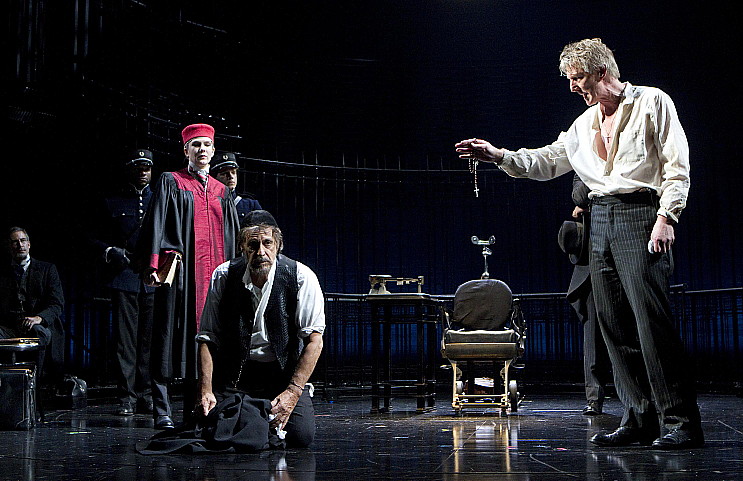
My review of Daniel Sullivan’s production of The Merchant of Venice has been posted on CultureVulture.net.

I didn’t manage to see the show when it was first staged in Central Park last summer, in rep with Michael Greif’s version of The Winter’s Tale, but I’m glad I caught up with it on Broadway.

Lily Rabe, Al Pacino, and Byron Jennings in "The Merchant of Venice"

“It’s a deep and upsetting rendition of one of Shakespeare’s darkest comedies….Sullivan’s subtle yet pointed staging made me unusually aware of the numerous contractual agreements in the play and how each of them comes loaded with some element of whimsy, perversity or downright cruelty. The scene where Shylock gets his day of reckoning could be considered the climax of the play, followed by some light-hearted comic business. But in this production, that tense scene launches an increasingly sickening series of humiliations, and nobody gets off the hook.”

You can read the complete review online here.