R.I.P.: Doric Wilson

May 10, 2011

Doric Wilson, who died Saturday May 7 at the age of 72, was virtually unknown to mainstream America, even to most theater people. But within the world of Off-Off-Broadway and post-Stonewall gay theater, he was a pioneer. He was one of the young out gay playwrights who made the legendary Caffe Cino his artistic home in the 1960s (along with Lanford Wilson and Robert Patrick), and in 1974 he founded the first gay theater in the United States, The Other Side of Silence (TOSOS). He had a tremendous influence on me as a young theater critic and baby gay liberationist hungry for historical touchstones.

We met in the summer of 1976, when I interviewed him and John Glines (separately) for a series of articles about gay theater for Boston’s Gay Community News. I was an earnest, starry-eyed 22-year-old Boston University student at the time, and I ended up publishing a rambling Q&A with Doric in GCN that strikes me now as embarrassingly naïve. But it was true that, as I wrote in the introduction, “As a person, Wilson is not ‘sort of’ anything – he is extremely intelligent, well-read, opinionated, headstrong, garrulous, and energetic.” Among the things that impressed me about Doric was his outspoken critique of gay homophobia, his willingness to describe himself unapologetically as “very promiscuous,” his openness as a leatherman, his refusal to distance himself from gay bar culture, and his frankness in articulating the subliminal ways that sexual attractiveness affects the way people interact professionally.

I don’t think anyone in the press had ever paid such close attention to Doric. I think he was flattered by my attention, as I was flattered by his openness (and his flirtatiousness, which led to the inevitable and inevitably anticlimactic one-night stand). Every time I saw him after that, he went right back into lengthy expostulation, as if I were still interviewing him, as if I were his personal historian, which was a little bit charming at first but quickly grew wearying. For all I know he did that with everyone. A large man physically and energetically, Doric spoke with a resonant, commanding voice as if addressing the multitudes, even in intimate circumstances.

In some ways, I was glad to take on the mantle of gay theater historian, because I had an ardent interest, particularly in the early days of Off-Off-Broadway. And I admired Doric’s plays (such as A Perfect Relationship and Forever After) for their willingness to depict the mundane aspects of gay life and romance with directness and humor as well as a sturdy but unpretentious theatricality. He liked to emulate the epigrammatic wit of Noel Coward but he also incorporated the casual way drag queens talk directly to the audience.

In 1977, I wrote a review of Doric’s play The West Street Gang for The Advocate, the national gay newsmagazine. (It was reprinted in Mark Thompson’s Long Road to Freedom: The Advocate History of the Gay and Lesbian Movement.) The play addressed the topical issue of gay-bashing and was performed site-specifically at the Spike, a leather bar in the West 20s, an area quite vulnerable to late-night attacks by marauding haters. Similarly, his play about the Stonewall uprising, Street Theater, premiered at the notorious Mineshaft and has a history of productions staged in funky gay bars. I was proud to include Street Theater in my anthology of gay and lesbian plays, Out Front, published in 1987 by Grove Press.

At a Queer Theater Conference in 1995, I moderated a panel discussion among several ground-breaking artists about the emergence of an out theater aesthetic. (A redacted transcript of this discussion appeared in The Queerest Art: Essays on Lesbian and Gay Theater, edited by Alisa Solomon and Framji Minwalla, who convened the conference for CLAGS.)  Doric was the grand old man on the panel, and he spoke very personally about his background with details I had never encountered anywhere else:

“I came to New York in 1958 from a ranch in Washington State. I did not come to New York in the cowboy style of the seventies. In the fifties, if you came from a ranch in Washington State, you came to New York trying to look like Noel Coward, and I looked as much like Noel Coward as I could. I’ve always been out. I grew up in a sort of pioneer family in a very unpopulated pioneer country, at that time, in Washington, the Five Cities.
There weren’t any five cities when I grew up. There were only two cities. But my grandfather had more or less founded the county, and built the roads and what-have-you.
So, I had that wonderful old-time American arrogance of pioneers, that it didn’t matter what I did, nobody had a right to say anything to me. So I came out in school. I came out because a friend who was gay killed himself when he realized that he was about to be discovered, and I decided I wasn’t a good enough shot to kill myself, so I’d better come out…
I came to New York to be a set and costume designer, but I was so naïve, I had no idea where one studies set and costume design. So I was used as an actor. I did any number of stock productions of Auntie Mame as young Patrick Dennis. My roommate at the time was a straight English actor and I wrote a play for a little theater workshop that we were in, an Adam and Eve play called And He Made a Her.
An actress in that company had just done a Tennessee Williams play at this coffeehouse on Cornelia Street in the Village. Now those of you who know New York City and know Cornelia Street know that it runs for one block. In the early sixties, what is now the West Village was almost part of Little Italy. It was not part of Bohemia.
So, the Caffe Cino was really more in Little Italy environment than New Bohemia. This actress, Regina Oliver, took me down to the Cino, introduced me to this short, impish, round man behind the counter: Joe Cino, who always had one hand on the arm of the cappuccino machine or ringing a bell to start the performance, so I always see Joe Cino with one arm in the air. I started to hand him the play while he was making a sandwich and making cappuccino. He opened the notebook, and he said, “Three weeks from now, on Friday,” and closed the notebook and pushed the play away. I turned to Regina and said, “What does that mean?” She said, “That’s when you open.” From that point on, we all just did plays at the Cino. Lanford [Wilson], myself, Tom Eyen – we all wrote gay plays there, but it never occurred to us that’s what we were doing. We also wrote bad plays there. Joe was completely open.
The other side of the coin was critics. In the sixties it was a problem if you were known as an out gay playwright. There were theaters that would not do your work. The most important of them was the Public Theater. Most of the Cino playwrights were not done at the Public. But we had the Cino.”


Good stuff online

May 10, 2011

Adam Nagourney’s piece on Jerry Brown in the New York Times Sunday Magazine renewed my long-held respect and admiration for the governor of California (below). He has exemplary personal integrity, and he walks his talk.

photo by Douglas Adesko for the NY Times

My friend and colleague Glenn Berger is now a hard-working and successful psychotherapist in Manhattan and a family man raising two kids with his wonderful wife, Sharon. His first career, however, was in the music business, where he got his start as a recording engineer with the legendary record producer Phil Ramone. Glenn is an excellent writer with energy and ambition to burn, and he has lately started to write detailed reminiscences of his time in the rock ‘n’ roll trenches, chapters of what I hope will be a full book. After his fascinating account of being in the studio with Bob Dylan for his landmark Blood on the Tracks album, Glenn has surpassed himself with a piece commemorating the recently departed Phoebe Snow, whose great first album was also the first project he completed as Ramone’s assistant. The essay gives a great eyewitness account of the recording sessions, with shrewd musical analysis and knowledgeable contextual background, but Glenn also steps back and considers Phoebe as a person and what she meant to her fans (including himself). The piece left me in tears.


Quote of the day: VEGETABLE

May 10, 2011

On May 10, 1893, the Supreme Court ruled that the tomato was a vegetable, not a fruit. Their ruling was in light of a 10-year-old piece of legislation called the Tariff Act of 1883, which ruled that a 10 percent tax had to be paid on all imported vegetables. The case, known as Nix vs. Hedden, was filed by John Nix and several other tomato importers against Edward Hedden, the Collector of Customs at the Port of New York. The case wound up in the Supreme Court, where Webster’s Dictionary was heavily cited. The plaintiffs argued that according to the dictionary definition of fruit — the structure that grows from the flower of the plant and holds the seeds — a tomato was a fruit. They called two witnesses, both of whom heard the definitions of “fruit” and “vegetable” out of the dictionary and were asked whether those definitions were any different in the world of trade and commerce. Both talked for a while but said no, the definitions were no different. The counsel for the plaintiff then read the definition of tomato.

Each side then proceeded to read a series of Webster’s Dictionary definitions. The counsel for the defense read “egg plant,” “squash,” “pepper,” and “cucumber” — all of which, like tomato, are fruits in the botanical sense — but which are widely considered vegetables. In response, the counsel for the plaintiff read the definitions of “potato,” “turnip,” “parsnip,” “cauliflower,” “cabbage,” and “carrot,” none of them botanical fruits but all considered vegetables.

Justice Gray delivered the opinion of the Court, and he said: “Botanically speaking, tomatoes are the fruit of a vine, just as are cucumbers, squashes, beans, and peas. But in the common language of the people, whether sellers or consumers of provisions, all these are vegetables which are grown in kitchen gardens, and which, whether eaten cooked or raw, are, like potatoes, carrots, parsnips, turnips, beets, cauliflower, cabbage, celery, and lettuce, usually served at dinner in, with, or after the soup, fish, or meats which constitute the principal part of the repast, and not, like fruits generally, as dessert.”

Nix v. Hedden has been referenced in numerous cases since, including a 1990 Second Circuit Court of Appeals case about a delay in a tomato shipment. The judge wrote: “In common parlance tomatoes are vegetables, as the Supreme Court observed long ago, see Nix v. Hedden, although botanically speaking they are actually a fruit. Regardless of classification, people have been enjoying tomatoes for centuries, even Mr. Pickwick, as Dickens relates, ate his chops in ‘tomata’ sauce.”

The debate has continued, but the problem is that “vegetable” has no actual scientific or botanical definition — it is a culinary term. In 1987, the state of Arkansas designated the Vine Ripe Pink Tomato as their official state fruit and vegetable.

Tomatoes were slow to catch on in the United States — in 1845, the editor of the Boston Courier wrote that tomatoes were “the mere fungus of an offensive plant, which one cannot touch without an immediate application of soap and water with an infusion of eau de cologne … deliver us, O ye caterers of luxuries, ye gods and goddesses of the science of cookery! deliver us from tomatoes!” This opinion was echoed over and over again by journalists, agricultural experts, farmers, and gardeners across the country.

The Writer’s Almanac


In last week’s New Yorker…

May 10, 2011

Yes, I’m a week, maybe two behind. But I didn’t want to let the moment pass without citing a couple of articles that made an impression on me.

Jon Lee Anderson is one of the New Yorker’s extraordinary war reporters, and his dispatch from Libya conveys with revelatory specificity the particularly scrappy, hand-to-hand nature of the effort to end the dictatorial rule of Qadaffi. It’s a corner of the world I would never know anything about except for such fine first-hand reporting.

Hilton Als also does a beautiful job profiling Jane Fonda, someone it’s easy to feel like you know everything about. Yet Hilton got extraordinary access to her daily life, and he earned it through scrupulous, thoughtful, and sympathetic attention to her unusually sprawling life’s work. The complete article can only be read online by subscribers, but you can access the link here.


Theater review: THE HOUSE OF BLUE LEAVES

May 4, 2011

My review of David Cromer’s Broadway revival of John Guare’s The House of Blue Leaves got posted today on CultureVulture.net. Check it out and let me know what you think.
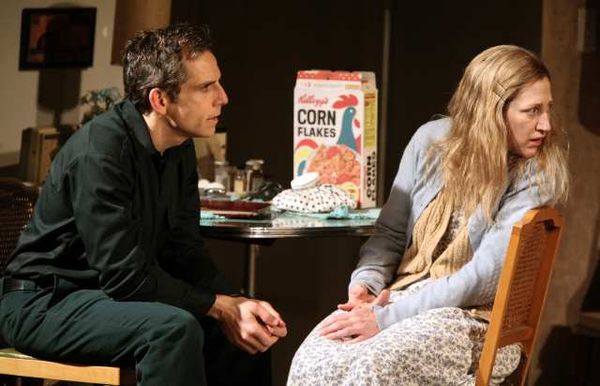
I say, in part: “The House of Blue Leaves is such a famous play—its premiere in 1971 gave Guare, one of our best playwrights, his first hit—and the 1986 Lincoln Center Theater revival is still so fresh in the memory that it’s easy to forget what a strange and unconventional play it is… The new Broadway revival looks fantastic on paper. The stars include Ben Stiller (above left) as Artie, Edie Falco (above right) as Bananas, and Jennifer Jason Leigh as Bunny (a role first played by Stiller’s mother, Anne Meara), and the director is David Cromer, who staged phenomenal productions in recent years of Thornton Wilder’s Our Town (which ran for two years Off Broadway) and the Broadway revival of Simon’s Brighton Beach Memoirs…. Sad to say, Cromer’s production gets it all wrong.”

You can read the complete review online here.