

Good stuff online: Dan Martin and Michael Biello’s song “Annie Sprinkle”
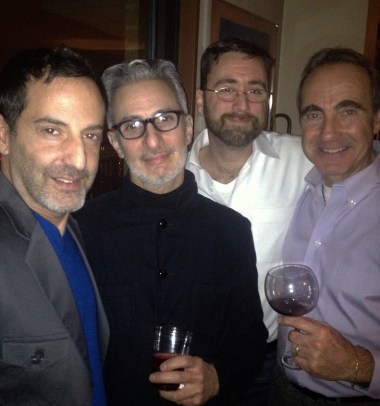
January 1, 2013Michael Biello and Dan Martin, partners in art and in life, have written many wonderful songs together over the years. They’re currently working on a show called In My Body, and they’ve made a demo recording of this delicious song about the legendary pleasure activist Annie Sprinkle. Sung by Michele Ragusa, the song describes the epiphanic experience of seeing Annie’s performance piece Post-Porn Modernist, where she invited audience members to the stage to look at her pussy…I mean, to examine her cervix. I witnessed an earlier version of this show, when Richard Schechner asked Annie to conduct her sex education class as part of a show he staged at the Performing Garage called The Prometheus Project, and I can attest to the beautiful, sweet, innocent, hilarious, and shamanic impact of Annie’s physical generosity. This was truly Living Theater! Dan and Michael capture the essence of Annie’s message: “To pleasure yourself is to pleasure the world!”
Quote of the day: WEIRD
December 31, 2012WEIRD
In old traditions those who acted as elders were considered to have one foot in daily life and the other foot in the otherworld. Elders acted as a bridge between the visible world and the unseen realms of spirit and soul. A person in touch with the otherworld stands out because something normally invisible can be seen through them. The old word for having a foot in each world is weird. The original sense of weird involved both fate and destiny. Becoming weird enough to be wise requires that a person learn to accommodate the strange way they are shaped within and aimed at the world.
An old idea suggests that those seeking for an elder should look for someone weird enough to be wise. For just as there can be no general wisdom, there are no “normal” elders. Normal bespeaks the “norms” that society uses to regulate people, whereas an awakened destiny always involves connections to the weird and the warp of life. In Norse mythology, as in Shakespeare, the Fates appear as the Weird Sisters who hold time and the timeless together.
Those who would become truly wise must become weird enough to be in touch with timeless things and abnormal enough to follow the guidance of the unseen. Elders are supposed to be weird, not simply “weirdos,” but strange and unusual in meaningful ways. Elders are supposed to be more in touch with the otherworld, but not out of touch with the struggles in this world. Elders have one foot firmly in the ground of survival and another in the realm of great imagination. This double-minded stance serves to help the living community and even helps the species survive.
— Michael Meade, Fate and Destiny: The Two Agreements of the Soul

Performance diary: PICNIC
December 31, 2012December 30 — I’ve never seen William Inge’s Picnic in any form. I’m not sure I’ve seen any play by Inge, once ranked alongside Tennesee Williams among America’s best-known playwrights, now associated with a certain kind of period drama about the emotional yearning of regular folks (and remembered as a sad closety gay alcoholic who committed suicide in 1973). I always picture an Inge play as being about a young stud who breezes into a patch of love-starved women, makes an impression, breaks a few hearts, and moves on – which is pretty much exactly what happens in Picnic. The original 1953 Broadway production starred Janice Rule as the prettiest girl in town, Madge; Paul Newman (in his Broadway debut) as Alan Seymour, the nice rich guy she’s supposed to marry; Ralph Meeker as Hal Carter, the sexy drifter who riles everybody up; Kim Stanley as Maggie’s plain younger sister, Millie; and Eileen Heckart as Rosemary, the wise-cracking schoolteacher with a desperate desire to be rescued. The play won the Pulitzer Prime for drama that year. Director Joshua Logan also made the 1955 film, which starred Kim Novak, Cliff Roberston, William Holden, Susan Strasberg, and Rosalind Russell. The Roundabout Theater’s revival, directed by the busy/ubiquitous Sam Gold, is perfectly built for people like me, who are curious about the play but have never seen it.
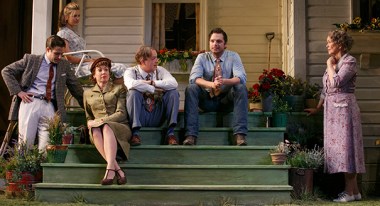
I was drawn in by the intriguing cast: Elizabeth Marvel as Rosemary, Reed Birney as the guy who’s been dragging his heels about marrying her, Mare Winningham as Madge’s mother, and Ellen Burstyn as the spinster who lives next door with her mean old (never-seen) mother and who is the one who hires Hal (played by Sebastian Stan, best-known for the Captain America movies) to do yard work and therefore parade shirtless in front of all these gals. Madeline Martin, the precocious youngster in August: Osage County on Broadway, plays Millie. All of them are enjoyable enough, but each plays his or her character as a caricature. By contrast, two actors new to me – Maggie Grace as Madge and Ben Rapaport as Alan – inhabit their roles with sincerity and understatement. Grace in her quiet way conveys the loneliness and oppression of being kept in the box of “prettiest girl in town,” and even though Alan could be the squarest, most thankless role in the play, Rapaport makes him genuinely kind and present in unpredictable ways. The two styles sort of clash, and I preferred the style of Grace and Rapaport. I think the show would have been stronger, more emotionally affecting if the others followed their lead. The show is still in previews. Who knows, it could look a lot different when it opens in mid-January. I will say that Chris Perfetti (below, with Maggie Grace), in the tiny role of the paperboy, is a sexy little fucker. And my favorite thing about the show is the line just before intermission, when Hal grabs Madge the way Stanley Kowalski grabs Blanche, and he says: “We ain’t goin’ to no goddamn picnic!”

Quote of the day: DIFFERENT
December 30, 2012DIFFERENT
Elaine May: “What have you learned, Mike?”
Mike Nichols: I’ve learned that many of the worst things lead to the best things, that no great thing is achieved without a couple of bad, bad things on the way to them, and that the bad things that happen to you bring, in some cases, the good things. For instance, if you grow up odd and—what is it when you’re left out? You’re not an extrovert—“
Elaine May; “Introvert?”
Mike Nichols: “No, when you grow up—“
Elaine May: “Peculiar?”
Mike Nichols: Peculiar. Different. The degree to which you’re peculiar and different is the degree to which you must learn to hear people thinking. Just in self-defense you have to learn, where is their kindness? Where is their danger? Where is there generosity? If you survive, because you’ve gotten lucky—and there’s no reason ever to survive except luck—you will find that the ability to hear people thinking is incredibly useful, especially in the theater.”
— Vanity Fair (read the whole thing online here)

 another eye opens