Quote of the day: GARMENT DISTRICT

September 22, 2013

GARMENT DISTRICT

A century and a half ago, New Yorkers had a much more intimate connection with their clothes, because New Yorkers were making them. The garment industry was established in the mid-nineteenth century. Then, as now, immigrants supplied the labor, doing piecework at home or working in the small factories for which the term “sweatshop” was coined.

Initially, garment manufacture centered on the Lower East Side, where the labor pool was based. Around the turn of the century, with the arrival of department stores, the garment factories moved to the West Twenties and into the West Thirties, the better to supply Ladies’ Mile, the shopping corridor along Sixth Avenue between Fourteenth and Twenty-third Streets. The loft buildings there provided comparatively airy work environments. A hundred years or so ago, the first zoning laws were introduced, with the goal of preventing the manufacturing industry from encroaching on residential districts. By the nineteen-twenties, the West Thirties had become home to thousands of factories, showrooms, and offices dedicated to the garment trade. More than three-quarters of the nation’s clothing was made in New York City.

Today, only three per cent of the clothes we wear are made in America. New York’s garment district has undergone a parallel decline. Fifty years ago, there were two hundred thousand industry jobs in the neighborhood; now there are about twenty-one thousand, fewer than half of them in manufacturing.

— Rebecca Mead, “The Garmento King,” The New Yorker, September 23, 2013

Garment_District_NYWTS_crop


Quote of the day: COASTING

September 20, 2013

COASTING

New Yorkers have too much reverence for their institutions. A young banker absolutely worships Goldman Sachs. A young journalist is in complete awe of Condé Nast. In Silicon Valley, growing up, your parents approve of you saying, “Oh, I could do something way better than that.”

— Bryan Goldberg, founder of Bleacher Report and Bustle.com

bryan goldberg


Performance diary: THE GLASS MENAGERIE

September 20, 2013

glass m celia k-b
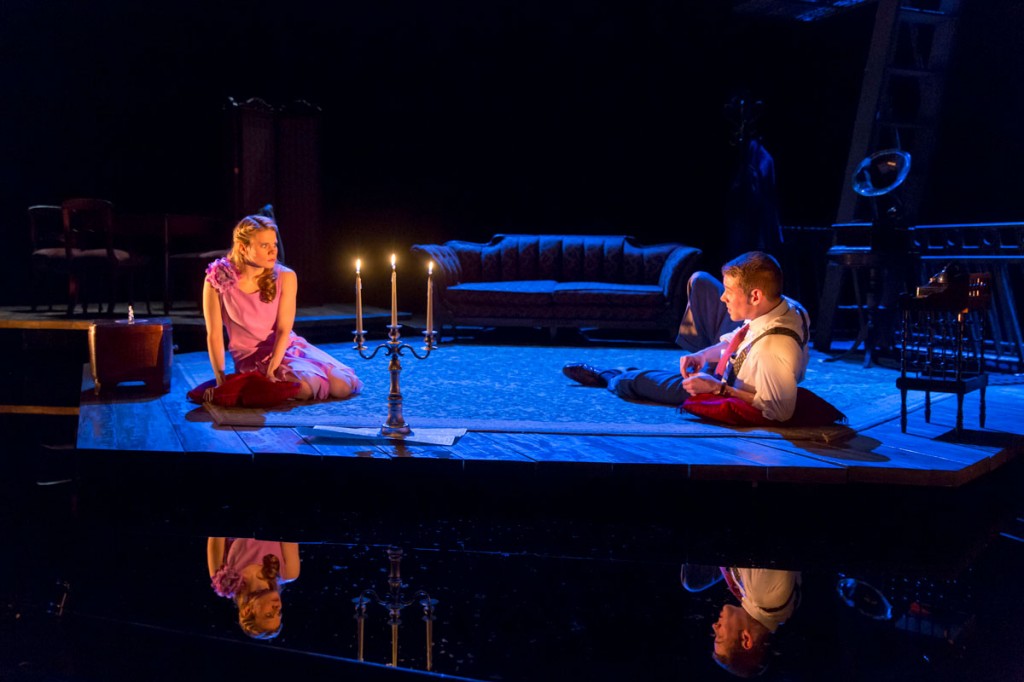
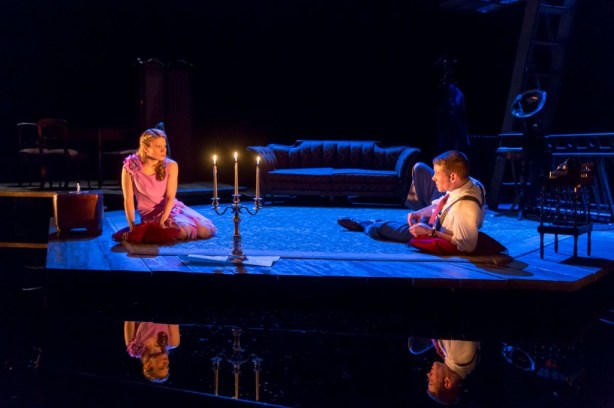
9.14.13 —  Everybody remembers the last five minutes of The Glass Menagerie, but I’ve never seen a production that placed such careful and meaningful emphasis on the first five minutes as John Tiffany’s revival currently on Broadway. I guess I’ve heard it a bunch of times, but I could never have told you that Tom Wingfield’s opening soliloquy describes economic conditions in the 1930s, “when the huge middle class of America was matriculating in a school for the blind. Their eyes had failed them or they had failed their eyes, and so they were having their fingers pressed forcibly down on the fiery Braille alphabet of a dissolving economy.” I wouldn’t have believed you if you told me that his mother Amanda would describe one of her suitors as “The Wolf of Wall Street” (the name of Martin Scorsese’s forthcoming film, starring Leonard DiCaprio and set in the contemporary world of securities fraud). Most of all, Tiffany and his key collaborators – choreographer/movement designer Steven Hoggett and set/costume designer Bob Crowley – combine the “memory play” aspect of Glass Menagerie with Tom’s mention of “tricks up his sleeve” to frame the naturalistic family scenes at the heart of the play with inventive, sometimes downright peculiar visual effects. As with Once and The Black Watch, the shows that put the team of Tiffany and Hoggett on the map in New York,  scene changes and transitions often involve the actors performing strange abstract gestural “dances”: Tom is drawn from the fire escape into the living room backwards as if memory exerted a literally magnetic pull; “setting the table” becomes a curious ethnographic tribal rite; and without giving away any spoilers, let’s just say Laura has never made an entrance before the way she does here.
glass m laura and jim
The production concept is strong and remarkable because it doesn’t get in the way of the actors but gives them something extra on their plate, so they go about their business (on a tiny island of tenement surrounded by Crowley’s lake of black goo) a little bit like naturalistic actors but also a little bit like performance artists. I think Tennessee Williams would have approved. His introductory stage directions explicitly state, “The scene is memory and is therefore non-realistic. Memory takes a lot of poetic license. It omits some details; others are exaggerated, according to the emotional value of the articles it touches, for memory is seated predominantly in the heart. The interior is therefore rather dim and poetic.”

glass m cherry jones
The actors are all terrific. Although Cherry Jones didn’t erase my memories of previous Amandas (Jessica Tandy, Jessica Lange, Judith Ivey), it didn’t remind me of any previous Cherry Jones performances, it’s completely created in the moment, and I don’t think I’ll ever forget her shattering delivery of the simple line “Betty who?” Amanda Plummer set a high-water mark for me playing Laura opposite Jessica Tandy, but I thought Celia Keenan-Bolger was awfully good – troubled and stubborn and a lot less fragile than we sometimes think of Laura as being. It’s always tough inhabiting a character so ostentatiously representing the playwright, but Zachary Quinto plays a lot of colors: claustrophobic, poet, proud member of the working class, resentful yet loyal son, loving brother. And there’s an attenuated moment on the fire escape with Jim, the Gentleman Caller (Brian J. Smith, suitably operating on a different frequency than the Wingfields), that suggests some history of physical intimacy the play never otherwise makes explicit.

glass m Jones-Smith-Quinto-wide-1024x682

The producers, by the way, have made available a thorough and informative study guide to the play – you can download the PDF here.

Photo diary: product placement

September 20, 2013

(click on photos to enlarge)

9-14 blessed teriyaki9-14 because of love9-14 kowloon condom9-17 fuck juice9-14 angles9-14 what's for dinner


Sex and sexuality: Learning from porn

September 19, 2013

At the Rowe Labor Day retreat in Massachusetts for gay, bisexual, and questioning men, I conducted a workshop called “Learning from Porn.” I felt ever-so-slightly scandalous broaching this topic while attending a conference at a Unitarian Universalist retreat center. At the same time, like my teacher and mentor Joseph Kramer I’m committed to healing the split between sexuality and spirituality in our culture. We all have bodies, and it is our spiritual invitation to inhabit them fully and mindfully. And reading a poster in the Rowe library enumerating the core values of Unitarian Universalism, I resonated with its championing “a free and responsible search for truth and meaning.”

As a number of participants in the workshop immediately acknowledged, almost every male adult has some kind of love/hate relationship with pornography, that ubiquitous form of entertainment that heavily influences the norms by which we judge our bodies, our desires, and our sexual partners — but we hardly ever talk about it to anyone. I wanted to create a safe, non-judgmental context in which to consider a few pertinent questions: What is hot about porn? What myths about sex does porn perpetuate, for better or for worse? What aspects of pleasurable sexuality never show up in porn? I quickly learned that men have plenty to say on all these topics.

I wrote an article about this discussion that was just published online by the Boston gay newspaper EDGE. Check it out here and let me know what you think.

basement blowline c