Photo diary: Peru part 1 (the Sacred Valley)

October 28, 2013

(click photo to enlarge)

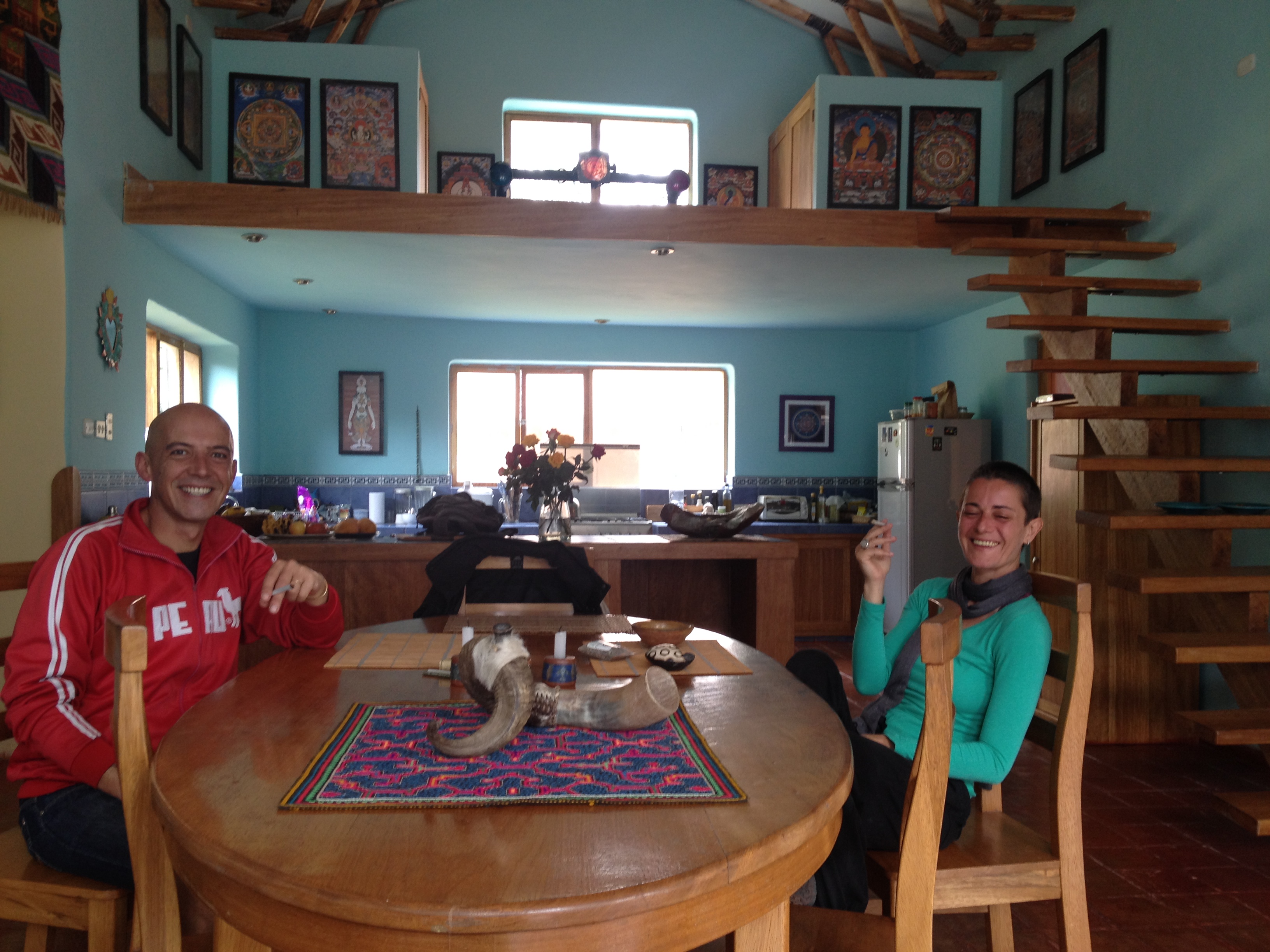
9-30 javier's house

On my way to Machu Picchu, I visited my friend Javier, a former New Yorker who now lives in Pisac, in the Sacred Valley between MP and Cuzco -- his friend Katya was currently sharing the house.

On my way to Machu Picchu, I visited my friend Javier, a former New Yorker who now lives in Pisac, in the Sacred Valley between MP and Cuzco — his friend Katya was currently sharing the house.

I was travelling with my friend Adam, who lives in Portland -- we shared the guest quarters

I was travelling with my friend Adam, who lives in Portland — we shared the guest quarters

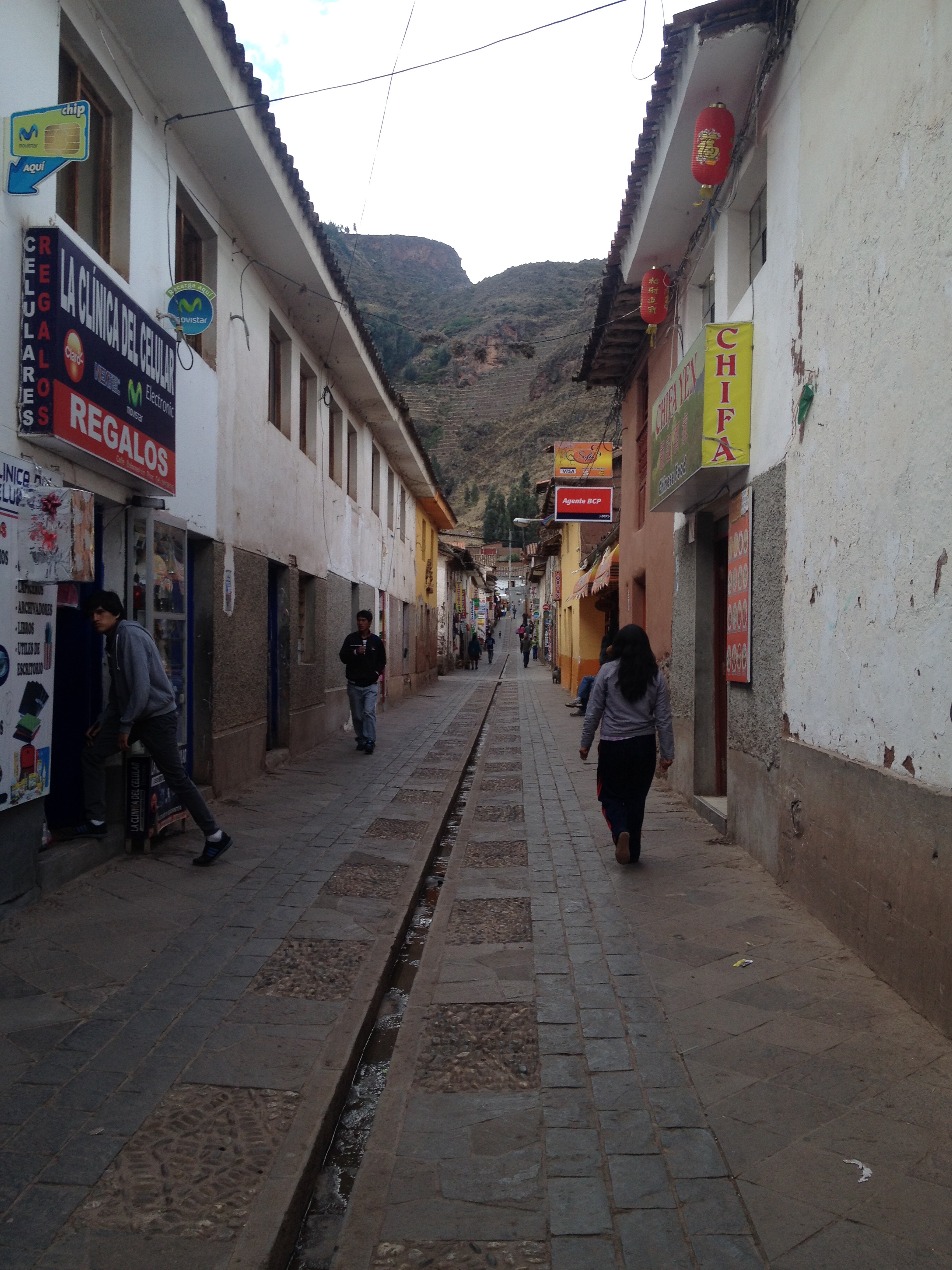
beautiful downtown Pisac

beautiful downtown Pisac

typical transportation in Peru -- custom-decorated three-wheel mototaxis

typical transportation in Peru — custom-decorated three-wheel mototaxis

9-30 ayahuasca restaurant

the outskirts of Pisac are pretty rustic -- wild pigs feast on scraps along the river, protected by their friendly guard dog

the outskirts of Pisac are pretty rustic — wild pigs feast on scraps along the river, protected by their friendly guard dog

10-3 roadside stand pisac10-3 all 4 of us


R.I.P. Ruth Maleczech

October 19, 2013

ruthmaleczech
While I was out of the country, the great American stage actress and Mabou Mines co-founder Ruth Maleczech died September 30 at the age of 74.  I had the pleasure of watching her work for more than 30 years and give memorable performances in productions staged by JoAnne Akalaitis (Kroetz’s Through the Leaves for Mabou Mines, Genet’s The Screens for the Guthrie Theater in Minneapolis), Peter Sellars (Velimir Khlebnikov’s Zangezi), and most especially her longtime partner Lee Breuer (Hajj, An Epidog).  She had an unforgettable, striking visage, with her flaming red hair and gap-toothed grin (Ben Brantley’s generous obituary in the New York Times mentioned one critic describing her as “a Technicolor Lucy on a binge”).

Beyond being phenomenally talented, she was kind, loving, and extremely honest. I got to interview her a number of times for articles about Mabou Mines in the Soho News, American Theatre magazine, and the New York Times. I remember being extremely touched hearing her talk about the sacrifices she’d made to be the uncompromising artist she was.

“The children have paid dearly,” she said, referring to the son (Lute Ramblin) and daughter (Clove Galilee) she had with Breuer. “They’ve paid with lack of time, lack of parent input when they need it, having to be sick at home alone sometimes when it would be nicer if somebody was there with you. They pay with not having things that their friends have, objects, you know, property. They pay by living in a very dangerous neighborhood because that’s the one that can be afforded. Sometimes I think the kids just look at you and think you’re a real asshole because you blew it. Especially in the ’80s. These are not the times to be a poor, struggling artist. It tends to be that when they need something really badly and there’s no money for them to have it, it just feels bad. Other times that doesn’t seem to be the most important thing. Sometimes they think it’s great because you do it.”


Quote of the day: LOVE

October 19, 2013

LOVE

Love takes off the masks that we fear we cannot live without and know we cannot live within. I used the word love here not merely in a personal sense but as a state of being, or a state of grace – not in the infantile American sense of being made happy but in the tough and universal sense of quest and daring and growth.

— James Baldwin

baldwin_0


Culture Vulture: THE MILK OF SORROW and MASSIVE ATTACK VS. ADAM CURTIS

September 29, 2013

FILM

9-28 milk of sorrow

I’m headed to Peru for a three-week trip to Lima, Machu Picchu, the Sacred Valley, and the Amazonian jungle. To prepare, I thought I’d see what Netflix might have to offer me. It coughed up The Milk of Sorrow, a beautiful film directed by Claudia Llosa (niece of the famed writer Mario Vargas Llosa). The main character (played by Magaly Solier, above) was “born during terrorism” and so inherited the fears and traumas her mother experienced at the hands of extremists. In other words, she imbibed “the milk of sorrow” (the English translation of La teta asustada, “The Frightened Breast”). The film tracks her from her mother’s death, the watchful nurturing of her uncle, who lives nearby and whose family business is planning weddings, and her employment by a rich neurotic concert pianist who lives in The Big House in a very poor neighborhood in Lima. It’s no Chamber of Commerce piece — it’s like getting to know Portland by watching a Gus Van Sant film — but it’s gorgeous, poetic, elliptical, beautifully shot. Llosa is one of a growing batch of phenomenal female filmmakers in Latin America, definitely someone to watch. Speaking of translation, I was amused that whenever quinoa was mentioned, the subtitles would call it “quinine.”

MUSIC/PERFORMANCE

9-28 in the future

In the New York Times magazine Robert del Naja, a member of Massive Attack, describes the band’s collaboration with video artist Adam Curtis as a “drive-in movie on acid that’s completely mental.” Not a bad description of this unusual performance event at the Park Avenue Armory. Massive Attack vs. Adam Curtis marks the first time Massive Attack has played in NYC for many years, and it’s fitting for such a smart, cool band that it’s not your typical concert. They’re on a stage behind three of eleven giant screens onto which Curtis does his thing, which is splicing together unused found footage discarded from news broadcasts. The narrative is all over the place, starting with audio from the first rock concert in Afghanistan, bouncing back and forth from the U.S. to Russia, developing a kind of multimedia essay about the difficulties of revolutionary action, how the desire to change the world has morphed into managing data, and the political forces that want the masses to fall in step so that things happening “According to The Plan.” Curtis’s heart is in the right place, but his absorption with the visuals wreaks chaos with any sort of narrative. He throws in every possible calamity that’s happened in the last 50 years, and some of his points seem obvious and others have a spark of brilliance. One sequence shows frightened people looking up at the sky and running while a series of buildings explode, crumble, and burn — all scenes from Hollywood action films released before 2001. It’s easy in hindsight to see how the architects of the 9/11 attacks got some ideas about the damage they could cause.

9-28 how shitty i feel

Meanwhile, Massive Attack provides an almost constant musical score. They cover a wacky assortment of American pop oldies (“Baby, It’s You,” “The Twist”) and a few ’80s chestnuts (“Bela Lugosi’s Dead,” “The Sultans of Swing,” Nirvana’s arrangement of Leadbelly’s “In the Pines”) with snatches of their own songs and a few by little-known Russian punk bands. An ethereal-voiced female shows up to sing several songs, including “The Look of Love” and a sweet sad ballad in Russian whose chorus went “You don’t know how fucking shitty I feel all day long.” In the audience we were all buzzing — could that be Elizabeth Fraser from Cocteau Twins? It wasn’t but it was fun to imagine her on the premises. The sound was incredible, the band was amazing to hear live, the visuals were dazzling but the message was murky. I am curious to know more about Adam Curtis’s work and see more after reading the article about him in last week’s New York magazine.

9-28 horse shadow


Media: “James Broughton Gave Me a Pearl Necklace” in RFD

September 29, 2013

The latest issue of RFD, the reader-written journal of the Radical Faerie community, is devoted to the late great poet and filmmaker James Broughton, the subject of recent documentary film by Stephen Silha and Eric Slade called BIG JOY. When I was younger and had a lot more hair, I had the pleasure of meeting Broughton in 1991 at the Gay Spirit Visions conference in North Carolina, and my brief remembrance of that occasion appears in RFD and below:

Joel Silver, James Broughton, and Don Shewey

Joel Singer, James Broughton, and Don Shewey

JAMES BROUGHTON GAVE ME A PEARL NECKLACE

I met James Broughton in September, 1991, when he graced the second annual Gay Spirit Visions conference in North Carolina as keynote speaker. Before that event, I knew he was a poet – his pithy, often humorous, often lightweight verses led some to consider him the contemporary gay incarnation of Rumi – and somehow I had absorbed the information that he had been married once upon a time to the legendary film critic Pauline Kael, of all people. But only in person did the full force of Broughton emerge.

He was elderly then, 77 and snowy-haired, a little frail but in pretty good health and attended by his loving companion Joel Singer. He was friendly and approachable, though of course he was also a showman. He knew how to attract and hold an audience, not so much by being loud and ostentatious but by radiating an amused intimacy and the elfin twinkle of someone who has marinated his epiphanies in joy rather than solemnity. He wore the mask of an airy-fairy gentle sprite, but when he opened his mouth to speak the hardcore metaphysical prankster revealed himself. Joseph Kramer, the visionary founder of the Body Electric School, also attended the conference as a guest speaker, and I vividly recall his rapturous attention as Broughton held forth on what he called “The Holy Trinity” – the phallus, the anus, and the perineum. Raven Wolfdancer, a beloved Atlanta faerie (later murdered on his doorstep by an unknown intruder, but that’s another story), introduced Broughton to the conference as “my bliss mentor, my ecstasy mentor. He taught me to parade my peculiar.”

For his keynote address, Broughton delivered a talk he had apparently given more than once, alternately titled “The Sexual Holiness of Men” and “The Sexuality of Spirit.” It was a kind of sermon, a dharma talk, a benediction dense with the distilled wisdom of a lifetime. You can find the verbatim text online, but in my diary I took notes, and looking at them now they contain one jewel after another. I realize that in the hour he was speaking I became a disciple, because the sentences that leapt out at me have stuck with me ever since.

Since this is a spiritual conference, I begin with a blessing: Hail Mary, quite contrary…

I’m a poet – do not expect reasoned argument.

I take my text from Novalis: “There is only one temple in the world, and that is the human body.” And the only proper activity in a temple is worship.

Churches exist to make you feel miserable.

Buddha is down on desire. Broughton is very up on desire.

Your brains have been washed with the detergent of guilt too long.

The penis is the exposed tip of the heart, the wand of the soul.

I was born to love my own kind, not compete with or acquire them.

Most communication is made of sneers and complaints. One of my mottoes is “Reach, touch, connect.”

At the baths, each cock was a bead in my rosary. Sexual loving is the true practice of religion. Put lovemaking before moneymaking and troublemaking. Teach it in schools. Holding hands, okay. Hug, yes, but with your whole body. I would add kissing. Practice this lifesaving on your neighbors. Love the living as much as the dying.

Stop thinking of yourselves as outcasts. You are meridians, raising consciousness, not babies. You can be and not beget. You may be outside of society’s mainstream but in the mainstream of wisdom.

I’d rather be kissed than stamped with approval.