This is my 1000th blog post on Another Eye Opens, and to celebrate the occasion I couldn’t imagine a better subject than ruminating about the Wooster Group, my favorite theatermakers in the world, whom I’ve written about for the Village Voice, the New York Times, 7 Days, the Los Angeles Times, and other publications.
I don’t envy daily newspaper reviewers faced with the task of writing a review of the Wooster Group’s Cry, Trojans! at short notice after one viewing. The production is so dense, crazy, complicated, and chaotic that even I had a hard time grasping what I was looking at, and I’ve been watching their work for more than 30 years. (I’ve gotten so accustomed to text-speak that I had to fight the urge to add “smiley-face” after that sentence.)
Cry, Trojans! is the Woosters’ adaptation of Troilus and Cressida, the epitome of what scholars talk about when they talk about Shakespeare’s “problem plays.” A literary mash-up of episodes from The Iliad with a more obscure legendary romance, T&C wanders between the two sides of the Trojan War, loosely tracking three violated love relationships – the Greek queen Helen, the lover of Paris stolen from her husband Menelaus; Cressida, the lover of Troilus traded away by her father Calchas in a prisoner exchange to Diomedes; and Patroclus, the lover of Achilles slain in battle by Hector. War is messy, love is messy, and boy, do Liz LeCompte and the Wooster Group love nothing more than a big mess.
In one of the nuttier schemes in recent theater production, the Royal Shakespeare Company was commissioned to mount a production of Troilus and Cressida for the World Shakespeare Festival, which was part of the London 2012 Olympic Arts Festival. The RSC’s Rupert Goold had the insane/inspired idea to invite the Wooster Group to collaborate with the RSC on a production in which the Woosters would play the Trojans, the Brits would play the Greeks, and they would rehearse separately until two weeks before opening. What could possibly go wrong?
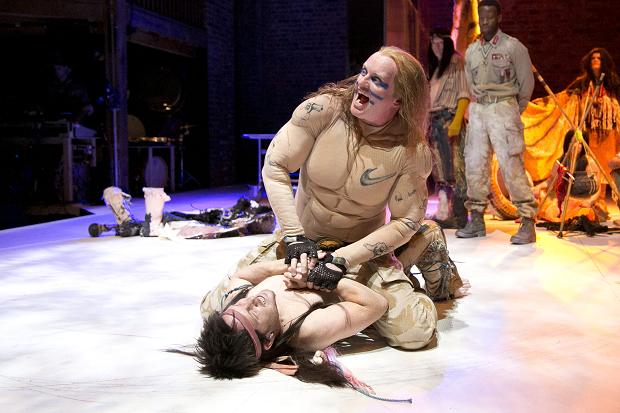
Early on, Goold bowed out as director of the Brits. His replacement, Mark Ravenhill, was better known as a playwright, actor, and Guardian columnist than as a director. One of England’s prominent contemporary gay playwrights and writer-in-residence at the RSC, Ravenhill will probably forever be best-known for having the balls to name a play Shopping and Fucking. (If only the script had more to remember it by than the title.) His conception for the Greeks in Troilus and Cressida was to accent the gayness; his Achilles and Patroclus lounged around in spa towels, and their slave Thersites was a drag queen in a wheelchair, while Ajax was played by an actor in a muscle-suit looking like a WWF head-banger.
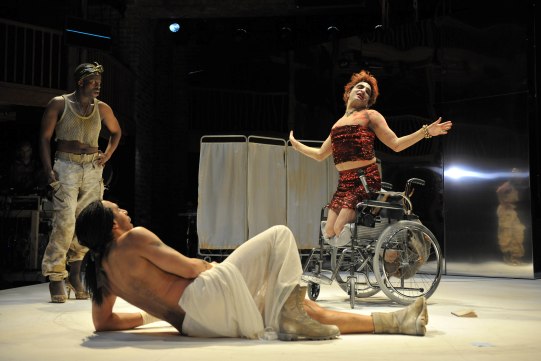
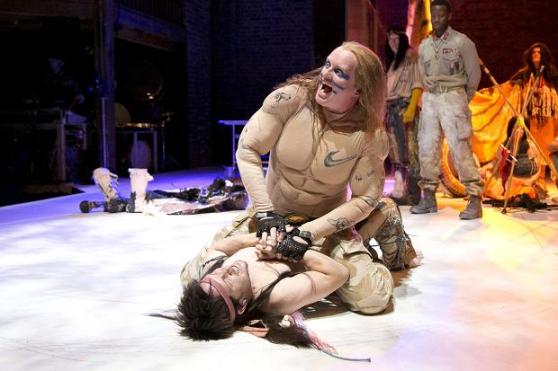
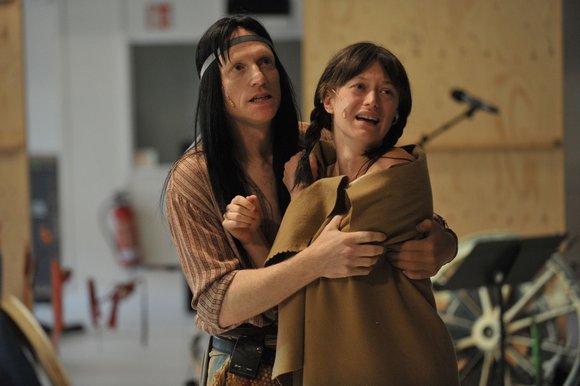
Meanwhile, LeCompte and the Americans went Native, dressing the Trojans in Hollywood- Injun attire, complete with teepees and jet-black wigs, with costumes and props provided by Dutch designer Folkert de Jong, whose specialty is postmodern tribalism that looks like handmade designer-grunge replicas of dumpster-diving treasures. (You can see a feature story on the costumes in the New York Times T Magazine online here.)


The title characters were played by Wooster superstar Scott Shepherd and guest artist Marin Ireland (above, ubiquitous Off-Broadway actress and, not incidentally, Shepherd’s girlfriend), and other group members and associates rounded out the cast (including Ari Fliakos, Greg Mehrten, and Gary Wilmes, phenomenally skilled and brave performers all). Of course, the Woosters also showed up with their full armamentarium of media technology: the radio mikes, the in-ear devices, the live mixing decks, and the multiple video monitors screening scenes from two feature films about Native Americans (Atanarjuat: The Fast Runner and Smoke Signals) and Splendor in the Grass (because…young love).
When the show opened at Stratford-on-Avon, the critical consensus was: WTF!?!?! A subsequent run in London fanned the flames of controversy, while cultivating a cadre of viewers willing to look at what was actually going on onstage.
That’s just the British chapter. A year and change later, the Woosters set to work adapting the show for presentation at their New York home base, the Performing Garage in Soho, sans the British cast. Kate Valk, the group’s other resident superstar, replaced Ireland, Suzzy Roche (who’s appeared in two previous WG productions) took over the role of Cassandra, and the guys in the group started playing the Greeks, in weird little black leather masks (below), as well as the Trojans. The production is in previews through February 15; after that it travels to Los Angeles for a week. Ultimately, the plan is to open the show officially sometime next season at one of the bigger venues the Wooster Group plays in NYC (St. Ann’s, Baryshnikov Arts Center, or the Public Theater).

I saw the show Saturday January 11 for the first time; when I went back two weeks later, Sunday January 26, I was surprised how substantially it had changed – I shouldn’t have been, because the group works meticulously over long periods of time. I somehow thought because they’d performed the show in London it was pretty much done, but really this is a complete reconception that LeCompte said, in an after-show talk, is still only two-thirds finished.
I won’t say a lot about the performance because it’s so clearly in flux. I will say that the notion of having the Wooster Group actors play the Trojan characters in Troilus and Cressida as Native Americans is a quintessential Liz LeCompte move. On the surface it seems corny, crude, outrageous, provocative, silly to the point of ridiculous – and then it reveals itself to be both conceptually sophisticated and rooted in a deep and astute textual analysis. After all, Shakespeare’s bizarre mishmash of a play was written for British actors to speak Elizabethan poetry while playing characters from The Iliad, an elaborate recollection of scenes from Greek history that may or may not have happened by a poet who may or may not have existed (some speculate that “Homer” refers to a consortium of ancient storytellers). The Woosters, who are obsessed with production concepts that have to do with re-enactments, landed on the idea of being as American as possible in their encounter with the Royal Shakespeare Company, and what’s more American than the indigenous people?

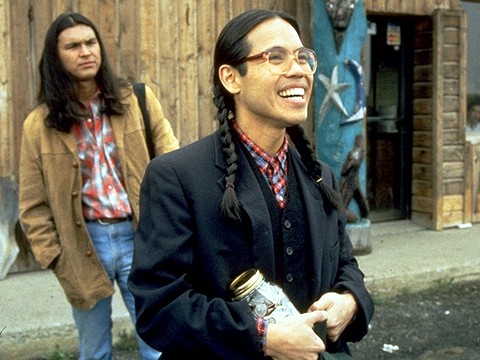
For years, part of the Wooster Group’s method has been for the actors to be watching scenes from movies on video monitors throughout the performance and meticulously imitating the gestures and movements they see, rather than blocking a play according to the script’s directions. Usually the audience isn’t privy to what the actors are watching, but in this production – since it’s performed on a thrust stage, with the audience on three sides – the screens are more prominent and visible to everyone. A big part of watching Cry, Trojans! is puzzling out the connection between what we’re seeing onstage and these film excerpts on the video monitors. It helps to recognize what the movies are. The Fast Runner (above) made a splash among cinephiles when it came out in 2001 as “the Inuit film,” the first movie made by an Inuit director and actors speaking their native tongue. It is itself an adaptation of an ancient epic, a corollary to The Iliad. And Smoke Signals was a 1998 indie film based on the beautiful quirky short fiction of Native American writer Sherman Alexie.

This is why I love the Wooster Group more than any other theater company in the world: their ability to mash up culture (the Bard meets Sherman Alexie meets cutting-edge Dutch designer meets Suzzy Roche) in a way that’s smart, funny, and deep and that forms a vibrant picture of the world I live in.










 another eye opens