Don’t you want to fall?
Don’t you want to fly?
Don’t you want to be dangled over the edge of this aching romance?
Last night I saw Matt Alber’s concert in Lincoln Center’s American Songbook series. The bearishly handsome, golden-voiced Texan doesn’t hide his love for men in the songs he sings about the quest for intimacy, to be seen and known. His best-known song, “End of the World,” uses the metaphor of an amusement-park ride to talk about the terrifying and exhilarating process of getting to know someone:
I don’t want to ride this roller coaster
I think I want to get off
But they buckled me down
Like it’s the end of the world
If you don’t want to have this conversation
Then you better get out
Cause we’re climbing to our death
At least that’s what they want you to think
Just in case we jump the track
I have a confession to make
It’s something like a cork screw
I don’t wanna fall, I don’t wanna fly
I don’t wanna be dangled over
The edge of a dying romance
But I don’t wanna stop
I don’t wanna lie
I don’t wanna believe it’s over
I just wanna stay with you tonight
The second half of the song kills me with the nuanced way it talks about the courage and vulnerability it takes to pursue love and connection when your heart’s been broken when other relationships haven’t worked out.
I didn’t mean to scream out quite so loudly
When we screeched to a halt
I’m just never prepared
For the end of the ride
Maybe we should get on something simpler
Like a giant balloon
But I’ve got two tickets left, and so do you
Instead of giving them away to some stranger
Let’s make them count, come on
Let’s get back in line again and ride the big one
Don’t you want to fall, don’t you want to fly
Don’t you want to be dangled over
The edge of this aching romance
If it’s gonna end, then I wanna know
That we squeezed out every moment
But if there’s nothing left can you tell me why
That it is you’re holding onto me
Like it’s the end of the world
This is exactly the territory we will be exploring in “THAT’S AMORE! Creative Rituals for Intimacy and Connection,” the workshop I’m conducting at Easton Mountain Retreat in upstate New York April 24-27. (By “we,” I mean me and the participants, not me and Matt. <grin>) It’s an opportunity to learn and practice using verbal communication, physical touch, and creative imagination to devise limited-time experiments in deepening the dance of intimacy and navigating the roller-coaster ride of romance. For more information about “THAT’S AMORE,” go here: http://bit.ly/AmoreEaston.
Meanwhile, if you haven’t already seen it, also check out the video for “End of the World,” which is one of the most beautiful, succinct, and swoonily romantic gay films ever made:
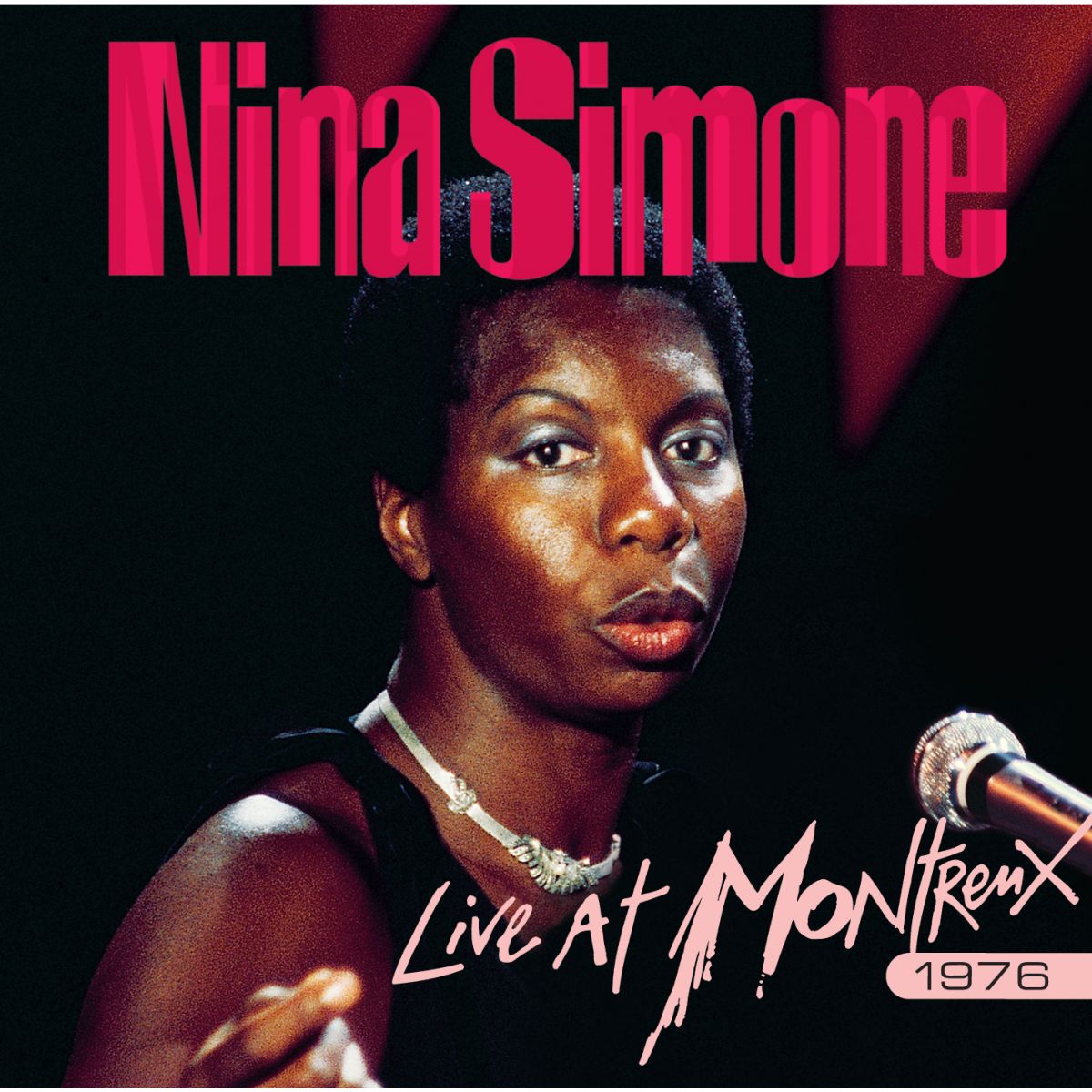
VIDEO:Nina Simone Live at Montreux 1976 – by chance someone posted on Facebook a link to a YouTube clip from this concert, her rendition of Janis Ian’s “Stars,” with a long spoken introduction. It was so riveting I had to buy the DVD. The concert is simply astonishing. (You can watch the whole thing online here.) Her musicianship is breathtaking, yet at the same time it is patently obvious that she is out of her fucking mind. Only after she died did the biographies reveal that she suffered from bipolar disorder. This concert could be used in medical schools to teach psychiatrists what that looks like. She free-associates, begins diatribes, catches herself, disappears very deeply into her stony face and fathomless eyes. Very disturbing and painful to watch, and yet you walk away dazzled that someone so deeply wounded and ill could even be up walking around, let alone play music like this. She only does six numbers in the hour-long concert, none of them bearing any resemblance to anything she put out on records. There’s a twenty-minute version of “Little Girl Blue” and a vamp she picks up from her drummer and turns into its own song that she gets up and dances to. The bonus material includes six songs she performed at the jazz festival other years.
FILM:The Grand Budapest Hotel – Wes Anderson’s movies are the epitome of twee, but you will not hear any complaint from me about that. I have enjoyed most of his curious, fast, absurdist, huge-cast epic capers (especially The Life Aquatic with Steve Zissou, Moonrise Kingdom, and The Fantastic Mr. Fox), and this one is no exception. One yummy brief performance after another (Harvey Keitel! Tilda Swinton! Edward Norton! Willem Dafoe! Bill Murray! Adrian Brody! Larry Pine! Casting by Doug Aibel, of course) but deeply appealing leading performances by Ralph Fiennes and his adorable Lobby Boy, Tony Revolori. It’s wildly whimsical yet inspired by the real-life absurdist tragedy of war-torn 20th century Europe, especially the work of Stefan Zweig.
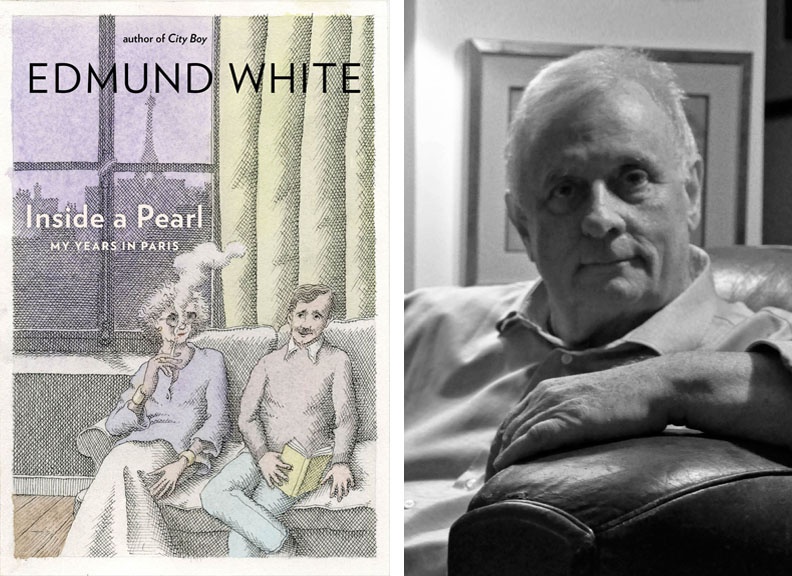
BOOKS: Edmund White’s Inside a Pearl: My Years in Paris – White’s latest memoir is a daredevil act of personal narrative, loosely organized as a portrait of his friendship with Marie-Claude (MC) de Brunhoff, a critic and translator, but branching out to reminisce and gossip about every fascinating character he encountered in the 15 years he lived in the French capital. It is gossipy, loving, self-revealing, shrewd, and beautifully written. A few choice tidbits:
one of his boyfriends, John Purcell, carried White’s novel A Boy’s Own Story around for a month but never got beyond page 10. “He said he was dyslexic, the vogue word of that decade for lack of literary curiosity, just as attention deficit disorder is the term now.”
“I guess I define intelligence as the power to make new, surprising, wide-ranging associations and never to rely on automatic, untested generalities.”
On the ultimate wisdom and generosity of polyamory: “Who were the members of Bernard [Minaret]’s salon? One was Jacques Fieschi, a successful writer of film scenarios who was also an amateur boxer (he had the smashed-in nose to prove it). Jacques had been Bernard’s lover for many years, then fell for Claude Arnaud. Rather than losing Jacques in a fit of jealousy, Bernard decided to ‘take the couple’ and so he moved Claude in. In that way he was like Cocteau, who, learning that his longtime lover – the much younger movie star Jean Marais – had fallen for a lifeguard, Paul Morihen, set his rival up in business as the proprietor of a bookstore downstairs from his apartment in the Palais-Royal, thereby extending his family by one member rather than diminishing it to zero.”
“In those days, sex dates in the gay world were made on telephone party lines. We taught [a female friend] to call out, ‘Bouffeur de cul cherche cul’ (‘Ass eater is looking for an ass’) over a gay party line and she said it in the voice of a raw teenage boy from the suburbs.”
“Outside I was as gushy as my Texas mother and inside cold and calculating.”
“I had been influenced by Nabokov’s observation that if he wanted to see whether a novel was a crappy best-seller, he’d just flip through it and if he saw too much dialogue, he knew it wasn’t for him. He reasoned that since dialogue always sounds alike, the writer couldn’t establish his own special tone if he handed the book over to his characters and their banal yammering.”
On the short-lived pre-internet/smartphone technology Minitel: “The cruising facility was the ligne rose (pink line), where users typed out their preferences for all to see. It took some doing to learn the abbreviations. JhCh TBM pour plan hard, pour SSR, look Santiag meant ‘Young man (Jeune homme) looks for (cherche) a very handsome guy (trés beau mec) – or, alternately, very well-hung (trés bien monté) – who wants rough sex (plan hard) and safe sex (sexe sans risqué) who wears Western-style cowboy (“Santiago”) boots.’”
“I now had a fatal Old World sense of conversation – that it should be exciting and frivolous and provocative and preferably scandalous. I’d mentally prepare two or three hot topics before every evening. But my style was withering to Americans, who like to graze peacefully in conversation, and my ‘sparkling’ style inhibited general conversation – which would revive, I would notice, whenever I went into the kitchen for the next course.”
“Until I became old and fat I was still going to saunas, but soon I discovered the whole paradise of cruising gerontophile chubby chasers on the Web.”
On life’s purpose: “I was alive in order to – well, to teach, to trick, to write, to memorialize, to be a faithful scribe, to record the loss of my dead.”
Thomas Maier’s Masters of Sex – on vacation in Florida, I read this biography of William Masters and Virginia Johnson, the pioneering sex therapists. I haven’t watched any of the TV series based on this biography; I read the book as a colleague for inspiration. A noteworthy passage, describing a moment that took place in 1954 at Washington University in St. Louis: “Masters visited the medical school library, looking for any book, medical article, or dissertation [related to the medical study of human sexuality]. ‘I realized that there was really nothing that had been written or researched that was going to be of any help in working out the physiology of human sexual response,’ he later observed.
“At Washington University, Masters found just one title about sexual functioning to shed some light. The textbook had been written by a former University of Illinois department chairman of obstetrics and gynecology who, as Masters learned, waited until retirement to publish it. Washington University kept this book on the reserve shelf. When Masters asked to see it, the librarian refused.
“ ‘I’m sorry, Dr. Masters, I cannot do that,’ she told him.
“Puzzled, Masters thought she had misunderstood him. ‘I do not want to take it out,’ he explained. ‘I just want to look at it.’
“The librarian wouldn’t budge. The textbook contained sketches – thin line drawings – of male and female genitalia, which the library superiors worried might be pornographic. As an associate professor, Masters wasn’t eligible to see it. Only full professors, heads of departments, and librarians could remove this book from the reserve shelf, he was told. …This small incident, Masters later reflected, ‘represented all too well medicine’s fearful approach to the subject of sex.’”
Some of Masters’ first important consultants on sexual functioning were sex workers. “During his first twenty months of research, he interviewed 118 female and 27 male prostitutes, from St. Louis and other cities. “Their streetwise frankness was far different than the stiff anxiety of his upper-middle-class patients who visited his office for a pelvic exam. These prostitutes, conscripted with the vice squad’s help, knew exactly what aroused a flaccid penis and stimulated a dry vagina, and how the two might come together with maximum efficiency. ‘They described many methods for elevating and controlling sexual tensions and demonstrated innumerable variations in stimulative technique.’”
When Masters and Johnson started viewing people having sex in their laboratory, their subjects wore paper bags and pillowcases over their heads for anonymity. When Masters’ mother heard about this, she volunteered to design and create silk masks for the volunteers to wear for their couplings.
They were interviewed by Playboy magazine, who asked “Traditionalists complain that investigations such as yours destroy the mystery of sex. Do you think that’s true?” Johnson replied, “We happen to think that the realistic, honest aspects of sexuality are a lot more exciting than the so-called mystery. The mystery to which the traditionalists usually refer has to do with superstition and myth. A knowledge of sex doesn’t impair but enhances it.”
Masters: “The greatest form of sex education is Pop walking past Mom in the kitchen and patting her on the fanny, and Mom obviously liking it. The kids take a look at this action and think, ‘Boy, that’s for me.’” A good description of my household growing up!
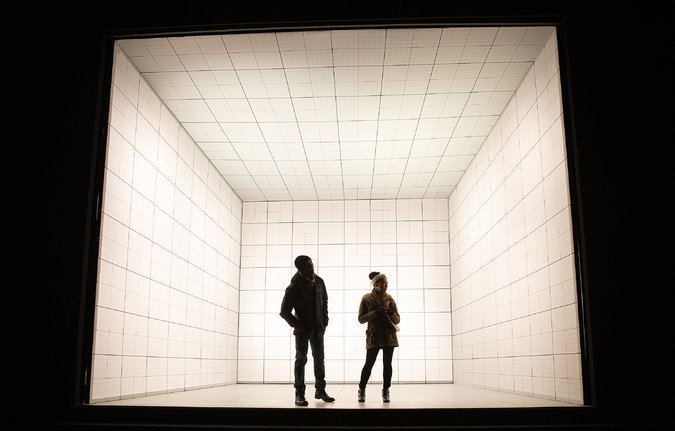
THEATER:Caryl Churchill’s Love and Information – I’m a longtime fan of Caryl Churchill’s brainy, super-theatrical plays. The latest, produced by New York Theater Workshop at the Minetta Lane, consists of 57 tiny vignettes, some of them one-line blackout sketches, that take place in a brightly lit white cubicle with different suggestive set pieces for each one. It’s an exercise in composing elliptical scenes on a general theme. Not my favorite of Churchill’s work but I am amazed and impressed that she scrupulously refused to repeat herself – each one of her 45 plays takes a different form, plays with a different genre, exercises a different muscle in her Olympian writer’s body. What I would really love is to have infra-red glasses and watch how the stagehands scramble around between scenes changing the furniture…
Rocky The Musical – the consensus is pretty much: lousy score, exciting and ingenious staging of the climactic fight, appealing performance by Andy Karl in the title role. I go along with all of that. I also had a special affection for my friend David Zinn’s witty costumes – someone had to figure out to dress those muscle hunks in period workout attire! I donated an old ripped up motorcycle jacket to the wardrobe – DZ painted the collar red and put it on the guy who delivers the big box TV set in Act 2.
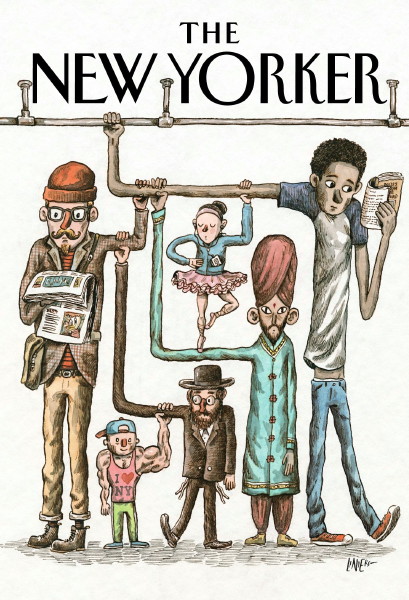
Some highlights in addition to Liniers’ delightful cover, titled “Straphangers”):
* Tad Friend’s profile of filmmaker Darren Aronovsky at work on the renegade Biblical epic Noah (I especially enjoyed the description of working with Nick Nolte doing the voice of a character mostly created by CGI);
* “The Reckoning,” Andrew Solomon’s very empathetic profile of Peter Lanza, the father of Adam Lanza, who killed 26 schoolchildren, his mother, and himself in Newtown, CT; and
* “Are You Listening?” by the wonderful novelist and memoirist Andre Aciman, remembering what it was like to grow up with a mother was was deaf.
My friend Adam was visiting from Portland and wanted to check out the Whitney Biennial, so we converged there with Vincent — the three of us hadn’t seen each other since we were in Peru together last fall. Each of the three floors of the exhibition was organized by a different curator, each of whom enlisted various artists to sub-curate sections, which was a clever form of collaboration and good way of balancing aesthetic, thematic, and academic perspectives.
The first piece that caught my eye was a collection of backlit photos by Gary Indiana. I was surprised and amused that both Adam and Vincent thought this was the same artist famous for the LOVE design seen everywhere (including the much-photographed public sculpture around the corner from my house, at 55th Street and Sixth Avenue — that would be Robert Indiana) rather than the prolific, dyspeptic novelist, commentator, and former Village Voice art critic.
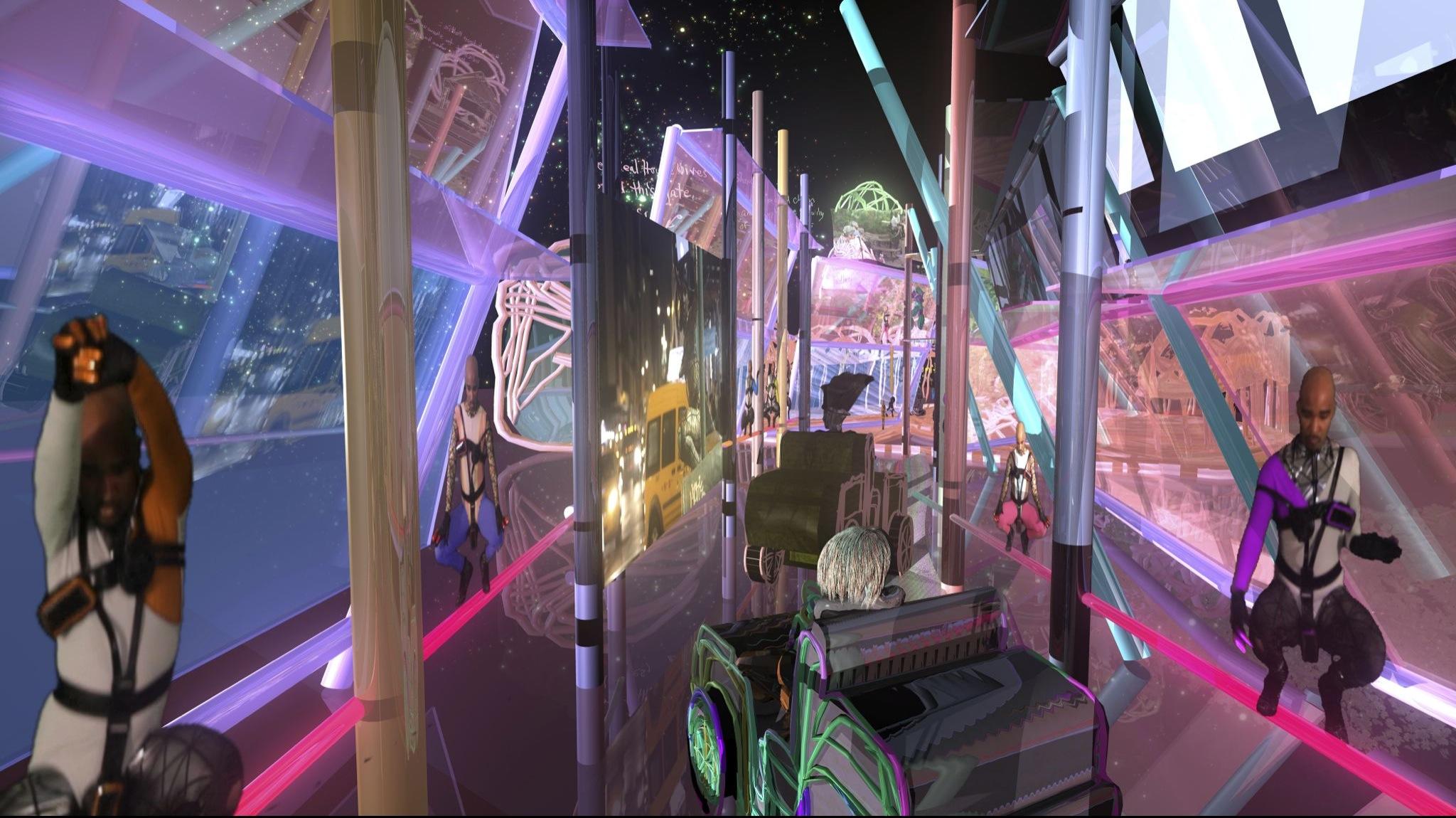
I’m not any kind of savvy connoisseur of contemporary painting, so the preponderance of work on the 4th floor (many by female artists, many in vaguely Abstract Expressionist mode) made little impression on me. The work on the 3rd floor, chosen by Stuart Comer (primary curator of media and performance at MOMA), was much more to my taste. My very favorite piece in the Biennial was Jacolby Satterwhite‘s dazzling HD video/animation Reifying Desire 6:
That piece hovers right outside a room constructed by Bjarne Melgaard that another friend described “Peewee Hermanesque,” an adult funhouse full of oversized stuffed animals with phallic snouts, sofas to lounge on, and mannequins representing transgender models in transition. (Transformation is an ongoing underlying theme of this Biennial, the last to take place at the Whitney’s famous Breuer building on Madison Avenue before the museum relocates to a new building in the meatpacking district.) A beautiful, arty, explicit film of two guys having sex plays on a flat-screen monitor while news footage of public brawls flash on the walls of the room.
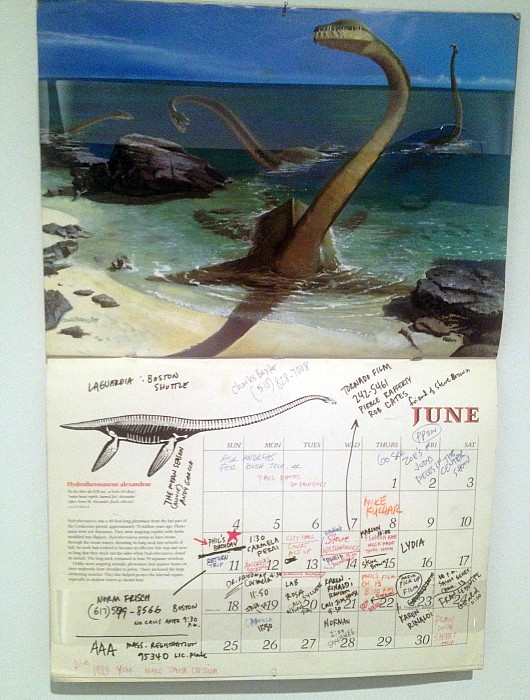
Another theme that Peter Schjeldahl dwells on in his review in this week’s New Yorker has to do with commemorating dead artists, both those who significantly influenced their peers and those who died in semi-obscurity, many though not all of them from the generation of artists lost to AIDS. Some of what’s displayed isn’t artwork as much as artifacts of interest, like this mysteriously poignant wall calendar that David Wojnarowicz used to record appointments:
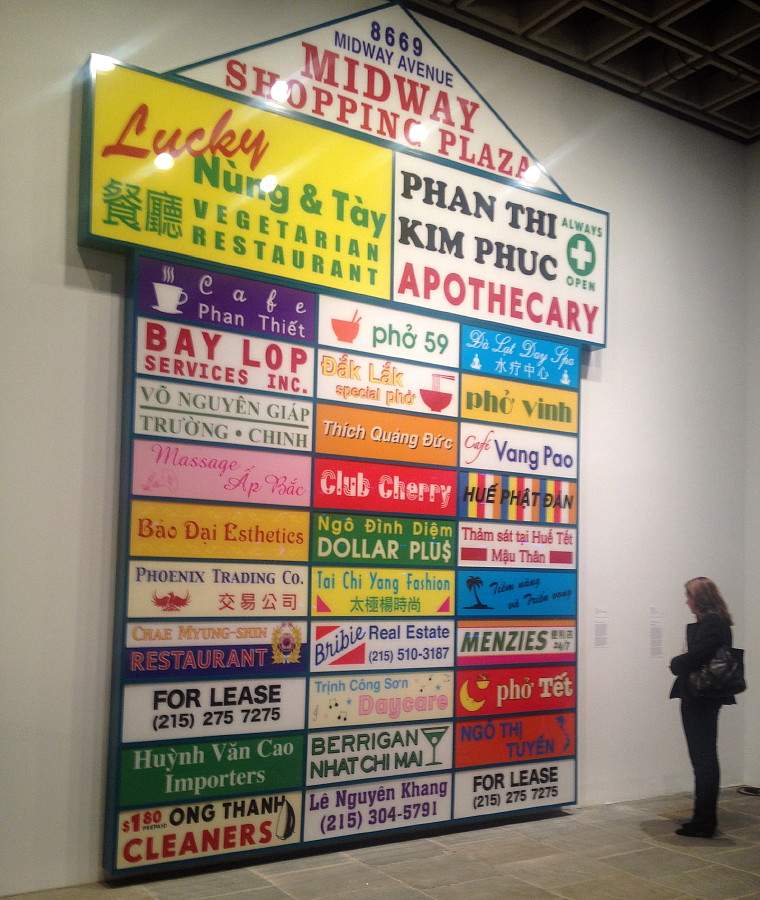
Another piece I liked very much was Ken Lum‘s piece slyly replicating the signage at a mundane urban shopping center with references to the Vietnam War:








 another eye opens