Archive for the 'quote of the day' Category

Quote of the day: HANGOVER

January 2, 2015

HANGOVER

If you were suffering from a hangover on New Year’s Day, you weren’t alone. The chief culprit is dehydration caused by the diuretic effect of ethanol, which can lead to shrinkage of brain tissue, and that causes headache. Alcohol irritates the lining of the stomach, causing queasiness. Other symptoms are caused by the toxic by-products of the liver’s detoxification process. For something so common, hangover is poorly understood by the medical community, and quack remedies abound.

Hangover remedies probably evolved hand in hand with alcohol consumption. Pliny the Elder counseled Romans to eat fried canaries or raw owl’s eggs. Ancient Assyrians tried to assuage their anguish by consuming a concoction of ground bird beaks and myrrh. Medieval Europeans consumed raw eels with bitter almonds. The Chinese drank green tea, which seems benign enough, but their neighbors the Mongolians ate pickled sheep’s eyes. The Japanese ate pickled plums. Then there’s the Prairie Oyster, introduced at the 1878 Paris World Expo: it’s a raw egg (with the yolk intact), mixed with Tabasco sauce, Worcestershire sauce, salt, and pepper. Puerto Ricans took a preventative tack: they rubbed sliced lemons in their armpits before drinking; In India, they drank coconut water, and there’s some merit to that, because coconut water is rich in electrolytes and it helps with the dehydration.

Then there’s the “hair of the dog” approach. In the 19th century, an Italian named Bernardino Branca developed a potion called Fernet: rhubarb, aloe, peppermint oil, and opiates. As a bonus, Fernet also cured cholera, or so Branca claimed. It’s still available today, minus the opiates. Some people swear by the Bloody Mary: tomato juice mixed with vodka and a variety of spices; Hemingway’s variant was tomato juice and beer.

A literature review in the British Medical Journal concludes that there is no reliable way to treat or prevent hangover after over-imbibing. The Algonquin Round Table writer Robert Benchley came to a similar conclusion: “A real hangover is nothing to try out family remedies on. The only cure for a real hangover is death.”

–The Writer’s Almanac

fernet-picasso

Quote of the day: COMPARISON

December 27, 2014

COMPARISON

Comparison is the thief of joy.

— Teddy Roosevelt

teddy roosevelt

Quote of the day: WORK

December 10, 2014

WORK

Anyone can do any amount of work, provided it isn’t the work he is supposed to be doing at the moment.

–Robert Benchley
Robert-Benchley

Quote of the day: OPTIMISM

November 27, 2014

OPTIMISM

Consider the remarkable transformation, in just a few decades, in people’s consciousness of racism, in the bold presence of women demanding their rightful place, in a growing public awareness that gays are not curiosities but sensate human beings, in the long-term growing skepticism about military intervention despite brief surges of military madness.

It is that long-term change that I think we must see if we are not to lose hope. Pessimism becomes a self-fulfilling prophecy; it reproduces itself by crippling our willingness to act. Revolutionary change does not come as one cataclysmic moment (beware of such moments!) but as an endless succession of surprises, moving zigzag toward a more decent society.

We don’t have to engage in grand, heroic actions to participate in the process of change. Small acts, when multiplied by millions of people, can transform the world. Even when we don’t ‘win,’ there is fun and fulfillment in the fact that we have been involved, with other good people, in something worthwhile.

We need hope. An optimist isn’t necessarily a blithe, slightly sappy whistler in the dark of our time. To be hopeful in bad times is not just foolishly romantic. It is based on the fact that human history is a history not only of cruelty, but also of compassion, sacrifice, courage, kindness.

What we choose to emphasize in this complex history will determine our lives. If we see only the worst, it destroys our capacity to do something. If we remember those times and places — and there are so many — where people have behaved magnificently, this gives us the energy to act, and at least the possibility of sending this spinning top of a world in a different direction. And if we do act, in however small a way, we don’t have to wait for some grand utopian future.

The future is an infinite succession of presents, and to live now as we think human beings should live, in defiance of all that is bad around us, is itself a marvelous victory.

–Howard Zinn, A People’s History of the United States

Howard_Zinn_A_Peoples_History_Of_The_United_States_sm

Quote of the day: POO

November 26, 2014

POO

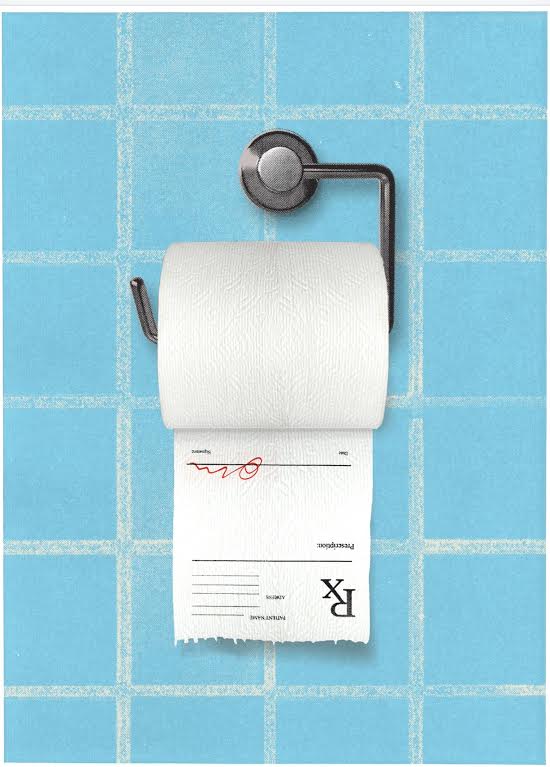
No one knows how many people have undergone fecal transplants—the official term is fecal microbiota transplantation, or FMT—but the number is thought to be at least ten thousand and climbing rapidly. New research suggests that the microbes in our guts—and, consequently, in our stool—may play a role in conditions ranging from autoimmune disorders to allergies and obesity, and reports of recoveries by patients who, with or without the help of doctors, have received these bacteria-rich infusions have spurred demand for the procedure. A year and a half ago, a few dozen physicians in the United States offered FMT. Today, hundreds do, and OpenBiome, a nonprofit stool bank founded last year by graduate students at M.I.T., ships more than fifty specimens each week to hospitals in thirty-six states. The Cleveland Clinic named fecal transplantation one of the top ten medical innovations for 2014, and biotech companies are competing to put stool-based therapies through clinical trials and onto the market. In medicine, at any rate, human excrement has become a precious commodity.

Science writers love to cite the freakish fact that for every one of our cells we are hosts to ten microbial ones, and nowhere are there as many as in our digestive tracts, which house about a hundred trillion bacteria, fungi, viruses, and other tiny creatures. (As one gastroenterologist put it to me, with only mild exaggeration, “We’re ten per cent human and ninety per cent poo.”)

–Emily Eakin, “The Excrement Experiment,” The New Yorker

excrement experiment