An optimist isn’t necessarily a blithe, slightly sappy whistler in the dark of our time. To be hopeful in bad times is not just foolishly romantic. It is based on the fact that human history is a history not only of cruelty but also of compassion, sacrifice, courage, kindness. What we choose to emphasize in this complex history will determine our lives. If we see only the worst, it destroys our capacity to do something. If we remember those times and places—and there are so many—where people have behaved magnificently, this gives us the energy to act, and at least the possibility of sending this spinning top of a world in a different direction. And if we do act, in however small a way, we don’t have to wait for some grand utopian future. The future is an infinite succession of presents, and to live now as we think human beings should live, in defiance of all that is bad around us, is itself a marvelous victory.
Why has the big lie stuck? Maybe it’s because Donald Trump made it appear more plausible by attaching it to a truth. And that truth, for the blue-collar white men among his base, is a powerful sense of loss, suggested by the last word in the slogan Make America Great Again. Red and blue states increasingly represent two economies, with Republicans turning more toward agriculture, extraction and manufacturing, and Democrats toward high-tech and professional services. The gap between them is widening: Between 2008 and 2018, the nation’s Democratic congressional districts saw median household income rise to $61,000 from $54,000, while incomes in Republican districts fell to $53,000 from $55,000. They have suffered other losses too; white men living in Republican counties have higher death rates than white men living in Democratic counties, and the gap between those rates increased more than sixfold from 2001 to 2019. Poor rural white Americans also report less optimism about the future than do equally poor Black or Hispanic ones.
From “loss”Trump has moved the emotional needle to “stolen.” The right to work and remain maskless during a pandemic, stolen. Story of heroic America, stolen. Statues, stolen. Culture, stolen. White power, stolen. Old-time manhood, stolen. Election, stolen. With “stolen,”as opposed to the more circumstantial “loss,”it’s much easier to assign blame. For the stolen election: the deep state, RINOs, Democrats. For stolen white livelihoods: China, immigrants, minorities. And one thing more, many MAGA enthusiasts say to themselves: Donald Trump will save us. The Democrats are preventing Trump from saving us. He is being stolen from us. And Trump has moved the needle from “stolen” to “steal me back”….
Whether a grievance, or a promise, is based on fact can come to feel beside the point. A former coal miner in an Appalachian county where 80 percent voted for Trump in 2020 told me he had recently gotten back on his feet after losing his job and falling into drugs. “When Donald Trump came to town in 2016, he told us he was going to bring back coal,” he said. “I knew Trump was telling me a lie. But I felt like he saw who I was.” The storm is here, Mogelson’s important book warns us, in the threat of public violence and at the ballot box. It’s here because a loss has for too long gone unrecognized, and because a lie that ties itself to this loss can feel more compelling to some than a truth that ignores it.
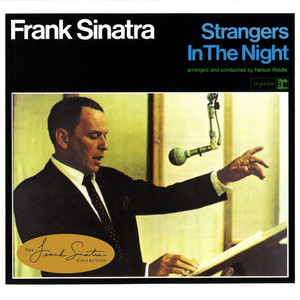
By the time Frank Sinatra stepped into the studio to record “Strangers in the Night” on April 11, 1966, he had already been singing professionally for thirty-one years and recording since 1939. He had seen trends come and go in popular music and had, in fact, set trends himself and spawned scores of imitators for decades.
Still, it was amazing that the soundtrack of the summer of 1966, according to the July 2 edition of the Billboard Hot 100, was topped by that little pop song. Amazingly, in the middle of the British Invasion, “Strangers in the Night” by Hoboken’s own beat out the Beatles’ “Paperback Writer” and the Rolling Stones’ “Paint It Black.” Today, the charts are so stratified and niche marketed, you would never see something like this happen. Nowadays, everyone stays in their own lane, guaranteeing themselves top honors in their own category even if that category is something like Top Klezmer Vocal Performance on a Heavy Metal Soundtrack Including Americana Samples.
But Frank had to slug it out with everybody, even though “Strangers” was a song he hated, one that he regularly dismissed as “a piece of shit”…[He] may have hated the song, but the fact of the matter is, he chose it. And therein lies a tale. By the time we had heard “Strangers in the Night,” it had gone through at least two sets of lyrics and a few people had already laid claim to its authorship. It’s a confusing tale that spans a couple of continents…
And as far as I know, no one has ever contested the writing of Frank’s hit from the following year, “Somethin’ Stupid,” though it is worth mentioning that it was written by Van Dyke Parks’s older brother Carson.
Jeremy O. Harris: One of the things I worry about is that the little gay boys and girls I’m friends with don’t meet people their age IRL. They only know people through their oomfs, right? The oomfs run the world.
Danez Smith.: What’s “oomf”?
J.O.H.: An oomf is an “O.O.M.F.” — “one of my friends,” as in someone you know only in a digital space, from Twitter or Tumblr.
D.S.: Oh, yeah, one of my followers.
J.O.H.: The idea that people are discovering their sexuality and their expressivity online is a beautiful thing. I have a 12-year-old niece who’s a she/they pansexual, and she learned about all of those things on TikTok. But there’s also a troubling thing where people become only what you see in 160 characters.
Adam Pendleton: But, Jeremy, it’s even more than that because those spaces are mediated spaces.
J.O.H.: Yes.
A.P.: So if you find your way into something, you might never find your way out. It becomes a prison.
D.S.: Look, if I can make it out the church, they can make it out of Twitter. [All laugh]
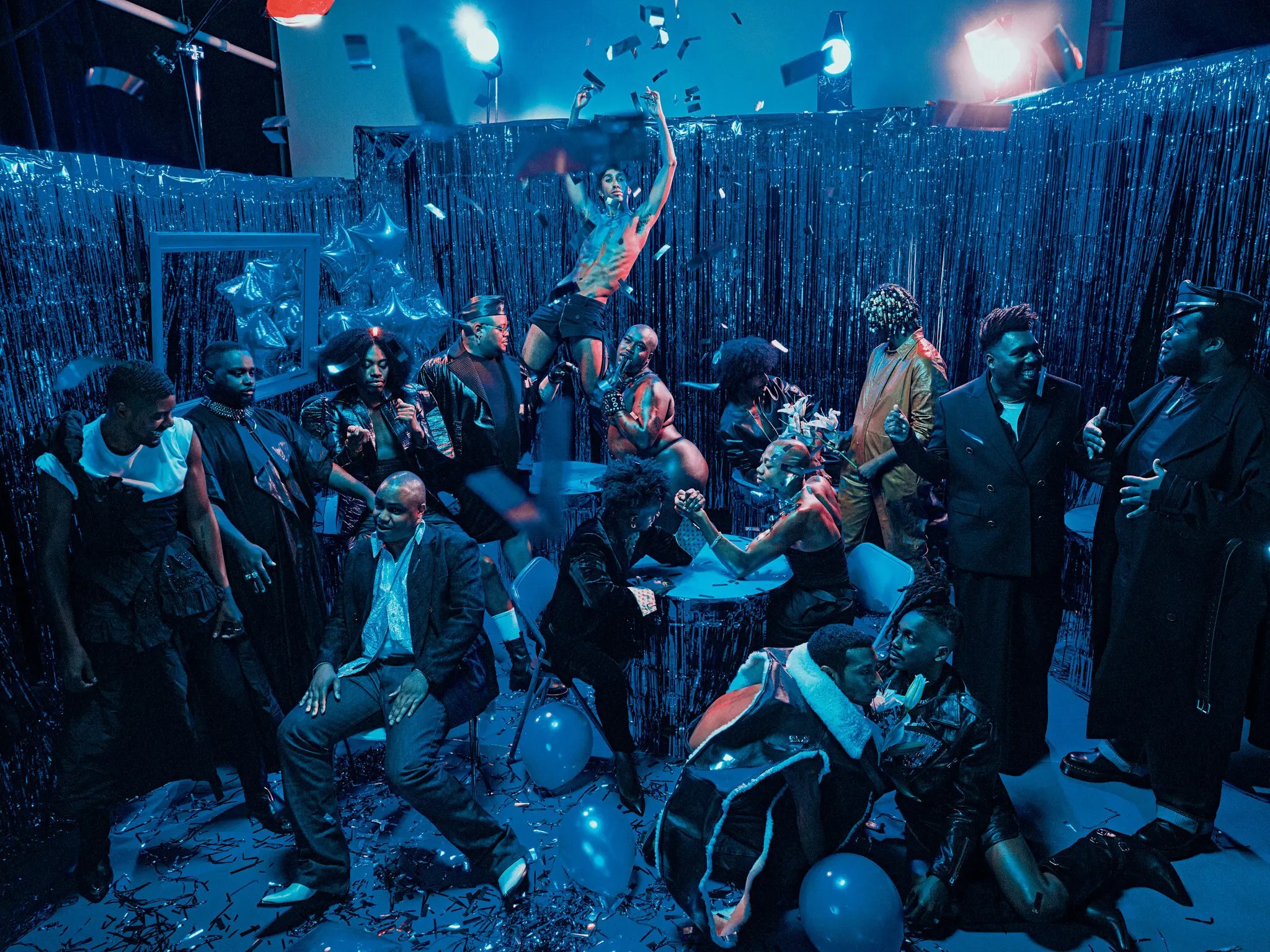
photo by Shikeith; clockwise from left: Don Christian Jones, Abdu Ali, Jeremy O. Harris, Jonathan Lydon Chase, Miles Greenberg, Brontez Purnell, Devan Simoyama, Hugh hayden, Saeed Jones, Jaquel Spivey, Jonathan Gardenhire, Clifford Prince King, Eric N. Mack, Edvin Thompson, D’Angelo Lovell Williams


 another eye opens