Archive for the 'Photo diary' Category

Culture Vulture/Photo Diary: CEILI, BUENA VISTA SOCIAL CLUB, RESERVATION DOGS, THE BOY AND THE HERON, and more

December 19, 2023

Culture Vulture had a rich international weekend of activity.

Friday night I returned to the Irish Arts Center, where I saw a wonderful evening of Irish poetry just two weeks ago. The occasion for this visit was to see Céilí, a fascinating collaboration between Darrah Carr Dance, a company of fresh-faced youngsters devoted to invigorating Irish dance traditions, and Seán Curran Company, a funkier crew whose leader came up through the Bill T. Zones/Arnie Zane Company’s brand of innovative modern dance. The title of the show refers to a house party, and the evening did have a light-hearted, celebratory feel as various combinations of dancers took turns doing their party pieces. They mostly danced to sublime live accompaniment by fiddle-guitar duo Dana Lyn and Kyle Sanna, except for one virtuosic handclap-and-foot-stomp duet (“Box Tops”) by Trent Kowalik and Lauren Kravitz – all the more impressive because at this performance Kowalik went on as understudy for Benjamin Freedman; Evan Copeland covered Freedman’s other duties that night. Throughout the evening I couldn’t take my eyes off Kowalik and Copeland. Kowalik, one of the three kids who won the Tony Award sharing the title role in Billy Elliot: The Musical on Broadway, is tall and light-footed and seemingly effortlessly maintains the signature verticality of Irish dancing. Handsome bearded Copeland, a longtime Curran associate, stood out for the precision of the lyrical shapes his dancing created. It was a dense, continuous hour-long expression of joy.

A community jam session was taking place in the lobby as we left to go around the corner to Ardesia Wine Bar for a delicious dinner of small plates – portobello fries, tacos, charcuterie – and a bottle of Spanish mencia.

Saturday afternoon – More joy burst from the stage of the Atlantic Theater Company’s Linda Gross Theater from the first notes of Buena Vista Social Club, the thrilling new musical built around the legendary Cuban musicians who appeared on the 1996 album (put together by record executive Nick Gold, guitarist Ry Cooder, and musical director Juan de Marcos González) and in Wim Wenders’ 1998 documentary. For the stage production, developed and directed by Saheem Ali, playwright Marco Ramirez crafted a narrative to weave together the histories of five key musicians and their lives in Havana in 1956 (pre-Castro) and 1996. He may have borrowed a page from Ma Rainey’s Black Bottom to portray Omara Portuondo as a demanding diva around whose whims the recording sessions take place. But Ali has assembled an incredibly talented cast – Natalie Venetta Belcon as Omara, Kenya Browne as her younger self, Renesito Avich as Eliades Ochoa, Julio Monge as Compay Segundo, Mel Seme as Ibrahim Ferrer, Jainardo Batista Sterling as Rubén Gonzalez, and Jared Machado, Olly Sholotan, and Leonardo Reyna as the younger Compay, Ibrahim, and Rubén – and he and music director Marco Pagula put together a spectacular band.

As if the music blasting from the stage wasn’t deliriously exciting enough, Patricia Delgado and Justin Peck fill the stage with energetic sexy choreography for six terrific dancers. Anulfo Maldonado’s nimble sets, Dede Ayite’s dazzling period costumes, and Tyler Micoleau’s bold lighting all contribute to the visual excitement. For anyone familiar with the album and the film, layers of feeling can’t help piling on top of each other watching these extraordinary singers and musicians exude love and devotion for Cuban music. I can’t imagine this show won’t move to Broadway, where I hope to revisit it, but I don’t think I’ll ever forget the joy of sitting in the third row of an intimate Off-Broadway theater receiving the blessing of this gorgeous show.
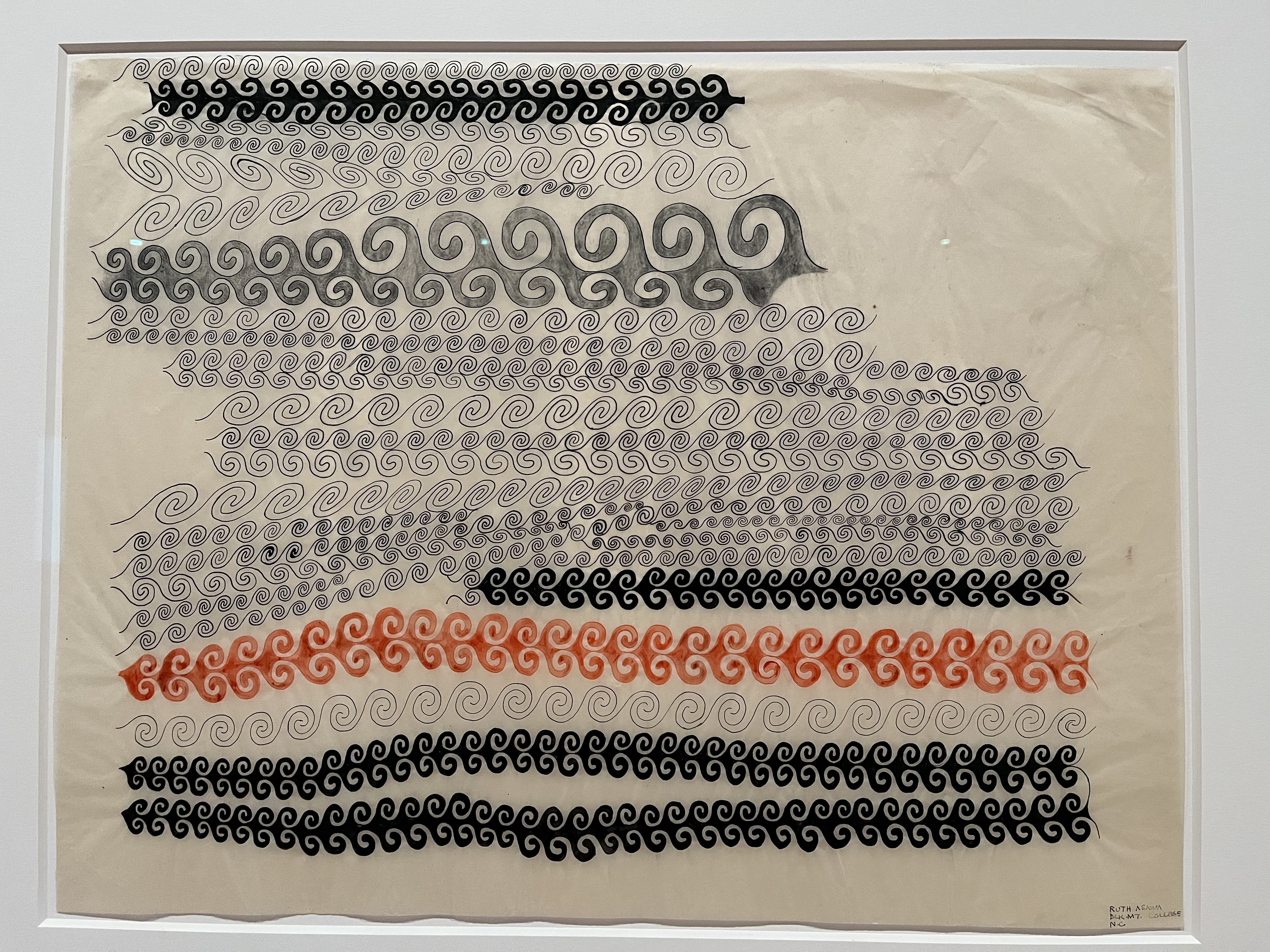
Our friend Sari and her adolescent son Sam met us afterwards for a stroll through the Whitney Museum, whose current offerings introduce museumgoers to Japanese-American artist Ruth Asawa (I first learned about her from the postage stamp in her honor; see “Untitled” above), African-American painter Henry Taylor, and in the project room Indigenous sculptor Natalie Ball. I never know what’s going to catch my eye at the Whitney.

I felt indifferent to most of Taylor’s unbeautiful paintings, though I thought his room of portraits of artists was witty (Tyler the Creator on a suitcase, above; Deena Lawson “in the Lionel Hamptons,” below) and his installation dedicated to the uniforms of the Black Panthers arresting.

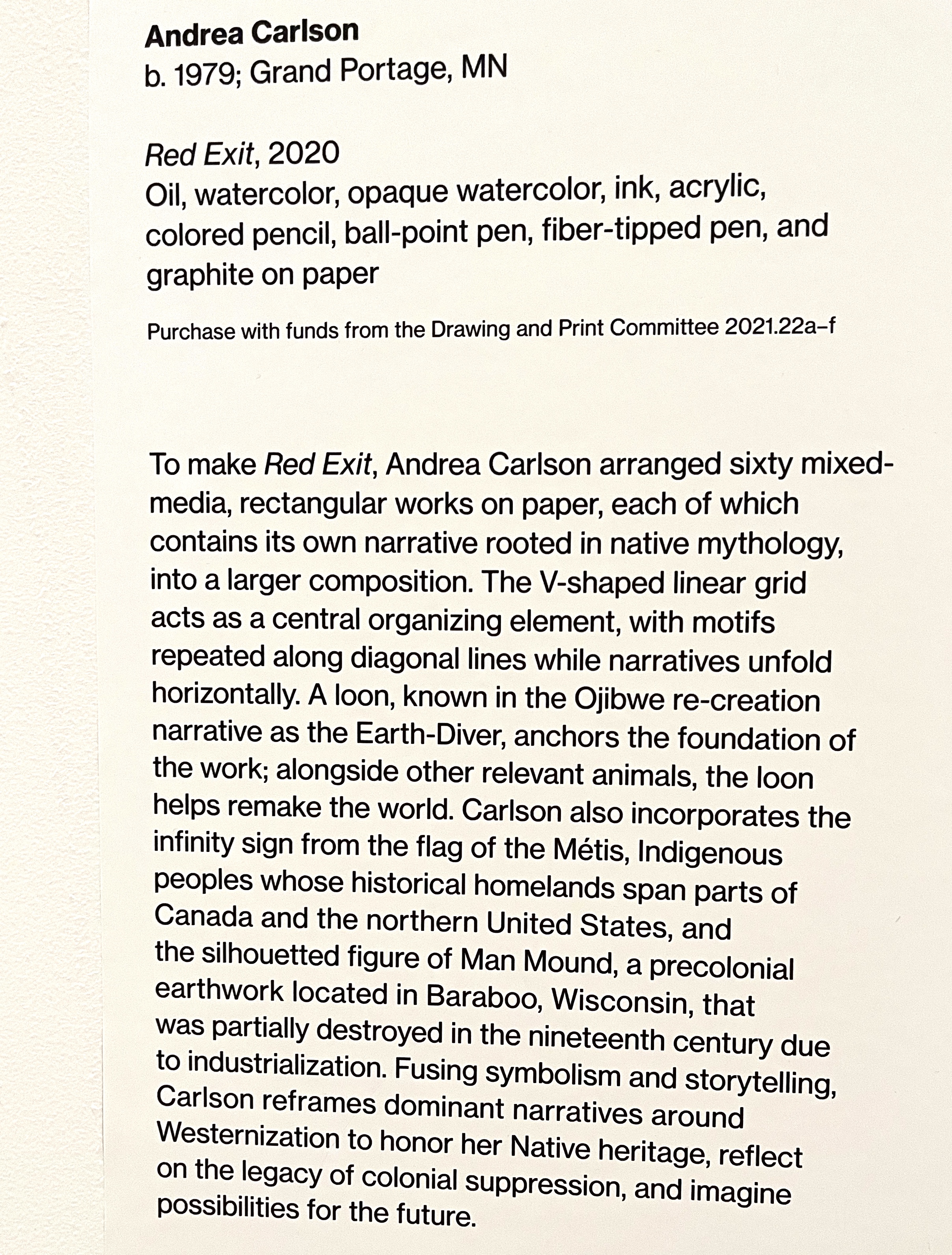
A complicated exhibition called “Inheritance,” curated by Rujeko Hockley, riffs on lineage and artistic legacies. Andrea Carlson’s ambitious Red Exit weaves evocative native symbols with abstract images.

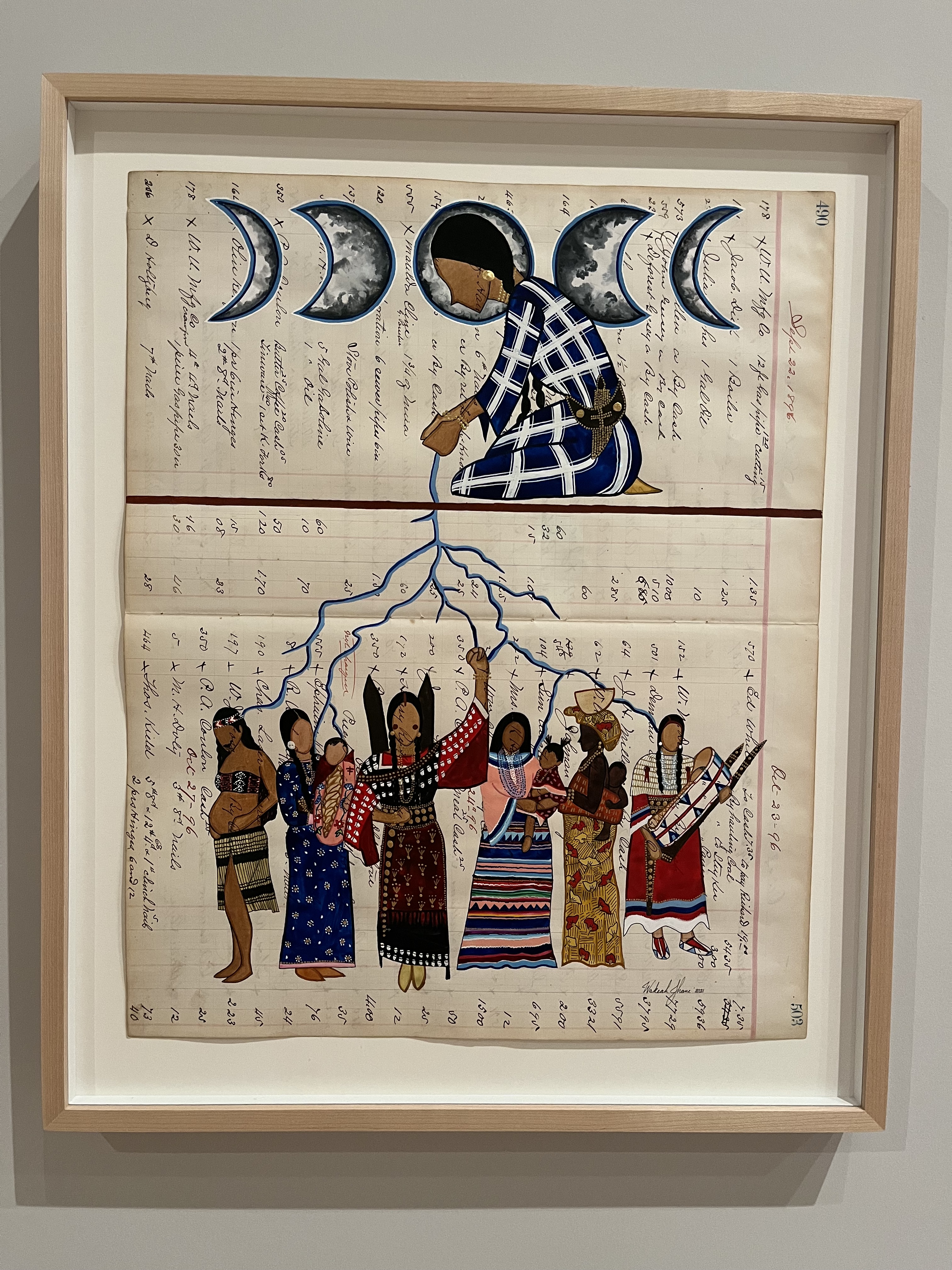
Wakeah Jhane’s Grandmother’s Prayers goes there with one resonant image.
And I found multiple ways to appreciate Sturtevant’s homage to Felix Gonzalez-Torres’s 1991 installation “Untitled (Blue Placebo),” in which viewers are invited to take a piece of blue-wrapped candy from a large rectangular field of them.

That tasty caramel tided me over until we had dinner at Osteria Nonnino on Horatio Street – paccheri with the spicy house sausage-and-vodka sauce and a bottle of nero d’avola.

Home from our expedition, Andy and I finished watching season 1 of Reservation Dogs on Hulu, one of the weirdest TV series in an era of extremely weird TV series. RezDogs mashes up Schitt’s Creek with Somebody Somewhere but in a blandly suburban Native community in Oklahoma. Taika Waititi co-created the series with Sterlin Harjo, and it has all the eccentricity and casual/jokey supernatural eruptions familiar from Waititi’s other work (Thor: Ragnarok, Jojo Rabbit, What We Do In The Shadows). The all-native cast is full of wonderful actors I’ve never seen before, some of them very young (see above), all of them masters at deadpan comedy. I usually give myself permission to enjoy the luxury of subtitles because dialogue flies by so quickly, but with this show it’s especially fascinating to read the native words that show up as regularly as the affectionate sobriquet “shitass”; also fascinating to see that the screenplay spells “Indian” as “NDN.”

A weird thing happened just as we were turning in for the night. A couple of drunken guys got into an altercation on the street in front of my building, and the one getting beat up pressed all the buzzers until someone buzzed them in, at which point they proceeded to tromp up and down the stairs yelling and fighting. “Ehh, macho straight guys, let them settle it amongst themselves,” I thought. But then I heard a woman scream, so I called 911. The scuffling and yelling went on, someone spat on someone, which escalated the fighting. Eventually the friends of the fighters dragged them away. Shortly thereafter four wet-behind-the-ears NYPD officers showed up, looking scared and clueless. The fighters had apparently grabbed two fire extinguishers and sprayed each other with them, so a cloud hung over the hallway. Saturday night in the big city.

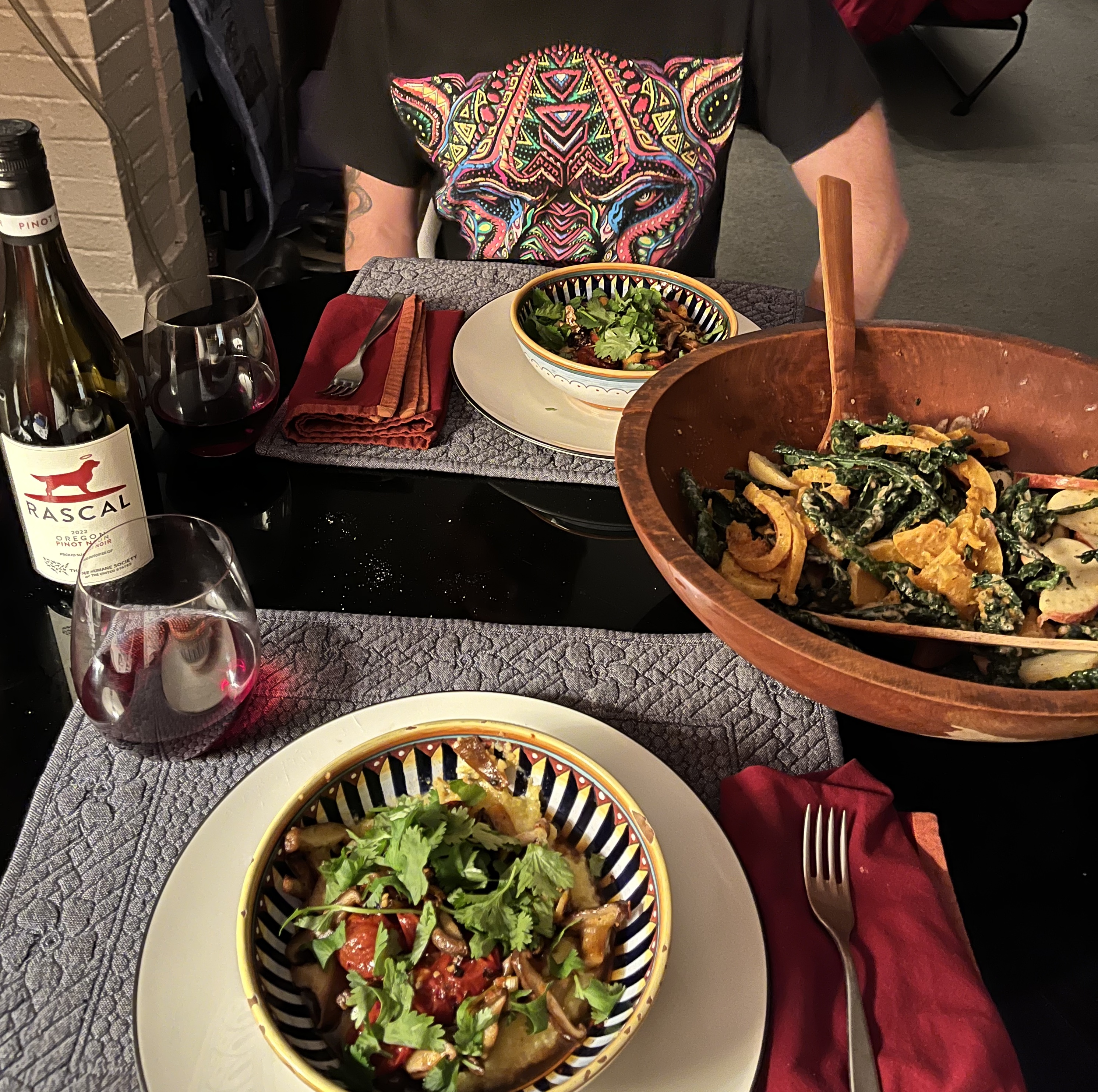
Sunday afternoon we trekked down to the East Village to see The Boy and the Heron, Hayao Miyazaki’s valedictory film, a beautiful and trippy fantastic-voyage mythological yarn full of tiny references to characters and images from the Studio Ghibli pantheon. We came home and I made two fairly ambitious dishes from the New York Times Cooking app – a kale and squash salad with almond-butter vinaigrette (per Ali Slagle) and spicy roasted mushrooms with polenta (thank you, Yotam Ottolenghi!).
Reading the Sunday New York Times fed my soul with a couple of items. The Sports section on Sunday featured a full-page article about football star Jordan Poyer headlined “A Safety Finds Enlightenment In Ayahuasca.” Dan Pompei compiled a respectful and factually accurate summation of plant medicine as Poyer talked openly and vulnerably about how the medicine helped him bring his alcohol abuse under control. Also, in the Times Magazine “Talk” column, David Marchese interviews David Byrne, who speaks thoughtfully and personally about change. While discussing the Buddhist concept of no-fixed-self and how what we think about ourselves can change, Byrne is asked how he himself has changed.

“Wow. Well, I realized quite a few years ago that as much as I might like to deny it, I harbored a lot of racial biases. At that point, a younger liberal person would say, Oh, I’m not racist, or I believe in equality. But at the same time, I was aware that I was also harboring these inner biases that I could occasionally sense. I realized I may rationally say that I’m not racist, but I have implicit biases that I would like to deny but they’re there. Overcoming those is more difficult than just rationally saying, Oh, no, that’s not right. Those beliefs and biases, whether they’re about race or women’s rights or whatever they might be, those things can take a long time to fundamentally change within us. I would like to think that I’ve been engaged in that process and was trying in [his Broadway show] American Utopia.”

Marchese asks, How do you do it?Good question. Let me think of some examples. People might say, Germans don’t have a sense of humor, or all Italians are really passionate; you might see a bunch of kids on a street corner and think, There’s trouble, I’m going to avoid them. In my experience, the way to work through some of that stuff is just to get to know other people as individuals a little bit better, and that starts to break those biases down. But that’s a slow process. And for somebody who’s not maybe the most social person in the world, that takes some work.”

I so appreciate David Byrne’s honest introspection. He sat in front of us when we saw David Adjmi’s superb play Stereophonic at Playwrights Horizons (he later wrote an essay about the play for the PH website), and I watched him chat freely with the fans around him, which I’ve hardly ever seen celebrities do in public. So I feel like I got to witness him stepping out of his comfort zone and practicing “getting to know other people as individuals.”

I’ve been thinking about how so much of the divisiveness in the world these days seems to boil down to people’s tolerance level for behaviors, identities, and beliefs that are different from their own. How much of that is learned, how much is inherent, how much is malleable? I feel like I have not only a huge tolerance but a deep and abiding appetite for experiencing difference. Was I born that way? Some of it surely has to do with realizing I was gay at an early age and looking at the world through a queer lens. I like the way another Times Magazine contributor, Venita Blackburn, put it, writing about the animated Japanese series Sailor Moon: “queerness is not just sexual…queerness is also existing under duress, where one’s instinct toward self-determination is a kind of spiritual expanse that grows from deep within the body and psyche then cascades out into an eventual shape unlike most others.”

But the other circumstantial piece that overwhelmingly influenced my experience of difference was growing up as a military dependent. My father grew up as a poor, uneducated farm kid in culturally homogeneous small towns in the Midwest. He didn’t lay eyes on a black person until he was 12, by which point he’d been indoctrinated with all the racist stereotypes of midcentury American culture. Ironically, his joining the U. S. Air Force and raising four kids meant that we got to travel all over the country and to Japan, which automatically exposed us to people, food, landscapes, and attitudes unlike our own.

Lucky me to have had that upbringing, and lucky me to have landed in New York City, where my craving for exposure to difference and other cultures can never be exhausted.

Culture Vulture/Photo Diary: Annie Sprinkle and Beth Stephens’s “EcoSex and the City”

June 19, 2023

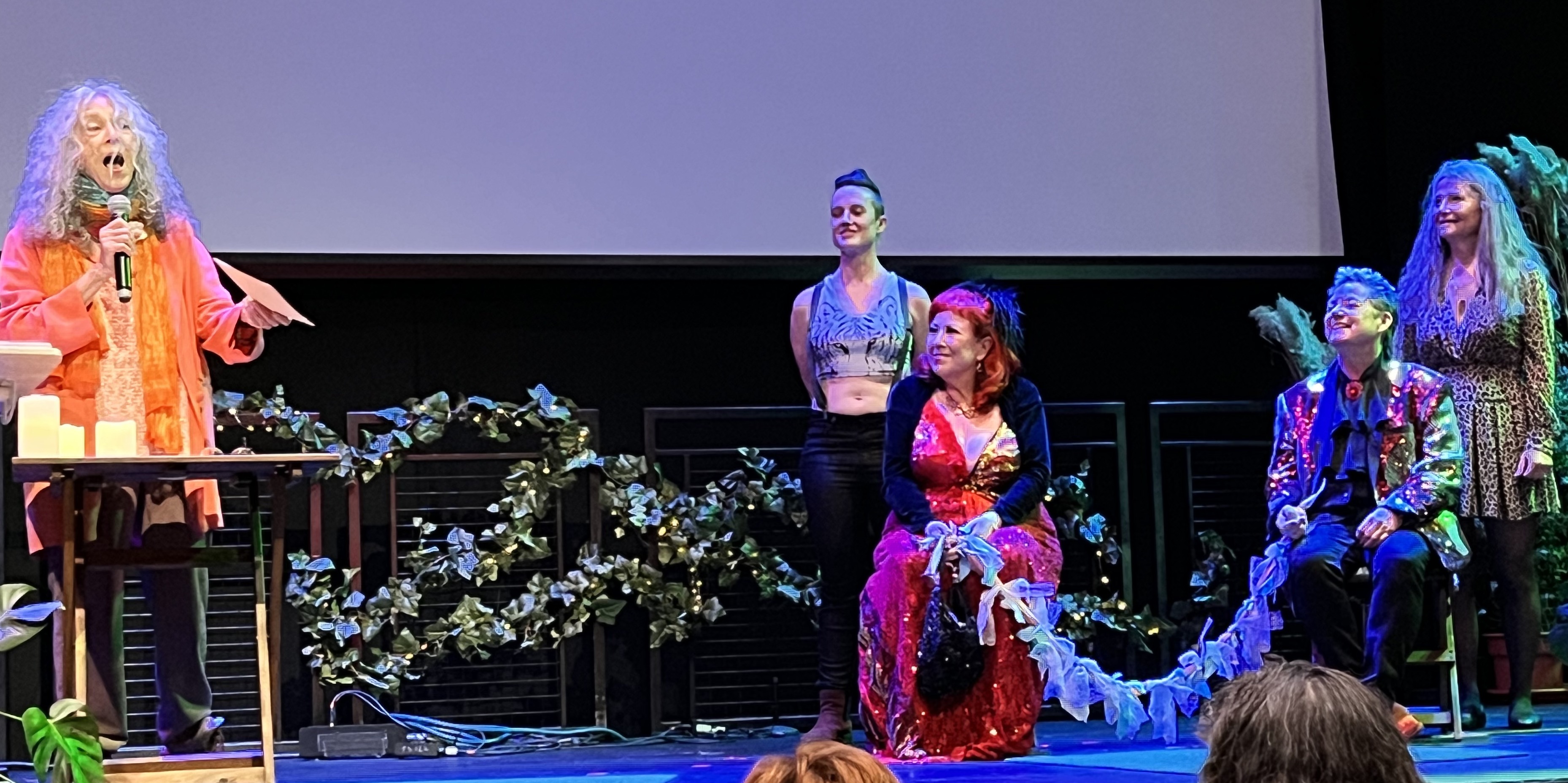
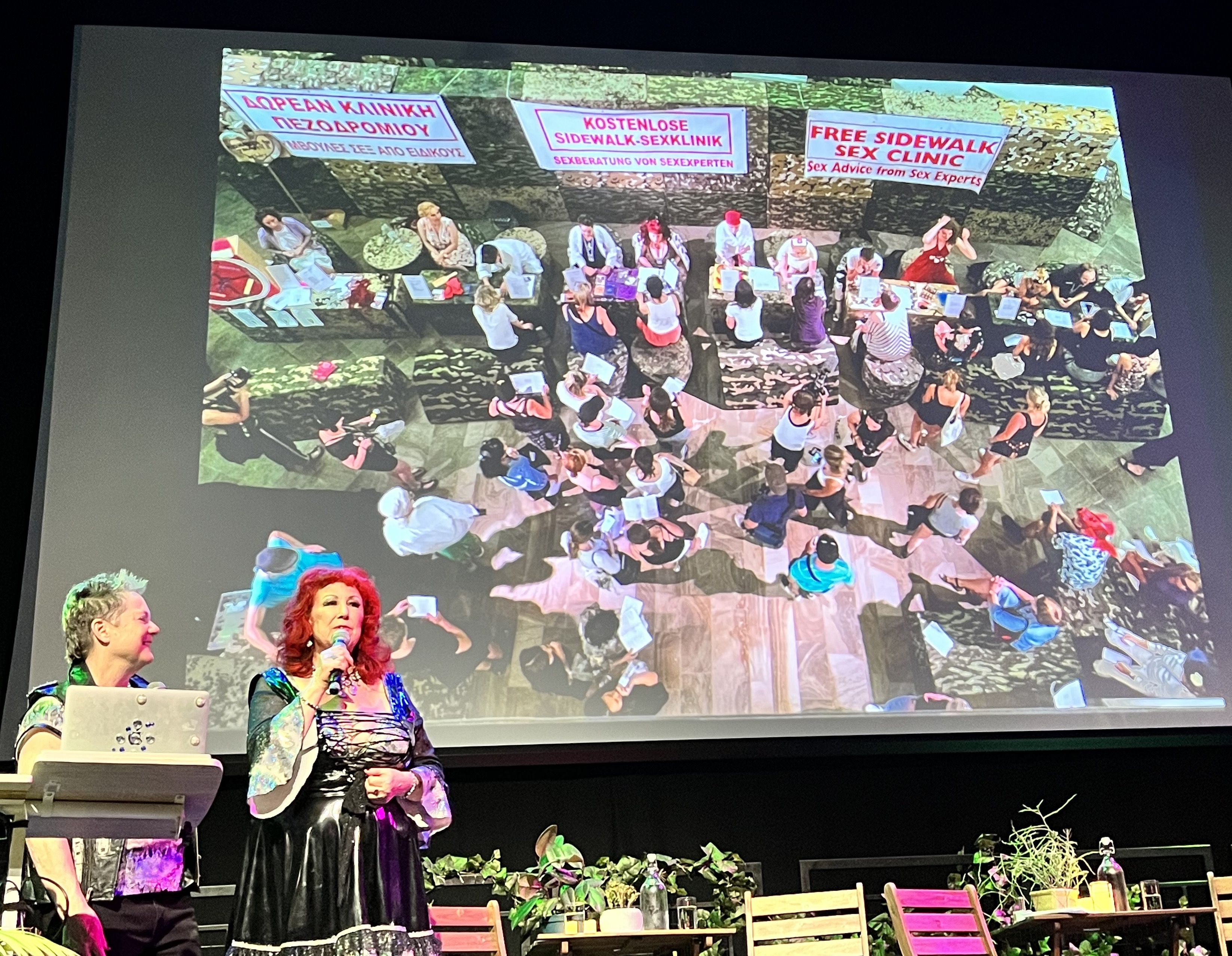
Annie Sprinkle, Beth Stephens, and 100 of their friends took over Performance Space New York (the venue formerly known as PS 122) with “EcoSex and the City: Exploring the Earth as Lover,” which sounded in advance like a wacky weekend of West Coast woo. Andy characterized it as “Witchy Ladies Talking About Their Vulvas, and Trees.” Both descriptions are not inaccurate. But in its sneaky way, it was a profound and timely festival of ideas.

I was going to say they aren’t kidding about being environmental activists, but really they are kidding, and that’s the point. Let’s face it, although it’s possibly the most urgent issue of the day, the language that surrounds environmental justice – climate change, sustainability, infrastructure – can be pretty dull and veer toward solemnity, shouting, and shaming. Annie and Beth bring a lively, loving, queer, body-centered, sensual approach to the topic that doesn’t mean they’re any less serious about it.

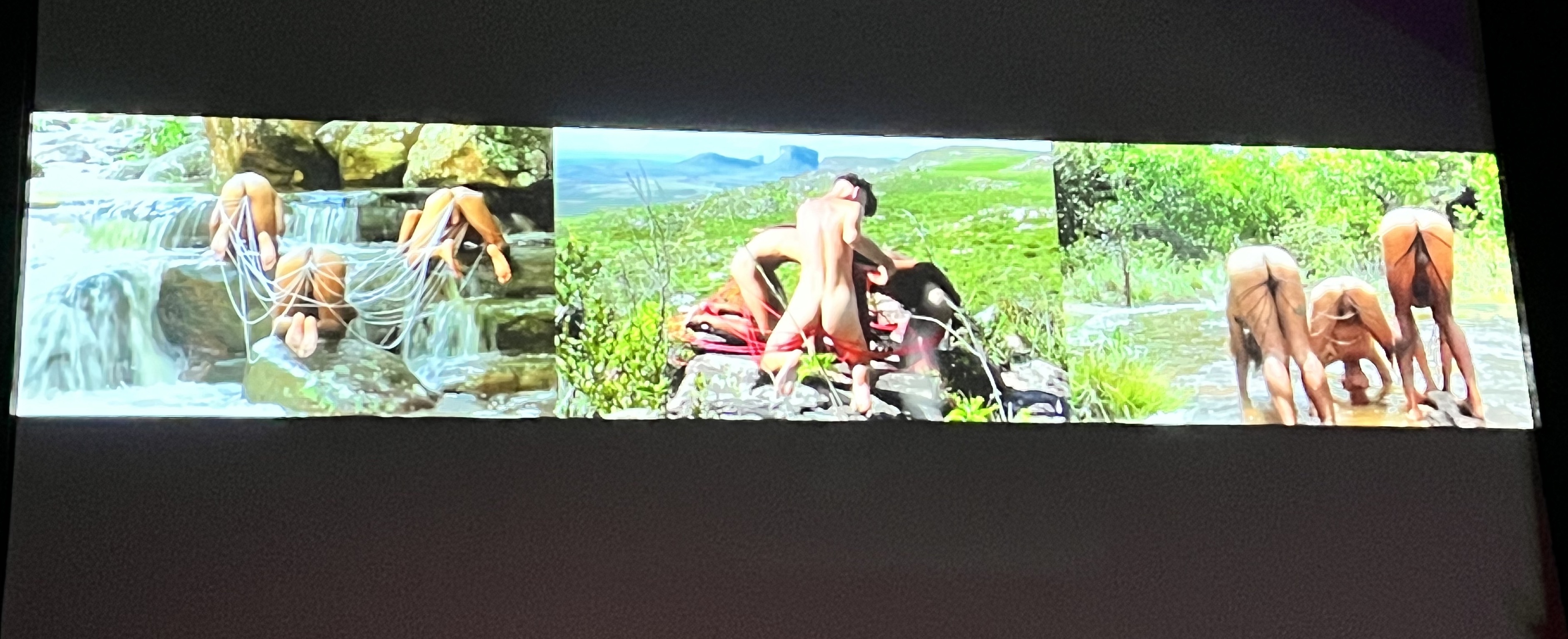
Playfulness permeates the language they use. To heal the world, Annie said more than once during the festivities, “It takes a brothel!” Annie of course came to fame in the 1970s as a porn star and sex worker and then evolved into a performance artist and sex educator whose cartoony persona allowed her to smuggle cutting-edge queer/feminist sensibility into an increasingly wider world. She and Beth, whom she met in 2002, identify as “eco-sexual,” meaning “The earth is our lover.” They were married to the earth by shamanic performance artist Guillermo Gomez-Peña, and it’s not a platonic love affair. They get down in the actual dirt, they made a beautiful film called Water Makes Me Wet, they’re working on a new movie called Playing With Fire, and they published a book called Assuming the Ecosexual Position. They model getting very personal and political about saving the planet. But they’re not fundamentalist about it – you can be “eco-romantic” or, if you’re still trying to figure out your entry point to environmental activism, you can be “eco-curious.” Submit to the “eco-sexual gaze”! Find your “e-spot”! Rub up against oaks and call it “Treebadism”!

Friday night Annie and Beth entered like royalty and were greeted as such by friends, fans, and collaborators. Intersectional to the nth degree, the festival opened with veteran life-art practitioner Linda Montano bestowing a ceremonial activation/benediction, followed by a collection of short films laying out the territory.

Annie and Beth started off the next morning with a whirlwind tour of their intertwined lives and art work.

The meat of the program on Saturday were two panels. In the morning, “Strange Kin,” filmmaker Maria Yoon (The Korean Bride) showed excerpts from her new work about marrying the dead (Ghost Wedding). Queer astrologer Michael J. Morris connected the stars to the earth. Scholar Camila Marambio talked about her cancer treatment and generously noted how human researchers and patients have benefited from lab animals who have “a talent for cancer.” Urban Tantra founder Barbara Carrellas showed scenes from her practice of Equine Tantra.

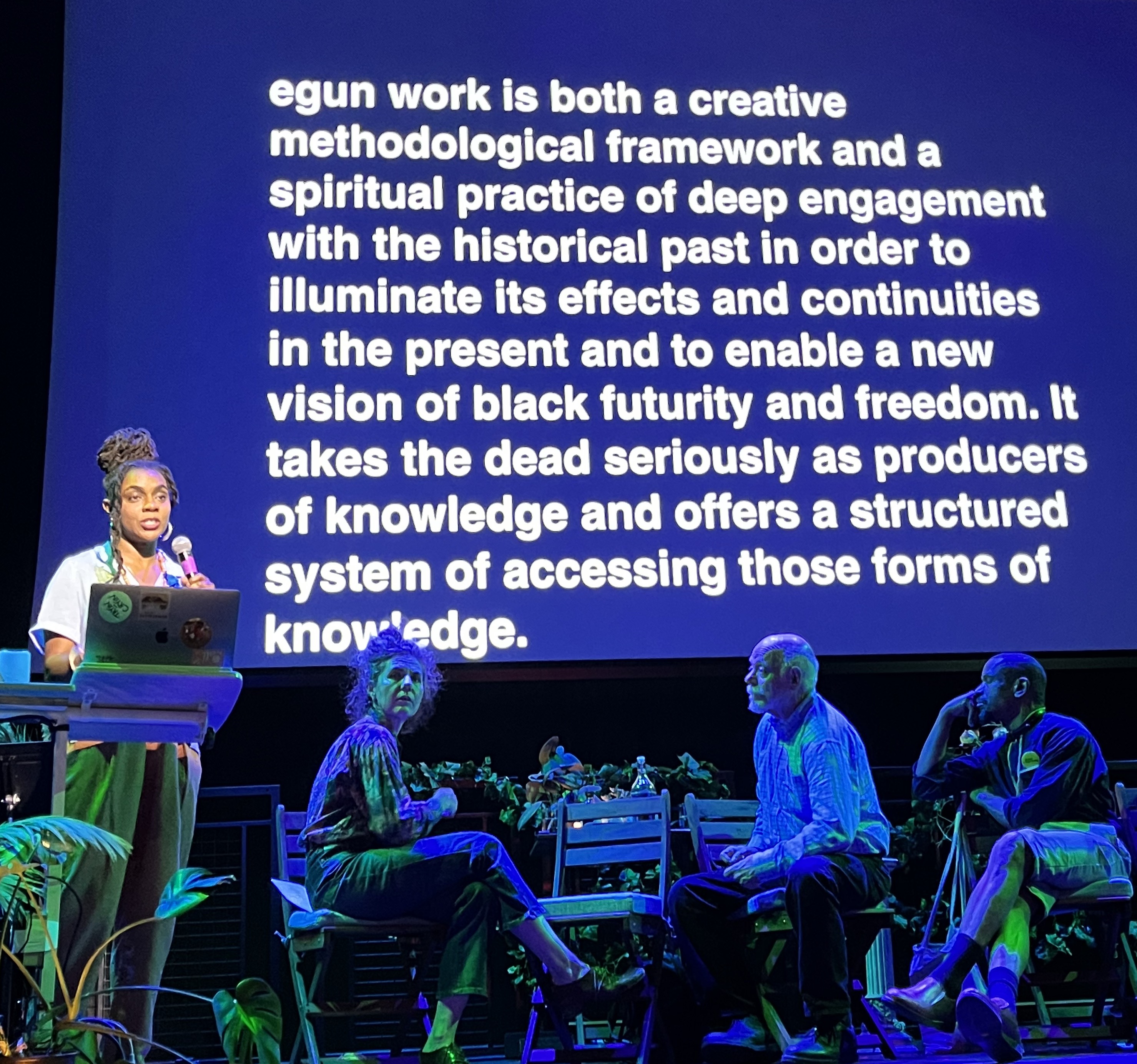
In the afternoon, “Elders & Ancestors,” charismatic Courtney Desiree Morris demonstrated  working with egun, which in Santeria is understood to mean the collective spirit of all the ancestors in a person’s lineage.

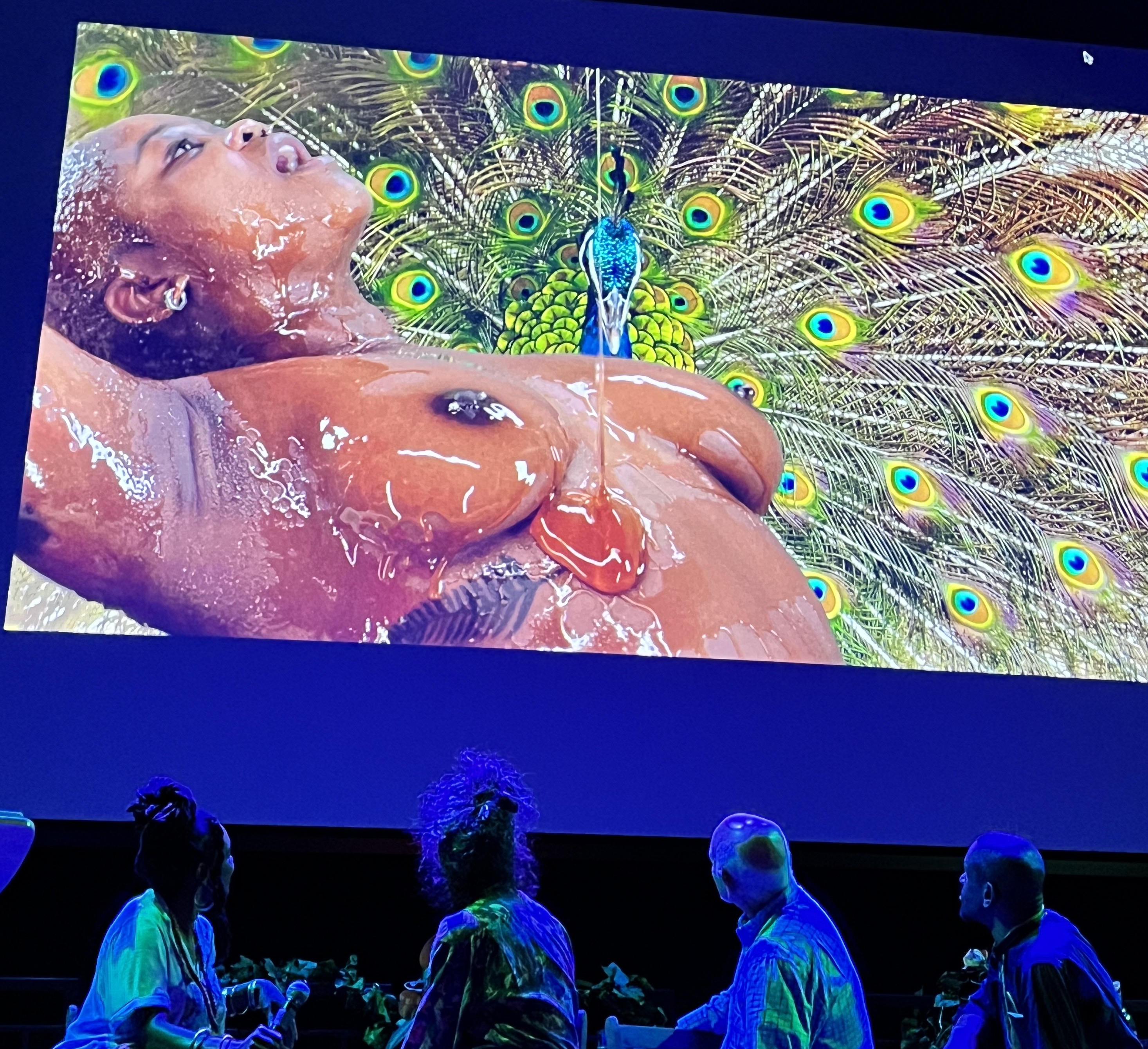
She also showed a clip from her film Oñí Ocan/The Heart of Sweetness, in which a succession of naked black bodies received a sensual libation of honey (she said they used 50 pounds of the stuff!).

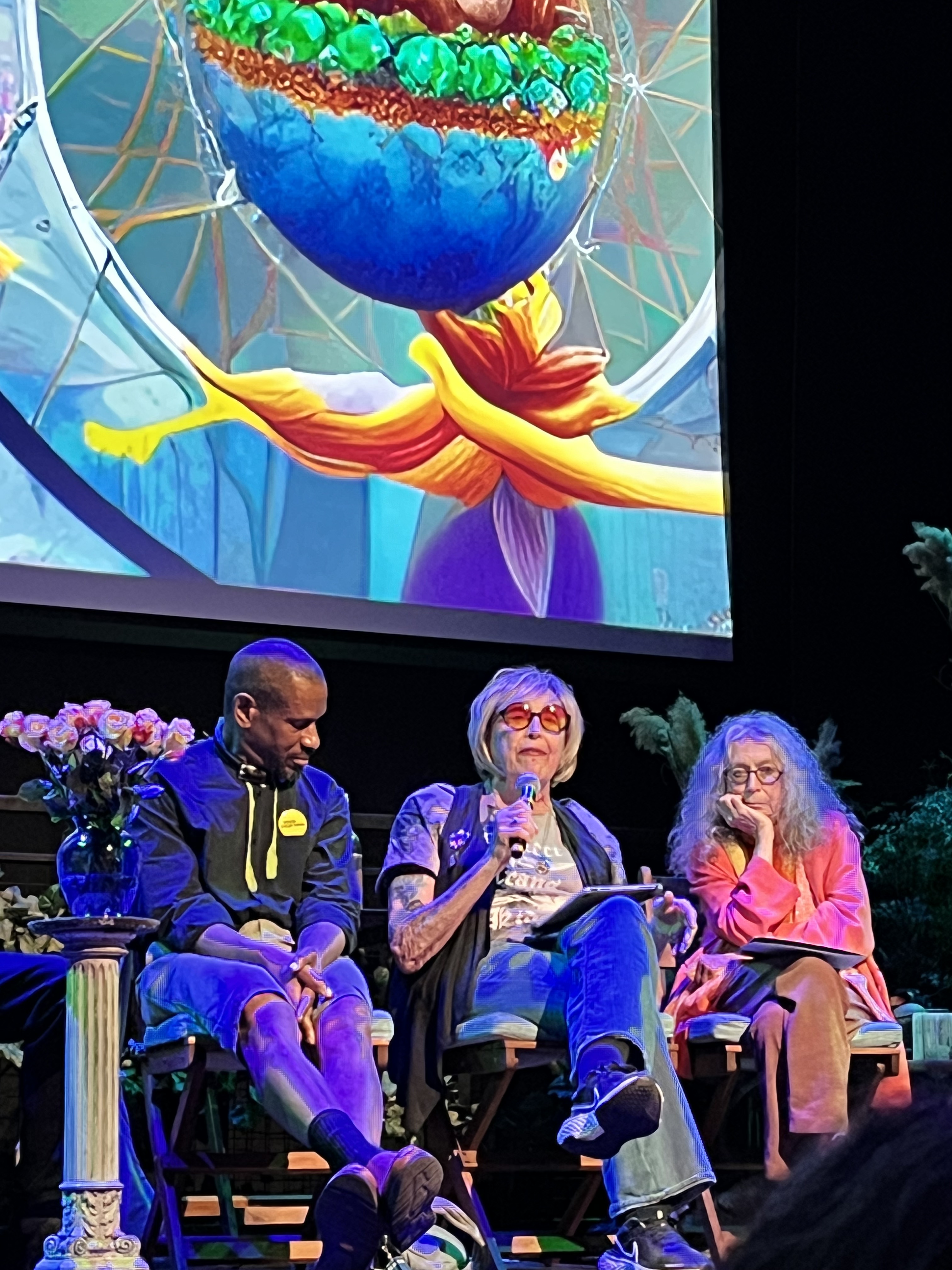
Savitri D. spoke about the value of being connected to a place, while video showed a gigantic tree being cut down limb-by-limb in NYC. Sur Rodney (Sur) and Philip Ward spoke about the sacred task of maintaining the archives of departed artists (Fluxus member Geoff Hendricks and writer-performer Quentin Crisp), constantly having to distinguish sentimental value from historical value.

Trans pioneer Kate Bornstein gave an ecstatically received talk on “Exploring Gender in Four Dimensions.”

And Linda Montano, who confessed to having “panel anxiety,” schooled the audience in the art of asking for help and had the others on the panel read the text that she had written.

I was beside myself with joy at the honor of being in a room with such living legends, getting to meet the likes of Veronica Vera and Beth Stephens (in her Vaginas of Anarchy motorcycle jacket), exchanging books with Annie (she emailed in advance to say she was looking forward to fondling my new book, Daddy Lover God, which heavily features Joseph Kramer, whom she and Beth consider their husband), and hanging out with old friends and colleagues like Kim Irwin and C. Carr.

I’ve had the pleasure of communing with Annie Sprinkle at intervals over the years. I have fond memories to hanging out with her, Keith Hennessy, and AA Bronson at the 25th anniversary of Pride celebration in NYC in 1994.

I took part in the wonderfully silly “Liberty Love Boat” action in 1998 (a colorfully costumed queer invasion of the Statue of Liberty) and got to photograph her in her mermaid outfit with the great lesbian writer Sarah Schulman.

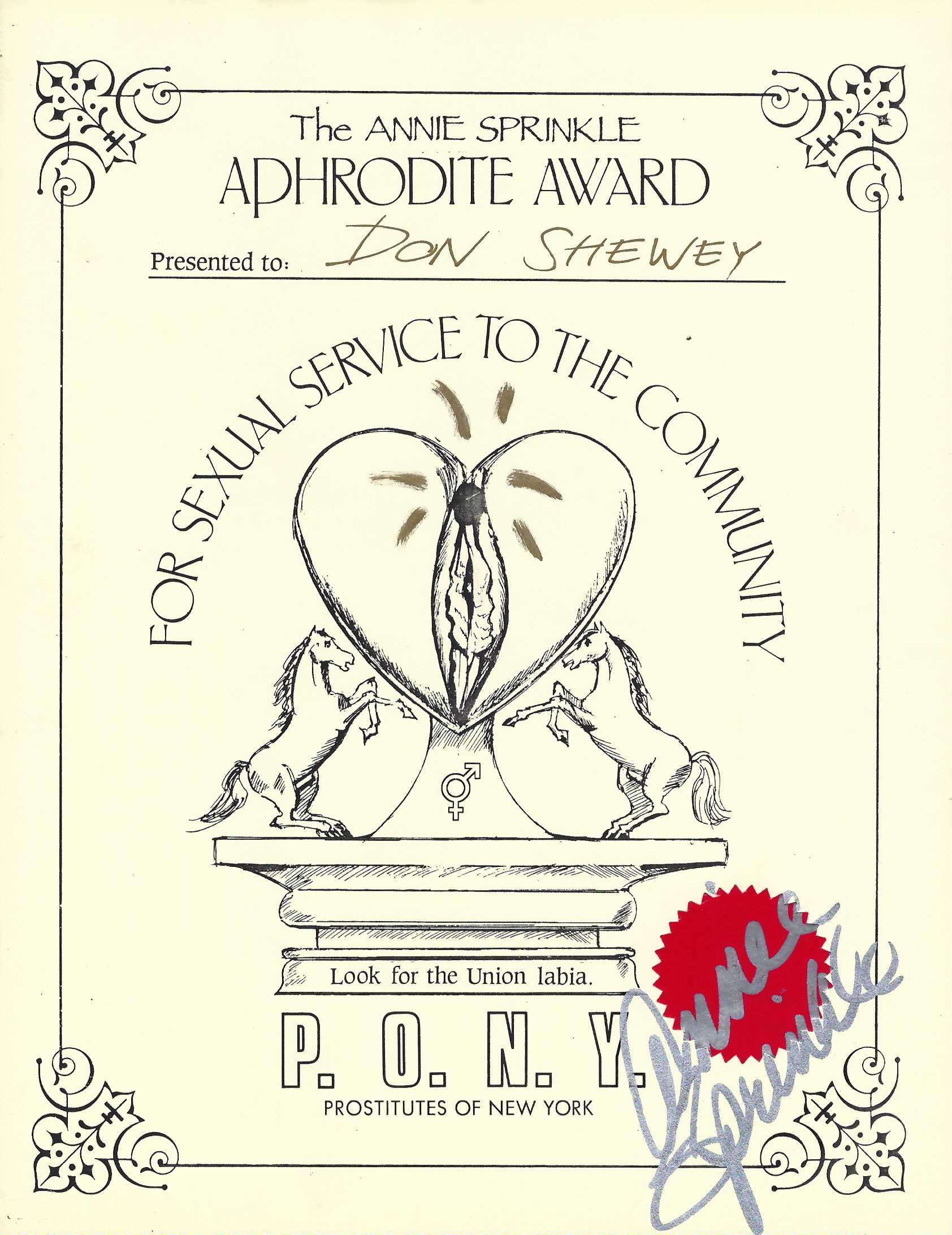
And one of my prize possessions is the Annie Sprinkle Aphrodite Award “for sexual service to the community,” given to participants in Joseph Kramer’s sacred intimate training in 1992.

I love and respect Annie so much for her courage, her honesty, her vivaciousness, her sense of humor, her deep spiritual commitment to nature, and the revolutionary way she gives herself permission to do what she thinks must be done without asking for approval from anyone.

Culture Vulture/Photo Diary: HAMLET, KIMBERLY AKIMBO, PLAYS FOR THE PLAGUE YEAR, THE BANSHEES OF INISHERIN, and more

November 14, 2022

The fall season took off like a roar. The last few weeks have been jampacked with music, movies, theater, and art.

October 27 – On the ninth anniversary of Lou Reed’s return to spirit, Laurie Anderson hosted a gathering of what was jokingly called “the cult” – the folks who loved and supported and collaborated with Lou. It was a mash-up of musicians, performers, and Tai Chi aficionados. Master Ren, Lou and Laurie’s teacher, led a rudimentary Tai Chi practice on the roof, while I nibbled crudites and chatted with New York Times reporter Sam Anderson and clocked a crowd that included Michael Imperioli, Julian Schnabel, Timothy Greenfield-Sanders, and Gina Gershon.

Downstairs, Jason Stern (above) – Lou’s tech director and right-hand man – talked about the recent releases from the archives and the exhibition “Caught Between the Twisted Stars” at the New York Public Library, curated by Don Fleming, who also spoke (below).

I chatted with Rameshkar Das (below top), who co-authored Ram Dass’s last couple of books, and Shahzad Izmaily (below right), who plays bass and keyboards with Arooj Aftab.

Stewed bull pizzle was served.

October 28The Gold Room at HERE, a very sexy and smart two-actor one-hour play by Jacob Perkins featuring Robert Stanton and Scott Parkinson who shift seamlessly through a dozen characters apiece, beautifully staged by Gus Heagerty.

We had dinner afterwards at Lupe’s with Parkinson (below right, whom we know as Scooter) and Marc Antoine Dupont, Body Electric buddies.

October 29 — Thomas Ostermaier’s bizarre and slapstick-y production of Hamlet started out at the Schaubuhne in Berlin in 2008 and completed its round of touring at Brooklyn Academy of Music. This stripped-down version employs six actors playing all the roles on a stage filled with dirt. The show starts with something that’s not in the play, the burial of Hamlet’s father, so that the wedding banquet literally takes place astride the grave. Many familiar, seemingly crucial scenes and lines were cut. “To be or not to be” occurred several times. And maybe because we were reading the subtitles while the actors spoke German, I encountered lines I swear I’ve never heard before in the umpteen productions of Hamlet I’ve seen in 50 years of theatergoing, such as “Eat a crocodile.” Surely Shakespeare didn’t write that? Guess again.

In the title role, Lars Eidinger has been given license to ham it up and ad-lib like crazy. There were lots of empty seats after intermission, and when some people got up to leave in the middle of the second half he muttered, “Rats leaving a sinking ship!” And as the final scene approached, he roamed around the audience looking for someone to go onstage and fight Laertes in his place. These antics served to keep the show lively, but I’m not sure they illuminated anything about the play. My friend Stephen Greco’s pithy review: “Not enough sadness.”

The lobby of the BAM Harvey hosted an exhibit of pertinent work by women and femme-presenting artists.

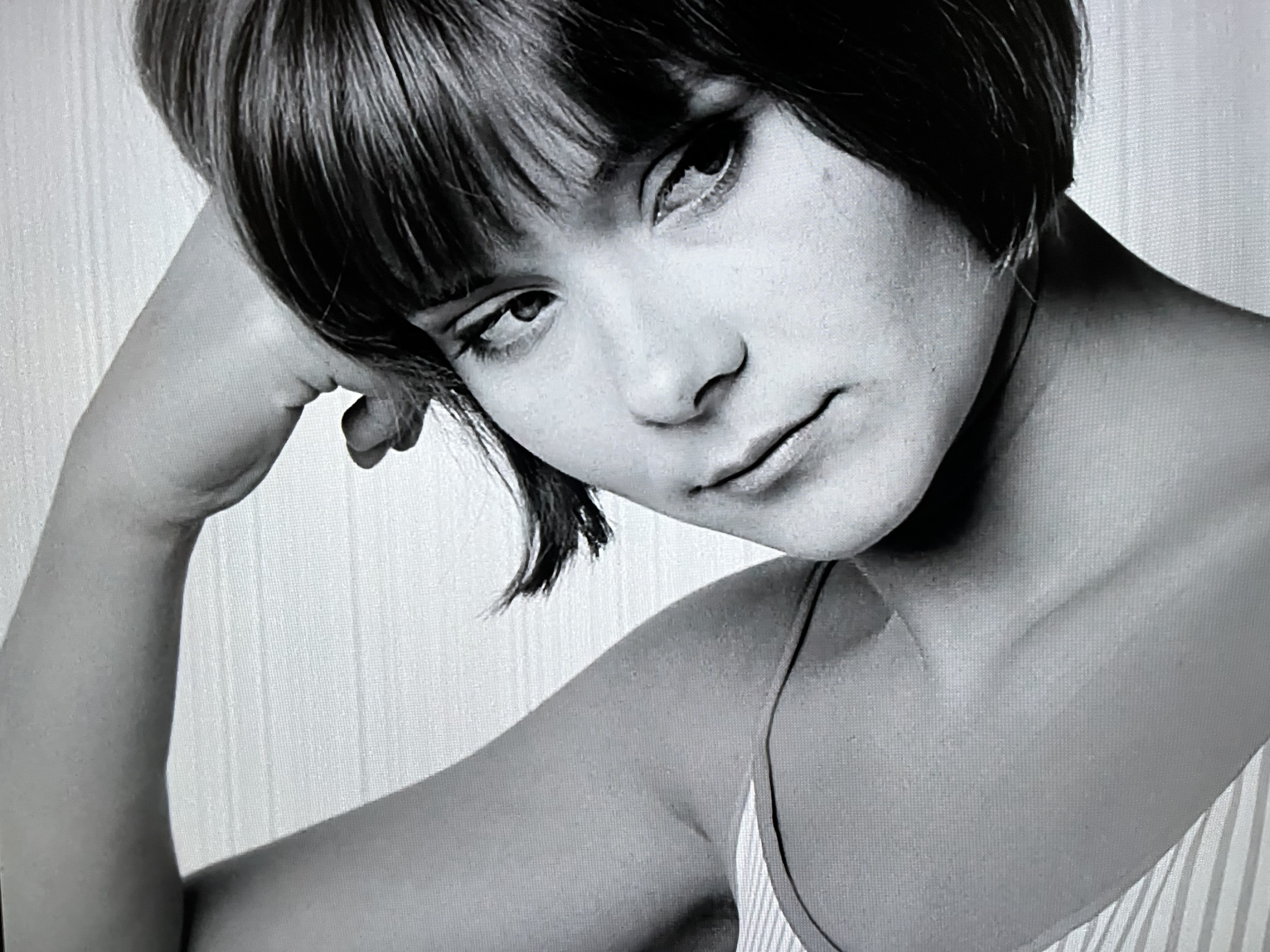
October 31 – On Mubi, I watched the early Godard film A Married Woman, from 1964, a love triangle – woman (Macha Meril), her husband and her lover (very handsome Bernard Noel).

It’s hardly a straightforward narrative but a combination of essay, poem, collage, photo album. Its style is referred to as modernist, I guess because it thrives on the things that film can do – quick cuts, juxtapositions. A recurring motif: zooming in on a public sign so that the few letters showing spell out a pertinent word. Crisp black and white, quite sexy, a lot of skin, and a few very long speeches or long dialogues interspersed with long sections without any faces or words. Very free and inspiring.
November 3 – I went to Playwrights Horizons to see Bruce Norris’s Downstate against my better judgment because I’ve deeply disliked his other plays. Indeed, it turned out to be exactly the kind of play that I hate: ostensibly addressing a provocative subject populated by constructs, not people, behaving implausibly from the get-go, in dialogue that is flagrantly exposition-heavy. The play lost me from the top. No one who works with sex offenders or their victims would ever counsel or approve of an adult survivor meeting a sex offender 1) at the sex offender’s residence 2) with three other residents wandering around in various states of undress eavesdropping. And what wife, accompanying her traumatized husband to such a meeting, would take a banal phone call in the middle of his reading a painful confrontational letter he’s waited his whole life to deliver? No. No. Just no. When the set-up is so flagrantly bogus, it’s hard for me to give credence to anything the playwright is trying to convey. Among the performances, K. Todd Freeman is brilliant as ever, even in a crappy play like this. Mine is clearly not the only possible reaction to Downstate. The friend who recommended it offered this analysis: “Everyone in the play has sexual needs. Some of these needs cause damage to others, others are not totally expressed but all here are punished. I don’t think in any way it’s about excusing or forgiving these people, but it’s about the reality of the desires that exist.” On Twitter, Paul Rudnick paused his Trump-trolling to say, “Bruce Norris’s play Downstate, now at Playwrights Horizons in NYC, is a miracle of writing, acting and directing. It’s harrowing, funny, thrilling and everything that great theater can be. Do not miss.” So go figure.

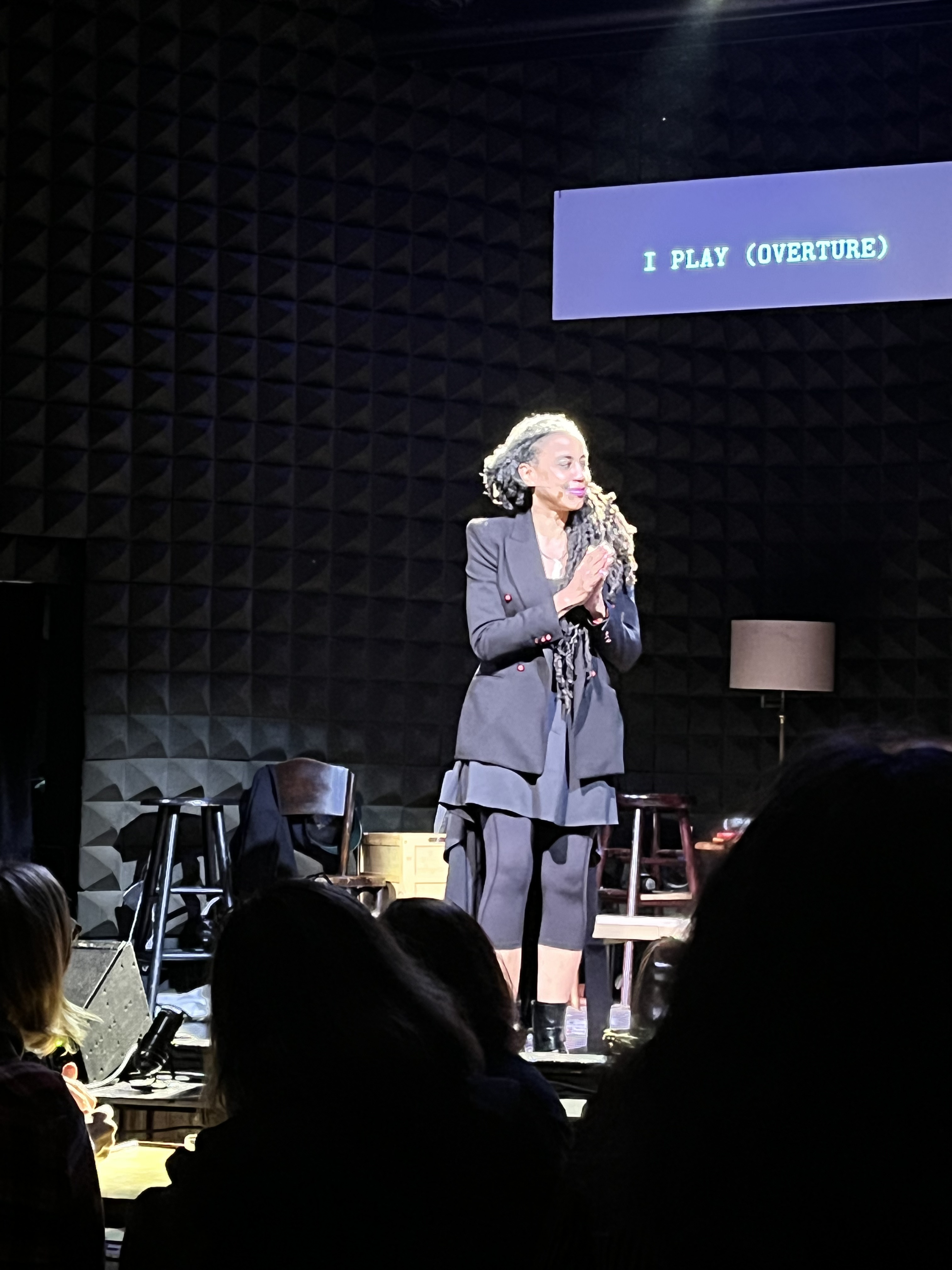
November 4 — I was delighted to win, through the lottery, a pair of tickets to the first performance of Suzan-Lori Parks’ new shows, Plays for the Plague Year, at Joe’s Pub. It’s a musical starring her (above) as The Writer, comprising the plays she wrote every day for 13 months starting March 13, 2020. The sketches and songs alternate between family life with Hubby (the wonderful Greg Keller) and Son aka Pumpkin Pie (the tall and rambunctious Leland Fowler) and public life – the pandemic, applauding the essential workers, the deaths of Breonna Taylor and George Floyd, RBG and Larry Kramer, her first husband Paul Ocher. “A banquet of the unbearable.” SLP is wonderful. She has a great expressive face, cuts a very charming figure onstage, and plays decent guitar. The scenes are often very short and to the point. She goes to Atlanta to work on a TV show (the Aretha mini-series, presumably) with her husband, and they go to double-check with the real estate agent that the owners of the house they’re renting know that Suzan-Lori is black. The agent hadn’t done so, assumed that because the owners were gay, they would not be bothered. But the couple insist, in such a way that makes you imagine all the unpleasant experiences they’d had in the past that led to ask the question so insistently. The owners did indeed turn out to be cool.

When we walked in, we were handed two slips of paper to be filled out and placed in baskets at intermission: thinking back on the lockdown year, what/who do you want to remember? What/who do you want to forget? The first one she read was, “I want to forget having a threesome with my roommates.” I thought the show was terrific, even if a little long – almost three hours. I think it will have a run.

My guest was filmmaker and queer community treasure Adam Baran, who knows Niegel Smith, the director (who stages most of Taylor Mac’s stuff), so I got to meet him. In the lobby they were selling copies of the script. I went to buy one, and a young woman standing next to me jokingly said, “Will you buy one for me?” Impulsively, I did. An actor just out of college at U. of Michigan, she had seen A Raisin in the Sun, which she said was fantastic. Her name is Shaunie Lewis (@itz_shaunie_k on IG). Ask for what you want, girl!

Chilling later with Andy, I shared with him the high points from the new “Super Deluxe” edition of the Beatles’ Revolver that Giles Martin put together, with early, middle, and late takes of “Yellow Submarine,” “And Your Bird Can Sing,” and “Tomorrow Never Knows.”

November 5 — Saturday afternoon was the Dessoff Choirs’ concert at Union Theological Seminary, an acoustically ideal venue for choral music, especially when it can feature the impressive pipe organ. This concert featured two ravishing pieces (a madrigal and a motet) by Vicente Lusitano (1520-1561), the first black composer to have his music published. It was another instance of musical rediscovery by Dessoff’s musical director Malcolm J. Merriwether (below), whose championing of 20th century black composer Margaret Bonds has led to more and more performances of her long-neglected work. (On YouTube, you can watch a half-hour conversation about Lusitano between Merriwether and Joseph McHardy, director of music for His Majesty’s Chapel Royal in London.) The concert continued with the Requiem by Maurice Duruflé with its ravishing polyphonics, its long-held hushed final notes, and a brief interlude with soloist Lucia Bradford and cellist Thapelo Masita. David Enlow masterfully handled the pipe organ throughout.

We had an early dinner afterwards with some of the singers at an Italian place on Broadway. Then we came home just long enough for Andy to change out of his tuxedo to go to see Kimberly Akimbo, which we liked very much. I didn’t see the 2003 iteration of the play, which David Lindsay-Abaire wrote for the amazing Marylouise Burke, but when he and Jeanine Tesori turned it into a musical, I wouldn’t miss it for the world. A teenage girl with that disease that ages you rapidly moves to a new school and falls in with a posse of ice-skating show nerds. Andy had never seen the great Victoria Clark and was blown away by her performance in the title role. As her ne’er-do-well yet infuriatingly charming aunt, Bonnie Milligan steals the show whenever she can; I smell a Tony Award. Stephen Boyer, playing Kimberly’s father, turns out to have a surprisingly lovely singing voice. The high school kids are adorable, especially Justin Cooley as Kimberly’s tuba-playing partner in the great adventure of Living Every Day Like It’s Your Last. I think it’s going to be a hit.

November 6 — Instead of making myself crazy watching the inconclusive results roll in from the midterm election, I took myself to the movies to see Martin McDonagh’s The Banshees of Inisherin. I’m a big fan of McDonagh, and this film reunited the stars of his first full-length feature, the hilarious In Bruges, Colin Farrell and Brendan Gleeson. Here they play best friends in a tiny town on a tiny Irish island in 1923 who have a falling out. The dialogue is absurd and hilarious, both heightened and mundane, the action is violent and mysterious (cf. his play A Behanding in Spokane), the surrounding characters are eccentric, a pet miniature donkey figures in the story, and if you know your McDonagh, animals hardly ever come out well in his work.

To me the spiky buddy-buddy relationship smacks of Sam Shepard (who was a big McDonagh fan) but I just listened to an interview where he said his biggest influences were Mamet and Pinter, that his early attempts at playwriting were all attempts to recreate The Birthday Party and American Buffalo. It doesn’t take a genius to detect in this slim tale a fable about the bloody civil war between North and South Ireland, but the movie doesn’t lean hard on that parallel.

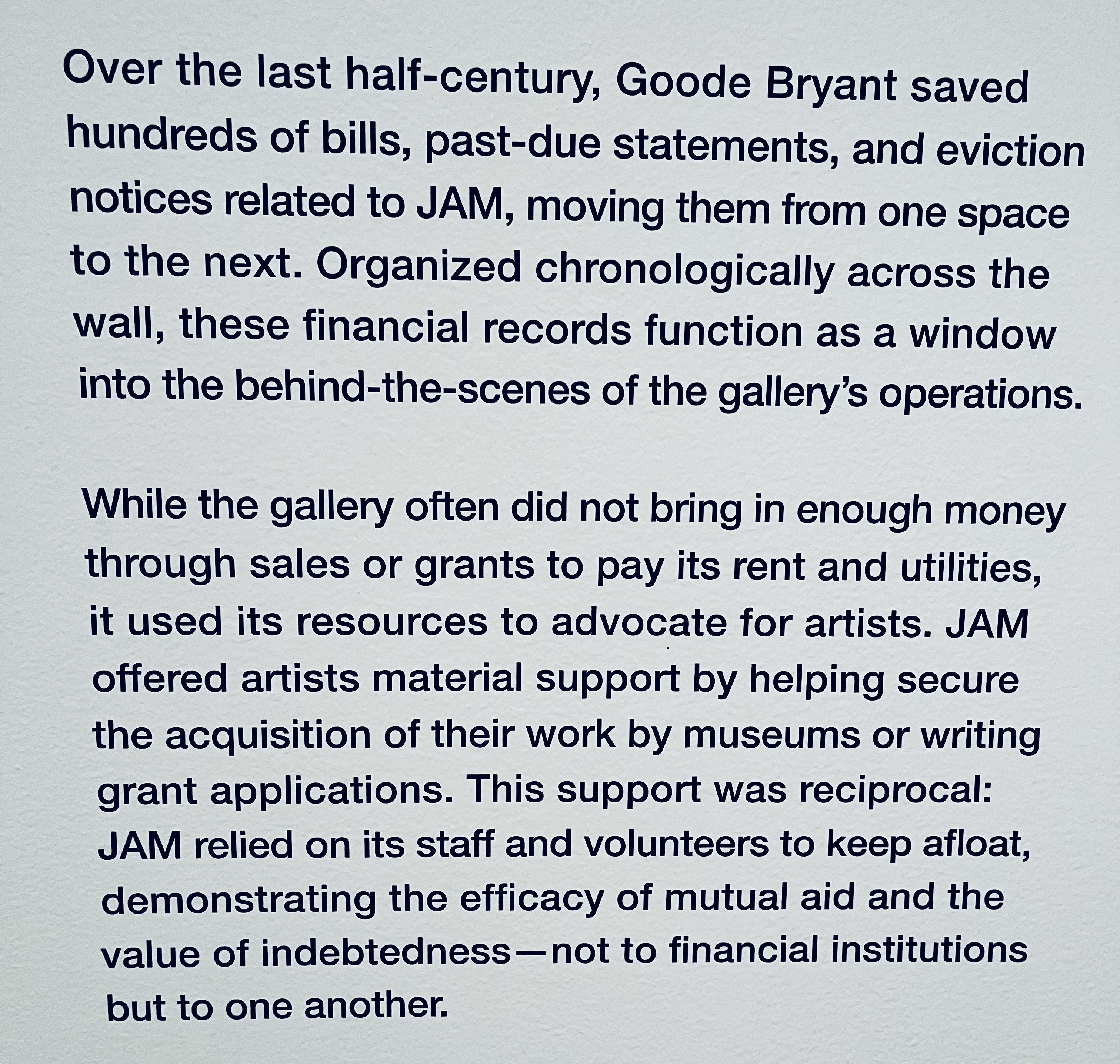
November 10 — On my way home from the post office I decided to stop in at the Museum of Modern Art to check out the exhibition devoted to JAM (Just Above Midtown), the peripatetic gallery founded by Linda Goode Bryant in midtown and eventually relocated downtown, showing a vast array of black artists (superstar David Hammons was an early and very active participant in the gallery’s operations, which were as much about community building as exhibiting art). I like this emerging trend of museums showcasing the work of legendary art spaces as if they were individual artists. I loved the frankness and transparency of this show, which includes a whole wall of JAM’s unpaid bills.

I enjoyed seeing work by artists I’ve admired in other contexts (painter Cynthia Hawkins, illustrator Valerie Maynard) and encountered some striking stuff new to me, like this provocative piece about Indigenous and English language by Edgar Heap of Birds.

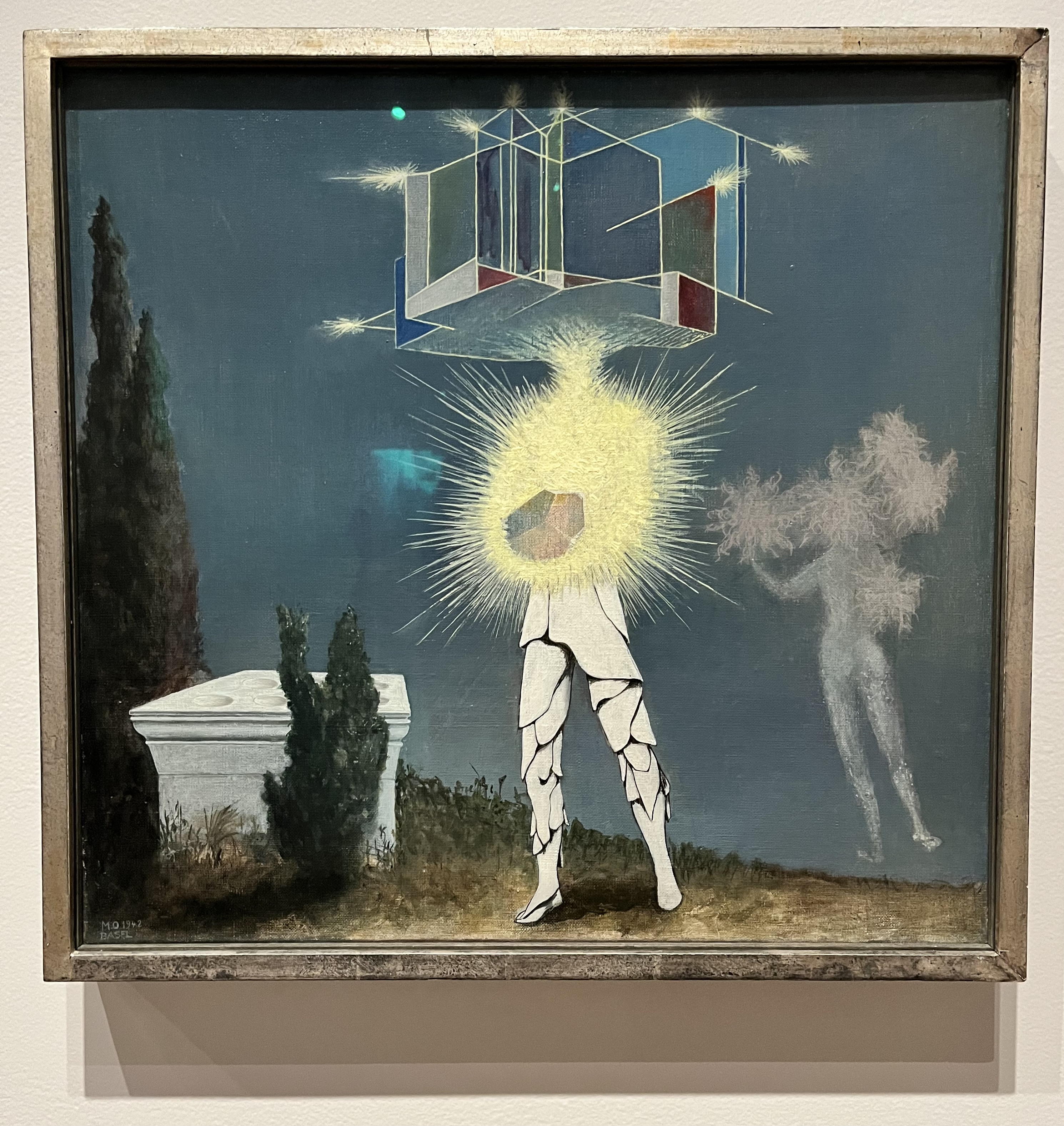
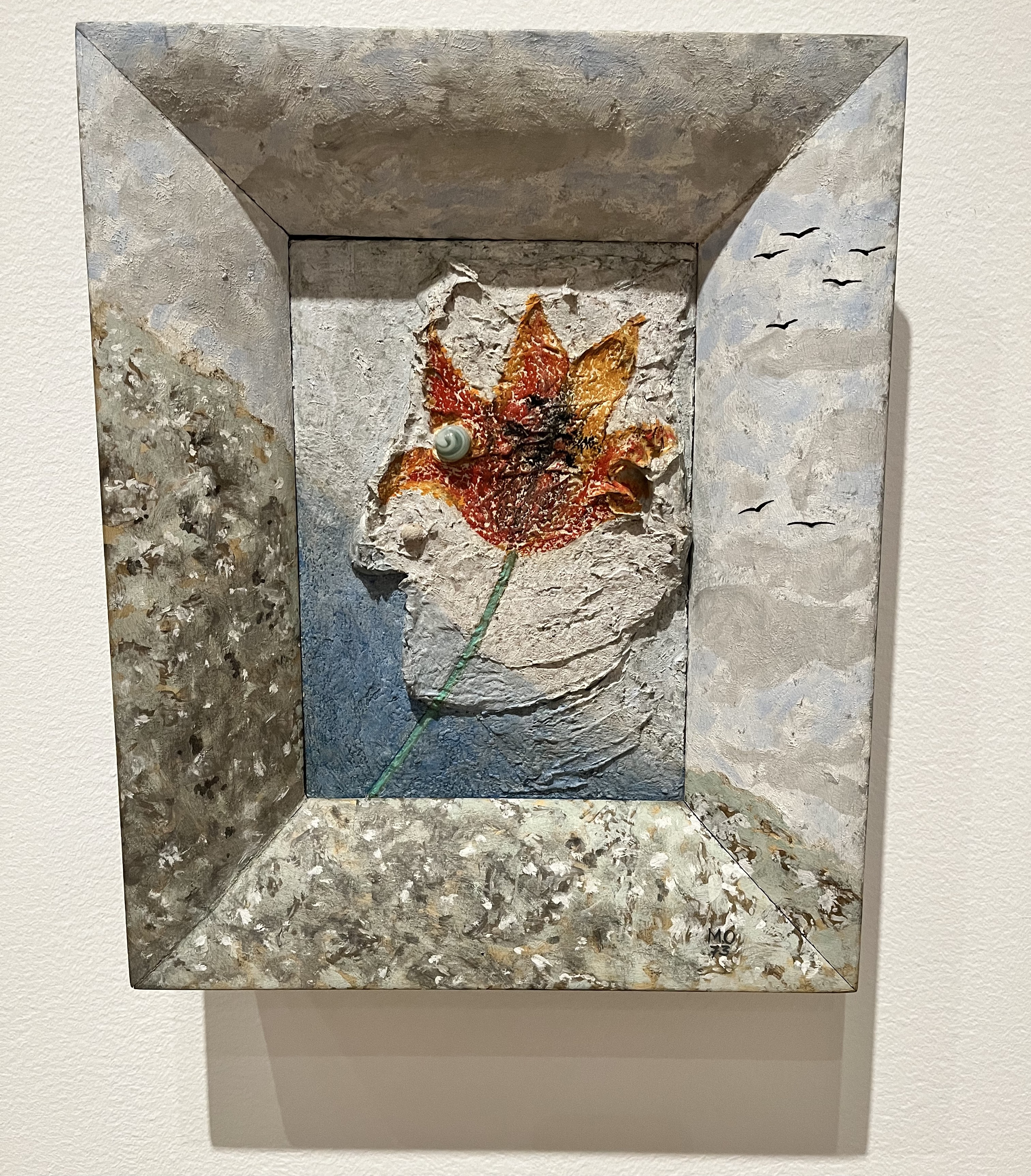
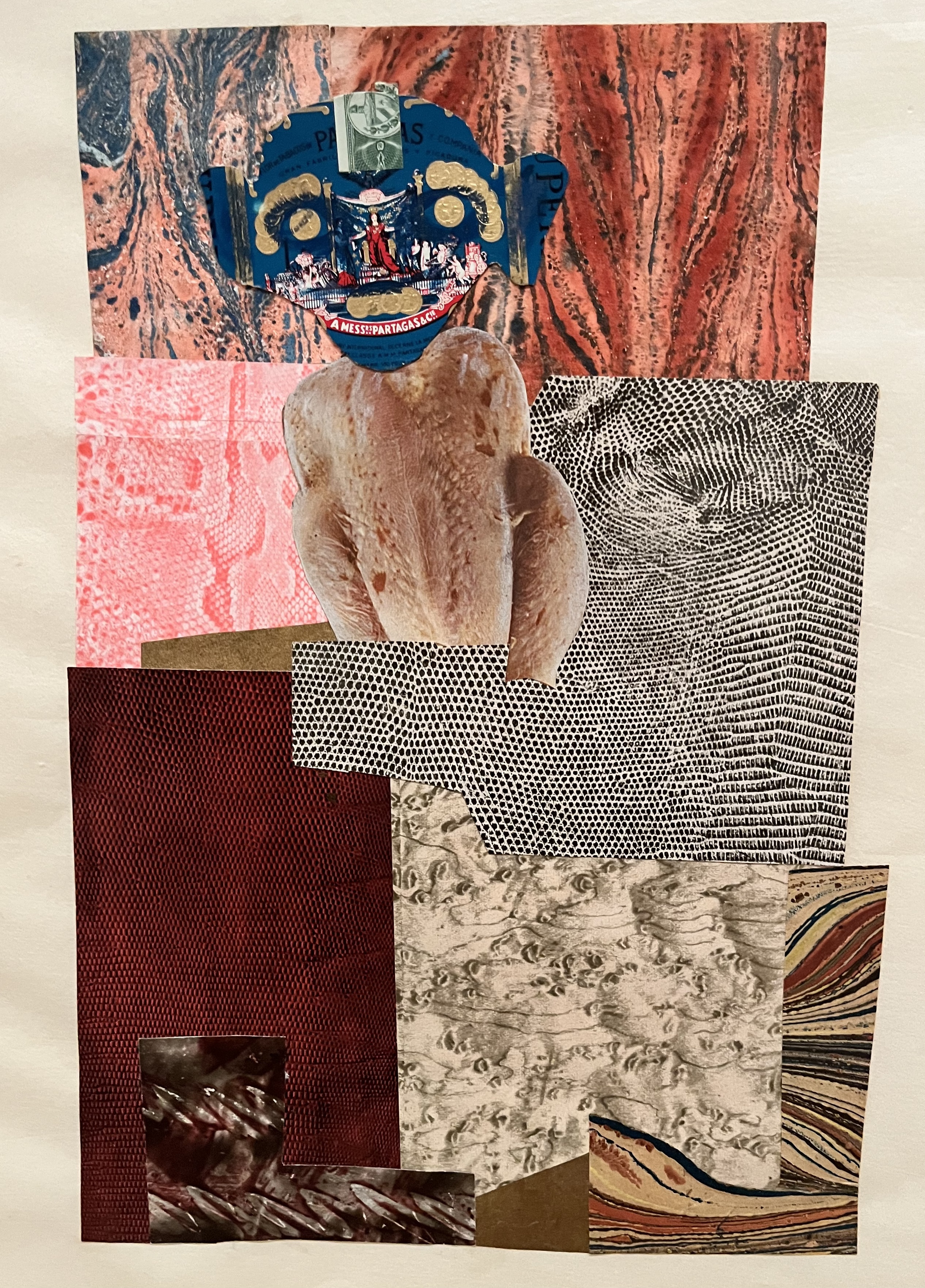
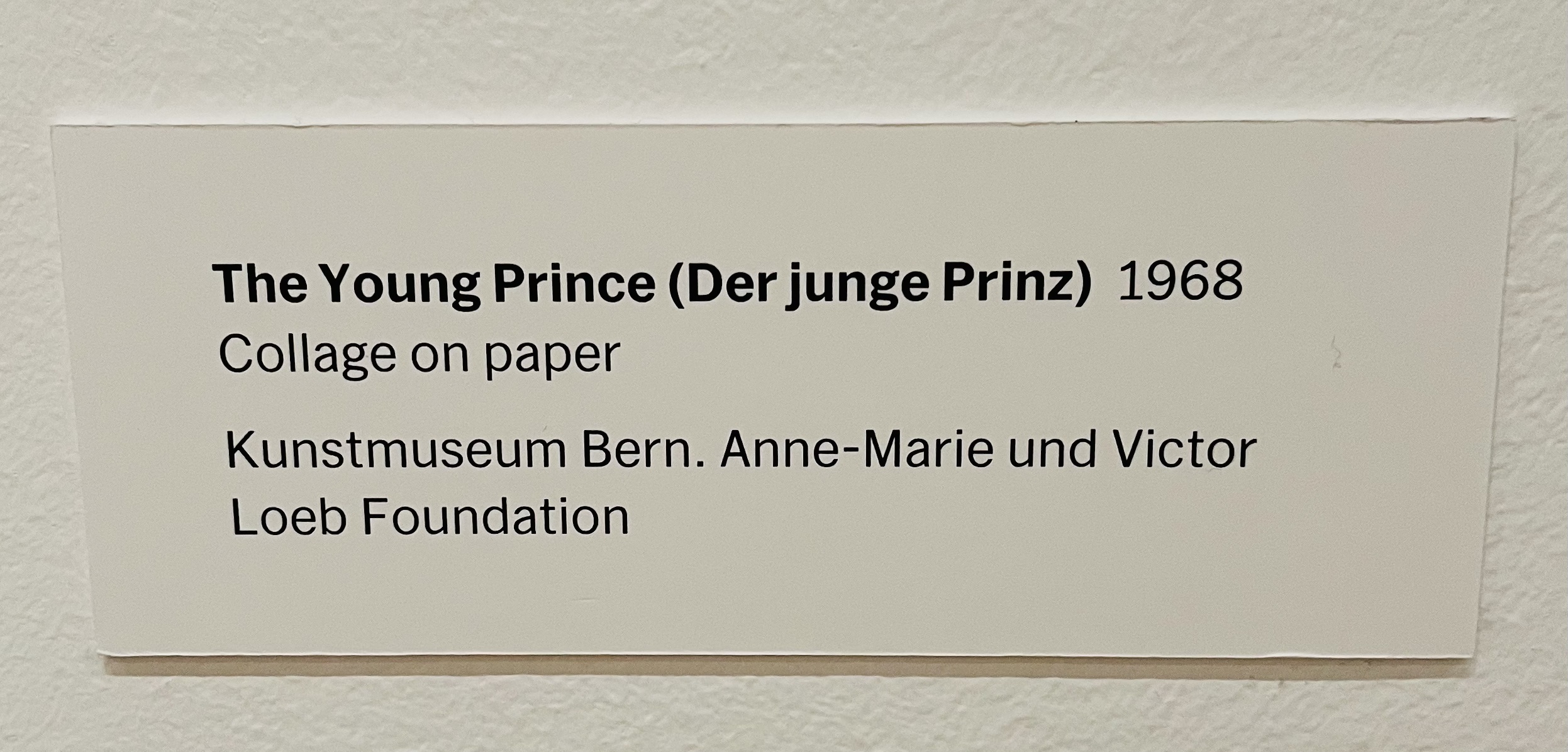
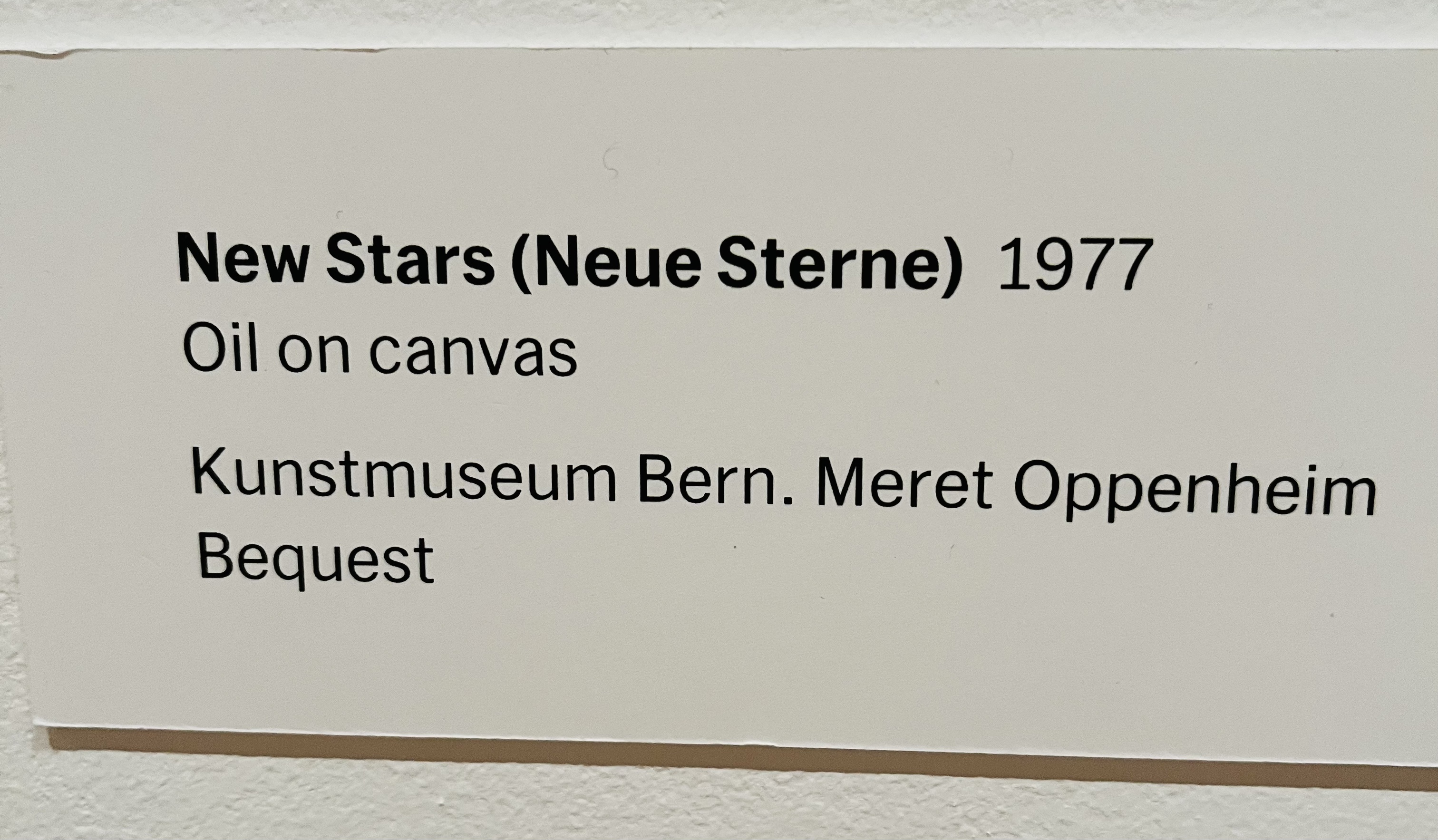
Down the hall from the JAM shows was a retrospective of work by surrealist Meret Oppenheim, about whom I knew almost nothing except for her famous fur-lined teacup. It excited me to witness the range and breadth of her art practice, which explored almost every possible medium without ever resolving into a recognizable style. The pieces that stood out most for me don’t look anything like each other.

I also enjoyed this canvas, displayed prominently in a hallway next to the atrium where Barbara Krueger’s installation still reigns triumpantly. As the T-shirt says, I too am not interested in competing with anyone. I hope we all make it.

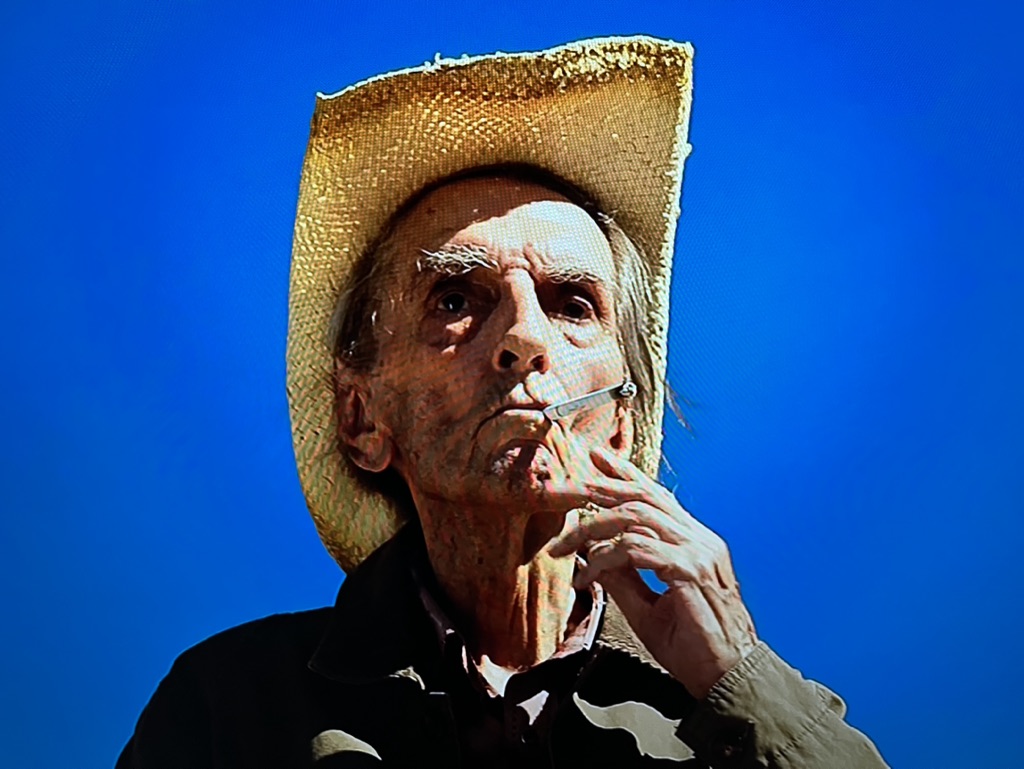
That evening I spent some time poking around MUBI to make the most of my monthly subscription and found myself watching a quirky queer short film called Starfuckers (gay sex workers in Hollywood plot revenge) and then a completely engrossing film I’d never heard of called Lucky, a bravura showcase for Harry Dean Stanton (below) by John Carroll Lynch, son of David Lynch, who plays a small, crucial role.

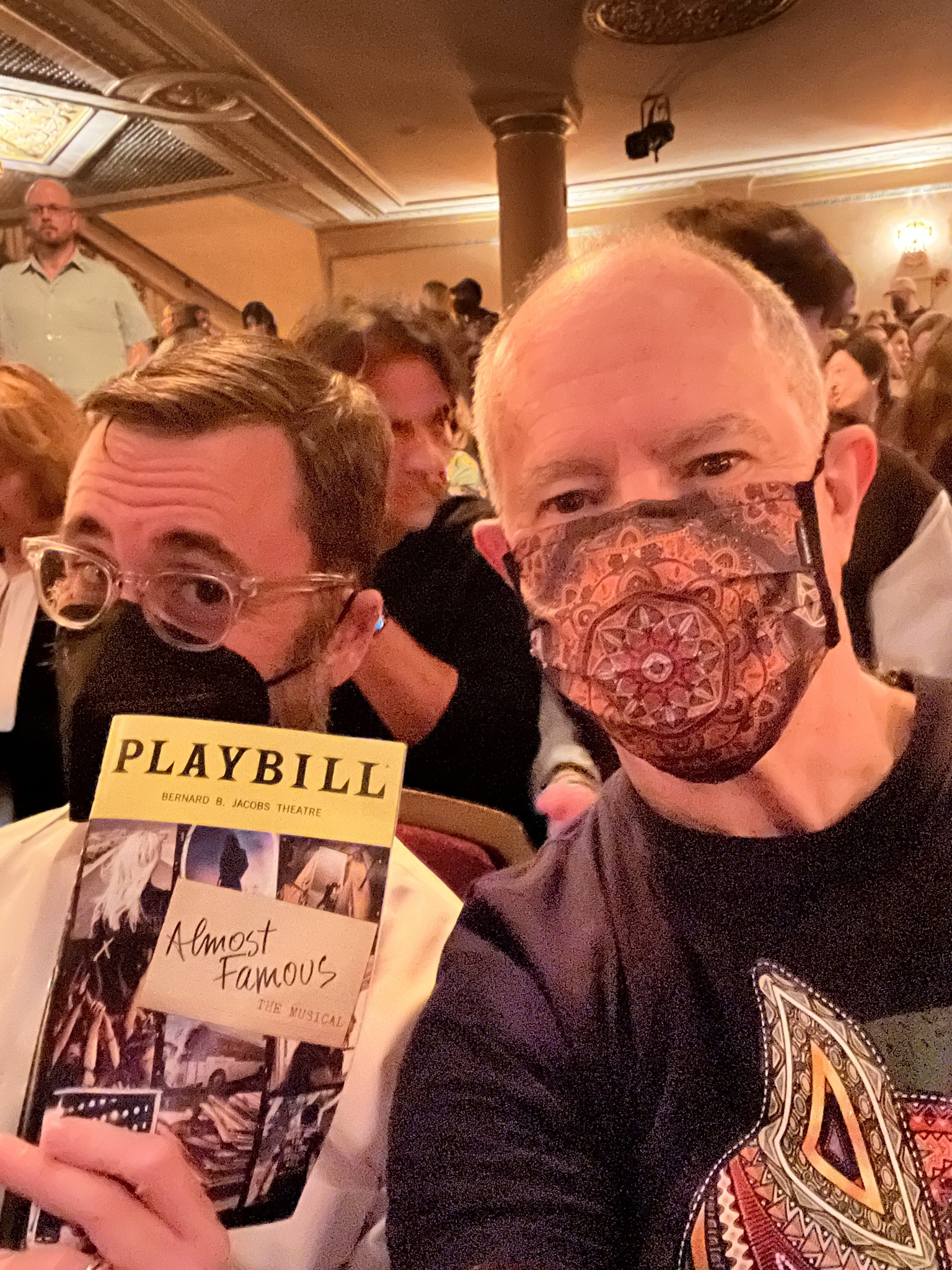
November 12 Cameron Crowe’s stage adaptation of his autobiographical movie Almost Famous, with music and lyrics by Tom Kitt, clearly lost some luster in its transfer from the Old Globe in San Diego, where it received ecstatic reviews in 2019, and its opening on Broadway, where it did not. The staging by Jeremy Herrin feels a bit limp. Still, there are pleasures to be had watching the cast inhabit the fantasy of Rock Star Life on the Road, circa 1973. Drew Gehling and Chris Wood have fun fronting the midlevel band that teenage journalist William Miller (Casey Likes) attempts to profile for Rolling Stone; ditto Rob Colletti as Lester Bangs, William’s snarling rock-critic hero-mentor. I kept thinking the show and the music were tame in their depiction of rock ‘n’ roll. But listening to the movie’s original soundtrack album later, I took in the point that the album and the movie make, which is that those rock bands — the Rolling Stones, Led Zeppelin, the Who, Lynard Skynard — didn’t do hardcore headbangers nonstop. They all had songs that inhabited a quieter, acoustic, folky/CSN territory. It was funny to emerge from the theater to commotion in the lobby – there was Cameron Crowe, happy to meet and greet and take selfies with excited fans.

It’s always fun delving into the background after seeing a show, reading reviews and interviews and other source material. A really fun complement to seeing Almost Famous was checking out the Netflix documentary Like a Rolling Stone: The Life and Times of Ben Fong-Torres while writing postcards to Get Out the Vote in Georgia for the Senate runoff race there. Ben Fong-Torres is best-known as a writer and editor in the early days of Rolling Stone (he’s a character in both the movie and the musical Almost Famous) but he has gone on to have an admirable career as a community organizer as well as broadcast journalist. And he kept all the tapes of the musicians he interviewed over the years!

Culture Vulture/Performance Diary: Queer Black Artists, Charlotte Adigéry & Bolis Pupul, Arooj Aftab, THE AFRICAN DESPERATE, Machine Dazzle, and more

September 29, 2022

The fall season kicked in big-time last week.

Sunday: I swear the New York Times’ fashion supplement T Magazine under Hanya Yanagihara’s editorship has more overt gay coverage than the Advocate does. This week’s cover story feature on young, queer black artists under 40 grew out of photographer Shikeith’s despire to pay tribute to Marlon Riggs’s groundbreaking 1989 documentary Tongues Untied, a beautifully poetic celebration of black gay male culture. The T Magazine event had several facets to it, beginning in Red Hook on August 1 with one of those history-making photo shoots gathering 24 artists in one place.

serpentwithfeet, Jacolby Satterwhite, Tune Olaniran, Troy Montez Michie, and Texas Isaiah, photo by Shikeith

The following day, five of them sat down with journalist Emil Wilbekin for a free-ranging conversation. Adam Pendleton, who recently had a splashy show in the atrium at MOMA, spoke directly to the discomfort many artists feel about having a minority-status adjective (black, queer, female, etc.) attached like a label to their work:

Adjectives are terrible, but generosity and legibility are important. And what I mean by that is: A project like this is almost a double-edged sword, in the sense that any instance where you’re identified is a terrible moment, actually. When you’re claimed as something — when you’re named as something — that’s not necessarily a moment of celebration or liberation. And that’s kind of what this being released into the world will mark. It’s funny because I actually never thought about any of this, so when you keep saying “Black,” “queer” — that’s not the language I used when I thought about myself as an artist. I was just like, “I’m an artist.” That was it.

I totally respect that apprehension, AND I will say for myself that I came out in the first post-Stonewall wave of gay liberation, and for me it has always been exciting when artists identify as gay or queer. It always makes me a little more interested in them. Not because I assume they will conform to some idea of what gay or queer art looks like — just the opposite. I’m thrilled to encounter yet another example of how rich and different and multifaceted queer art can be. So while this T Magazine feature included a few artists I already knew about (Jeremy O. Harris, Brontez Purnell, Jacolby Satterwhite, serpentwithfeet, Jaquel Spivey, and Ato Blankson-Wood, in addition to Pendleton), I now have a bunch more queer black brothers – poets, actors, musicians, designers, and visual artists — whose work I’m curious to investigate. I actively want to know what they have to say about beauty and desire, gender and politics, love and life. The names: Don Christina Jones, Abdu Ali, Jonathan Lydon Chase, Miles Greenberg, Devan Shimoyama, Hugh Hayden, Saeed Jones, Jonathan Gardenhire, Danez Smith, Clifford Prince King, Eric N. Mack, Edwin Thompson, D’Angelo Lovell William, Tunde Olaniran, Troy Montes Michie, and Texas Isaiah.

You can read an extended version of the conversation online here.

Hilarious side note: Leon Curry curated a Spotify playlist that provided the soundtrack for the photo shoot, and the T article includes a link. But the trap-heavy playlist has been thoroughly scrubbed of curse words, and the result is that some tracks make no sense at all because of the frequent dropouts that interfere with sound, sense, and flow.

Monday: The title and the structure of The Nipple Whisperer by the mononymous Lui suggests that the book is a step-by-step guide to cultivating nipple eroticism. It is that, but it is also a lot more. It is ultimately a stealth manual for sacred intimates.

The author has carefully surveyed key encounters with clients and lovers, and he shares with readers his trial-and-error experiments in sexual healing with a huge amount of grace, wisdom, and excellent writing.

Tuesday night: Touring the US for the first time, the Belgian synth-pop duo Charlotte Adigéry and Bolis Pupul took Bowery Ballroom by storm. Their debut album, Topical Dancer, dropped earlier this year – fun, effervescent, quirky, playfully political.

Best demonstration: “Blenda,” a hot hot groove (Bolis is the one-man band) while she sings, “Go back to the country where you belong/Siri, will you tell me where I belong?” In performance, they’re energetic and physically unafraid.

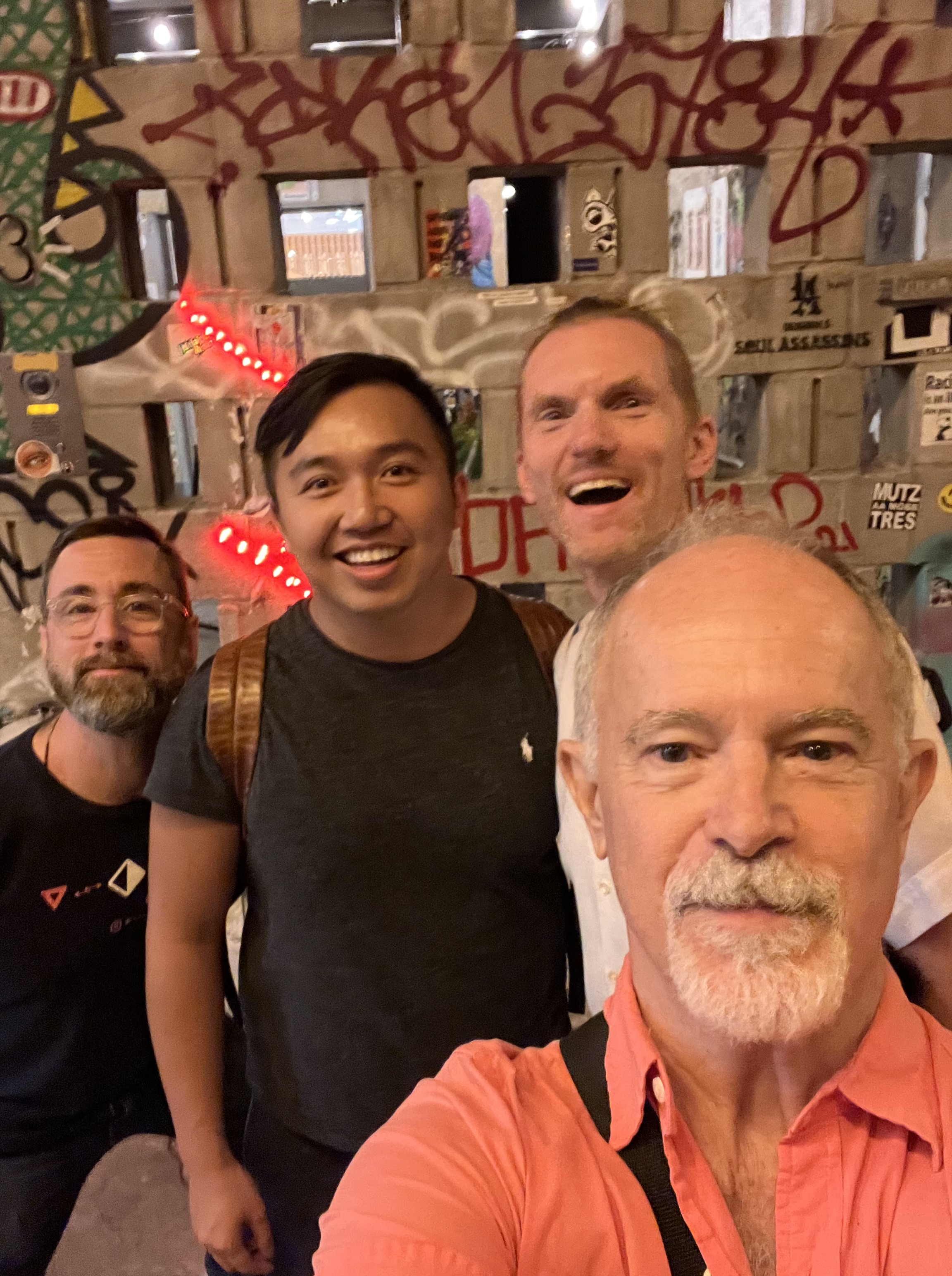
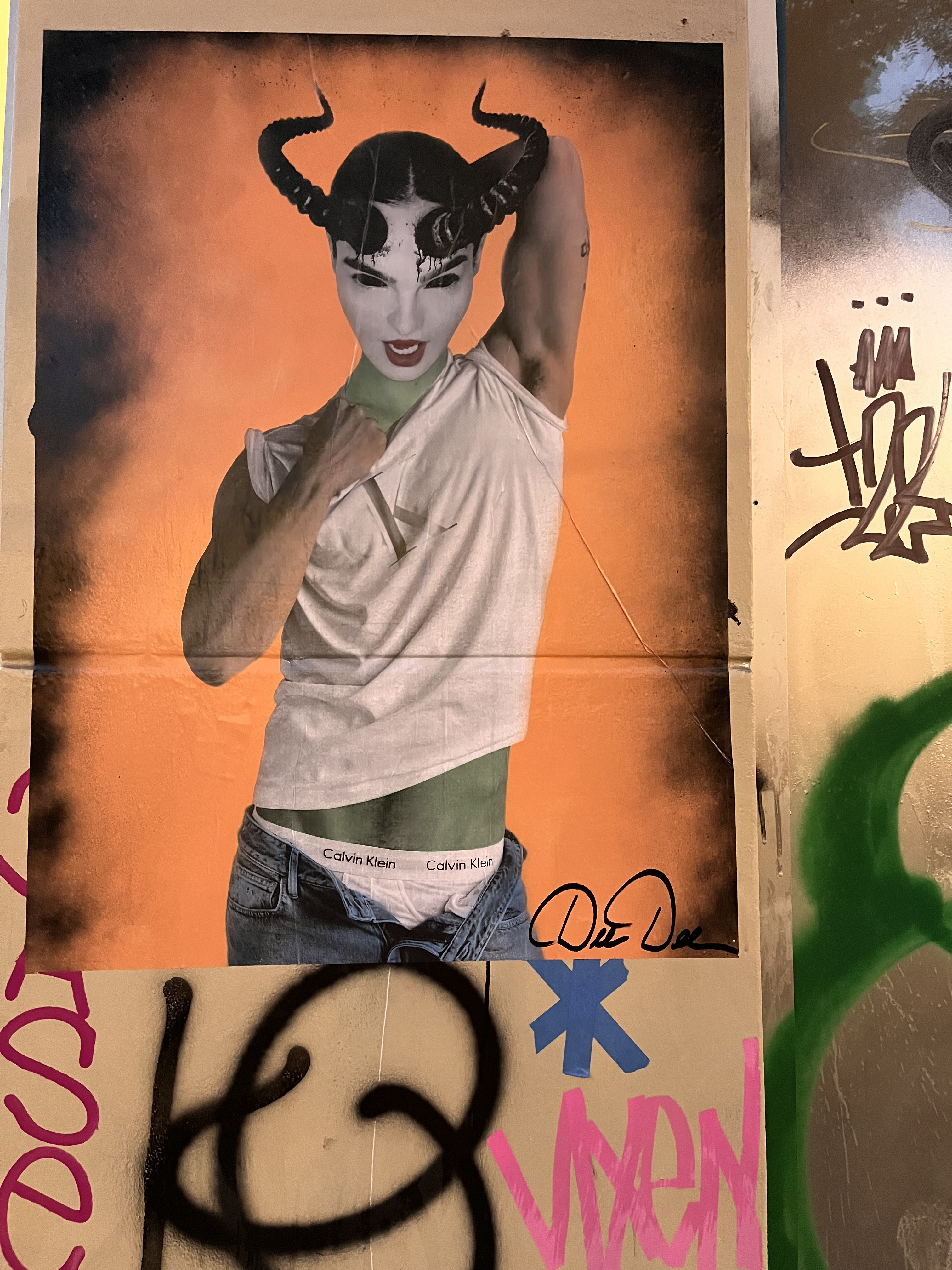
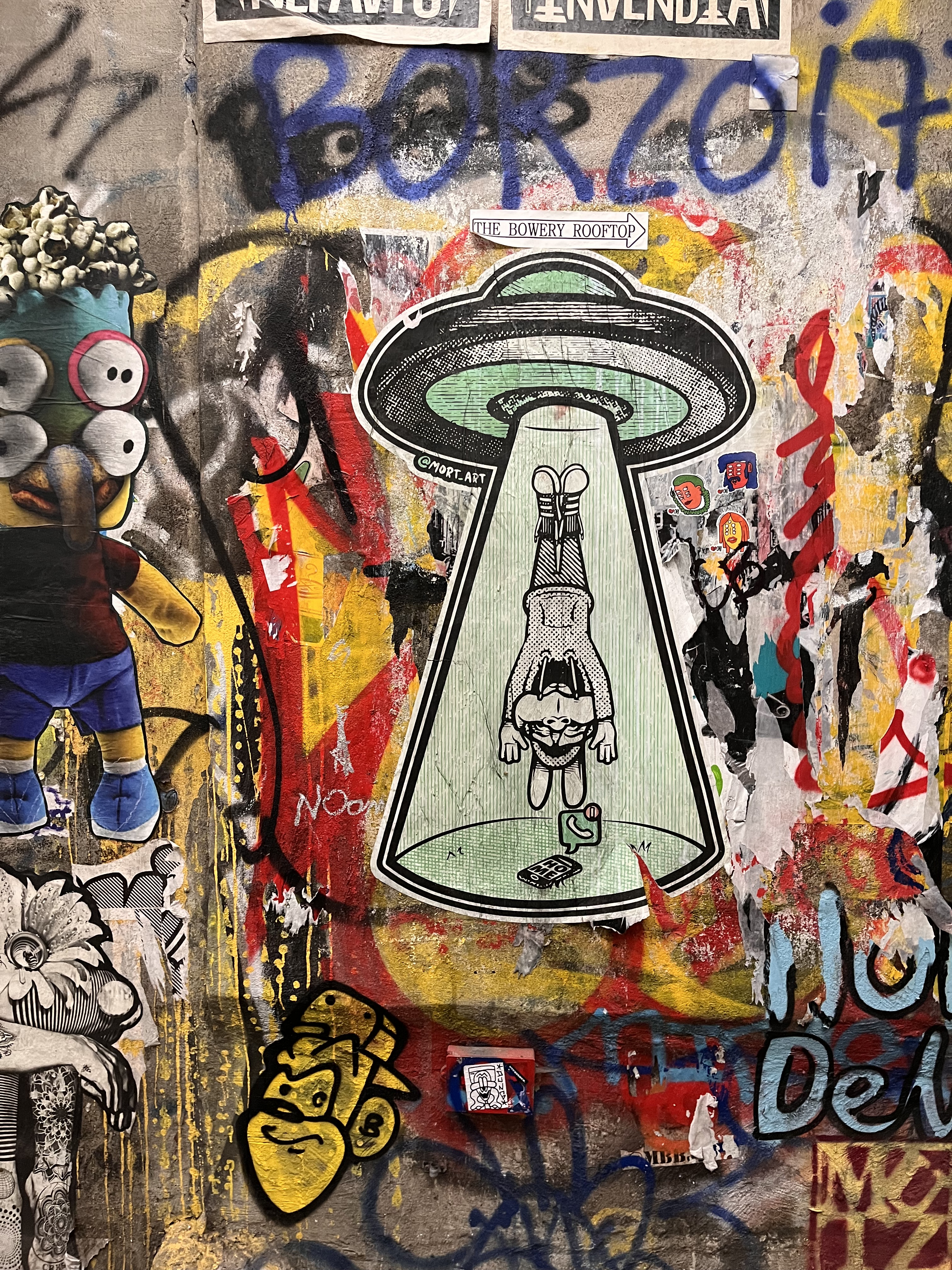
For their last number, they both jumped off the stage and cut a Soul Train swatch through the audience, communing and boogeying down with the ecstatic crowd. (Their next gig is at a festival in Bentonville, Arkansas!) Our posse of Body Electricians met beforehand for a drink and a bite at Loreley Beer Garden, and we took a stroll down Freeman Alley checking out the ever-changing artwork.

Wednesday: MUBI subscribers get free admission to one indie-film-in-need-of-an-audience every week. This time it was The African Desperate by Martine Syms at the Quad, a very smart, edgy portrait of a black female artist’s last 24 hours in an MFA program at a rural upstate New York campus (filmed at Bard). It opens with Palace Bryant (a brave performance by Diamond Stingily) sitting for a final studio visit with her four white faculty advisors, each with their own brand of excruciating micro-aggressiveness. As she packs up for home in Chicago and navigates stolidly ambivalent farewell partying with her classmates, frenemies, and gender-fluid flirtations, the name-checking of art theoreticians flows as freely as the party drugs.

Syms gives herself a huge amount of freedom to play with the kind of jump cuts, layering, and sound games you’re more used to encountering in music videos and TikToks than in feature films, not unlike, say, Janicza Bravo’s Twitter-inspired Zola or Michaela Coel’s mini-series I May Destroy You. (Although didn’t the recently departed Jean-Luc Godard do all of that first?) I’m not the only person who referenced Gaspar Noë’s Climax during some of the extended, chaotic, nerve-wracking sex-and-drugs sequences. One of the quirks that cracked me up was when friends would be sitting around dishing other people and the soundtrack would blank out the names, as if they were blind items in a gossip column. Speaking of soundtracks, you can listen to the music from The African Desperate on Spotify here.

Thursday: Someone at the Metropolitan Museum’s Live Arts department had the inspired idea of inviting Aroof Aftab, the sublime queer Pakistani Grammy-winning singer, to perform at the Temple of Dendur. Taking the stage, Aftab declared this was the most epic performance the group had ever played, which is saying something because she’s been touring (a lot of festivals) continuously since the release last year of her sublime album Vulture Prince.

She’s an incredible singer in the ghazal tradition, which conveys fragments of poetry in long slow exquisite lines without being show-offy. But she also has a wonderful dry sense of humor. She noted that people tend to classify her music as sacred because so much of it is slow, somber, soulful. But she specifically included one song in English on her album (taken from a Rumi poem, its entire text goes “Last night my beloved was like the moon/So beautiful”) to indicate that all the songs she sings are about being intoxicated and unhappy in love.

After opening the show with the album’s gorgeous first song, “Baghon Main,” she chatted for a while, admitting to the audience that she usually talks a lot and tells jokes between songs but she was a little intimidated by the august venue, so maybe not. In place of her usual glass of red wine, she had whiskey in a paper cup to sip throughout the show. And she said she’s lately taken to tossing roses into the audience, but she worried that security would tackle her if she tried that at the Met. Well, after a few more sips of whiskey, all her inhibitions flew out the window, and she cracked jokes about her fancy outfit, which made her feel like a car (and which she swapped out halfway through the show for a more comfortable but still glam long silvery coat). And she doesn’t shy away from sly political commentary, noting that the Temple of Dendur “may or may not be stolen.” (It is, after all, located in the Sackler Wing, named after the family whose pharmaceutical company has been castigated and prosecuted for its part in the opioid crisis.) And one by one all those long-stem roses onstage wound up in the hands of pretty ladies who caught the singer’s eye.

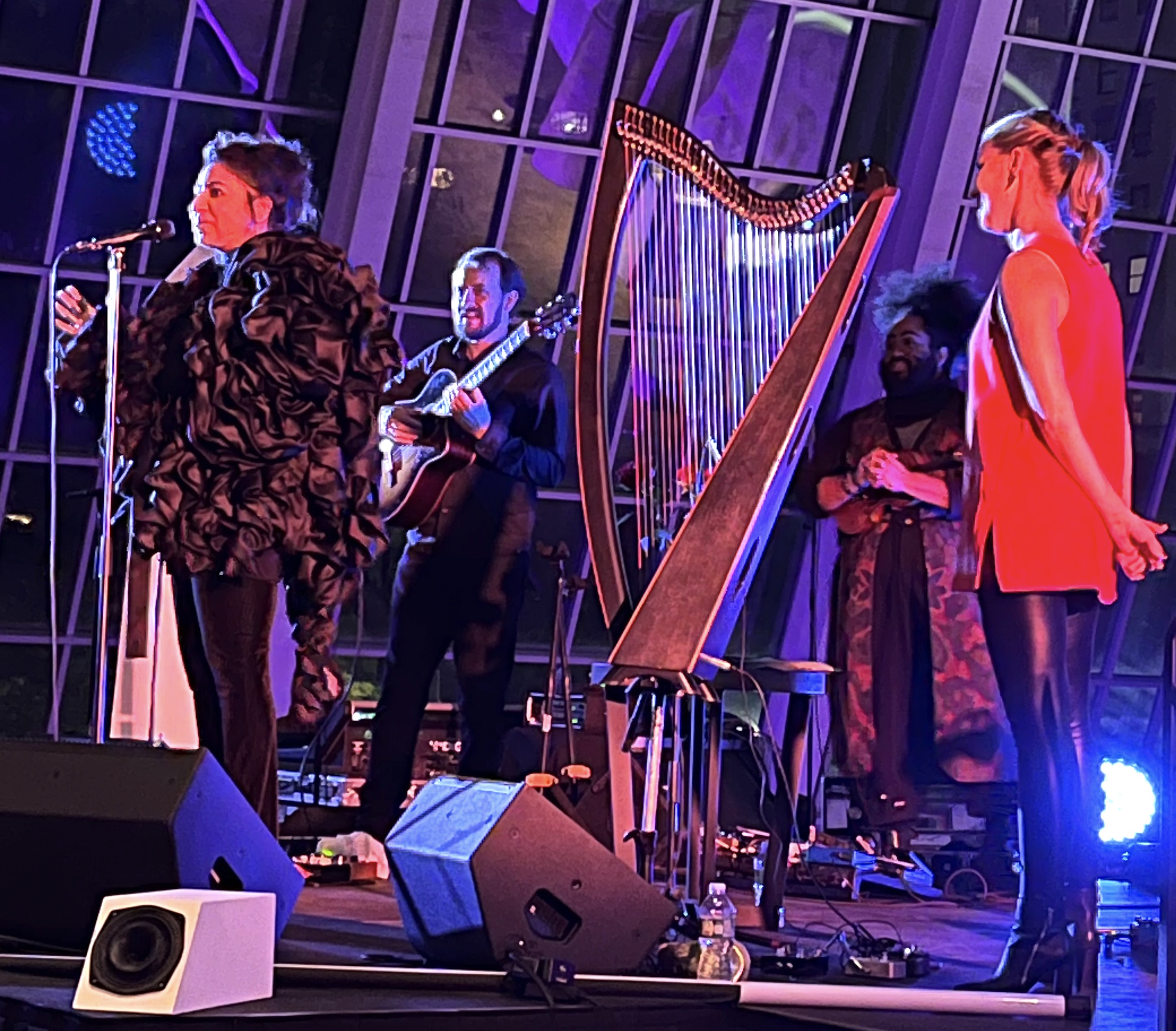
The acoustics were perfect for her mostly acoustic band, an oddball ensemble of harp (Maeve Gilchrist, tall blond whose high heels doubled as percussion), guitar (Gyan Riley), violin (the gender-queer glory that is Darian Donovan Thomas), and bass (Shahzad Ismaily, who also adds some crazy spice on the synthesizer keyboard he balances on his lap). She said they’d learned a lot about song order on tour, so they closed with their “happy” number, their “banger,” “Mohabbat,” which only in the world of ghazal could be considered a “banger.” The show was being filmed so will undoubtedly manifest online somewhere, but if you’ve not yet had the pleasure of hearing this exceptional vocalist, I would encourage you to check out her “Tiny Desk Concert” filmed during the pandemic for NPR.

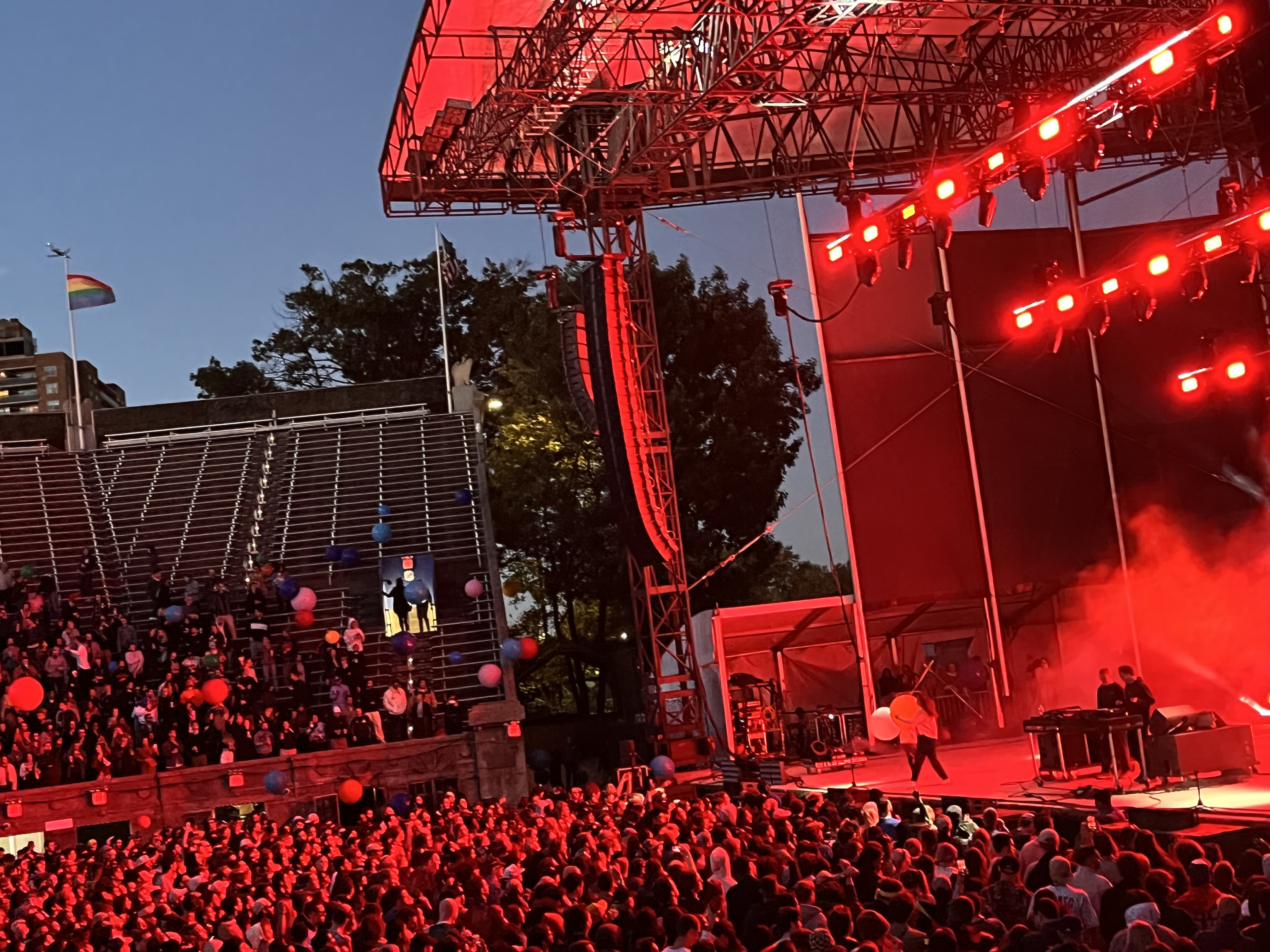
Friday: I returned to Forest Hills Tennis Stadium (where I saw Bon Iver and Odesza earlier in the summer) for another extravaganza featuring EDM superstars Jamie XX, Four Tet, and Floating Points. The latter two took the stage together, taking turns driving.

I’m a big fan of Floating Points (a happy bespectacled nerdy Brit named Sam Shepherd) and his bass-heavy grooves; he put out an extraordinary album last year called Promises featuring the London Symphony Orchestra and the legendary jazz saxophonist Pharoah Sanders, who died the day after the Forest Hills concert. Four Tet (another Brit named Kieran Hebden with very eclectic tastes) used his turns to conduct noise experiments that didn’t thrill me. A group of five little girls danced and frolicked behind them every so often. After an hour, Four Tet got the stage to himself and got more fun.

Jamie XX (aka James Thomas Smith, former member of the XX) definitely knows how to please a crowd by mashing up his own tuneful beats with surprises for the audience to sing along to (“Psycho Killer”! Ariana Grande’s “Into You”!).

Andy and I met up with our friends Jay and Paul, who just moved from Brooklyn to New Jersey and needed to let off some steam. Mission accomplished!

Saturday: Our friend Allen was visiting from San Francisco so Saturday afternoon we took him to the Museum of Art and Design and introduced him to the genius that is Machine Dazzle, who gets two whole floors to display his “Queer Maximalism.” The fifth floor showcases some of the mind-boggling outfits Machine created for Taylor Mac’s “24-Decade History of Popular Music.”

The fourth floor covers his non-Taylor costumes for shows at the Guggenheim, at Rice University’s Moody Center for the Arts, and for the Dazzle Dancers.

The detail and the beauty is insanely overwhelming. You could make separate trips to the show just to study the handbags, the shoes, and especially the kkkkkrazeee headdresses.

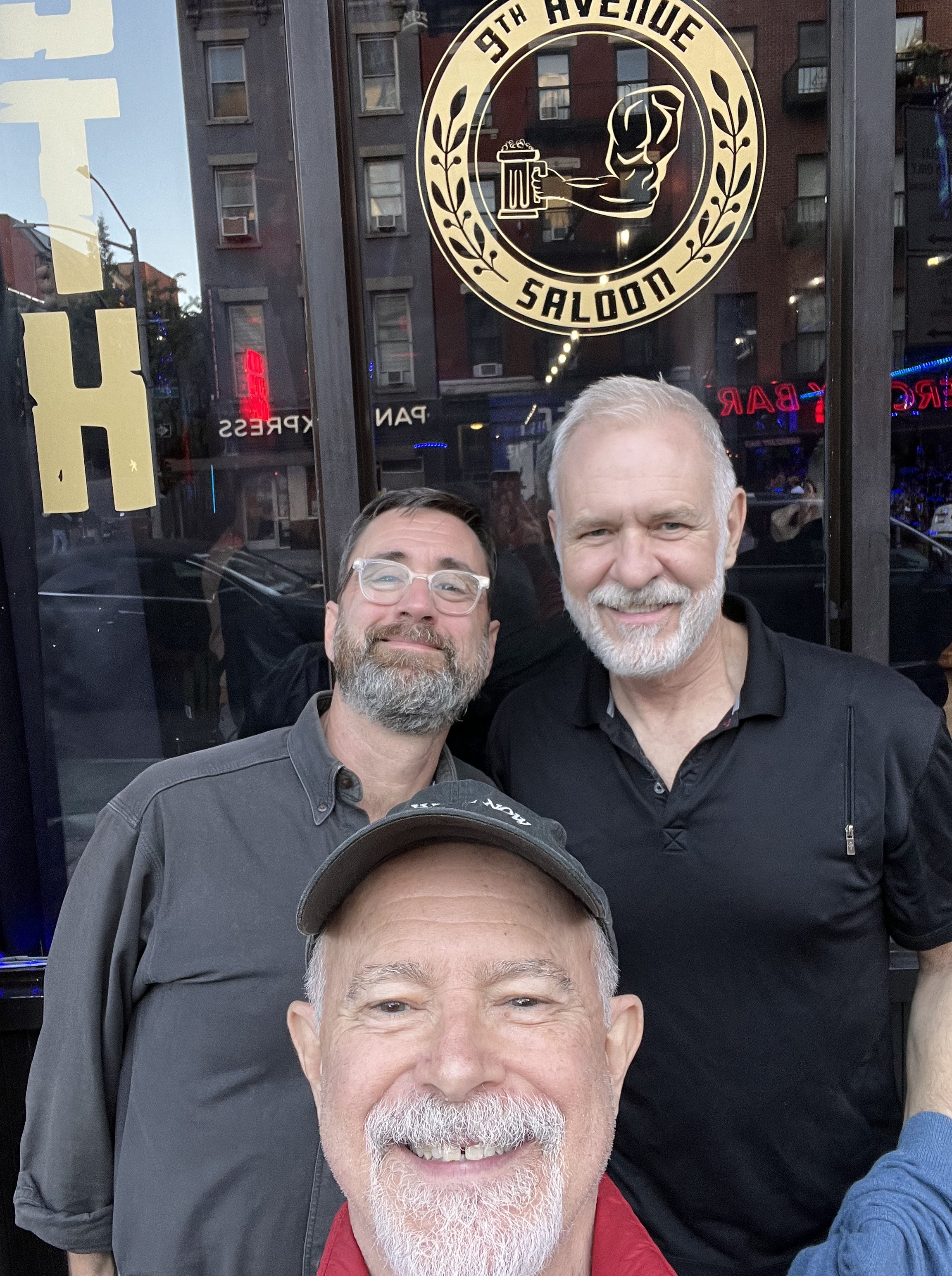
After beers at the 9th Avenue Saloon, Allen went off to Brooklyn, and we continued the day of Queer Maximalism by seeing the David Bowie movie MOONAGE DAYDREAM.

Not exactly a documentary, it’s more of a cinematic essay that collages rare concert footage, talk show appearances, and period cultural artifacts to present Bowie as more than a rock musician or pop star and more of a philosophical artist on a quest for meaning, for understanding his place in the universe. It’s written, directed, and produced by Brett Morgen, but the real wizardry is Morgen’s spectacular editing.

Sunday: I was feeling a little overwhelmed and oversaturated, but I raced down to the East Village on an electric Citibike (the trains were not running properly) to see Mud/Drowning at Mabou Mines at 7:30…only to learn that the show was at 2pm that afternoon. I rescheduled for this coming Friday, sandwiched between Monochromatic Light (Afterlife), the Tyshawn Sorey concert staged by Peter Sellars at Park Avenue Armory, and two very different shows on Broadway — MJ The Musical and Tom Stoppard’s Leopoldstadt. Next week: another wacky, eclectic marathon starting with Flying Lotus at BAM, continuing with David Greenspan’s one-man version of Gertrude Stein’s Four Saints in Three Acts, and at long last Funny Girl on Broadway!

Culture Vulture/Photo Diary: CAROLINE, OR CHANGE, Jasper Johns, Jennifer Packer, THE POWER OF THE DOG, and more

November 22, 2021

November 14 – Michael Longhurst’s revival of Caroline, or Change has had its delayed opening at Studio 54 under the auspices of Roundabout Theatre Company. Originally mounted in London, the show did nothing to erase my memories of the virtually impeccable original production that George C. Wolfe staged first at the Public Theater and then on Broadway. But Sharon D Clarke is indeed remarkable in the title role of Tony Kushner and Jeanine Tesori’s beautiful, strong musical play.

November 15 – I’ve been on a Paul Bowles roll recently, happily making my way through a massive volume of his letters (In Touch, edited by Jeffrey Miller). Bowles occupied one of the more fascinating corners of 20th century art as a novelist, composer, musical anthropologist, and photographer. He married Jane Bowles — both of them deeply idiosyncratic fiction masters, both of them queer — and for a time they lived in the famous house in Brooklyn also occupied by the likes of W. H. Auden and Chester Kallman, Benjamin Britten and Peter Pears, Carson McCullers, and Gypsy Rose Lee. He had to be one of the most pretentious/precocious teenage artists who ever lived — his first day in Paris he hung out with Jean Cocteau AND Gertrude Stein (who took him under her wing for a while and called him “Freddy”). The letters include a long missive he wrote to Ned Rorem while having a not-very-enjoyable trip of mescaline.

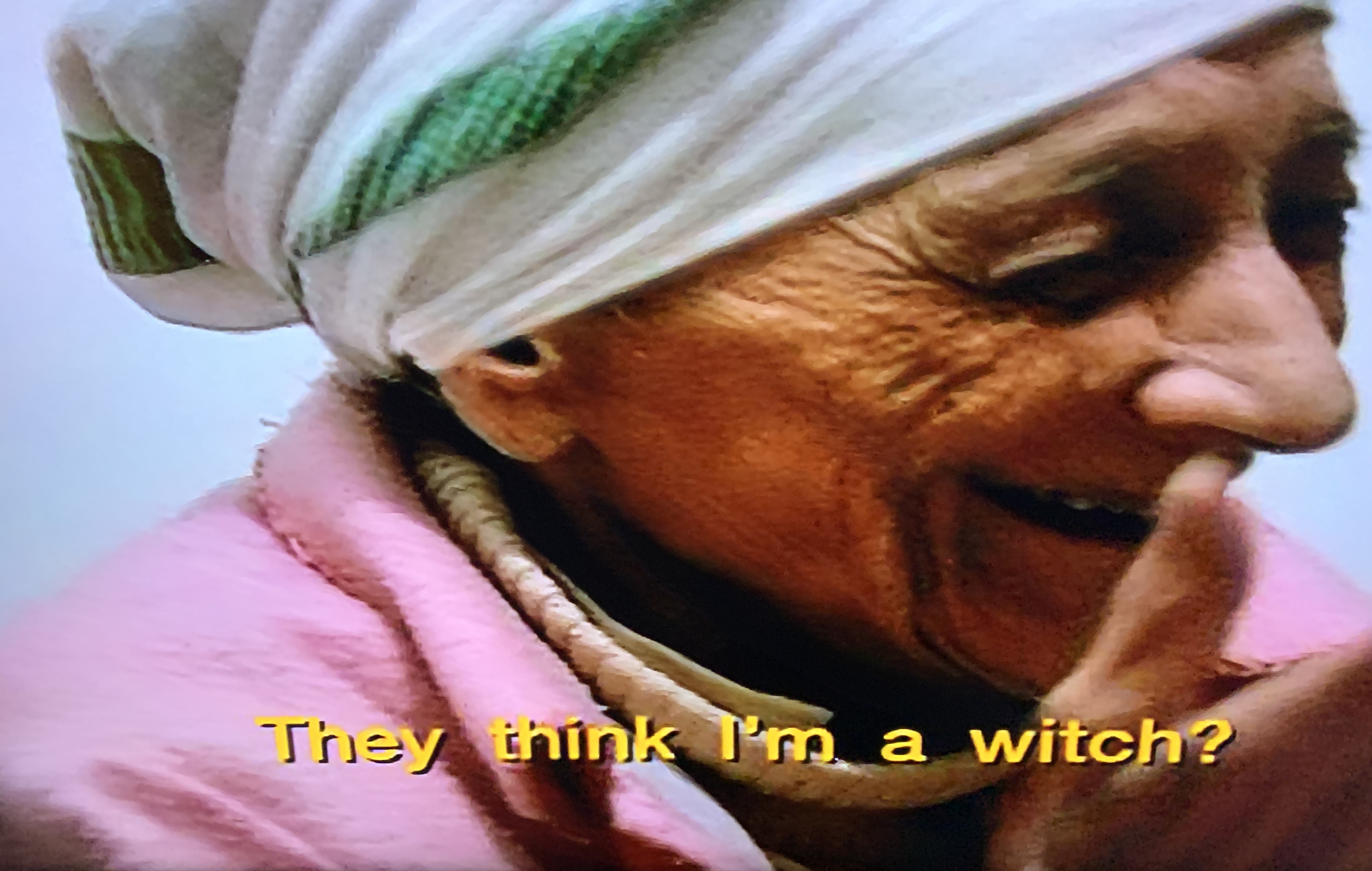
Jennifer Baichwal’s documentary Let It Come Down (available on DVD from Netflix) fed me plenty of tidbits. The filmmaker managed to get footage of a NYC hotel room meeting between Bowles (above), William S. Burroughs, and Allen Ginsberg, the last time those literary lions all met. Burroughs pronounces The Sheltering Sky “an almost perfect novel” (I agree) while also referring to Without Stopping, Bowles’ memoir, as Without Telling, because he’s so maddeningly discreet about anything having to do with sex, romance, or actual people (in contrast to Gore Vidal’s memoirs, which Burroughs appreciates for dishy gossip on every page). Bowles has nothing good to say about Bertolucci’s film version of The Sheltering Sky. I was also intrigued to see footage of Cherifa, Jane Bowles’s mysterious partner, as an old woman (below) repeating without denying rumors that she was a witch who exerted strange powers over JB.

November 18 – I don’t have anything nice to say about Lynn Nottage’s new play Clyde’s, directed by Kate Whoriskey for the Second Stage at the Helen Hayes Theatre, so I’m not going to say anything at all.

November 19 – I dutifully showed up at the Whitney Museum to check out Jasper Johns: Mind/Mirror (the other half of this retrospective is at the Philadelphia Museum of Art), which only confirmed the inability of Johns’ work to move me at all. His imagery (flags, numbers, maps, etc.) has always landed on me as extremely banal and ugly. The one piece that stood out for me in this show is Field Painting, probably because it looks a lot like the kind of multimedia “combine” that was the specialty of Robert Rauschenberg, his former partner and an artist whose lively, restless, generous creativity has always excited me.

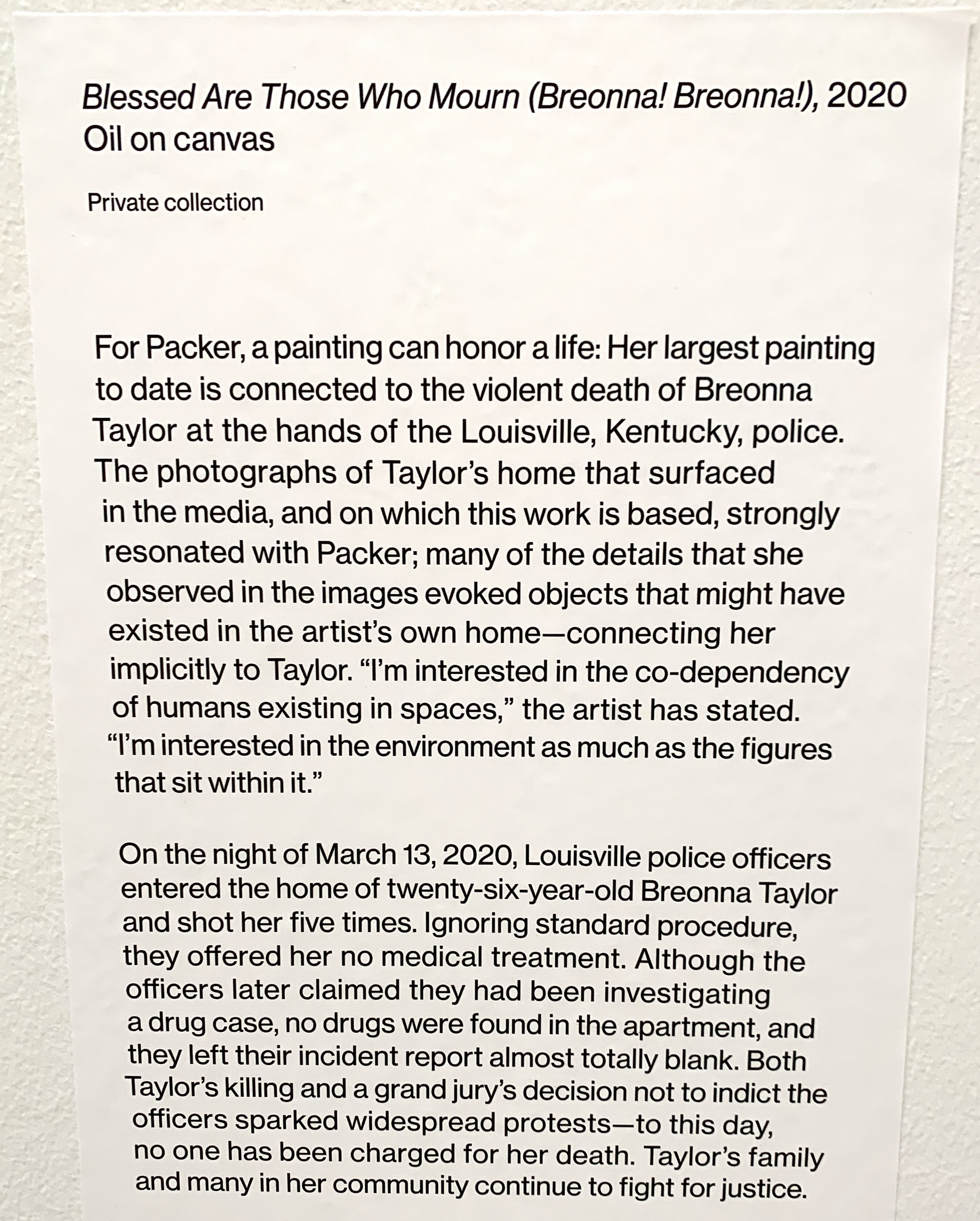
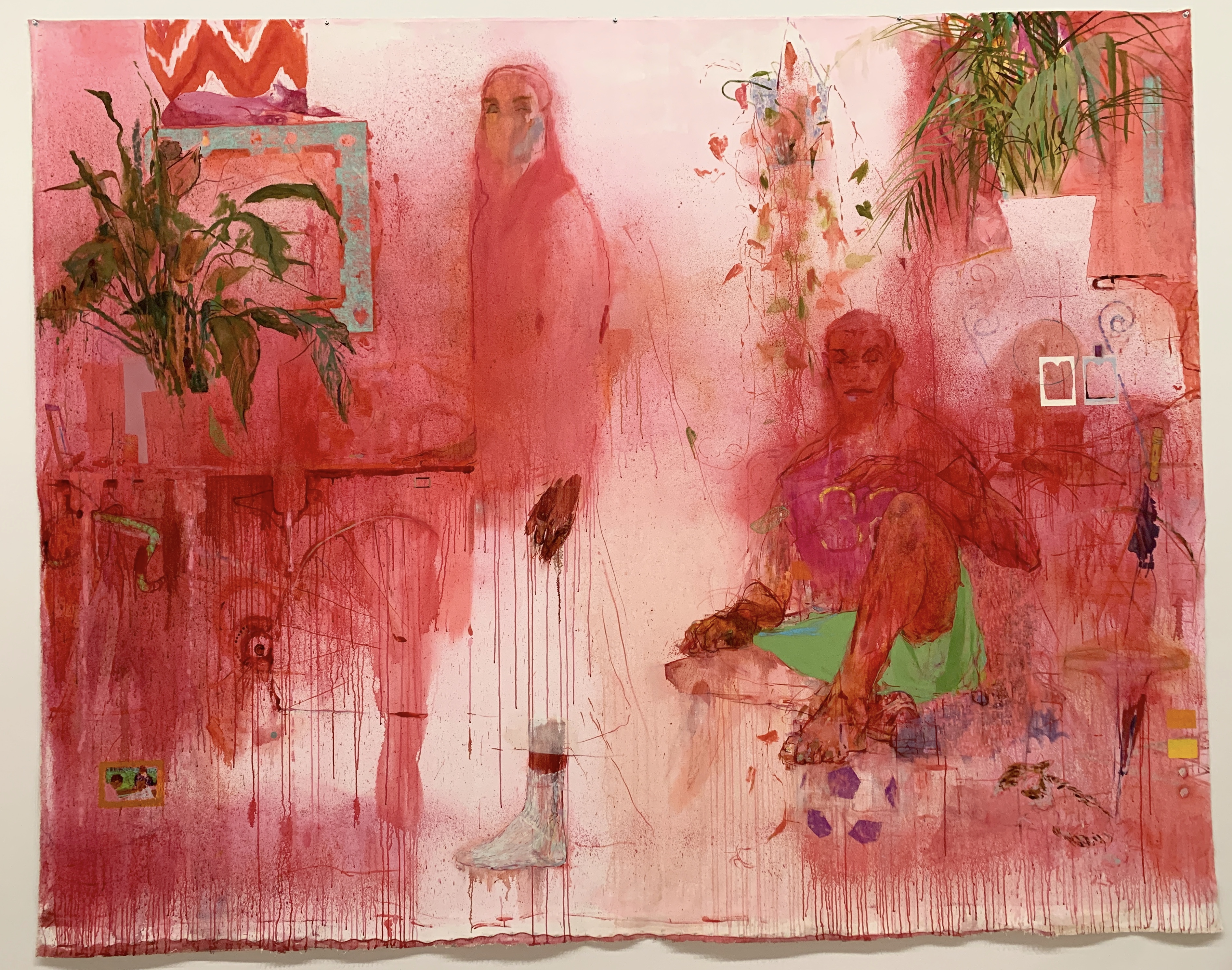
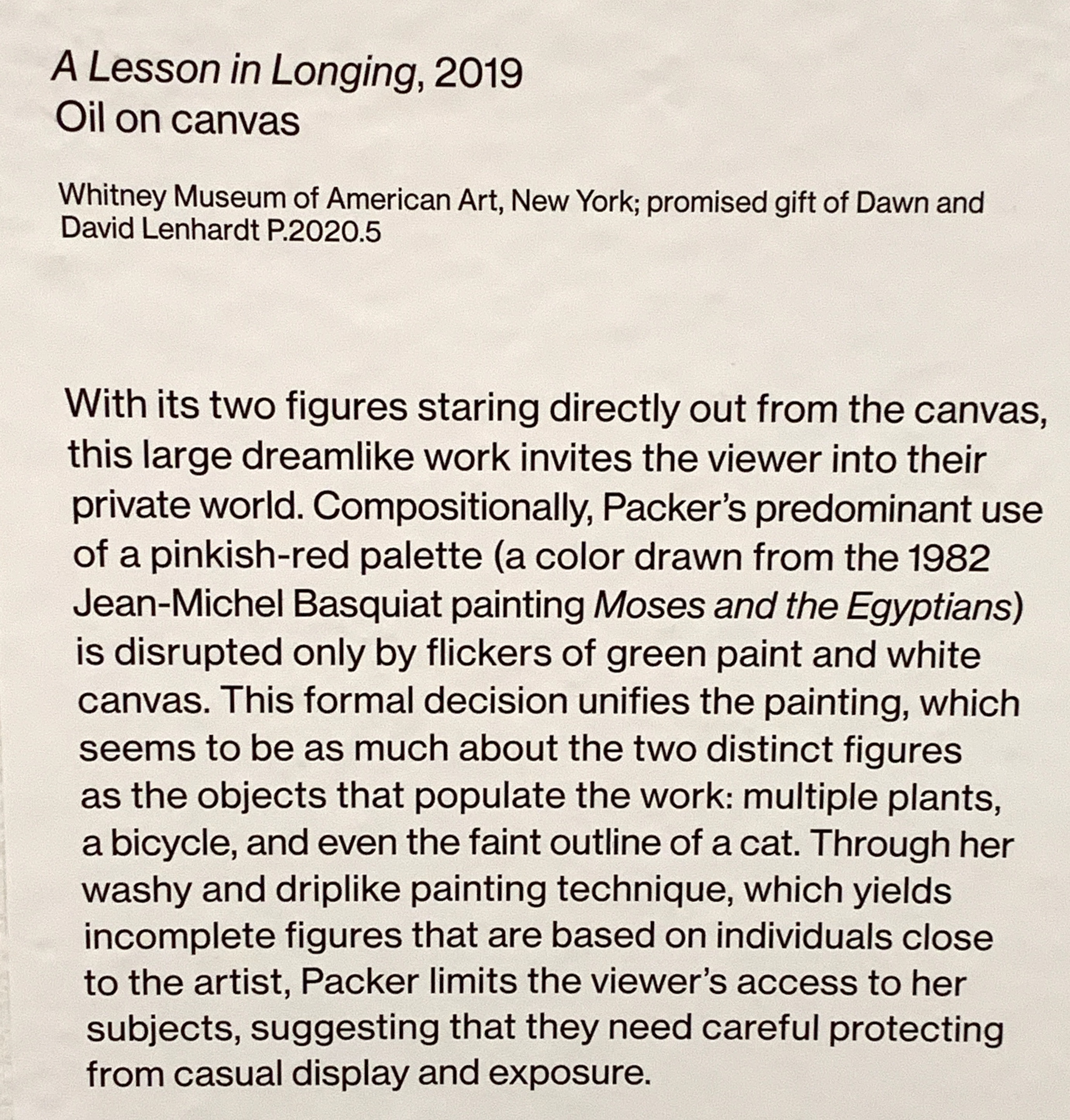
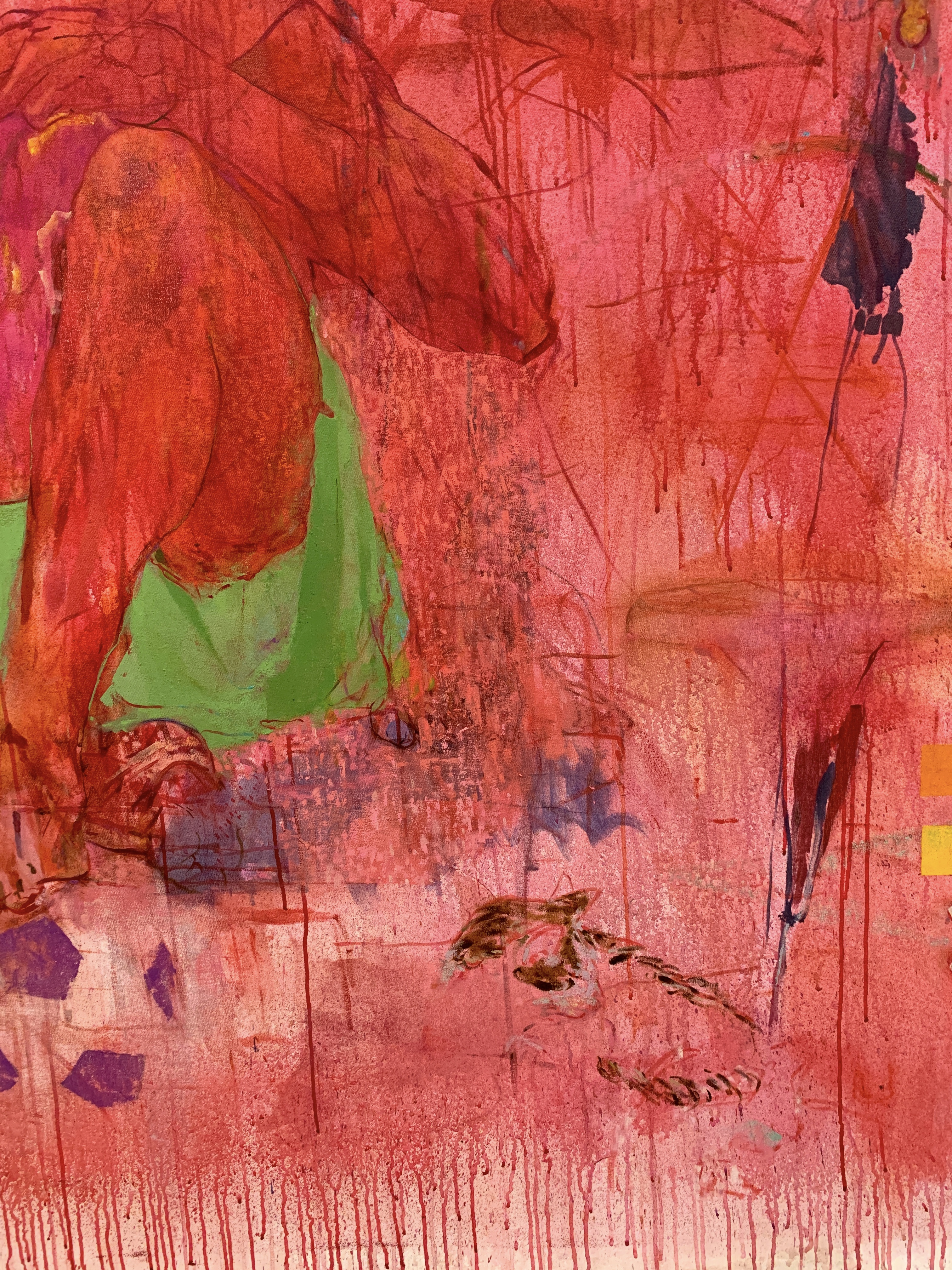
The real reward of this expedition was encountering the splashy exhibition by a painter new to me: Jennifer Packer: The Eye Is Not Satisfied With Seeing. Her large multilayered canvases merge representation and abstraction in unusual and beautiful ways.

I’d also never heard of My Barbarian, the Los Angeles-based art collective, whose installation on the first floor is small but dense and fun and alive with film and animation.

November 20 – Today was National Trans Day of Remembrance. As I’ve done numerous times in the past, I gathered with Gays Against Guns – the activist organization formed after the Pulse massacre in Orland in 2016 – and manifested as one of the Human Beings, silent veiled figures dressed in white representing victims of gun violence. I held placards commemorating Tiara Banks and Dominique Lucious, two of the 34 trans Americans killed by guns this year alone (more have been murdered through other means).

We stood in front of the Washington Square Arch as passersby read and absorbed the stories of these lives lost to senseless violence, and then we processed across the park to Judson Memorial Church, where there was a ceremony and service honoring trans lives.

Among the other Human Beings were two artist friends who’d never met. I got to introduce Paul Wirhun (aka Rosie Delicious aka Egmananda), a radical faerie artist who specializes in psanky (eggshell painting), to Antonius Wiriadjaja (aka Oki), whose Instagram #foodmasku (“I make my meals into masks and then I eat them”) went from pandemic pastime to online sensation. Oki, whom I met playing with Gamelan Kusuma Laras, is also a victim of gun violence (innocent bystander to a drive-by shooting in Brooklyn) and tireless advocate for better gun control laws.

I also got to meet Camille Atkinson (below right), who’s from New Orleans and knows how to rock a memorial outfit.

I wasn’t chomping at the bit to see Lin-Manuel Miranda’s film version of Jonathan Larson’s musical tick…tick…BOOM, mostly because I’m not a fan of Andrew Garfield (still haven’t forgiven him for his shallow performance in Angels in America on Broadway – minority opinion, I know, since he walked away with the Tony Award). Nor was I a big fan of Rent, of which TTB is kind of a rough draft. But it was Saturday night on Netflix, so we tuned in. The first 10-15 minutes were tough going, with all the selling-it-to-the-rafters Broadway-style singing we’ve been overdosing on lately. What kept us going were the cameos – I kept exclaiming with delight spotting New York theater treasures among the supporting cast and background players (see the complete list online here), and Andy had fun spotting familiar geographical landmarks and vicariously inhabiting cramped Village apartments recognizable from when he himself was a lad in the early ‘90s finding his way through NYC.

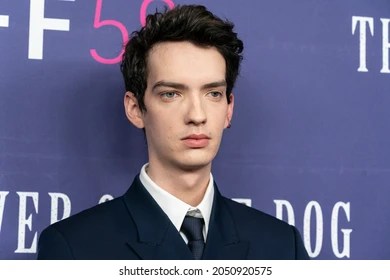
November 21 – MUBI is yet another curated streaming platform for arcane art cinema from all around the world. I’ve encountered some gems and a lot of quirky curiosities there, and just when I think “Is this really worth $10.99 a month?” they’ve sweetened the deal by offering subscribers a free ticket to a brand-new art film playing in theaters. I might not have gotten to Jane Campion’s new film The Power of The Dog so quickly if it hadn’t been playing two blocks from my house at the Paris Theater, FOR FREE. But wow, so glad I did! I’ve loved a lot of Campion’s work, and this one is right up there. I’m never drawn to any movie that falls in the category of “Western” – even one set in Montana but shot in the hills of New Zealand – but this one is exceptional. I had flashes of thinking about There Will Be Blood and Days of Heaven and Brokeback Mountain and even A Streetcar Named Desire but then the film (based on a novel by Thomas Savage) goes several places I would never have guessed. I say no more except to recommend it to anyone who has the patience for a slow-moving but intensely emotional drama. Among the strong performances is one you won’t quickly forget by this kid named Kodi Smit-McPhee.

Opinions are not ideas. I wish I had more ideas than I do. But I do have positive opinions about three other shows playing right now, shows that would surely never be produced on Broadway if it weren’t for the ruptures we’ve seen in the last couple of years. I highly recommend the two downtown hits playing in rep at the Lyceum Theatre, Tina Satter and Half Straddle’s Is This a Room and Les Waters’ production of Lucas Hnath’s Dana H. (with quietly astonishing lead performances by Emily Davis and Deirdre O’Connell, respectively). Ditto Alice Childress’s Trouble in Mind, a trenchant and still pertinent play about racial politics in New York theater finally having its Broadway premiere at the American Airlines Theatre, elegantly staged by Charles Randolph-Wright for the Roundabout, with especially fine performance by LaChanze, Chuck Cooper, and Michael Zegen.