Archive for the 'performance diary' Category

Performance diary: HEDWIG AND THE ANGRY INCH, EARLY SHAKER SPIRITUALS, Streb Company’s FORCES, and Gamelan Kusuma Laras

June 2, 2014

hedwig
5.24.14
— I had my doubts in advance, but Neil Patrick Harris really pulls off the starring role in HEDWIG AND THE ANGRY INCH. The flashy show finally making its Broadway debut at the Belasco Theater is way different from the funky lounge act through which the original Off-Broadway production took the theater world by storm. John Cameron Mitchell, the show’s creator and original star, had a scrappy seat-of-the-panties energy and vulnerability that uncannily mashed-up pathos with rock-n-roll spectacle. For all the new production’s conceptual conceit that it’s appearing on Broadway for one night as a special favor on the set of the disastrous Hurt Locker: The Musical, this Hedwig is a big lavish show, smartly staged by Michael Mayer with fantastic sets by Julian Crouch, costumes by Arianne Phillips, and dazzling lighting by Kevin Adams. NPH in no way convinces as “an internationally ignored song stylist” – he’s like Liza Minnelli playing Sally Bowles: dramaturgically wrong for the part, but theatrically totally satisfying. The score sounds better than ever, and the tight young band turns the show into one hot rock concert.

hedwig tommy gnosis

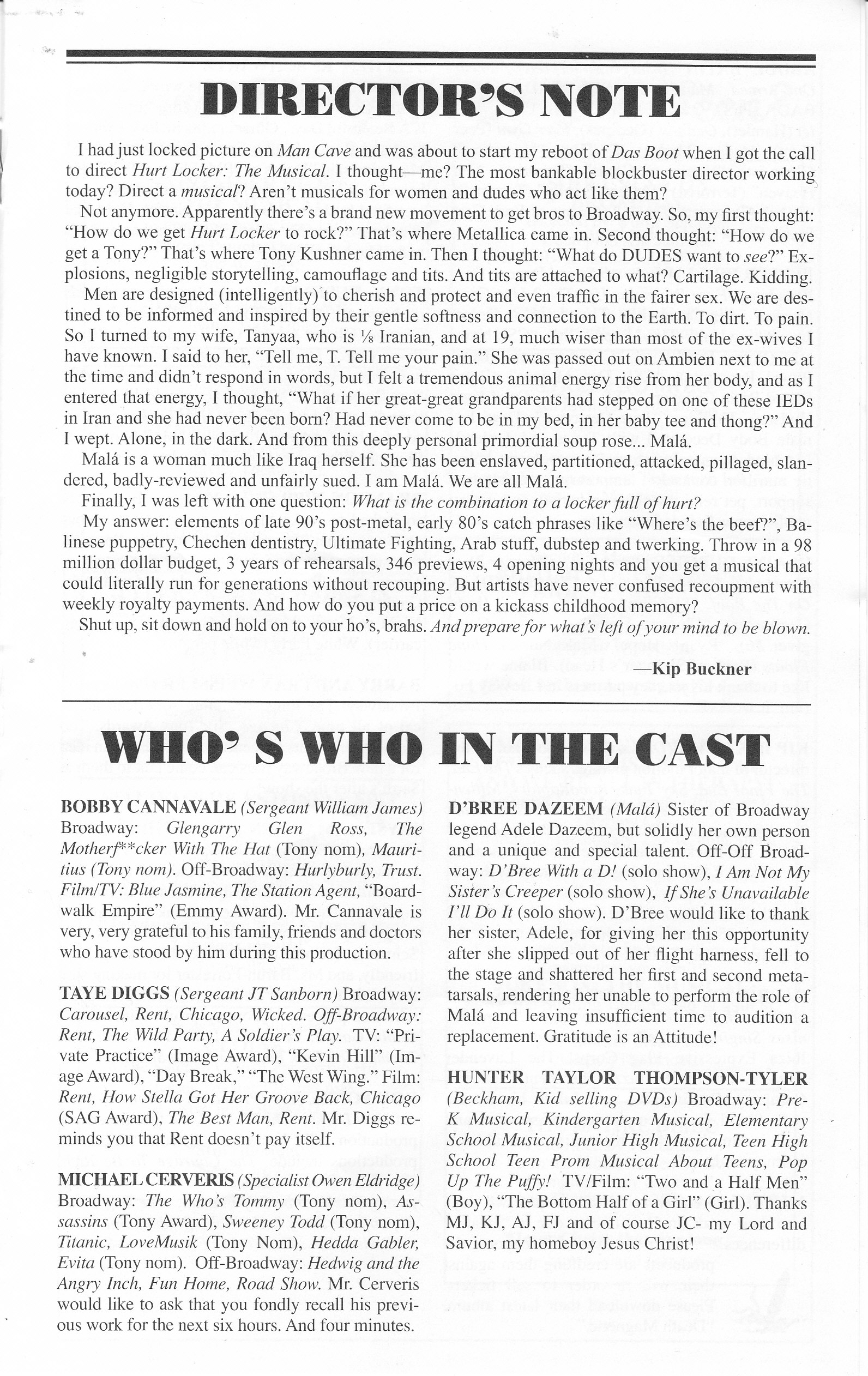
Afterwards, I had occasion to appreciate the enormous amount of time and energy that went into the whole back story about Hurt Locker: The Musical, which supposedly closed at intermission on its opening night. I’d heard about the dummy program for that show floating around, but it’s not handed to ticketholders for Hedwig – copies are scattered around on the floor under the seats, and you have to be savvy enough to pick one up for yourself. It’s a delicious bonus. Every page of the fake program is stuffed with hilarious inside jokes (the copy is apparently written by Mike Albo and others). I’m reproducing the key pages here, for the benefit of people too far away to the see the show. Locals, check it out for yourself! (click on the images to enlarge — read all the obsessive fine print)
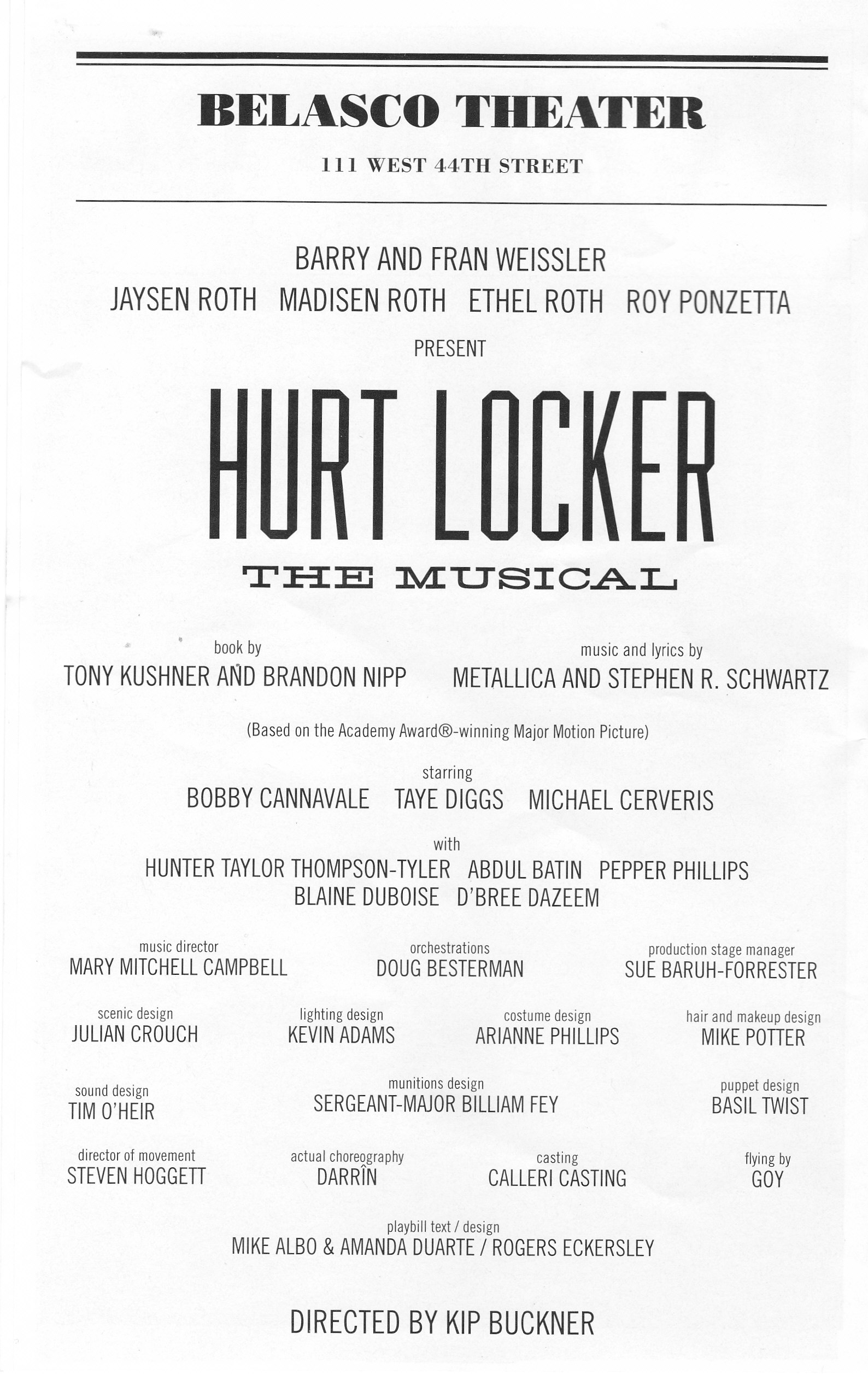
hurt locker 2hurt locker 3hurt locker 4hurt locker 5hurt locker 6

5.25.14 – The Wooster Group’s Early Shaker Spirituals is the exact opposite of Hedwig’s flashy spectacle. It’s small, contained, earnest, pure. I love that it’s a complete departure from their best-known style of dense techno-theater mash-up, but it’s not completely unprecedented: it falls in the category of “record album interpretations,” of which they’ve done two before (Hula and the first stage of what became L.S.D. (..Just the High Points…). The hour-long show has four getting-to-be-elderly female performers – Frances McDormand, Suzzy Roche, Wooster artistic director Elizabeth LeCompte, and the company’s manager/producer Cynthia Hedstrom – standing or sitting and singing 20 songs from a 1970s recording of Shaker hymns (the most famous being “Simple Gifts” and “Run Shaker Life”). This being a Wooster Group piece, they are dressed in Shaker costumes but strapped into wireless battery packs and earpieces through which they hear the vinyl recording being played, but we don’t. We see the sound technician dropping the needle on the album, which sometimes lands a few seconds before the end of the previous track, so the singers dutifully echo whatever they’re hearing.

EARLY SHAKER SPIRITUALS

At the end of the 20 songs, they are joined by veteran dancer-choreographer Bebe Miller, also in Shaker costume, and four young guys in contemporary street clothes, and they all perform a series of Shaker dances to some of the same songs. The dances waver between being authentic reenactments and slightly goofy exaggerations. It is a odd but completely reverent homage to a religious community through music and movement.

early shaker dancing
LeCompte has not performed with the company since the mid-1970s, and it’s quite moving to watch her onstage looking both vulnerable and completely committed. Watching Early Shaker Spirituals, I couldn’t help remembering interviewing LeCompte at the time of creating Route 1&9, the legendary mash-up of Thornton Wilder’s Our Town and a Pigmeat Markham vaudeville routine that got the Wooster Group in trouble for its use of minstrel-show blackface. “When we read Our Town over and over again, for me it was like saying a prayer,” LeCompte told me. “It was calming and soothing. It was everything you knew had no relevance in your life anymore, but it was still beautiful to listen to. It’s so sentimental, and I don’t know how I feel about sentiment. But I know I love it. ”

5.30.14 – My curiosity was piqued about Streb Company’s latest show Forces when I found out that the creative team included the brilliant theater director Robert Woodruff, writer Jim Lewis (Fela!), and composer David Van Tieghem. Like every other Streb event I’ve seen, it’s a nonstop demonstration of her dancer-gymnast daredevils flinging themselves around the stage, against the floor, against Plexiglas walls, against each other, interacting with theatrical machinery (turntables revolving in opposite directions, a human-sized gyroscope, an elevated box, a Cirque du Soleil-like contraption called the Rocket). I wasn’t sure what Woodruff and Lewis contributed, but I guess they worked with Streb on the filmed interview segments projected onto the back wall during set changes and dancer breaks, recalling Wim Wenders’ film on Pina Bausch. They’re interesting and well-shot, and the performers give their all. I couldn’t take my eyes off of hunky Daniel Rysak but the team captain was clearly brave and virtuosic Cassandre Joseph. In contrast to most theater events, at Streb the audience is encouraged to take pictures and videos and share them via social media.

5-30 streb slice5-30 streb gyroscope5-30 streb rocket

6.1.14 — Gamelan Kusuma Laras, the Javanese gamelan ensemble that I play with, got invited to give a concert at Riverside Church as part of the Christ Chapel Chamber Series. It was a beautiful concert in a lovely setting (the views of the river from the tenth floor were spectacular)

6-1 grants tomb
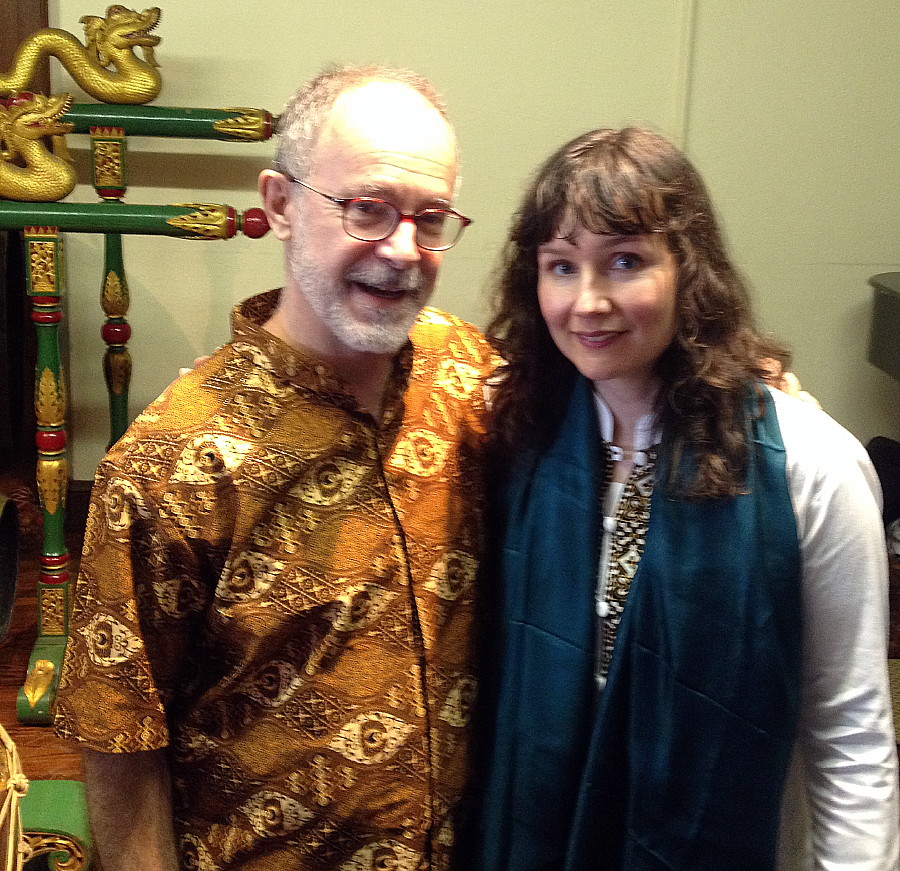
with a full house of attentive listeners. I love playing with this ensemble, under the direction of our wizardly musical director I. M. Harjito. For this concert, I got to alternate among several different instruments (gong, kempu, saron, and singing with the gerongen [male chorus]). But for me the high point of the concert was hearing two exceptional singers – Dylan Widjiono (below), a regular member of our group, who sang the introductory bawa for Gendhing Onang-Onang,

6-1 dylan6-1 don jessika
and Jessika Kenney (above right), a guest artist who flies in from Seattle to sing for our concerts and whose unaccompanied improvised andhegan for Ladrag Kutut Manggung. Listening to extraordinarily talented, passionate, open-hearted vocalists from just a couple of feet away was thrilling beyond belief. Their singing brought tears to my eyes.
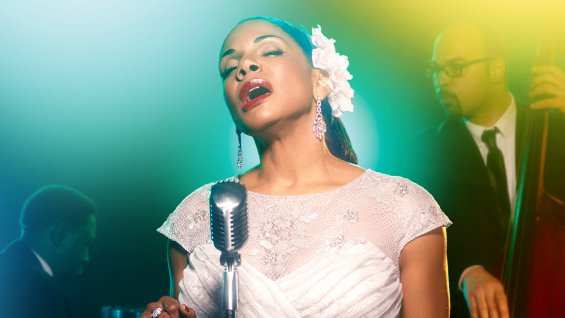
 

Performance diary: LADY DAY AT EMERSON’S BAR AND GRILL

May 5, 2014

audra_mcdonald_lady_day
5.3.14 – From the very first note she sings in Lady Day at Emerson’s Bar and Grill, Audra McDonald dives deep into the persona of Billie Holiday and never comes out. It’s not a superficial impersonation or even a musicianly tribute to an indelible style. It’s a carefully studied and crafted performance, ever so slightly stylizing the vowels she sings in a way I’ve never heard anyone else do. It doesn’t even necessarily sound exactly like Holiday but I liked the curious and specific attention McDonald paid to each moment of each song. She has had excellent help from her director, Lonny Price, who took a pretty drab script by Lanie Robertson and made an event out of it, surrounding the singer’s bandshell with cabaret tables to make the usually cumbersome Circle in the Square Theater deliciously intimate. McDonald has a surfeit of conventional beauty, something Holiday lacked, but she’s willing to get rough and look unpretty. The moments when she starts building a tirade about racism in the music business or financial exploitation and her accompanist Jimmy Powers (played by Shelton Becton) gently guides her back into a song reminded me uncannily of Nina Simone in concert (see her riveting, disturbing Live at Montreux video). You know you’re watching a brilliant performer in serious decline, yet Price finds a way to end the show with a spot of unexpected theatrical grace.

Performance diary: RED-EYE TO HAVRE DE GRACE

May 3, 2014

red-eye
5.2.14 –
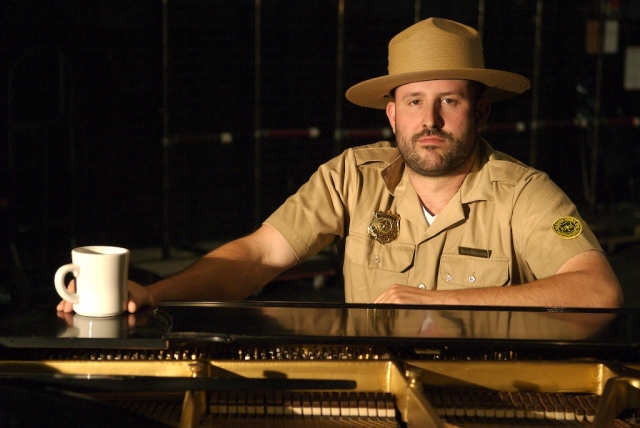
Red-Eye to Havre de Grace is a sneaker of a hit show down at New York Theater Workshop. Written, directed, and designed by Thaddeus Phillips, developed and produced by his company Lucidity Suitcase Intercontinental, it’s an intimate 90-minute spectacle for four performers – the brothers who composed and perform the music, David and Jeremy Wilhelm; Ean Sheehy, who plays Edgar Allen Poe in the crazed last days of his life, taking train rides up and down the Eastern seaboard trying to promote his essay on the meaning of life, “Eureka”; and Alessandra L. Larson, who plays the ghostly dancing figure of Poe’s beloved dead wife Virginia without speaking a word. The music and the staging are surprising, witty, and theatrically inventive. The show falls in the category of non-traditional musical, a la Natasha, Pierre, and the Great Comet of 1812 or The Adding Machine. For me, it was a cool introduction to this Thaddeus Phillips person, definitely someone to keep an eye on. And for gay guys with a taste in bears, Jeremy Willhelm in his park ranger uniform (below presents a new erotic ideal.

jeremy wilhelm

Performance diary: MAKE IT BIG

April 28, 2014

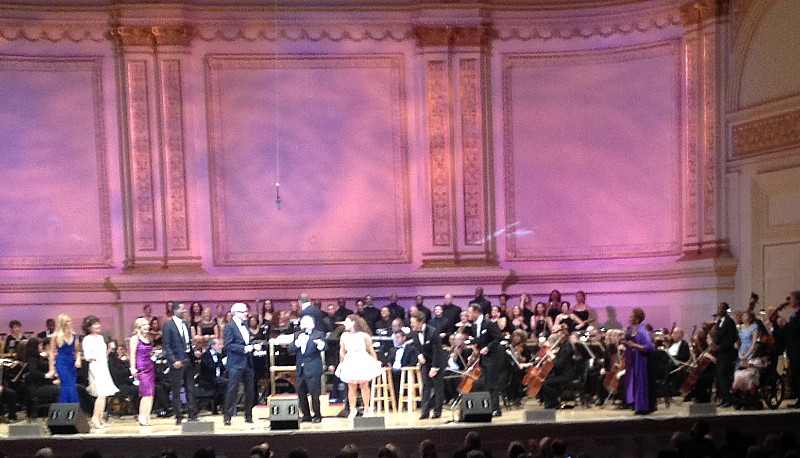
The New York Pops celebrated its 31st birthday gala by honoring Marc Shaiman and Scott Wittman for their three decades of writing music and lyrics for Broadway, Off-Broadway, Off-Off-Broadway, the West End, movies, and TV. I snared a last-minute ticket and vicariously kvelled for Shaiman and Wittman, whose work I’ve watched and enjoyed from the beginning. It’s one thing to have your music recorded in the studio for a soundtrack album or original cast recording. It’s very cool to hear it coming out of a Broadway orchestra pit. But to get to witness a whole evening (well, 90 minutes) of a full orchestra playing your stuff at Carnegie Hall? Golden.

Some magic moments:

* the three gals who got famous playing the lead role of Tracy Turnblad — a curiously tan Marissa Jaret Winokur (Broadway), Nikki Blonsky (movie musical), and the now-svelte Ricki Lake (original John Waters movie) — belting out the opening number of Hairspray, “Good Morning, Baltimore”;

* Sophie von Haselberg reading a funny and loving poem that her mother, Bette Midler, wrote for Shaiman’s 50th birthday;

* Martin Short doing a lovely song called “Simply Second Nature” from the current London hit Charlie and the Chocolate Factory;

* Capathia Jenkins reprising her hilarious and roof-raising number from Martin Short: Fame Becomes Me called “(Let a Big Black Lady) Stop the Show.”

Some version of that last phenomenon had already happened earlier in the show when Jenifer Lewis came out to deliver the 11 o’clock number from Hairspray, “I Know Where I’ve Been.” Lewis let it be known that when it was freshly written, Shaiman and Wittman asked her to record a demo of the song. “So I like to think they wrote it for me. Everybody who’s sung it since then thinks the same thing. But bitches: I. Sang. It. First.” She proceeded to sing the hell out of it. The audience stood up. Including me.

4-28 big finale

The show closed, of course, with the rousing anthem that closed Hairspray, “You Can’t Stop the Beat,” with most of the original cast (Winokur, Clark Thorell, Corey Reynolds, Kerry Butler, Laura Bell Bundy, and Linda Hart), joined halfway by Wittman and Shaiman (above). I surprised myself by getting a little teary-eyed because, even out of its dramatic context, this catchy little pop romp still sneaks in its funky political punch, equivalent to the last speech in Tony Kushner’s Angels in America: the world only spins forward.


Performance diary: the Wooster Group’s CRY, TROJANS!

January 31, 2014

This is my 1000th blog post on Another Eye Opens, and to celebrate the occasion I couldn’t imagine a better subject than ruminating about the Wooster Group, my favorite theatermakers in the world, whom I’ve written about for the Village Voice, the New York Times, 7 Days, the Los Angeles Times, and other publications.

I don’t envy daily newspaper reviewers faced with the task of writing a review of the Wooster Group’s Cry, Trojans! at short notice after one viewing. The production is so dense, crazy, complicated, and chaotic that even I had a hard time grasping what I was looking at, and I’ve been watching their work for more than 30 years. (I’ve gotten so accustomed to text-speak that I had to fight the urge to add “smiley-face” after that sentence.)

Cry, Trojans! is the Woosters’ adaptation of Troilus and Cressida, the epitome of what scholars talk about when they talk about Shakespeare’s “problem plays.” A literary mash-up of episodes from The Iliad with a more obscure legendary romance, T&C wanders between the two sides of the Trojan War, loosely tracking three violated love relationships – the Greek queen Helen, the lover of Paris stolen from her husband Menelaus; Cressida, the lover of Troilus traded away by her father Calchas in a prisoner exchange to Diomedes; and Patroclus, the lover of Achilles slain in battle by Hector. War is messy, love is messy, and boy, do Liz LeCompte and the Wooster Group love nothing more than a big mess.

In one of the nuttier schemes in recent theater production, the Royal Shakespeare Company was commissioned to mount a production of Troilus and Cressida for the World Shakespeare Festival, which was part of the London 2012 Olympic Arts Festival. The RSC’s Rupert Goold had the insane/inspired idea to invite the Wooster Group to collaborate with the RSC on a production in which the Woosters would play the Trojans, the Brits would play the Greeks, and they would rehearse separately until two weeks before opening. What could possibly go wrong?

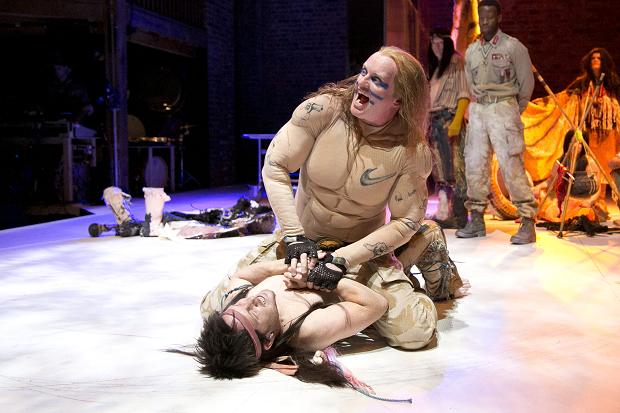
Early on, Goold bowed out as director of the Brits. His replacement, Mark Ravenhill, was better known as a playwright, actor, and Guardian columnist than as a director. One of England’s prominent contemporary gay playwrights and writer-in-residence at the RSC, Ravenhill will probably forever be best-known for having the balls to name a play Shopping and Fucking. (If only the script had more to remember it by than the title.) His conception for the Greeks in Troilus and Cressida was to accent the gayness; his Achilles and Patroclus lounged around in spa towels, and their slave Thersites was a drag queen in a wheelchair, while Ajax was played by an actor in a muscle-suit looking like a WWF head-banger.

T and C i T&C london 2

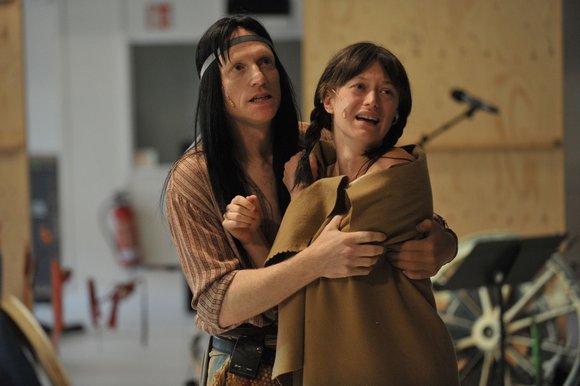
Meanwhile, LeCompte and the Americans went Native, dressing the Trojans in Hollywood- Injun attire, complete with teepees and jet-black wigs, with costumes and props provided by Dutch designer Folkert de Jong, whose specialty is postmodern tribalism that looks like handmade designer-grunge replicas of dumpster-diving treasures. (You can see a feature story on the costumes in the New York Times T Magazine online here.)

trojans-murphy-slide-P4G7-jumbo TroilusCressida_281561k
The title characters were played by Wooster superstar Scott Shepherd and guest artist Marin Ireland (above, ubiquitous Off-Broadway actress and, not incidentally, Shepherd’s girlfriend), and other group members and associates rounded out the cast (including Ari Fliakos, Greg Mehrten, and Gary Wilmes, phenomenally skilled and brave performers all). Of course, the Woosters also showed up with their full armamentarium of media technology: the radio mikes, the in-ear devices, the live mixing decks, and the multiple video monitors screening scenes from two feature films about Native Americans (Atanarjuat: The Fast Runner and Smoke Signals) and Splendor in the Grass (because…young love).

When the show opened at Stratford-on-Avon, the critical consensus was: WTF!?!?! A subsequent run in London fanned the flames of controversy, while cultivating a cadre of viewers willing to look at what was actually going on onstage.

That’s just the British chapter. A year and change later, the Woosters set to work adapting the show for presentation at their New York home base, the Performing Garage in Soho, sans the British cast. Kate Valk, the group’s other resident superstar, replaced Ireland, Suzzy Roche (who’s appeared in two previous WG productions) took over the role of Cassandra, and the guys in the group started playing the Greeks, in weird little black leather masks (below), as well as the Trojans. The production is in previews through February 15; after that it travels to Los Angeles for a week. Ultimately, the plan is to open the show officially sometime next season at one of the bigger venues the Wooster Group plays in NYC (St. Ann’s, Baryshnikov Arts Center, or the Public Theater).

trojans-murphy-slide-DT4K-jumbo-v2
I saw the show Saturday January 11 for the first time; when I went back two weeks later, Sunday January 26, I was surprised how substantially it had changed – I shouldn’t have been, because the group works meticulously over long periods of time. I somehow thought because they’d performed the show in London it was pretty much done, but really this is a complete reconception that LeCompte said, in an after-show talk, is still only two-thirds finished.

I won’t say a lot about the performance because it’s so clearly in flux. I will say that the notion of having the Wooster Group actors play the Trojan characters in Troilus and Cressida as Native Americans is a quintessential Liz LeCompte move. On the surface it seems corny, crude, outrageous, provocative, silly to the point of ridiculous – and then it reveals itself to be both conceptually sophisticated and rooted in a deep and astute textual analysis. After all, Shakespeare’s bizarre mishmash of a play was written for British actors to speak Elizabethan poetry while playing characters from The Iliad, an elaborate recollection of scenes from Greek history that may or may not have happened by a poet who may or may not have existed (some speculate that “Homer” refers to a consortium of ancient storytellers). The Woosters, who are obsessed with production concepts that have to do with re-enactments, landed on the idea of being as American as possible in their encounter with the Royal Shakespeare Company, and what’s more American than the indigenous people?

fast runner
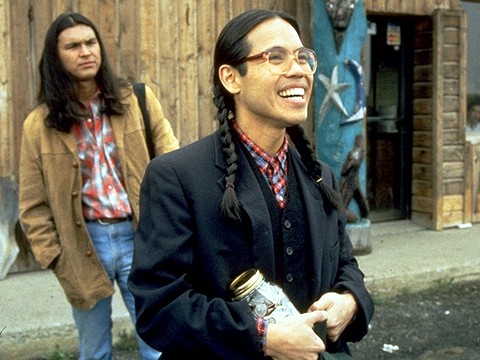
For years, part of the Wooster Group’s method has been for the actors to be watching scenes from movies on video monitors throughout the performance and meticulously imitating the gestures and movements they see, rather than blocking a play according to the script’s directions. Usually the audience isn’t privy to what the actors are watching, but in this production – since it’s performed on a thrust stage, with the audience on three sides – the screens are more prominent and visible to everyone. A big part of watching Cry, Trojans! is puzzling out the connection between what we’re seeing onstage and these film excerpts on the video monitors. It helps to recognize what the movies are. The Fast Runner (above) made a splash among cinephiles when it came out in 2001 as “the Inuit film,” the first movie made by an Inuit director and actors speaking their native tongue. It is itself an adaptation of an ancient epic, a corollary to The Iliad. And Smoke Signals was a 1998 indie film based on the beautiful quirky short fiction of Native American writer Sherman Alexie.

smokesignals3
This is why I love the Wooster Group more than any other theater company in the world: their ability to mash up culture (the Bard meets Sherman Alexie meets cutting-edge Dutch designer meets Suzzy Roche) in a way that’s smart, funny, and deep and that forms a vibrant picture of the world I live in.