May 13 – Yes, it’s Family Week (heard from all my sisters on my birthday yesterday and went out for dinner with Andy’s mom, whom I met for the first time). But all that was much more cheerful than the milieu of Beth Henley’s play, produced by MCC Theater at the Lucille Lortel. Set in an expensive treatment center out in the Arizona desert, it focuses on Claire, a 40-ish woman whose life fell apart when her teenage son got murdered. Not that her life was going so great otherwise – she and her abusive husband teeter on the verge of divorce, her daughter is an adolescent hellcat, one sister leans on her for money all the time, the other stays as far away as she can (allergic to emotional distress), and their belittling mother expends all her energy maintaining denial about her horrendous parenting skills. Very short (70 minutes) and delivered in very short scenes, the play is both a smart writer’s supercilious take on the banalities of pop psychiatry and a sensitive playwright’s portrait of a hurting person’s effort to find hope and healing in the face of life’s torrential devastations. It’s a tricky balancing act, not successfully managed by Jonathan Demme in his debut as a stage director. He cast as Claire Rosemarie DeWitt, who played Rachel in Rachel Getting Married, and she delivers the same kind of blank performance she gave in the movie, entirely unsuitable as the grieving Claire (although she manages to produce tears on demand – a good trick, but not enough). Sami Gayle as the obnoxious teenage daughter Kay is obnoxious. Kathleen Chalfant and Quincy Tyler Bernstine are both very good actors doing what they’re asked to do – be bluntly selfish and oblivious to the harm they cause others. But the production winds up feeling empty at the core and unsatisfying.
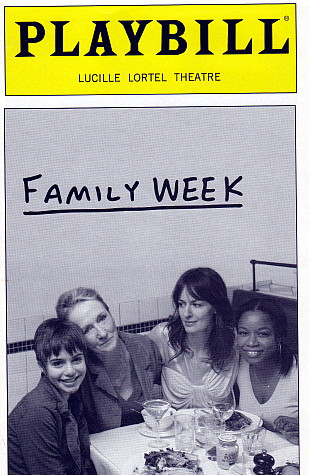
I vividly remember the original New York production of Family Week and share Jonathan Demme’s fondness for the play based on that production, staged by Ulu Grosbard with an honest respect for struggling people as well as the absurdities and cruelties of family life. I saw the show with Sarah Schulman, and we were both impressed with it and a little surprised that it didn’t get more acclaim. The cast included Rose Gregorio (Grosbard’s wife) as Claire’s mother, insanely insistent on the credentials of everyone in sight, and Carol Kane as the ne’er-do-well sister, who flouts all the rules of the treatment center, smoking and drinking and wearing inappropriately sexy outfits. (I’m not generally a fan of Kane and her mannerisms but thought she wielded them in that production with a strong artistic sense of character portrayal.) Most of all, Sarah and I were riveted by the central performance of Angie Phillips as Claire. From the moment she walked onstage, you wanted to cry looking at her – a woman profoundly collapsed in on herself, devastated with grief and self-ignorance. The detail I’ll always treasure is that, during the series of excruciating confrontations with family members when Claire is asked what she’s feeling, she often had to turn around in her chair and look at the list on the blackboard of primary emotions (anger, pain, shame, guilt, fear, loneliness) to identify which she was experiencing. It’s very easy for pop culture to mock psychotherapy and the notion of family interventions – but anyone who’s actually lived through one knows that they can be not only shattering but healing and life-altering. And I respect Beth Henley for wanting to capture that in a play.
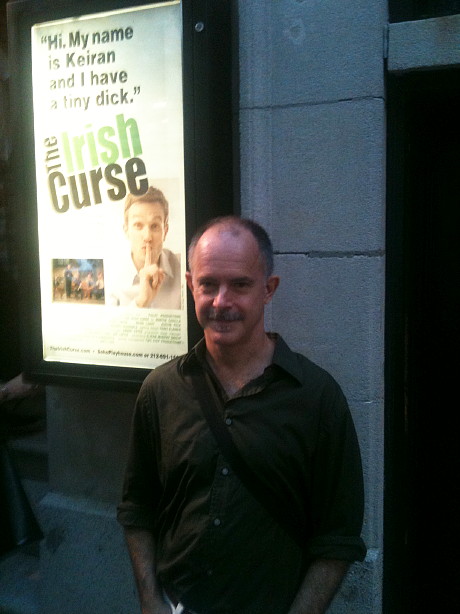
May 14 – I have similar feelings for Martin Casella, author of The Irish Curse. His play is really crude and sit-commy, and the production is almost unbearable. Directed by Matt Lenz, the actors overact outrageously in a tiny Off-Broadway theater (the Soho Playhouse). The worst offender is Dan Butler, whom I always used to like seeing onstage; here he shouts almost all his lines, in one of the worst Southern accents I’ve ever heard an actor assume. Nevertheless, the brave enterprise of the play is that it depicts a support group for men who have small penises to talk about it. (Much is made of this as an anatomical feature disproportionately visited on Irishmen, though that was news to me until this play came along.) This is a subject no one ever talks about publicly except as a joke. But clearly for guys with really small dicks, it’s no joke. And for all the clowning around, clumsy exposition, and Odd Couple histrionics, the playwright does manage to cram into his play a lot of what guys with small dicks struggle with: not feeling like a man, avoiding sex, compensating through drinking or bragging or compulsive sex, feeling cheated by life to the point of despair. Certainly, as a sex therapist I’ve heard plenty of stories just like these and can vouch for their veracity. I just wish they’d been embedded in a better play.
Archive for the 'performance diary' Category
Performance diary: therapy plays (FAMILY WEEK, THE IRISH CURSE)
May 16, 2010Performance diary: back and back and Bach
May 9, 2010May 7 – I’m not the kind of theatergoer who sees shows again and again. I have to really like a show to see it more than once. Aside from the Wooster Group, whose every production I have seen three or more times (because I love them so), it’s rare for me to repeat. Same with movies, same with books: I’d rather experience something than revisit something I’ve already encountered, even something I loved. I have seen Fela! three times, and I saw Spring Awakening 4 ½ times (once I employed the time-honored theater-geek tactic of second-acting the show, grabbing a seat in the balcony just to re-live the ecstasy of watching the number “Totally Fucked” rock the house). My friend Tom Dennison is the opposite of me – when he likes something, he likes to watch it over and over. He saw Spring Awakening seven times (and that was after the original cast left), and he’s seen David Cromer’s production of Our Town about a dozen times. I admire that kind of devotion.
My friend Misha Berson, the theater critic for the Seattle Times, was in town this week for her twice-a-year marathon catching up on new shows, and we were supposed to see Enron together. But once they posted their closing notice, it seemed no longer newsworthy to cover, so she switched gears and arranged to see Martin McDonagh’s A Behanding in Spokane. Of course, I had no problem switching gears with you, since I liked the show very much. Seeing it a second time yielded no big rewards, but it was interesting to experience the squeeing of the Christopher Walken maniacs in the audience. Zoe Kazan and Anthony Mackie were very consistent and energized. I got the sense that Walken and Sam Rockwell were laying back, now that the show has been running a while. Not that they were phoning it in, but there was a certain slackness to their energy. Nevertheless, I enjoyed noticing the trade-off: what was lost in a certain kind of Pinter-esque tension, there was a gain in wacky rock-and-roll assurance between those two guys. Walken is so so deadpan, dropping his voice for impact so you have to really lean in and pay attention, while Rockwell relishes playing fast and loose, as if he’s some guy who just wandered onto the set. I did look forward to his front-of-curtain monologue, which does have an explosive impact on the audience. When he says, “I keep waiting for something exciting to happen. Maybe a prostitute will get stabbed…” the audience responds with a combined gasp of horror and surprised laughter. A guy in the balcony got caught up in a bout of barking laughter so helpless that Misha found it creepy, understandably. Classic McDonagh moment.
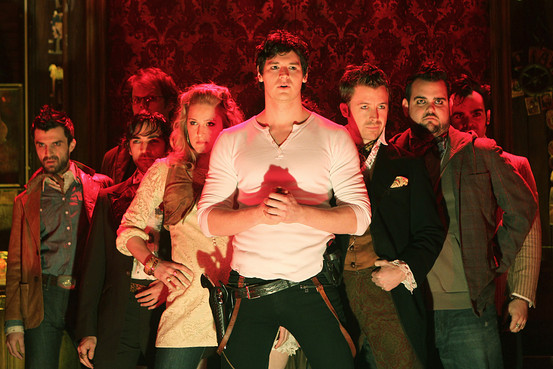
May 8 – Then Saturday afternoon we reconvened at the Public Theater for my second dose of Bloody Bloody Andrew Jackson, which I loved again. I really respect the incredible energy of each individual performer, including the musicians, but of course most of all the charismatic Benjamin Walker in the title role. The staging is tremendous, and the play itself continues to impress me with its daredevil juxtaposition of classic American contradictions – generosity and selfishness, smarts and stupidity, victim and bully. Populism, yeah yeah! I understand they’re putting out an original cast album. Can’t wait! Misha had seen an earlier version of the show in Los Angeles and hadn’t cared for it, thought it was sophomoric and shallow. She liked it much better this time, said they’d sharpened the script, and that the addition of Danny Mefford’s choreography made a huge difference. It is sensational. In the lobby, Misha met a ninth-grade girl who was seeing the show for the third time. I can understand that. There’s a heat and energy to the show that’s just delicious to have blasting at you again and again.

Afterwards, I grabbed a falafel and lemonade at Tahini and then made my way to my next gig, a concert called “The Roots of Bach and Beyond” by the Dessoff Choirs at Calvary St. George’s Church in Stuyvesant Square. Okay, I went because my boyfriend sings with the Dessoff, but I’m so glad I went. It was a beautiful concert, organized and conducted by Patrick Dupré Quigley. The centerpieces were two Bach motets (“Singet dem Herr nein neues Lied” and “Jesu, meine Freude”), one before intermission and one after, each preceded by pieces by composers who influenced Bach: Mendelssohn, Kuhnau, Pachelbel, Schutz, Frescobaldi, and Buxtehude. (I just love saying the name Buxtehude.) Actually, the second half began with “Immortal Bach,” a fascinating, slightly nutty 1988 piece by the Norwegian Knut Nystedt in which the sections hold notes for different intervals. The choir was in fine voice, the acoustics in the church are amazing, and Quigley’s conducting and introductory chats were exemplary. A fine time.
Performance diary: THE KID
May 8, 2010May 6 – I’ve been hearing about The Kid, the musical adaptation of Dan Savage’s book about adopting a child with his boyfriend, for several years. A friend of Stephen’s, Michael Zam, wrote the book, and with his partners lyricist Jack Lechner and composer Andy Monroe he has been chasing down producers until Scott Elliott agreed to mount the show at the New Group, directing it himself. And it’s terrific: funny, honest, entertaining, smart, and theatrical, not unlike, say, the musicals of Bill Finn. It tells a real and compelling story with a lot of humor but also a lot of heart, and it’s shockingly free of bogus moments that pander either to the audience or to some tradition of musical theater.

The real Dan Savage is a larger-than-life character already, an incredibly smart, sharp-tongued and potty-mouthed sex columnist and political commentator. I was amazed at how successfully the musical created a stage version of Dan that refers to the real-life guy and yet becomes a separate entity – a tribute to the writing and the directing but mostly to the performance of Christopher Sieber. I’ve never felt one way or another about Sieber, but he really puts out here. It’s a little shocking that he’s chubbed up for the part, which makes him NOT look like Dan Savage, but he stays wonderfully true to the character’s highly neurotic, rage-filled smartass and yet completely inhabits a very intimate vulnerability. Lucas Steele as his boyfriend Terry is fine but somewhat thinly drawn – it’s hard to know what Dan sees in him, other than his being “young and cute” (not my taste, but whatever). But their relationship is sexy and feisty and culturally plugged in (I love the role Bjork plays in their life). And the rest of the cast is absolutely terrific – minor superstars of contemporary New York theater including Ann Harada (Christmas Eve in Avenue Q), Tyler Maynard (Altar Boyz), the spectacularly pale and skinny Brooke Sunny Moriber (The Wild Party, The Dead, Parade), and especially Susan Blackwell (of [title of show] fame), who plays the woman from the adoption agency who serves as liaison to the birth mother whose baby the guys adopt. The story has plenty of potential for both zany comedy and dramatic tension, and the treatment of the birth mother – Melissa, a homeless alcoholic teenager – is handled with extraordinary respect and restraint. She’s very well played by Jeannine Frumess, and everything about her has a different tone than Life At Home with Dan and Terry. The score carefully walks a line between storytelling and show-biz. There’s a modesty about it that I really liked, and there are several moments that are genuinely touching. Melissa’s song, “Sparechangin’,” is a dramatic highpoint that shifts the show to an intriguing deeper layer. Many of the songs are chatty and fun, along the lines of, say, Falsettos or Baby, with the occasional change-of-pace blast (“Seize the Day”). But at key moments things drop into truer and realer in a way that feels really solid (the candidate for instant classic is “I Knew,” a PFLAG anthem if I ever heard one, nicely sung by Jill Eikenberry as Dan’s mother). Bravo to this team for pulling it off. I think The Kid is going to be a hit.
Performance diary: 666
May 1, 2010April 30 — 666, the Spanish comic spectacle at the Minetta Lane Theatre, wasn’t on my radar at all until I read the review in the New Yorker’s listings, which piqued my pervy curiosity:
“The four very funny and talented comedians who comprise the Spanish comedy theatre troupe Yllana (and who created this show) act out, Charlie Chaplin-style, what goes on in a maximum-security prison where they are all awaiting execution. Three perverted criminals (Fidel Fernandez, Joseph Michael O’Curneen, and Juan Ramos Toro) get stabbed, slashed, shot, gassed, electrocuted, beheaded, and splashed with pee—while intermittently raping and sodomizing their innocent cellmate (the especially gifted Raul Cano)—and seem to enjoy every minute of it. Because they don’t speak, the actors prod the audience into making certain sound effects to go along with the tasteless antics, and they even bring a young female audience member onstage—what Cano showers her with, once he dies and comes back as a devil wearing nothing but a two-foot-long penis, is a lot more than attention. The elegance and brilliance of the pantomime save this show, directed by David Ottone, from being too offensive to sit through.”

Friends, don’t make the mistake I made of going to see this witless clown show. Even at 80 minutes, it’s a long series of juvenile sketches vamping until they get to the big finale, which involves all four guys running around the stage and through the audience with long comic phalli out of an Aristophanes play. It’s not despicable — the performers are reasonably talented, and the redhead is pretty damned cute, and they are attempting to play with theatricality, focusing on the peculiar task of getting the audience to make noise, any noise — but it’s really dumb. It reminded me of Puppetry of the Penis, which lured many an otherwise theater-savvy gay guy into the theater for what turned out to be a puerile cabaret act best suited for tanked-up bachelorettes. I was embarrassed because I dragged five friends to see the show with me (see below)…but the lesbians in our group actually enjoyed the show more than I did, so go figure. In any case, we had fun yakking over dinner down the street at Marinella afterwards — three gay American guys and three foreign-born gay gals (one Mexican, one Brazilian, one Norwegian).
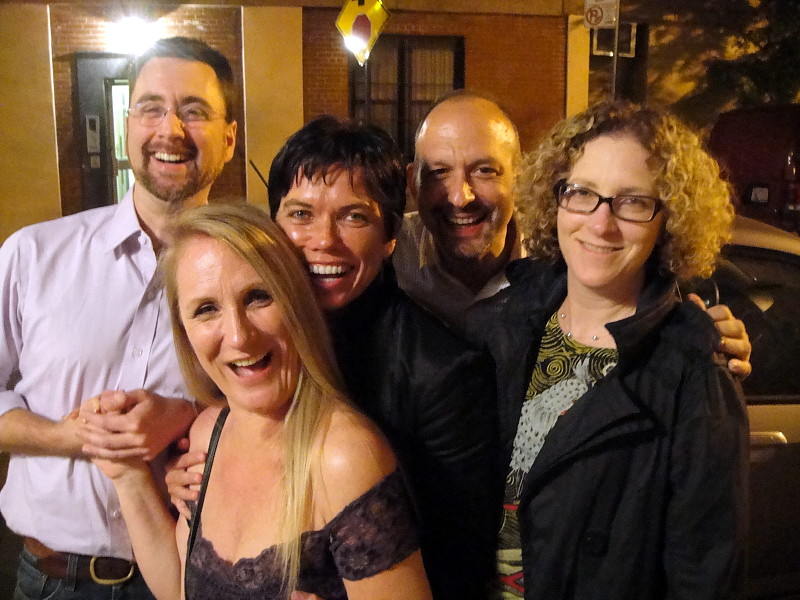
Andy, Rosie, Marta, David, and Judy
May 1 — Much better use of time and energy was the beautiful, engrossing Otto Dix show at the Neue Galerie. An artist who got his start drawing fantastically graphic scenes of war during his Army service in World War I (and whose career ended with Hitler’s denunciation of “degenerate art”), Dix wandered freely back and forth between portraiture and caricature, fine art and social commentary. You’ve probably seen images of his without knowing it. A lot of them are grotesque, even repulsive — I asked Andy to show me which was his favorite, and the concept stymied him because the work isn’t exactly easy to like — but compelling. (My favorite was the unusually delicate “Elegant Passerby,” what looks like a cloud of person on the street that turns out to be a veiled woman holding a small dog with the face of an owl.) Dix’s depictions of war, for instance, are everything that we’re NOT allowed to see about the war our country is conducting in Iraq right now: up-close, unsanitized, completely unromantic and upsetting. The portraits are fascinating both for the emotion that leaps out of them but also for sheer accomplishment. I liked getting right up close to the famous painting, below, of Anita Berber (this dame didn’t live to see 30, but doesn’t she look twice that?) and seeing that it was made with oil and tempera on plywood. And then of course any visit to the Neue Gallerie is an opportunity to stop at the elegant Cafe Sabarsky for sachertorte and/or a Gruner Vertliner.

Performance diary: doubling back
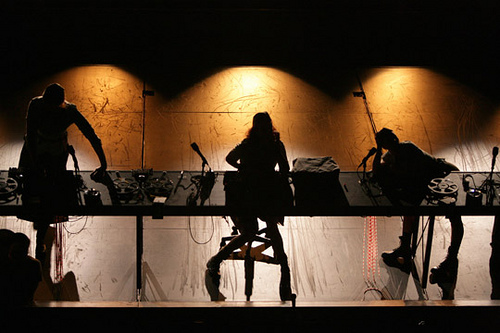
April 25, 2010April 23 – Andy and I went back to see North Atlantic because you can never absorb everything about a Wooster Group production in one viewing. And indeed, it was very different this time sitting in the next to last row downstairs than it was sitting in the second row center. From the very front the actors were on top of us and overwhelming in their way. From the distance of the back row, the entire frame came into view, including the minimalist video representing the ocean surface behind the stage. When you’ve seen the piece once, you don’t have to focus on whoever’s speaking and you can pay attention to what crazy things the rest of the ensemble is up to. They’re not frozen in place – I just noticed this time the nutty shoeshine business that Doberman and Houlihan were up to as the military officers strode back and forth. I’ve just finished reading The Wooster Group Work Book, Andrew Quick’s incredibly detailed and engrossing study of five productions (from Frank Dell to To You, the Birdie!), in which Liz LeCompte talks about the paces she puts the actors through, having them work very hard to make something happen in the moment rather than looking overly rehearsed. So I was very aware of how, for instance, Scott Shepherd (below) managed the dead space around the leaden jokes he tells as Colonel Lud.

Almost all the notes I took were crazy little Jim Strahs lines I hadn’t necessarily heard before, such as:
— Waddya got for the layman, something that lights up and talks back?
— Ya gotta make ‘em squirt.
— I can’t do that. What does that make me, a soft-shell crab?
— You’re so deformed you could have been born in a can of Pepsi.
— Go ahead, wet your stick.
— Slithers??? Jumps!
— You’ll be shitting shoelaces for the next 35 years.
— Who’s he calling Schwitzpuppen?
The sound score is always subtly changing, throughout the show and from one performance to another, and you could spend the entire time just tracking that. I still giggle every time I think about the scene where the men down front are singing the dirty ditty “There’s a Place in France” (“where the women wear no pants”) while upstage the women are sliding on the tilted stage floor faintly mashing it up with snatches of Chic’s “Le Freak” (“awwww freak out!”). I spoke to Liz briefly after the show and that’s what she was fixated on – she said they’d only just solved some of the acoustic bugaboos in the theater at the Baryshnikov Arts Center that North Atlantic has inaugurated. She also said the group is leaving soon to perform in Romania – “Don’t ask!”
Andy and I happily debriefed about the show walking up Ninth Avenue afterwards until we found ourselves stopping for dinner at a relatively new place, Terrazza Toscana, at 50th Street, where sat outdoors on the roof and had a delicious meal: spaghetti with lamb stew for him, orecchiette with pancetta and haricots verts for me, with a lovely bottle of copertino.

April 24 – Revisiting American Idiot: for all my grumbling about how the songs in the show blurred together after a while, I notice that after listening to the original cast album now I can’t get several of them out of my head (“Are We the Waiting,” “Know Your Enemy,” “21 Guns”). I guess if I knew the Green Day album in advance – like apparently Theatermania’s Dan Bacalzo did – I would have been squealing with delight throughout the show at what Michael Mayer did with each song. That’s what I would probably do if someone made a stage show out of, say, Joni Mitchell’s Hejira album. Not a bad idea….paging Michael Mayer!
 another eye opens