Archive for the 'In this week's New Yorker' Category

In this week’s New Yorker…

October 15, 2010

A lot of good stuff, including Calvin Tompkins’ typically engrossing profile of L.A.-based artist John Baldessari and a suitably entertaining (and long) piece about Nick Denton and Gawker. The most important (and depressing) read, though, is Sean Wilentz’s well-reported if disheartening piece about Glenn Beck, the Tea Party, and their willingness to embrace the insane, paranoiac political philosophy of the John Birch Society, which I thought had been discredited long ago. My mind is reeling from this passage:

“In June, the congressman Bob Inglis, of South Carolina, a tough conservative who nonetheless backed Bush’s financial bailout, lost a vicious primary fight with a right-wing insurgent named Trey Gowdy. Tohis amazement, I…nglis was confronted on the campaign trail by voters whowere convinced that numbers on their Social Security cards indicatedthat a secret bank had bought them at birth.”

I did have a good laugh at least once reading the piece. Talking about Barry Goldwater’s run for president in 1964, it says:

“In the general election, though, Goldwater suffered a crushing loss to Lyndon Johnson, partly because Democrats succeeded in making him look like a captive of the loony right. (To the Goldwater slogan “In Your Heart, You Know He’s Right,” the Democrats shot back, “In Your Guts, You Know He’s Nuts.”)”

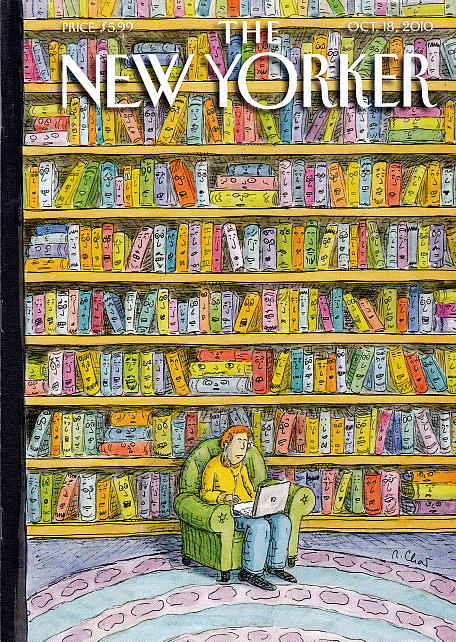
Balancing out the grim political news are a bunch of funny cartoons and an adorable cover by Roz Chast, entitled “Shelved.”
 

In this week’s New Yorker

October 7, 2010


It’s the Money Issue, with two really long upsetting stories worth reading.

Ryan Lizza’s detailed report on the attempt by John Kerry, Lindsey Graham, and Joseph Lieberman to write epochal climate-change legislation and then rally enough support in the Senate to pass it is as depressing and infuriating a picture of how the U.S. government works as any I’ve read. The sheer idiotic partisan politics of assholes like Mitch McConnell (“the Republican leader and architect of the strategy to oppose every part of Obama’s agenda”) would theoretically outrage the voting public…except that the populace turns out to be equally idiotic. Nobody comes off looking good, including the Obama Administration.

Then there’s Philip Gourevitch’s survey of the modern humanitarian-aid industry, which centers on Dutch journalist Linda Polman’s book The Crisis Caravan: What’s Wrong with Humanitarian Aid?, which deals with a lot of ugly truths about the Red Cross and other humanitarian efforts and how they paradoxically perpetuate suffering by relieving warring countries and insurgencies from cleaning up their own messes.

This kind of eyes-open, well-written, hard-headed journalism is what I read The New Yorker for. It’s nice to have a balance, though, so I also really enjoyed Nora Ephron’s piece “My Life as an Heiress.” Nora Ephron is just a fantastic storyteller, don’t you think?

Not to mention a beautiful Chris Ware story as the fold-out cover and a terrific lead Talk of the Town piece by Steve Coll about shaky U.S. relations with Pakistan.

In this week’s New Yorker…

October 4, 2010

…actually, before the moment passes and the new issue arrives in my mailbox, I want to mention a couple of noteworthy pieces in LAST week’s issue.

Malcolm Gladwell wrote a thoughtful essay about the difference between social activism and social networking, contrasting the world of Facebook/Twitter with civil rights actions in the 1960s, like the day when four college students in Greensboro, NC, sat down at a segregated Woolworth’s counter and asked to be served. To me, the piece was a good reminder that online networking is useful for disseminating information and staying in contact with friends and acquaintances, but when it comes to Getting Things Done, there’s no substitute for community action that you do with other people in the same room.

Music critic Alex Ross did an excellent piece about one of my all-time culture heroes, John Cage (above), on the occasion of the publication of Kenneth Silverman’s biography, Begin Again. Here’s a story I’d never heard before: after years of living on the edge of poverty, “by the end of the fifties, Cage’s financial situation had imiproved, though not because of his music. After moving to Stony Point [NY], he began collecting mushrooms during walks in the woods. Within a few years, he had mastered the mushroom literature and co-founded the new York Mycological Society. He supplied mushrooms to various elite restaurants, including the Four Seasons. In 1959, while working at the R.A. I. Studio of Music Phonology, a pioneering electronic-music studio, in Milan, he was invited on a game show called ‘Lascia o Raddopppia?’ — a ‘Twenty-One’-style program in which contestants were asked questions on a subject of their choice. Each week, Cage answered, with deadly accuracy, increasingly obscure questions about mushrooms. On his final appearance, he was asked to list ‘the twenty-four kinds of white-spore mushrooms listed in Atkinson.’ (Silverman supplies a transcript of this historic moment.) Cage named them all, in alphabetical order, and won eight thousand dollars. He used part of the money to purchase a VW bus for the [Merce] Cunningham company.”

In this week’s New Yorker…

September 23, 2010

…I was most fascinated by Jane Mayer’s Talk of the Town piece on Walter Mondale, who makes a savvy assessment of Obama’s presidency so far:

“In my opinion, Obama had a few false presumptions. One was the idea that we were in a post-partisan era.” The other was “the idea of turning things over to Congress—that doesn’t work even when you own Congress. You have to ride ’em.” Further, he suggested that Obama should stop thinking about what he can get from the Republican opposition: “You should explain clearly what you want, and, if they oppose you, attack them for it.”
Also in this issue, nice piece by Rebecca Mead on Elevator Repair Service, whose production of Gatz coming up at the Public Theater is a must-see.

In this week’s New Yorker

August 26, 2010

The ever-impressive Jane Mayer delivers a fascinating, well-reported, disturbing, even devastating expose of David Koch, the oil refinery magnate after whom Lincoln Center’s State Theater has been renamed and who (with his brother Charles) has funded many of the scurrilous Tea Party-related “grass-roots” groups determined to destroy President Obama and his political agenda.


And then there’s the cover image, titled “Pause”…