Archive for the 'In this week's New Yorker' Category

In this week’s New Yorker

May 14, 2011


Who is Indra Nooyi? She’s the 55-year-old Hindu vegetarian C.E.O. of PepsiCo. That’s one of many intriguing facts and factoids I gleaned from the overstuffed innovators issue of the New Yorker this week. John Seabrook’s piece on how PepsiCo is attempting to position itself as a “good company” producing stuff that is “good for you” is hilarious at times but also full of absorbing descriptions of, for instance, how potato chips are made. (“Snacks for a Fat Planet”) Key quote: “As part of PespiCo’s commitment to being ‘the good company,’ the corporation wants to play a leading role in public-health issues, and particularly in the battle against obesity. Some people think this is ludicrous. Marion Nestle, the author of ‘Food Politics’ and a professor of food studies at N.Y.U., told me, ‘The best thing Pepsi could do for worldwide obesity would be to go out of business.’ ”

Malcolm Gladwell’s story on how a visit by Steve Jobs to Xerox PARC contributed to Apple’s getting out ahead in the innovation competition turns up this amusing tidbit about the evolution of the computer mouse. After glimpsing one during a visit to Xerox’s R+D plant, Jobs went to Dean Hovey, one of Apple’s key early designers, and said “You’ve got to do a mouse.” Hovey recalls:

“‘I was, like, ‘What’s a mouse?’ I didn’t have a clue. So he explains it, and he says, ‘You know, [the Xerox mouse] is a mouse that cost three hundred dollars to build and it breaks within two weeks. Here’s your design spec: Our mouse needs to be manufacturable for less than fifteen bucks. It needs to not fail for a couple of years, and I want to be able to use it on Formica and my bluejeans.’ From that meetings, I went to Walgreens…and I wandered around and bought all the underarm deodorants that I could find, because they had that ball in them. I bought a butter dish. That was the beginnings of the mouse.”

Then there’s Anthony Lane’s droll tour of Pixar headquarters in Emeryville, California. “How you get a job at Pixar, nobody knows. The most reliable method is to be born there, preferably in a cupboard full of office supplies, then to sit tight for twenty years before sneaking out over Christmas and finding space at a workstation. You could apply to the effects team, say, but only if the number of doctorates you hold is divisible by three. Even the lone visitor, effusively welcomed and ushered around, is an intruder: the sticker on my lapel bore the phrase ‘A stranger from the outside!’ Nine-nine per cent of that is a joke — it’s a direct quotation from ‘Toy Story,’ chirruped by the trio of silly green aliens — but the one per cent was menacing enough to give me pause. And, certainly, were I to stand in the atrium of the main building and cry out, ‘I have never even used PowerPoint! or Excel! I am not an animator! I am a man!,” retaliatory action would be swift. Special forces in yellow hazmat suits would drop from the ceiling on ropes, isolate me under an airtight dome, evaporate me, and vacuum up the remains, as they do in ‘Monsters, Inc.,’ when the sock of a human child — a menace to health and security — is found on the factory floor.”

Just minutes after his impressive report from Libya, Jon Lee Anderson weighs in with another spectacular closely observed piece about how the effort to turn over the war in Afghanistan to the Afghans is going (“Letter from Khost Province: Force and Futility”).

Judith Thurman’s review of the show at the Metropolitan Museum of Alexander McQueen’s fashion designs makes me definitely want to check it out. Joan Acocella once more turns me on to an obscure writer I’ve never heard about, Paula Fox, who turns out to be Courtney Love’s grandmother. I haven’t read Michael Ondaatje’s story “The Cat’s Table” yet, but I’ll bet it’s very good.


In last week’s New Yorker…

May 10, 2011

Yes, I’m a week, maybe two behind. But I didn’t want to let the moment pass without citing a couple of articles that made an impression on me.

Jon Lee Anderson is one of the New Yorker’s extraordinary war reporters, and his dispatch from Libya conveys with revelatory specificity the particularly scrappy, hand-to-hand nature of the effort to end the dictatorial rule of Qadaffi. It’s a corner of the world I would never know anything about except for such fine first-hand reporting.

Hilton Als also does a beautiful job profiling Jane Fonda, someone it’s easy to feel like you know everything about. Yet Hilton got extraordinary access to her daily life, and he earned it through scrupulous, thoughtful, and sympathetic attention to her unusually sprawling life’s work. The complete article can only be read online by subscribers, but you can access the link here.

In last week’s New Yorker…

April 21, 2011

I seem to be running a week behind at this point. But in the “Journeys” issue I enjoyed reading Evan Osnos’s report about travelling through Europe with Chinese tourists. Hilton Als’ review of the new revival of Anything Goes starring Sutton Foster was so interesting it made me want to see the production, which otherwise I’ve been ignoring since the Lincoln Center production is still so fresh in my mind. Sasha Frere-Jones astonishes me by repeatedly writing interesting pieces about pop musicians I’ve never heard of who have already made 13 albums already! The latest is Bill Callahan, whom he makes sound quite intriguing. Since he turned me on to Of Montreal and Bon Iver, I tend to pay attention whenever Frere-Jones writes about music.

But my favorite piece in this issue is by Geoff Dyer, the novelist whose Jeff in Venice, Death in Varanasi impressed me very much. He writes about a pilgrimage he made to two famous earthworks, Walter De Maria’s “The Lightning Field” in New Mexico and Robert Smithson’s “Spiral Jetty” in Utah. Dyer is a fantastic writer, and his observations are worth reading. In passing, he refers to an essay D.H. Lawrence wrote about Taos, which he compares to the monasteries of Europe. I was particularly struck by this passage because Andy and I recently watched Into Great Silence, the engrossing documentary about the very austere Carthusian monastery in the French Alsp called the Grand Chartreuse, which made us question what purpose such isolated temples of worship and study serve in the bigger picture. Lawrence provides a very interesting perspective on that question:

“You cannot come upon the ruins of the old great monasteries of England, beside their waters, in some lovely valley, now remote, without feeling that here is one of the choice spots of the earth, where the spirit dwelt. To me it is so important to remember that when Rome collapsed, when the great Roman Empire fell into smoking ruins, and bears roamed in the streets of Lyon and wolves howled in the deserted streets of Rome, and Europe really was a dark ruin, then, it was not in castles or manors or cottages that life remained vivid. Then those whose souls were still alive withdrew together and gradually built monasteries, and these monasteries and convents, little communities of quiet labour and courage, isolated, helpless, and yet never overcome in a  world flooded with devastation, these alone kept the human spirit from disintegration, from going quite dark, in the Dark Ages. These men made the Church, which again made Europe, inspiring the martial faith of the Middle Ages.”

In last week’s New Yorker…

April 11, 2011

…which was the first issue I read in its digital version (on my iPad) while vacationing in Vieques… the pieces that grabbed me were:

  1. Ken Auletta’s profile of Wall Street Journal editor Robert Thomson, a close friend of Rupert Murdoch’s
  2. Laura Miller’s story on fantasy writer George R. R. Martin (most famous for A Game of Thrones) and the ruckus he’s created among his fan base by not finishing the latest book in his series
  3. Tad Friend’s piece about Anna Faris, an actress I’ve never seen but who sounds pretty funny
  4. Keith Ridgway’s short story, “Goo Book”

    Unfortunately, you have to be a subscriber to read this online.
    But I can share with you my favorite cartoon:

In this week’s New Yorker

April 1, 2011

My favorite things:

1. David Grann’s long, riveting, bewildering reporting piece about assassination, conspiracy, corruption, and self-destruction in Guatemala.

2. Colin Jost’s hilarious Shouts & Murmurs piece “Explaining Your Time Warner Bill.”

3. Two astonishing poems: a beautiful tender one by Tennessee Williams, never before published, and one by Sophie Cabot Black, a poet new to me.

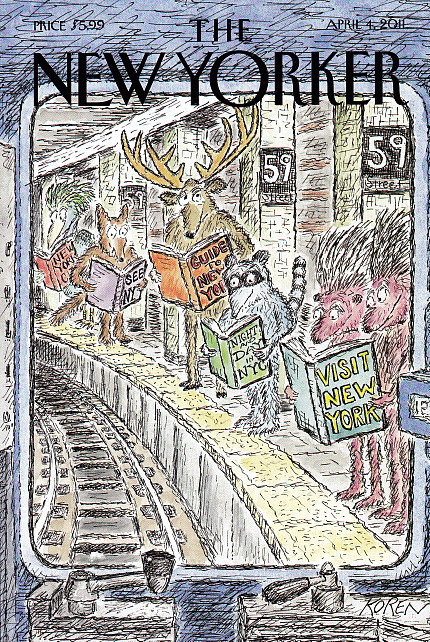
4. The delightful cover by Edward Koren (below).