Archive for the 'In this week's New Yorker' Category

In this week’s New Yorker

November 27, 2011


An especially good issue of the magazine, starting with the cover (“Promised Land” by Christoph Niemann), a reminder that the first European settlers on this continent arrived uninvited, and not too many of them bothered to learn the language(s) the Natives spoke.

By design or happenstance, this issue is anchored by three strong reporting pieces about renegades and innovators having a big impact.

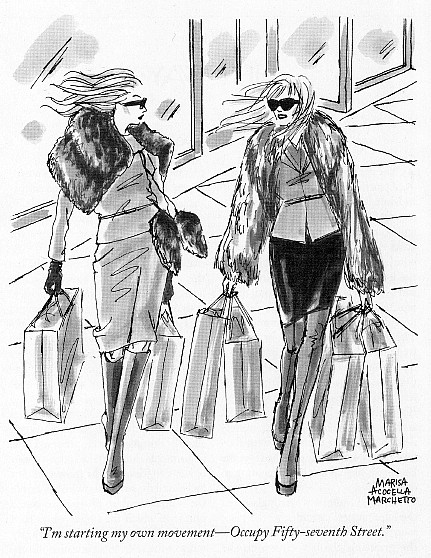
Mattathias Schwartz’s piece on Occupy Wall Street goes beyond anything I’ve read in pinpointing the key individuals responsible for launching and maintaining a nascent grass-roots movement that profoundly eschews the notion of leaders. Not only does it shed light on Kalle Lasn and Micah White, the unlikely duo at the heart of the Canadian-based anti-consumerism publication Adbusters, but the article name-checks a couple of people crucial to putting OWS in gear: 26-year-old Justine Tunney (one of several transgender anarchist activists who collectively responded to Lasn’s now legendary call for the occupation) and Marisa Holmes, a 25-year-old anarchist and filmmaker to whom people listen when she speaks.

George Packer contributes a fascinating profile of Peter Thiel, the super-smart, disturbingly cute (to ginger fans) entrepreneur who created PayPal in 2002 with his friend Elon Musk and two years later loaned Mark Zuckerberg half a million dollars to crank up Facebook. Thiel turns out to be, among other things, a devout gay Christian, a serious Ayn Radian libertarian, and an unapologetic Republican who voted for John McCain in 2008. The mind boggles. It is clear that Packer, one of the New Yorker’s hotshot reporters these days, is both intrigued and appalled by Thiel and his friends. He’s invited to a dinner party where “the two subjects of conversation were the superiority of entrepreneurship and the worthless of higher education.”

[Biotech specialist Luke] Nosek argued that the best entrepreneurs devoted their lives to a single idea. Founders Fund [an investment group co-founded by Thiel with Napster’s Sean Parker] backed these visionaries and kept them in charge of their own companies, protecting them from the meddling of other venture capitalists, who were prone to replacing them with plodding executives.
Thiel picked up the theme. There were four places in America where ambitious young people traditionally went, he said: New York, Washington, Los Angeles, and Silicon Valley. The first three were used up; Wall Street lost its allure after the financial crisis. Only Silicon Valley still attracted young people with big dreams — though their ideas had sometimes already been snuffed out by higher education. The Thiel Fellowships
[which award 20 $100,000 two-year grants to brilliant people under the age of 20 to enable them to quit college and start up business] would help ambitious young talents change the world before they could be numbed by the establishment.
I suggested
that there was something to be gained from staying in school, reading great works of literature and philosophy, and arguing about ideas with people who have different views. After all, this had been the education of Peter Thiel. In The Diversity Myth,” he and Sacks wrote, “The antidote to the multiculture is civilization.” I didn’t disagree. Wasn’t the world of liberatarian entrepreneurs one more self-enclosed cell of identity politics?
Around the table, the response was swift and negative. [Artificial-intelligence researcher Eliezer] Yudowsky reported that he was having a “visceral reaction” to what I’d said about great books. Nosek was visibly upset: in high school, in Illinois, he had failed an English class because the teacher had said that he couldn’t write. If something like the Thiel Fellowships had existed, he and others like him could have been spared a lot of pain.
Thiel was smiling at the turn the conversation had taken. Then he pushed back his chair. “Most dinners go on too long or not long enough,” he said.

The third innovator featured is the 28-year-old French artist who goes by the initial JR, who has orchestrated large-scale guerrilla photo installations in the slums of Southern Sudan, Kenya, Cambodia, India, and Brazil. Raffi Khatchadourian’s article follows him as he creates an art project empowering regular people in the Hunts Point neighborhood of the Bronx.

Then there’s Ariel Levy’s piece on Rita Jenrette, former Congressman’s wife now turned Italian principessa — nutty piece but worth reading just because Levy is such a fine, entertaining writer.

While I’m at it, I want to mention a couple of pieces from last week’s Food Issue worth going back and reading. First and foremost is Eric Idle’s hilarious Shouts & Murmurs piece, “Who Wrote Shakespeare?” There’s also a fascinating piece by John Seabrook about apples, specifically the breeding of a new hybrid apple called the SweeTango. And Judith Thurman contributes a delicious and inspiring little meditation on pine nuts.

A New Yorker Thanksgiving (thanks to Roz Chast)

November 24, 2011

In this week’s New Yorker

November 6, 2011


Last week’s Cartoon Issue was pretty disappointing. This week’s issue had, for one thing, much better cartoons.


But in addition there were three absorbing features: James Wood on what personal libraries have to say about us; D. T. Max on a young pianist new to me named Helen Grimaud; and the great war reporter Jon Lee Anderson on the last days of Qaddafi. I also enjoyed Alec Wilkinson’s Talk of the Town piece about Gillian Welch and Dave Rawlings on the road and Hendrik Hertzberg’s editorial mulling over the contrasting political strategies of the Tea Party and Occupy Wall Street.

In this week’s New Yorker

October 23, 2011

The central feature is a long, absorbing profile by Ken Auletta of Jill Abramson (above, photographed by Mary Ellen Mark), the first female executive editor of the New York Times. I admire her and wish her well, and the article told me lots of things I didn’t know. (Among other things, she’s exactly my age and was at Harvard while I was at Boston University.)

David Sedaris’s “Personal History” piece about his travails as a boyhood swimmer and his unsuccessful attempts to ever get his father’s approving attention is funny and stinging, typical for Sedaris. (And if you’re a subscriber, you can hear him read the piece aloud on your app.) And John Lahr’s review of The Mountaintop and We Live Here  served the purpose of confirming my suspicions and convincing me that I don’t need to see those plays.


I also appreciated this “Critic’s Notebook” by Joan Acocella, brief enough to quote in full:

“Press releases and reviews are always telling us how our savviest artists ‘deconstruct’ the things of the past: take them apart and reveal their wrong, wrong assumptions. In fact, when today’s artists do adaptations of ‘Romeo and Juliet’ or Martha Graham, it’s usually not because they scorn those old favorites but because they cherish them. Modernism was a harsh, puritanical movement. Times have changed, under postmodernism. Actually,w e should probably thank something more specific, the gay art movement of the nineteen-sixties forward. In a world blasted beige by modernism, Charles Ludlam, John Waters, and Jack Smith gave magenta back to us. But all reforms get absorbed, and John Kelly is a product of such synthesis. His 1988 dance-theatre work ‘Find My Way Home,’ which will be revived at New York Live Arts Oct. 21-29, is a modern take on Gluck’s ‘Orfeo ed Euridice.’ There is no ‘deconstruction’ here: no knowing-better. The piece is a tribute to Gluck, and a serious essay on how it is to lose the thing you loved.”

In this week’s New Yorker

October 16, 2011

Travelling abroad for two weeks, I finally got used to and even learned to like reading The New Yorker on my iPad. I don’t think it’s just because I was on vacation and had plenty of time to read that I found these last two issues to be really strong anthologies of articles. The most recent issue was chock full of good stuff, starting with Barry Blitt’s wonderful cover illustration of Steve Jobs checking in with the concierge at the ultimate Genius Bar.


And it continues with Nicholson Baker’s lovely tribute to the guy responsible for “being able to carry several kinds of infinity around in your shirt pocket” and the device Baker describes as “this brilliant, slip-sliding rectangle of private joy.”

Adam Gopnik contributes an illuminating salute to The Phantom Tollbooth, a children’s book I’ve heard about, never read, and never knew that the great cartoonist Jules Feiffer had anything to do with. Adam Kirsch, writing about H.G. Wells, reveals him to be a bad writer but a prodigious fornicator (a similar conclusion reached by Joan Acocella in her piece the previous week about Georges Simenon). James Wood’s essay on Alan Hollinghurst manages to be admiring and respectful while mercilessly exposing the novelist’s tics and careless repetitions. The publication of a long-lost Eugene O’Neill one-act reminds me of everything I hate about O’Neill — the bloated, unnecessary stage directions and the corny, outlandish attempts at reproducing dialect.

The center of the issue contains three smart, riveting, vastly different fact pieces. Michael Specter reports on how Portugal treats heroin addiction as a medical issue rather than criminal activity. Tad Friend’s story about Andrew Stanton, Pixar’s star screenwriter-director, reveals lots of good moviemaking detail. “He read and reread Lajos Egri’s ‘The Art of Dramatic Writing,’ which taught him to distill movies to one crisp sentence before making them. For Finding Nemo it was ‘Fear denies a good father from being one,’ and for Wall-E  ‘Love conquers all programming.’ ”

Best of all is Evan Osnos’s long, detailed, scary “Letter from Fukushima,” which recounts every step of how workers at the Daiichi Nuclear Power Station dealt with the dangerous destruction to the plant by the tsunami in March. Besides dropping in some fascinating geeky tidbits (nuclear workers willing to jump in and jump out of high-dose conditions are nicknamed dose fodder, glow boys, and gamma sponges), the article traces a few half-forgotten pockets of Japan’s nuclear history. I was only dimly aware of the impact on Japan of US hydrogen bomb testing in the Bikini Atoll. Osnos reports: “The ordeal caused a panic in Japan; a petition against further hydrogen-bomb tests secured the signature of one in every three citizens. it was the start of what became known as Japan’s ‘nuclear allergy.’ In less than a year, Japanese filmmakers had released Godzilla, about a creature mutated by American atomic weapons. ‘Mankind had created the Bomb,’ the film’s producer, Tomoyuki Tanaka, said of his monster, ‘and now nature was going to take revenge.’ Godzilla’s radioactive breath and low-budget special effects were campy to the reset of the world but not to the Japanese, who watched the film in silence and left in tears.”

The previous week’s issue (cover date October 10) had a similar trio of quirky business articles at its core — Joshua Davis on the inventor of the currency of the future, the bitcoin; Akash Kapur’s “The Shandy,” about a cow broker in India; and Calvin Trillin’s droll coverage of duelling jewellers in Toronto’s cash-for-gold business. I couldn’t care less about Taylor Swift but read every word of Lizzie Widdicombe’s thorough profile of her. (Okay, I was on a bus Florence to Siena.) But if there are only a couple of must-reads in the issue, one is very long (Jane Mayer’s report on villainous Art Pope, one of the major funders of all the worst right-wing Republicans coming down the pike) and one is very short (Patti Smith’s memoir about shoplifting the World Book Encyclopedia and getting caught).