Archive for the 'In this week's New Yorker' Category

In this week’s New Yorker

November 21, 2012

Some great stuff:

* Adam Gopnik’s lead editorial, “Military Secrets,” which includes this brilliantly succinct comment: “Benghazi is a tragedy in search of a scandal; the Petraeus affair is a scandal in search of a tragedy”;

* Victor Zapana’s sad, brave “Personal History” story about his mother, who was famously convicted in a notorious/controversial instance of “shaken baby syndrome”;


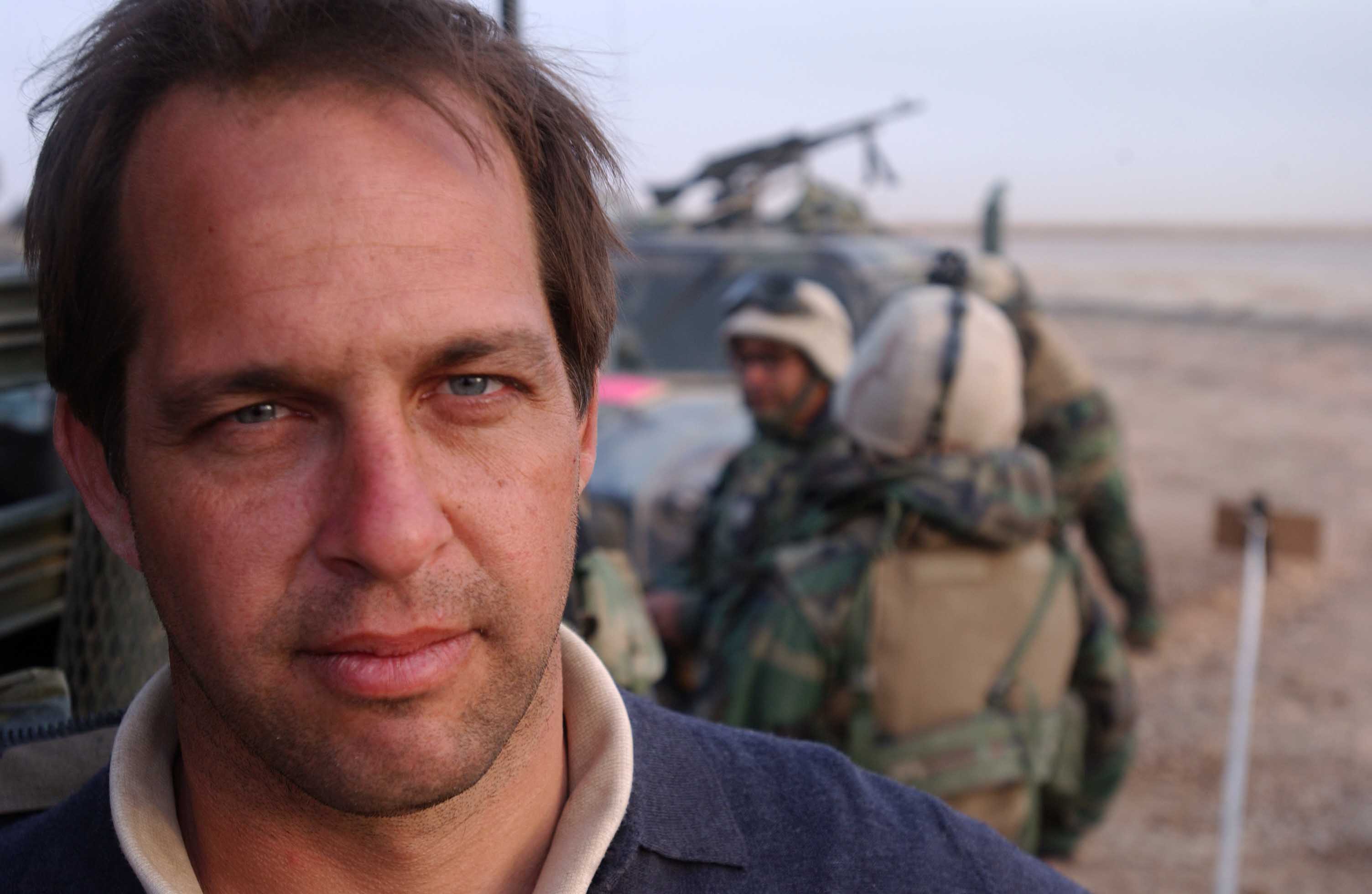
* Nick Paumgarten (above) totally geeking out, at considerable length, about being a “Deadhead” — since he’s an editor at the best magazine in the world, he gets incredible access to cool stuff, and online he posts a list of his thirteen favorite live recordings available for free streaming or downloading from an amazing website I never knew about, archive.org;

* “Queer Eyes, Full Heart,” Emily Nussbaum’s detailed mash note to Ryan Murphy, creator of Glee, Nip/TuckAmerican Horror Story, and other TV shows (who knew Nussbaum could be so gay-savvy?); and

* Jill Lepore “Tax Time,” which takes one of the most boring subjects on earth and gives it her diligent reporter’s all, ending with this eloquent take-home:

“Taxes are what we pay for civilized society, for modernity, and for prosperity. The wealthy pay more because they have benefited more. Taxes, well laid and well spent, insure domestic tranquility, provide for the common defense, and promote the general welfare. Taxes protect property and the environment; taxes make business possible. Taxes pay for roads and schools and bridges and police and teachers. Taxes pay for doctors and nursing homes and medicine. During an emergency, like an earthquake or a hurricane, taxes pay for rescue workers, shelters, and services. For people whose lives are devastated by other kinds of disaster, like the disaster of poverty, taxes pay, even, for food.

“What’s surprising, given how much money and passion have been spent to defeat a broad-based, progressive income tax over the past century, and how poorly it has been defended, is that it has endured – testimony, perhaps, to American’s abiding sense of fairness. Taxes are a pact. That pact needs renewing.”
 

In this week’s New Yorker

November 11, 2012


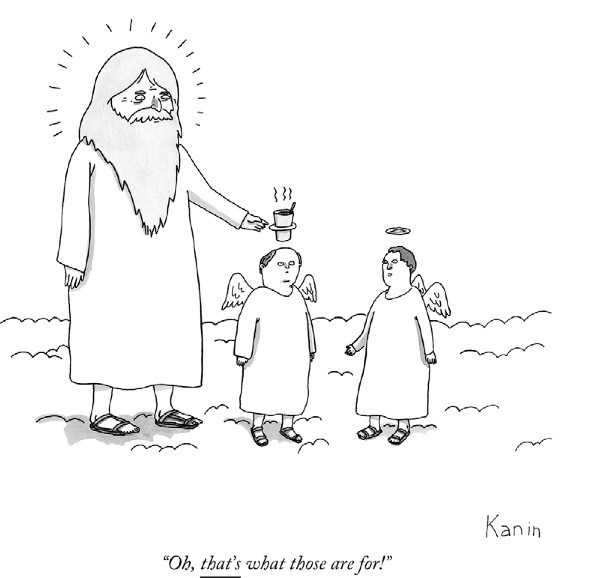
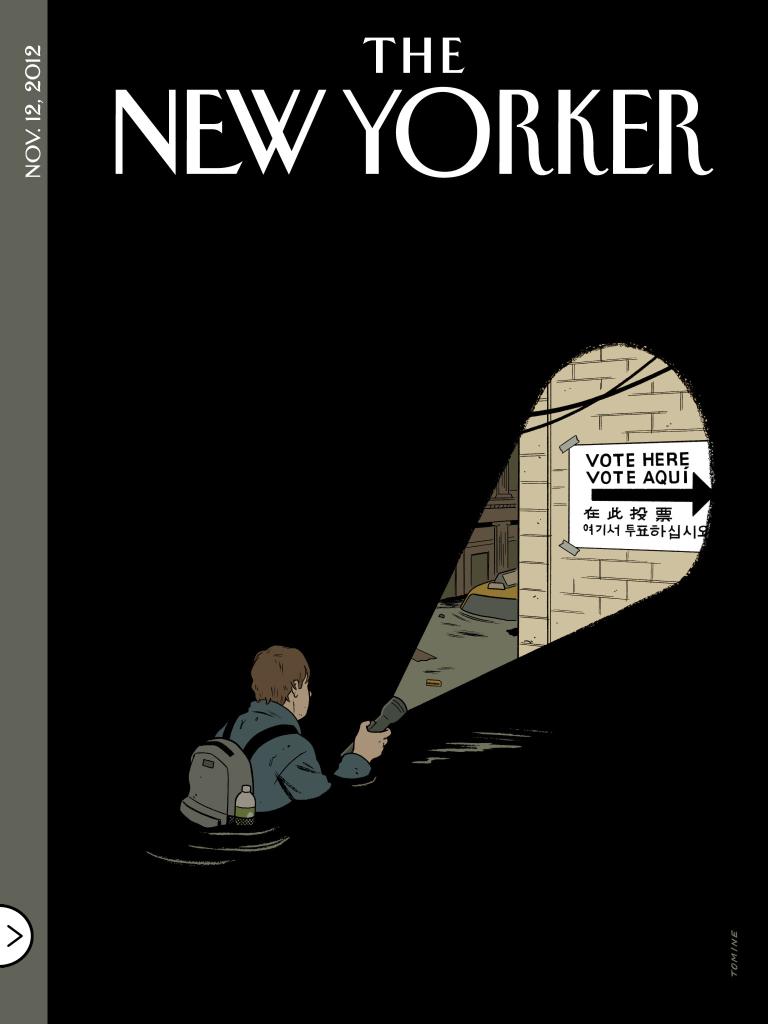
Aside from Adrian Tomine’s spiritually if not literally accurate depiction of Election Day in Sandy-smashed New York City (above), I was taken by three major features:

* Wendell Steavenson’s “Letter from Cairo,” detailing the disturbing backlash against women in post-Mubarak Egypt and the inspiring courage of the young women unwilling to shut up and stay home;

* Judith Thurman’s entertaining profile of Betty Halbreich, the crusty, truthtelling 85-year-old personal shopper at Bergdorf Goodman; and

*Alex Ross’s “Love on the March,” an intimately personal essay about several books on the history of the gay rights movement, most notably David Halperin’s How to Be Gay: Male Homosexuality and Initiation. Sample passage: “As Halperin puts it, ‘every identity is a role or an act.’ it’s just that straight-male performance is granted instant authenticity. Super Bowl Sunday, seen from a certain angle, is a pageant as intricate and contrived as the annual invasion of the drag queens on Fire Island.”

In this week’s New Yorker

October 26, 2012


The Politics issue of the New Yorker this week has some very strong good stuff: the long thoughtful endorsement of Obama for re-election; Jane Mayer’s fantastic story about Hans von Spakovsky, the reprehensible villain who is single-handedly responsible for the Republican push for voter-ID laws to disenfranchise populations who don’t favor Republican candidates; and the mesmerizing saga written by George Packer of Jeff Connaughton, someone who has toiled behind the scenes in politics as a speechwriter, lobbyist, and assistant for decades. But the single best story is Dexter Filkins’ “Atonement,” in which the New York Times reporter (pictured below) witnesses the highly emotional meeting in California between severely traumatized Iraq veteran Lu Lobello and the surviving family of three civilians Lobello killed on April 8, 2003, when U.S. forces moved into Baghdad. I wept nonstop reading the story.

In this week’s New Yorker

September 20, 2012


A weird thing about the New Yorker’s annual Cartoon Issue is that it pretty much always creates high expectations and doesn’t live up to them. This week, as in the past, the cartoons don’t seem as good as many regular issues, even though there are twice as many.


The best thing about this issue is “The Lie Factory,” Jill Lepore’s American Chronicles piece about the two individuals who created the whole industry of political lobbying . Clem Whitaker and Leone Baxter, a couple of right-wing conservative,  created Campaigns Inc. in 1933. They started out in newspapers and then figured out how to run political campaigns in favor of businesses by smudging the line between advertising, advocacy, and journalism. They were the ones who first undertook to persuade the American public that universal health care was “socialized medicine” and therefore unspeakably evil. It’s a fascinating and disheartening chapter of American political history.

Key quote from William Gavin, an advisor to Richard Nixon who wrote in a memo: “Voters are basically lazy, basically uninterested in making an effort to understand what we’re talking about…Reason requires a higher degree of discipline, of concentration; impression is easier. Reason pushes the viewer back, it assaults him, it demands that he agree or disagree; impression can envelop him, invite him in, without making an intellectual demand. . . . When we argue with him we demand that he make the effort of replying. We seek to engage his intellect, and for most people this is the most difficult work of all. The emotions are more easily roused, closer to the surface, more malleable.”

I did also love this amazing photo by Martin Roemers that accompanied Mohsin Hamid’s short story “The Third-Born”:


Last week’s issue, by the way, had a terrific profile of Elizabeth Warren by Jeffrey Toobin, an excerpt from Salman Rushdie’s new book about his life under the fatwa that made him a target for assassination by Muslim fanatics, and a good piece by Hilton Als on Robert Wilson and the evolution of Einstein on the Beach.

In this week’s New Yorker

September 9, 2012

Before the moment passes, I’d like to put in a good word about several absorbing articles in the Style Issue, cover-dated September 10:

* John Seabrook on Federico Marchetti, the business nerd who dragged fashion kicking and screaming into e-commerce with Yoox.com;

* John Colapinto on Will Guidara and Daniel Humm, who bought out and took over Danny Meyer’s  Eleven Madison Park and elevated it to a ridiculously world-renowned restaurant;

* Aleksandar Hemon’s profile of Lana and Andy Wachowski, the filmmaking siblings who made The Matrix and its spin-offs and whose most recent work is the forthcoming adaptation of David Mitchell’s mind-bending novel Cloud Atlas (I enjoyed Tom Hanks’ quote — “I work for free. I get paid for waiting.” — and was touched by this remark by Steve Skroce, who has storyboarded for the filmmakers since The Matrix: “After the success of the first Matrix, they were able to get point son the box-office, video games, etc. They had a dinner at this great Italian restaurant in Santa Monica and all their key collaborators were invited. At each place setting was a golden envelope with a check inside. I’m not sure who got what, but I know what I received was far beyond what I could ever have guessed or hoped for.”); and

* Ian Parker on Bjarke Ingels, the Danish architect who has made himself a brand name at 37.

Then there’s Thomas McGuane’s short, pungent story “The Casserole” and Ariel Levy’s supercilious review of Naomi Wolf’s book Vagina: A New Biography, which made me laugh out loud. Key passage: “Wolf claims that vaginal slander — referring to the vagina by its ‘awful’ feline moniker, for instance — ‘apparently affects the very tissue of the vagina.’ She bases this conclusion on a study of female rats whose vaginal tissue showed signs of change after periods of stress. The experiment did not, however, entail researching yelling ‘Rat pussy!’ at the animals; stress was manufactured physically. Wolf’s interpretation of the science is, as usual, rather free.”

And who doesn’t love a cover by Ian Falconer?