Archive for the 'from the deep archives' Category

From the deep archives: Michael Mayer

April 20, 2010

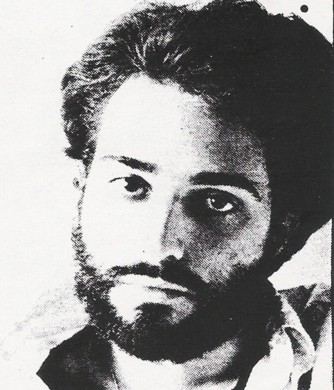
On the occasion of the Broadway opening of American Idiot, I resurrected an interview I did with director Michael Mayer in 1998 for The Advocate — back before Spring Awakening, when he’d just directed the fantastic revival of Arthur Miller’s A View from the Bridge starring Anthony LaPaglia and Alison Janney.

Michael Mayer is in a quandary. We’re sitting in a Chelsea diner near where he lives with his Jewish doctor boyfriend, and he’s brooding over the morning’s New York Times. On one hand, there’s an article announcing that Triumph of Love, the musical that he’d nurtured since its conception and that became his Broadway debut as director, would be closing after an all-too-brief run. On the other hand, there’s a two-column full-page ad for his revival of Arthur Miller’s A View from the Bridge quoting the rave reviews it had just received.

Sad as it is to watch a favorite show go down the tubes, just having two shows on Broadway at the same time is enough to establish 37-year-old Mayer as a director to watch. He’s been on a roll since 1993, when his former New York University classmate Tony Kushner invited him to direct a student production of Perestroika, the second part of Kushner’s Pulitzer-winning gay epic Angels in America, at their alma mater. The Broadway producers were sufficiently impressed to hire Mayer to direct the national touring company of Angels the following year, which put him on the map. Since then he’s worked almost nonstop, frequently with prominent gay writers such as Craig Lucas (Missing Persons) and the late Howard Ashman (the revue Hundreds of Hats).

Staging both an intimate vaudevillean musical and a Greek tragedy transposed to ‘50s Brooklyn would be a fun challenge for any director, and Mayer feels his secure gay identity has been an asset to both projects. What interested him about James Magruder’s translation of  Triumph of Love, Pierre Marivaux’s gender-bending 18th-century comedy about a female Don Juan who woos both men and women in pursuit of her true love, was “the cultural flypaper aspect of camp sensibility.” Throwing in Tin Pan Alley references and openly acknowledging the diva worship that surrounds a star like Betty Buckley, Mayer and Magruder were “amusing ourselves, which is what gay people have always done, because who else will do it?”

Meanwhile, Mayer brought a ‘90s bluntness to View, whose main character, consumed by an illicit passion for his niece, projects his sexual confusion onto his wife’s Italian immigrant cousin, whom he brands as queer. “In the ‘50s the audience had no distance from Eddie’s psychological problems,” says Mayer. “You couldn’t acknowledge homophobia because there wasn’t anything else going on in the culture. The difference now is that we’re more visible.”

Growing up in Bethesda, Md., Mayer experienced his share of  “typical suburban homophobia: being called faggot, being shoved every day in the hall, things written on my locker.” Luckily, his parents were supportive. “I mean, hello — when I was 8, I woke up one morning to find the double-album Judy at Carnegie Hall on my pillow.”

Those memories of gay adolescence will come in handy next spring when Mayer directs John C. Russell’s Stupid Kids, “a queer re-telling of Rebel without a Cause featuring two gay teenagers, a boy and a girl, who form a union that is their safe haven in a world that is at best indifferent and at worst really hostile.” Lest anyone pigeonhole him as one kind of director, though, Mayer’s also working with lesbian playwright Paula Vogel (How I Learned to Drive) on a revival of On a Clear Day You Can See Forever.
From the deep archives: Chay Yew

April 6, 2010

Seeing Chay Yew’s production of Kia Corthron’s play reminded me that I interviewed him for The Advocate in 1999. I’m re-posting that story here and on my website:

NOTHING COMPARES TO YEW

“Gay theater has become more diverse in terms of aesthetics and stories,” says playwright Chay Yew. “But let’s face it. How many gay plays are being done? Quite a few. Who are they about? Beautiful young white men. And they’re usually not deep. They affirm the image we want of ourselves, or they’re titillating. There’s a place for that, but it’s not my kind of gay theater.”

The 33-year-old playwright, who was born in Singapore but grew up in the U.S., got his first hit of gay theater from seeing Larry Kramer’s The Normal Heart. “I came out utterly moved, rejuvenated, and angry,” he recalls. Still a communications major at Boston University, he wrote his first play, Porcelain, about a young Asian man who kills the would-be lover he meets in a public toilet. His second play, A Language of Their Own (which received a stellar production at New York’s Public Theater in 1995), portrays a gay Asian-American couple who break up when one discovers he’s HIV-positive. Next August the La Jolla Playhouse in San Diego will mount Wonderland, a play in monologue form about an Asian-American couple and their gay son who gets kicked out of the house by his father and takes to drugs and hustling.

Currently on the boards at New York’s Manhattan Theatre Club is Red, in which a best-selling Asian-American novelist tracks down a former star of the Beijing Opera, a gay father famous for playing female roles.

Yew says he originally wanted Red to make a connection between the Cultural Revolution that destroyed a generation of Chinese artists and Newt Gingrich’s attempt to abolish the National Endowment for the Arts. But he also jokes that he wanted to write “a big chinky play” that would impress 60-year-old regional theatergoers. Inevitably, though, “it’s a very gay play,” he says, “because it’s about divas. All the characters are passionate about their art. Sort of like All About Eve.”

April 13, 1999

From the deep archives: Jim Strahs and NORTH ATLANTIC

March 21, 2010


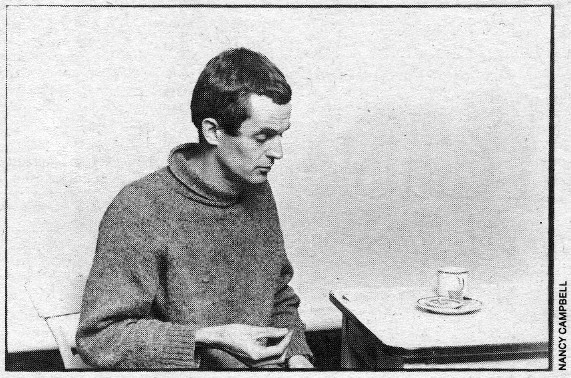
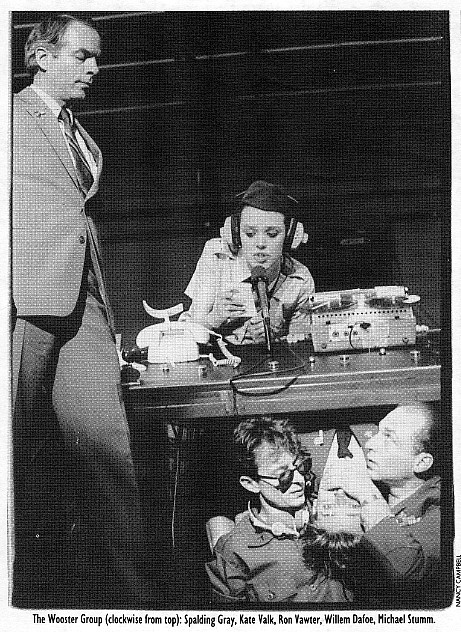
Inspired by seeing the revival of NORTH ATLANTIC, I rooted around in the long list of articles I’ve published about the Wooster Group over the year and posted online a 1982 Village Voice feature on Jim Strahs (above, several years before he wrote NORTH ATLANTIC for the Group) and a 1989 feature for 7 Days about the original production (below).

From the deep archives: Christopher Walken

March 11, 2010


On the occasion of his return to Broadway, I’m posting the interview I did with Christopher Walken for my book Caught in the Act: New York Actors Face to Face (a collaboration with photographer Susan Shacter). It’s one of my favorites in the book because of his humility and the way he talks about his relationship to the audience. At the time, Walken had confounded expectations by taking a cameo role in the 1986 Lincoln Center revival of John Guare’s House of Blue Leaves, for which he was onstage only for the last ten minutes of the play.

In House of Blue Leaves, you just sit there looking out at the audience – it’s one of the weirdest, most Brechtian performances I’ve ever seen.
I’m looking at them and they’re looking at me. That’s what I’m here for. That’s what I meant before when I said I’m starting to know what I’m for. A lot of critics object to that, but I do it on purpose. I believe that’s what God wants me to do.

God wants you to look at the audience?
I know, you say something like that and people think you sound like the Ayatollah Khomeini. But I look around as an intelligent person and see so many wonderful actors doing the other thing – why would I want to enter than arena? I believe as a performer you have to create your own arena so that in a sense there is no competition.

See the whole interview here.

From the deep archives: Harry Kondoleon’s “Self Torture and Strenuous Exercise”

March 2, 2010

This was my review in the Soho News of the first Harry Kondoleon play produced in New York:

I wish Harry Kondoleon’s Self Torture and Strenuous Exercise had played longer than its 10 showcase performances, so I could urge you to see it. Kondoleon’s amusing one-act isn’t great, but it’s more than merely diverting. A comic soap opera about urban sophisticates, it’s one of those crazy, Joe Ortonesque plays in which the characters say and do the outrageous things most people think of but never actually say and do – that’s how Kondoleon can squeeze so much material into a feverish 45 minutes.

Carl confesses to his best friend Alvin that he’s in love with another woman besides his wife, Adel; Alvin assures him that’s okay for a widower, not knowing that Adel survived her latest suicide attempt and not knowing that Carl’s paramour is his own wife, Beth. Adel arrives in disguise, wrists bound, and swearing vengeance. “Carl is the source of everything evil in the world!” she cries. “Adel, calm down,” soothes Alvin, “you’re beginning to distort things.” The two women eventually team up against the egomaniacal Carl; Beth is a frustrated poet, Adel an aspiring novelist, and they’re tired of being exploited in Carl’s pulpy best-sellers. “I won’t wear lost love like a corsage,” sobs Beth, launching a hilarious demonstration of her orchidaceous verse. “How long are you going to keep sending the same five poems to The New Yorker?” taunts Carl. “You think they’re amnesiacs?”

All this hysteria was smartly enacted in Theater Core’s production at the Newfoundland Theater, especially by May Quigley as Adel and Ken Olin as Carl (who seemed, aptly, a swell guy rather than the “rat with a necktie” he was pegged by the women). Max Mayer’s staging was also clever; on exiting, the actors retreated to a balcony over the stage to observe the action as raptly as the audience did.

Self Torture played on a double bill with Keith Reddin’s Desperadoes, which opened with a promising Sam Shepard-ish image: a woman pasting wet dollar bills all over a blindfolded man in jockey shorts tied to a chair. The play didn’t live up to that tableau, though. It was Moonchildren meets When You Comin’ Back, Red Ryder meets American Buffalo without any real threat of danger. Those plays are decent models, though, and Reddin is clearly a writer with potential.

Soho News, August 20, 1980