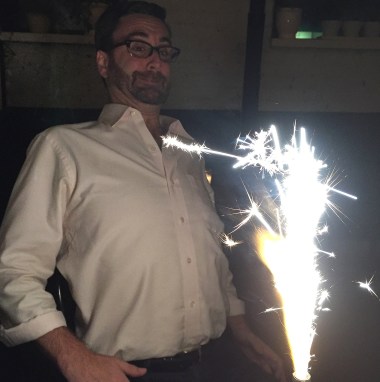
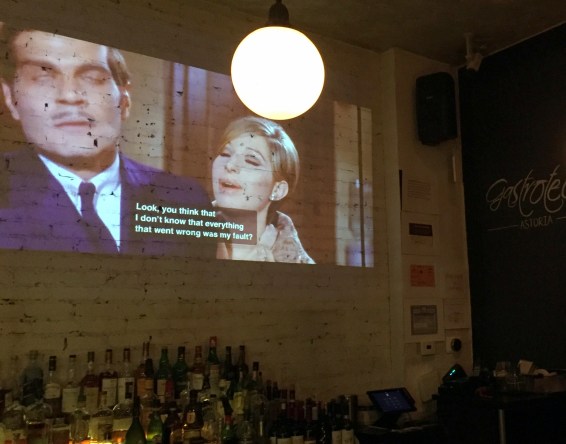
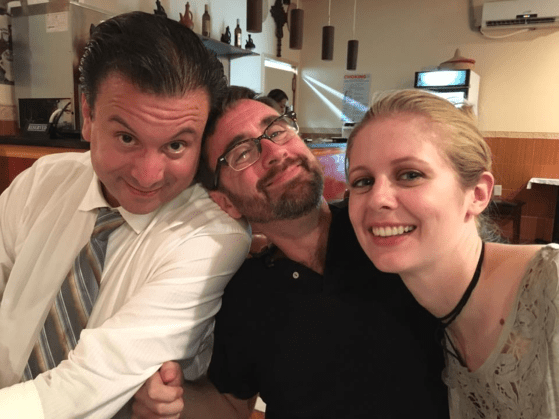
We started Andy’s birthday celebration with a delicious dinner (and sparkling dessert) in the company of Ben, Randall, and Hugh at Gastroteca Astoria.
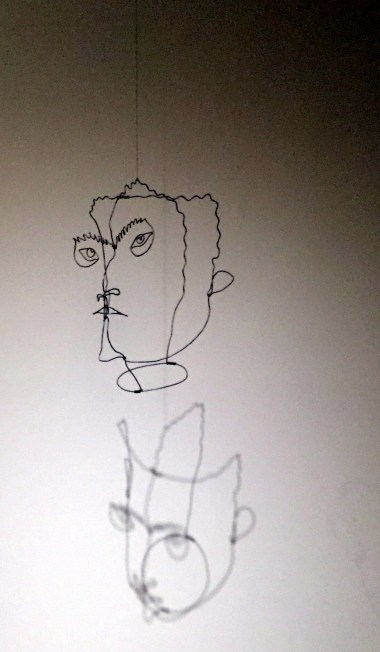
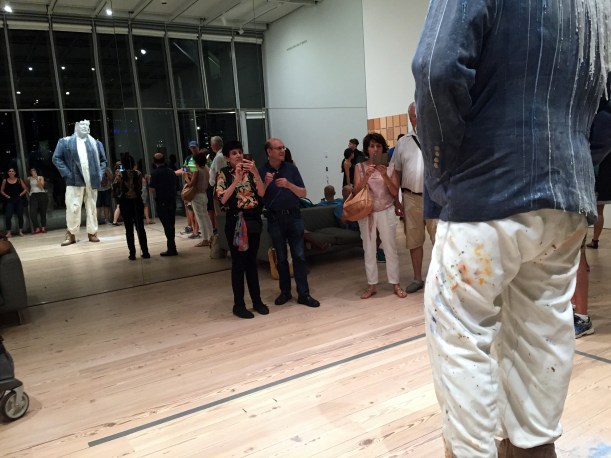
The celebration continued Friday night with a sunset bike ride down to the Village and a stroll through “Human Interest,” the Whitney Museum’s show with its intriguing array of interpretations as to what constitutes a portrait. Alexander Calder’s wire mobile of Edgard Varese. Diane Arbus’s baby picture of Anderson Cooper. Urs Fischer’s giant sculpture of Julian Schnabel as a burning candle. Jean-Michel Basquiat’s Hollywood Africans. Duane Hanson’s Woman with Dog, so startlingly realistic that I seriously believed it was a little piece of performance art, someone sitting and reading letters all day with a dog at her feet.
Saturday turned to be a perfect day for a ferry ride to Gunnison Beach in Sandy Hook, NJ, bicycling to and from the Seastreak terminal on the East River. For dinner we met Cesar, Alison, and Bob for Ethiopian food at Abyssinia in Harlem.
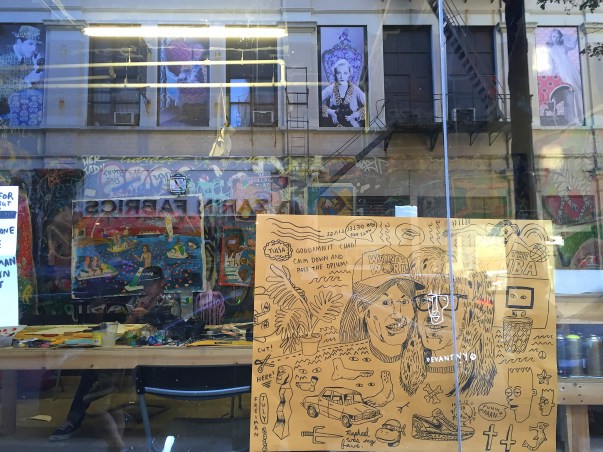
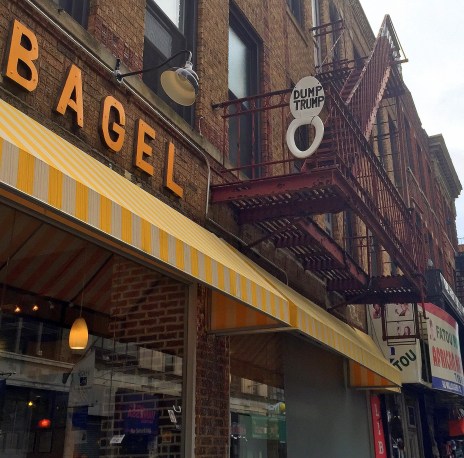
Sunday afternoon I took Andy to the Metrograph Cinema to see the Madonna documentary, Truth or Dare, which he’d never seen. We enjoyed strolling through the Lower East Side and Soho, taking in the new storefronts and street art. We thought our T-shirts together could form the basis of a PhD thesis about the cross-pollination of comic books and gallery art in the late 20th century.
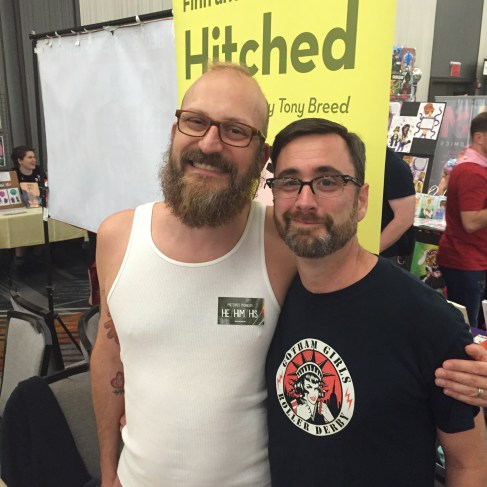
Andy and I checked out day two of FlameCon, the LGBTQ comics convention at the Brooklyn Bridge Marriott. It was a dazzling festival of gay geekery as far as the eye could see, with a full range of ages, colors, races, gender identities, and geek communities in evidence.
Andy got to reconnect with Tony Breed, an artist whose web comic inspired an ongoing Twitter conversation and virtual friendship.
We were both delighted to meet big sexy bear Steve MacIsaac, creator of the smart and beautiful and melancholy graphic zine Shirtlifter. (I overheard him earnestly explaining to someone where the name comes from.)
The organizers did an impeccable job thinking of all the ways to make FlameCon inviting for populations who don’t always feel welcomed — free day for teenagers, stickers indicating what pronouns you prefer, a break room with a name I couldn’t parse (AFK Lounge, which my darling Big Honking Geek translated for me: Away From Keyboard).
I bought a book (Kindris) and a T-shirt from Anthony Dortch, Jr., whose trippy textured work immediately resonated with me.
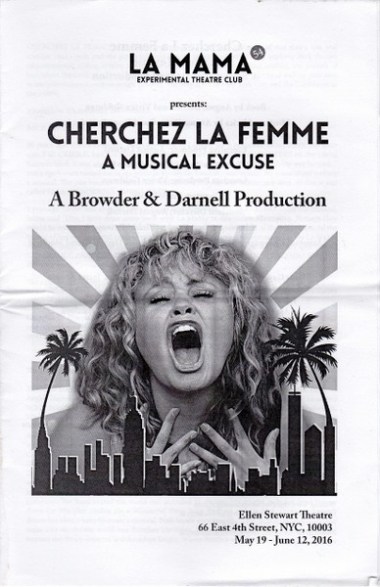
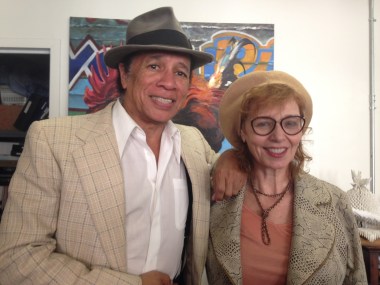
May 31: The mere announcement that La Mama ETC would be presenting Cherchez La Femme (subtitled “A Musical Excuse”), a show created by August Darnell and Vivien Goldman (pictured below), for three weeks (May 19-June 12), sent me on a high-speed excursion down Memory Lane. Darnell was a founding member of Dr. Buzzard’s Original Savannah Band and the creator of the pop group Kid Creole and the Coconuts. I was a huge fan of those acts and as a young pop-culture journalist spent a couple of years obsessively following their work. I wrote big feature stories about Darnell for the Soho News and the Boston Phoenix. For Rolling Stone, I reviewed the first two Kid Creole albums (Off the Coast of Meand Fresh Fruit in Foreign Places), the Savannah Band’s third album, and the solo album by Savannah Band’s lead singer Cory Daye. I also wrote a Soho News review of what I think was the first and only live concert in New York City by the Savannah Band, which was pretty shambolic; my reward for writing honestly about its painful shortcomings was a soggy package of dogshit delivered to the Soho News office. But for a short period of time, I had a friendly relationship with Darnell, and my Boston Phoenix feature details his emergence as an artist better than anything else I’ve read, at least until Jon Pareles’ feature in the Arts and Leisure section of the New York Times last week (which was where I learned that Stony Browder Jr., Darnell’s brother and mentor, had died in 2001).
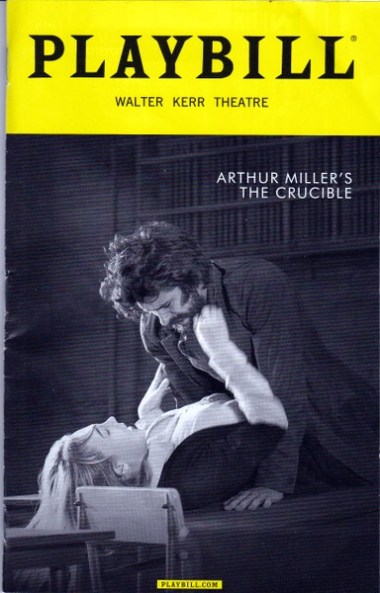
Andy and I and our friends Bob and Phil attended the second preview of Cherchez La Femme, which was pretty rocky. The book rambled, the staging was awkward, and the lively performers struggled to do their best while singing to prerecorded tracks blasted at uneven volume. But several production numbers stood out, thanks to the snappy choreographer of Kyndra “Binkie” Reevey and the snazzy costumes by Adriana Kaegi (Darnell’s ex-wife and former Coconut). I somehow expected the score to feature a nonstop barrage of Savannah Band/Kid Creole favorites. Instead most of the songs came from later, lesser-known Kid Creole albums, released after many listeners (including me) had lost interest. But the little bits of familiar music that did show up were a blast – besides scene-change snippets of “I’ll Play the Fool” and “Sour and Sweet,” we heard the title song (reprised as a curtain call), “Annie, I’m Not Your Daddy” (the lyric changed to “Addy,” after a character in the play), and a song from a Gichy Dan album called “You Can’t Keep a Good Man Down” that now I can’t get out of my head.
I’m delighted for Darnell that he’s gone back to his first love, writing plays (he did write the original songs for an Eric Overmyer musical called In a Pig’s Valise produced by the Second Stage in 1989). And it has been fun if slightly unnerving to revisit a cultural obsession from 36 years ago. I look back at my coverage of these artists and cringe a little at my naivete about drugs (Stony Browder didn’t get his name by being stoical) and my somewhat provincial white-boy attitude about world music. I am impressed how ahead of the game August Darnell was with his own variations on sampling and appropriation. And at the time the only corollary to the extended social/artistic Savannah Band scene I could point to was George Clinton’s Parliament-Funkadelic. Nowadays there are numerous similar enclaves of loosely affiliated artists, especially in the hiphop world (Odd Future, the Internet).
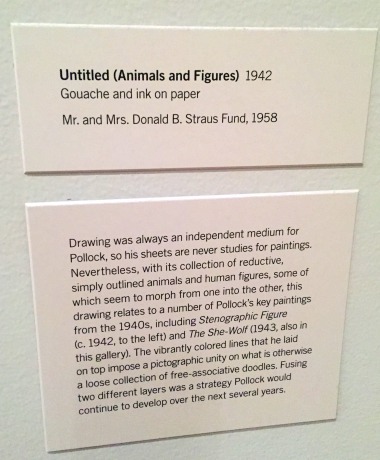
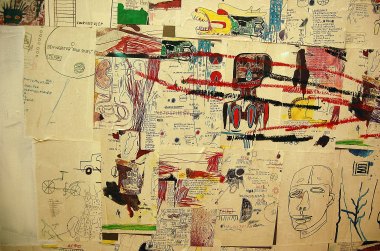
My unusually culture-crammed weekend started Saturday afternoon with a spin through MOMA. I walked through the Degas show and the Marcel Broodthaers retrospective, which didn’t interest me, on my way down to the Jackson Pollack show finishing its run. I was surprised at how small the show was but I got a lot out of it. Never having seen early pre-drip work, I was fascinated to bear witness to Pollack’s very particular version of exploring the overlap of abstraction and representation. Some paintings and drawings clearly look back at Picasso; others intriguingly look like precursors of Basquiat, both in the scribbly drawing (see “Untitled (Animals and Figures)” below, and below that a detail from Basquiat’s “Glenn”) and in the sense of large-scale performance across the canvas.
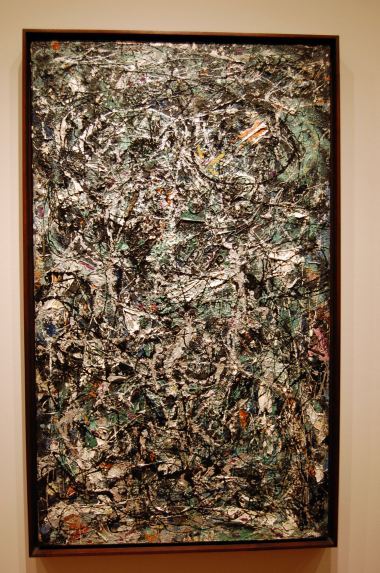
I’m similarly mesmerized and bowled over by Pollack’s masterpiece “Number 1A” (detail below top) and the Basquiat masterpiece “Glenn” (below bottom) which has been hanging on the second floor of MOMA for a while (I never get tired of seeing it).
It’s so strange how not every Pollack canvas leaps out at me, but certain ones do – in this show, “Full Fathom Five” knocked me out with its depth and texture.
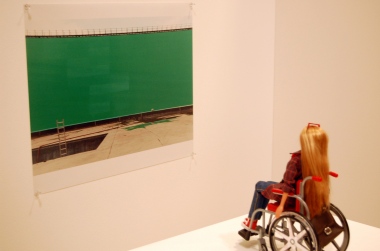
I also checked out Rachel Harrison’s show Perth Amboy, a strange installation with a lot of cardboard and enigmatic tableaux, including this one featuring a Becky Friend of Barbie doll:
I spent the late afternoon revisiting A Fish Called Wanda, a movie I saw at a screening when it came out in 1988. Andy has watched it so many times that he has certain speeches memorized, most notably when Wanda (Jamie Lee Curtis) goes off on Otto (Kevin Kline):
“To call you stupid would be an insult to stupid people! I’ve known sheep that could outwit you. I’ve worn dresses with higher IQs.” Seeing it again was fun. Kline absolutely earned his Academy Award for this audaciously gigantic comic performance as a handsome, sexy scoundrel. Curtis is hardly the world’s greatest actress but she’s good and game and never looked more beautiful than she does in this movie, which was directed (Andy reminded me, mining IMDB for all the trivia he could find, since the DVD came without a commentary track) by Charles Crichton, famous for British comedies such as The Lavender Hill Mob.
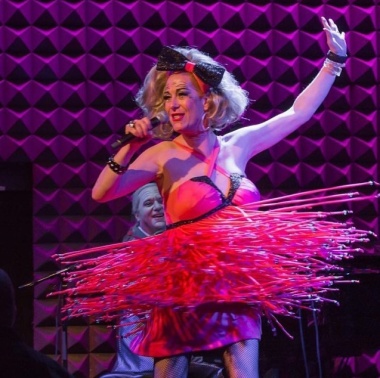
Saturday night we headed to Joe’s Pub for the long-awaited reunion of Kiki and Herb, tickets for which Andy had snapped up last September in the half-hour they were on sale before they sold out. Their show, Seeking Asylum!, was a blast from the get-go, when the offstage announcer introduced them by saying, “Please be aware that these performers are in their eighties, and they’re doing their best, considering…” In the years since Justin Vivian Bond and Kenny Mellman took a break from their legendary gig, Bond has embraced a transgender identity and really stepped into the role of artist-as-activist, which has only upped her game as Kiki DuRane. Behind the mask of superannuated chanteuse and clown, she delivers depth-charge commentary on everything that must be said today from a sharp, queer point of view. Kiki narrates her travels since the day of President Obama’s inauguration, which took her from one turbulent political hotspot to another where she delivers her own brand of savage love. “What the world needs is less othering, more mothering!”
As usual, the setlist constantly surprises with savvy semi-obscure singer-songwriter selections (Suzanne Vega’s “The World Before Columbus,” Fiona Apple’s “Extraordinary Machine”) and crazy hilarious medley-mashups (“Make Yourself Comfortable/When Doves Cry,” “Seasons of Love/The Rainbow Connection/Edelweiss/Tomorrow Belongs to Me”). The indisputable highlight of the generously long show kicked Kiki into shamanic mode, channeling the fury and frustration of Nina Simone on “Mississippi Goddam,” no longer a relic of bygone civil-rights movements: “Everybody knows about Carolina/Everybody knows about Alabama/Everybody knows about Tennessee/Everybody knows about Mississippi/Goddam!” We laughed, we cried, we peed in the Public Theater’s trans-friendly bathroom.
Sunday afternoon we found ourselves clicking around HBO and landed on Timothy Greenfield-Sanders’s documentary The Out List. Along with what might be considered the usual suspects (Neil Patrick Harris, Cynthia Nixon, Ellen DeGeneres, Wanda Sykes, Larry Kramer), I dug encountering a few LGBT heroes not previously on my radar, including Janet Mock (below, center), Dallas County sheriff Lupe Valdez, Wade Davis (below, left), and Twiggy Pucci Garçon (below, right).
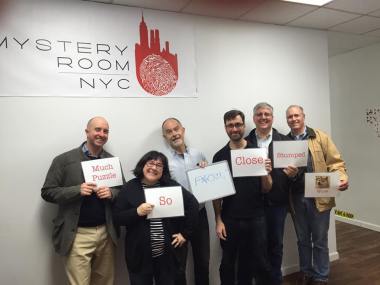
Then I ran off to the second rehearsal in three days with Gamelan Kusuma Laras gearing up for our gig at Asia Society May 14 and 15 performing a wayang kulit (shadow-puppet play) with renowned Javanese dhalang (storyteller) Ki Midiyanto. Afterwards I met Andy and several friends at Mystery Room NY, one of several venues operating in a genre popularized by Escape the Room that combines immersive theater with group puzzle-solving. We were locked into a laboratory for 60 minutes charged with the task of solving the mysterious disappearance of a veterinarian engaged in high-level research involving dogs. Besides being fiercely competitive, Andy turns out to be ferocious when it comes to puzzle-solving – he went into total “Doctor Who” mode leading our team through a series of fun discoveries, although we didn’t manage to free ourselves before the hour was up. (The cheerful Kiwi gal who checked us in and fed us cues throughout the hour informed us that only 15% manage to solve all the puzzles in the given time.) It’s a fun party activity for people who have had their fill of karaoke.
Andy went off to watch Game of Thrones with a bunch of fanboys while I hunkered down with a bowl of popcorn and Andre Téchiné’s Unforgivable, an absorbing novelistic pansexual romantic drama set among the crumbling villas of Venice with a good cast that included Carole Bouquet as a bisexual French real estate agent, André Dussollier as her much older, highly impulsive, somewhat paranoid novelist husband, Adriana Asti as her ex-girlfriend who’s now an alcoholic semi-retired private investigator, and handsome Andrea Pergolesi as a cash-poor aristocrat turned drug dealer.
Also this weekend I read Samuel R. Delany’s graphic memoir Bread & Wine, a collaboration with artist Mia Wolff, which tells the remarkable story of how the great pioneering gay black sci-fi/fantasy writer met his partner Dennis Rickert when the latter was homeless, selling books on a blanket at Broadway and 72nd Street and sleeping in a doorway on the Upper East Side. His pungent description of the first night they spent at the Skyline Hotel – the smell that emerged when Dennis took off his shoes, the color of the water after the two baths he took, the powerful sex they enjoyed – charts new territories of erotic intimacy measured in poetic language and evocative black-and-white drawings.























 another eye opens