7.24.15 I’m no expert on Dancenoise, the performance art duo Annie Iobst and Lucy Sexton (below), but they’re legendary to me nevertheless. In their heyday (late ‘80s/early ‘90s), they never did shows that had long runs. They were more likely to manifest in late-night club dates (at 8 B.C. or King Tut’s Wah Wah Hut) and one-off festival appearances while I was busy going to sit-down shows in theaters. I did glimpse them occasionally doing walk-ons at the Bessie Awards shows or group-show galas but never felt I’d really gotten the full whammy. So thank you, Whitney Museum, for “DANCENOISE/Don’t Look Back,” a mini-retrospective inaugurating the performance facilities at the new venue in the West Village. There was an installation, some film screenings, a variety show, and then a three-night full-length performance of new and old material.

It’s hard to describe what they do in their string of funny, savage, politically pointed vaudevillean sketches, except that they generally gravitate toward everything women are NOT supposed to do. The program notes at the Whitney quoted Tom Murrin the Alien Comic calling them “the premier practitioners of synchronized aggression,” which is a great succinct summation. After a brief funny freshly finished Charles Atlas film of them running through the museum on their way to the show, they made their usual famous entrance: completely naked except for high heels, flaunting their completely real now-aging unshaved untucked bodies with the fierceness of warriors. They ran through a multitude of costumes, pulled guns and shot each other repeatedly like tireless kids playing, they yielded the stage for scantily clad bump-and-grind boys (including the likes of hunky actor Jonathan Walker, drag clown Hapi Phace, monologuist Tony Stinkmetal, and Elevator Repair Service’s Mike Iveson), they flung fake blood everywhere. In my favorite section, the high-quality sound system blasted Fleetwood Mac’s “You Make Loving Fun” while Lucy and Annie did some partnered ballroom dancing with genderqueer partners (Richard Move and Connie Flemming), all them in black bras and panties, eventually joined by a whole stage-ful of folks in the same outfit bouncing up and down to the music. No big verbal commentary, just a lot of anarchic energy and sexual vitality, which was exhilarating. Coming right after the revival of And That’s How the Rent Gets Paid at the Kitchen, it felt like a fun and funny time-warp. A lot of the same faces showed up in the audience – Andy and I sat next to Nicky Paraiso and chatted afterwards with John Hagan, Yolanda Hawkins, and William Niederkorn. At home I dragged out Cindy Carr’s anthology On Edge: Performance at the End of the Twentieth Century and read out loud her observant piece on Dancenoise, which was published in April 1989 but pretty much described the show we’d just seen:
“These are terrorists wielding a shtick, and with it they attack power in its many disguises. Their shows are always teeming with pop culture junk, since that’s where power hides and where it emanates from – the evening sound bites, the advertising arias, the fashion forecasts, the top forty wool-gatherers. The Dancenoise way of knowledge is to see life as one ungentrified unregenerate 14th Street, just a ramshackle boulevard where everything from Shakespeare to the unwritten law on how to wear a leotard can finally be destroyed and displayed in a bin. The performances level everything in their path, turning slogans into mantras, banality into ritual, pearls into swine. As a rule, they’re a riot and a gas.”
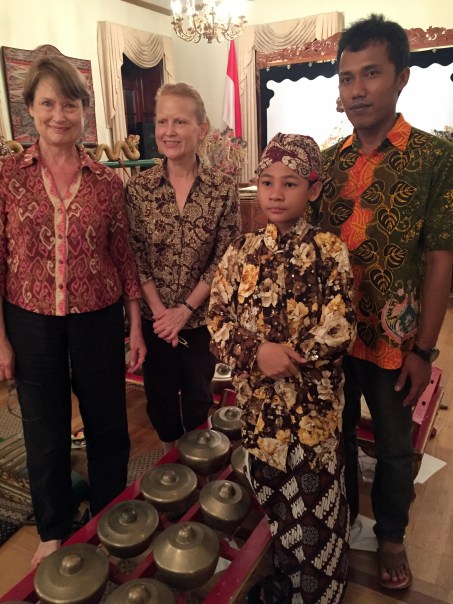
7.29.15 For gamelan musicians, playing for a wayang kulit (shadow-puppet play) constitutes an unusual challenge – although there’s a basic score with familiar notation, the music has to go wherever the dalang (storyteller) goes, so the players have to be alert to split-second stop-and-start cues. I finally got my first crack at playing under those circumstances when Gamelan Kusuma Laras accompanied the performance of “The Story of Gatotkacha” at the Indonesian Consulate featuring a dalang named Gymna Cahyo Nugroho, an eleven-year-old prodigy from Yogyakarta, Java, who was in the U.S. for the first time for two shows (the night before he was in Washington, DC).

He travels with his father, his teacher, and some key musicians (including the kendhang player, who essentially conducts the ensemble with his drum), none of whom spoke much English. The afternoon rehearsal was a little rough, and afterwards Gymna looked very tired and wrung out, probably jet-lagged. But he put on a pretty amazing show, manipulating the leather puppets, singing and voicing the various characters, and improvising jokes and reactions to the audience.


Most wayang kulit tell stories from the Mahabharata, and one thing you quickly learn is that there are tons and tons of battle scenes, which meant that a lot of our score required playing long sections of sampak — bang-bang-bang-bang loud and fast, kind of exciting and kind of monotonous.

Sitting and playing for hours is pretty punishing on the body. But we had a full responsive house and a lot of fun. Gymna seemed shyly proud of himself and smiled a bit except when cameras pointed at him, in which case he snapped into a very solemn professional pose.
7.30.15 I didn’t see the original stage production of The Last Five Years but I got a lot out of the original cast recording of Jason Robert Brown’s intimate musical, mainly because of the cast. Sherie Rene Scott and Norbert Leo Butz are arguably the finest musical theater performers of their generation, and the album displays them at their very best. The show runs on two conceptual elements. It portrays the arc of a relationship from his-and-hers perspectives, proceedings backwards in time (from breakup to first meeting) by not-quite-making-it actress Cathy and forwards (from first date to walking out) by hot young best-selling novelist Jamie, and it tells the story entirely in songs, with very little dialogue. And Brown writes some strong solid songs: “Still Hurting” and “A Summer in Ohio” are highlights for her, “Shiksa Goddess” and “If I Didn’t Believe in You” for him.

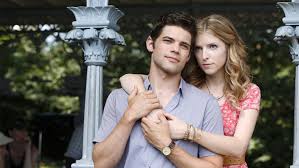
I was happy to learn that it was made into a movie by Richard Lagravanese and curious to see how it played out. The movie was released in an unusual manner – pay-per-view before theatrical release, which is several cuts above direct-to-video and mainly aimed at the theater-geek audience that made the live broadcasts of The Sound of Music and Peter Pan such big hits. Anna Kendrick and Jeremy Jordan (above) are appealing actors with musical-theater cred, and their drama is touching at times. I confess I got a little tired of their voices, which were a little too nonstop theatrical for me, spoiled as I am by the warm, flexible, more singer-songwriter pop-oriented voices of Scott and Butz.
8.3.15 Daniel Sullivan’s production of Cymbeline is a triumph for Shakespeare in the Park. Especially given the play’s insanely complicated, even ludicrous plot, the show is unexpectedly entertaining. Sullivan smartly addresses head-on the absurdly dense exposition that happens at the top of the show and the equally dense final scene that has to wrap up every conceivable variety of plotline the playwright ever used (a program note mentions that “scholars have counted 27 revelations in the final scene alone”) with a sly attitude that makes merry of the play without trashing it altogether. And he’s assembled a terrific ensemble of solid veterans, all of whom get doubly or triply cast (usually with at least one surprise appearance.)

Lily Rabe and Hamish Linklater are very fine as the young lovers, though Rabe is never very convincing disguised as a boy and Linklater is more fun playing the buffoon Cloten than the quasi-hero Posthumus. Patrick Page is excellent in the title role, as is Steven Skybell as hard-working servant to the Queen, played by Kate Burton a little too timidly for my taste. Raul Esparza absolutely steals the show, though, as flashy, fast-talking bad guy Iachimo. The production makes great use of Esparza’s razzle-dazzle Broadway song-and-dance chops but he also nails both the sound and the sense of Shakespeare’s language. These folks are amply aided by top-notch sets by Riccardo Hernandez, costumes by David Zinn (loved the Queen’s costume, which looks like something out of a Tim Burton production at the Metropolitan Opera), lighting by David Lander, lovely original score by Tom Kitt, and the other actors I haven’t mentioned: Teagle Bougere, Jacob Ming-Trent, and David Furr.

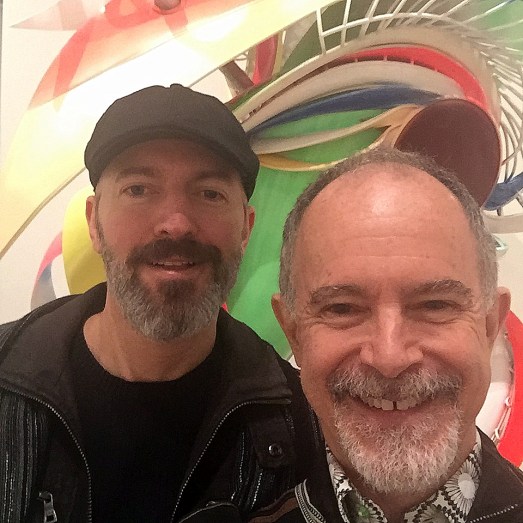
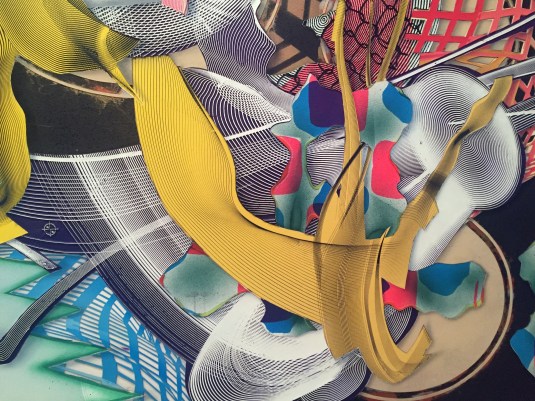
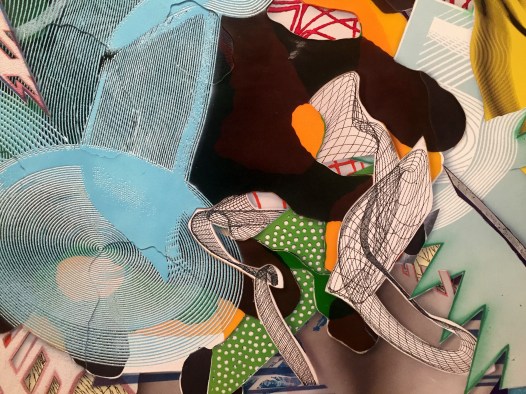
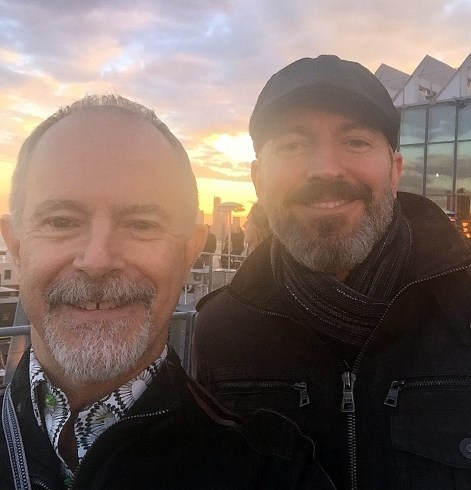
 Brent had never been to the Whitney, so I made it a point to show him around. On our way to the spectacular views from the terrace, we came upon an exhibition by a painter I’d never heard of. “Archibald Motley: Jazz Age Modernist” contains a generous sampling of beautiful portraits and several rooms of Motley’s richly hued scenes from black American life, full of vitality and humor.








 another eye opens