Posts Tagged ‘the new group’

Culture Vulture: HELEN., SABBATH’S THEATER, and STEREOPHONIC

October 31, 2023

Cultural weekend! Friday night, Andy and I met friends for dinner at The Smith in the East Village in honor of a recently departed college chum. It was Hallo-weekend and the streets were full of costumed revelers. We were most amused to see a couple dressed as tourist (him in I ❤️ NY t-shirt) and the Statue of Liberty.

Saturday – beautiful day, up to 80 degrees. We took part in the Gays Against Guns action in response to the mass shootings in Lewiston, ME. I had a Google Hangout conversation with Alastair Curtis, a young theater artist in London who’s just discovered the work of Harry Kondoleon and wanted to talk to me in preparation for a reading he’s doing of Christmas on Mars. In the evening, Andy and I were back in the East Village to see Helen., the SuperGeographics production of Caitlin George’s play directed by Violeta Picayo. In the lobby we chatted a little with producer Anne Hamburger (whose En Garde Arts brought the show to La Mama), Linda Chapman, Chay Yew (looking very buff), and two young artists Anne is cultivating. I enjoyed the play, a dense, poetic, cheeky, queer/feminist riff on Greek mythology that reminded me of Young Jean Lee’s Lear the way it played fast and loose with familiar stories. In this version, Helen and her twin sister (!) Klaitemnestra and their sibling Timandra operate under the supervision of Elis, god of discord. This restless Helen isn’t waiting around to be abducted from her husband – she’s got wanderlust and knows how to use it. Picayo’s excellent production – light, fun, funny – made extensive use of quirky props (crowns, marbles, a barbecue) and almost continuous underscoring (by the great sound designer Darron L. West) with terrific performances, especially by charismatic Constance Strickland as Eris and Lanxing Fu as Helen (below center, with Grace Bernardo as Klaitemnestra and Melissa Coleman-Reed as Timandra).

Sunday afternoon we saw Sabbath’s Theater, Philip Roth’s late novel adapted for the stage by John Turturro with Ariel Levy. I never read the novel but the promotional material and the advance feature in the New York Times built up my expectations for a sexier/ filthier event than the New Group production turned out to be. But I guess for some (straight?) people any reference to masturbation comes off as racy rather than (as Roth has always demonstrated) a typical feature of most people’s sex lives. For all its lustiness, the play is primarily a melancholy contemplation of loss, desire, and death as the title character Sabbath (played by the brave, inventively comic, ever-watchable Turturro, below), a former puppeteer brought down by arthritis and a sex-with-student scandal, recalls the lovers, friends, and relatives he’s lost and considers joining them by throwing himself out the window of his high-rise apartment or walking naked into the sea. Jason Kravits and the great Elizabeth Marvel have fun playing all the other characters with distinctly different costumes, voices, and body habitus. Jo Bonney’s production struck me as tame, and in contrast to Helen., the sound score (by Mikaal Sulaiman) came off as intrusive and annoying at times rather than evocative or scene-setting. I pointed out to Andy that the fine-print trigger warning in the program (“This production contains nudity, sexual situations, strong and graphic language, and discussion of suicide.”) could apply to virtually every show at the New Group.

photo by Jeenah Moon for the New York Times

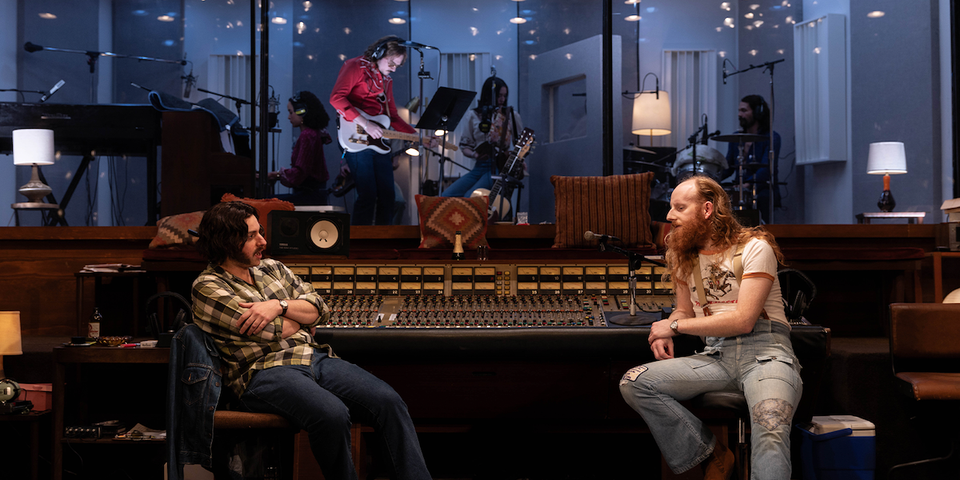
I loved Rob Weinert-Kendt’s succinct summary: “If Robert Altman directed a Chekhov play about a 1970s rock band struggling to perfect their next album, it might look (and sound) something like David Adjmi’s STEREOPHONIC.” I saw the play a couple of weeks ago and it’s stuck with me like few plays I’ve seen in recent years. A three-hour play can seem a little daunting these days, but Daniel Aukin’s production at Playwrights Horizons casts a spell. When I try to name the unusually evocative atmosphere to myself, I keep coming back to Fassbinder – the intense attention to tiny increments of human behavior, the honesty about intertwined love and depravity, artists at work, extraordinary design on every level, occasional longeurs but that being part of the astonishing success of capturing life in its complexity. Pop music was my first love, and I related to the play’s deep immersion in rock music culture much the same as Todd London did in his terrific essay on the PH website. (There you can also read commentary by David Byrne, who happened to be in the audience for the performance I attended; my friends and I noted how remarkably friendly and chatty Byrne was with the people sitting around him. One member of my posse is a hardcore Fleetwood Mac nerd and regaled us at intermission and afterwards with all of his observations about the Easter eggs hidden throughout the play – for instance, that Lindsay Buckingham has a brother who’s an Olympic swimmer, like the LB character in the play. And he knew exactly which Steve Nicks song was deemed too long to be included on Rumours.) The set designed by David Zinn manages to look completely natural and lived-in while being actually insanely meticulous in its creation of an artificial environment that works as an additional character in the play. Ditto the impossibly intricate sound design by Ryan Rumery. The performers are uniformly excellent, all playing their own instruments on ingenious original songs by Will Butler of the Arcade Fire. But what impressed me most of all is how the playwright, the director, and Tom Pecinka, the actor who plays Peter (the Lindsay Buckingham stand-in), collaborated to create the most nuanced and compassionate portrait of a perfectionist I’ve seen in any medium.
Performance Diary: Wally Shawn fever

October 22, 2021

Most people who aware of Wally Shawn know him as a funny face in movies like The Princess Bride or a funny voice in animated films like Toy Story. A subset of the population associates him with My Dinner with Andre, Louis Malle’s 1981 film of Shawn and director Andre Gregory sitting in a restaurant talking about life and death and art; apparently, a whole new generation has caught onto this film thanks to references on The Simpsons and TikTok parodies, and it’s been cited as progenitor to the world of low-budget mumblecore movies. Shawn’s most substantial contribution as an artist, however, is his body of work as a playwright. He hasn’t written that many plays, and they’re not performed that often. When they do, it’s a cause for celebration and attention.

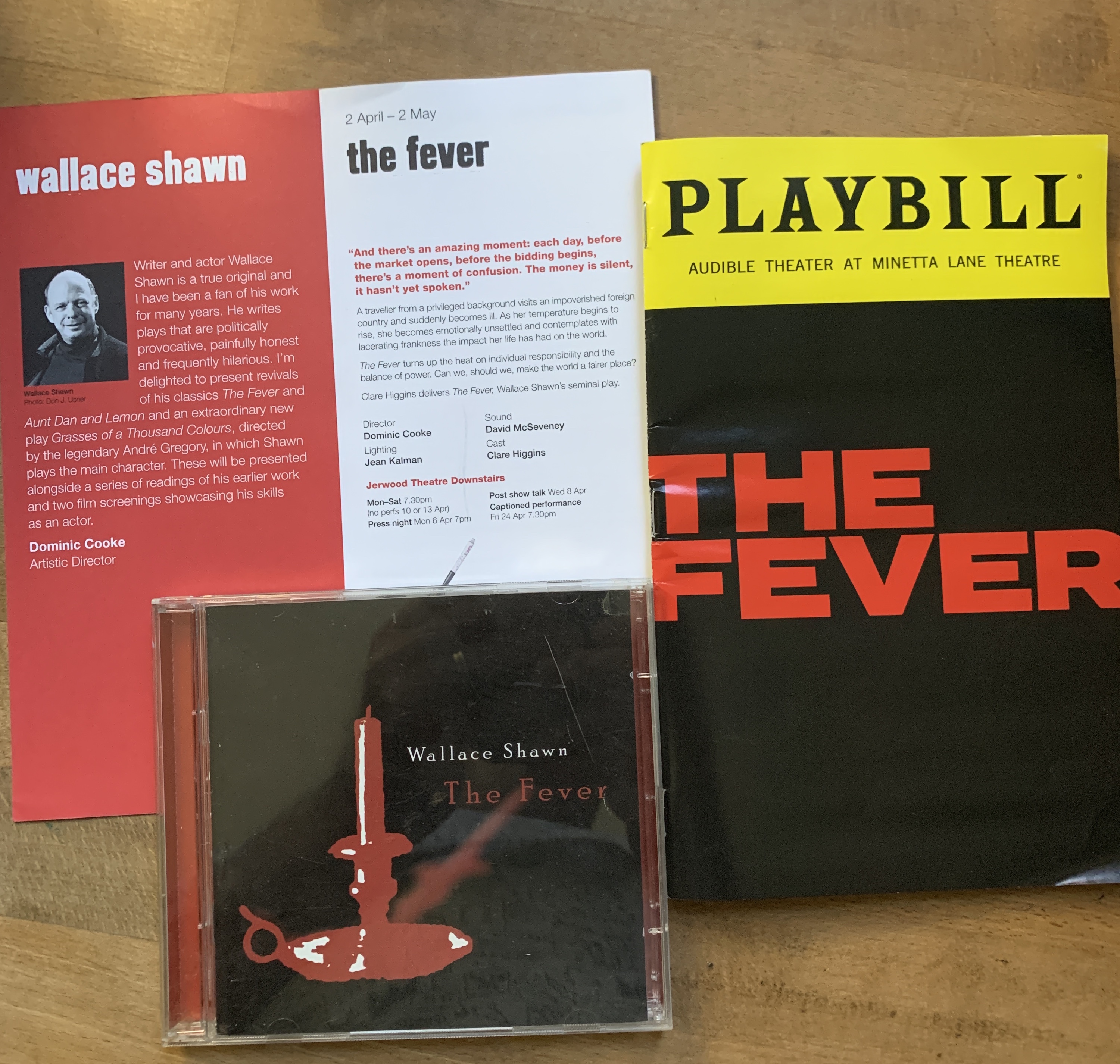
Currently onstage at the Minetta Lane Theatre is the one-person play The Fever, co-produced by Audible (which plans to release it as an audiobook) and the New Group, whose artistic director Scott Elliott is one of Shawn’s primary champions in the theater world and who staged this production, which stars Lili Taylor. Tiny, whip-smart, and super-appealing, Taylor previously appeared in Shawn’s play Aunt Dan and Lemon, also directed by Elliott for the New Group. The Fever is a tricky, intellectually thorny, emotionally challenging piece (the complete text is available online here), and Taylor (below, photographed by Daniel Rader) dives deeply and bravely into this exercise in thinking out loud.

Originally performed in 1990 by Shawn himself, The Fever is a 1 hour and 40 minute monologue by a character known as The Traveller. Sitting on the floor of the bathroom in a hotel room in the middle of the night, “in a poor country where my language isn’t spoken,” she experiences a dark night of the soul, brooding about her life and especially her relationship to money, her economic class, poor people, world politics, and the death penalty. Typical for Wally Shawn’s plays, the character is slippery – at times she evokes identification and sympathy, other times you draw away from her. You’re constantly having to gauge your distance from her. She fanatically examines what she’s observing in great detail, whether it’s her internal experience of being at a cocktail party or ruminating over the meaning of the expression “commodity fetishism” as it turns up in Karl Marx’s Capital.

At the core of the piece is a moral wrestling match that many of us experience walking down the street in New York every day. You see a homeless person begging on the street – you think, “I’ll give him some money” – a voice inside you says, “Why not give him ALL your money?” – you retort, “I can’t give him ALL my money…” In The Fever Shawn carries that internal dialogue on to the nth degree. It could devolve into liberal hand-wringing but it never does, because Shawn’s prose is so carefully wrought and Taylor’s performance stays absolutely present. Shawn’s work always makes audiences uncomfortable, and this play is no exception – some people will find it very hard to take. But I respect it tremendously.

Writing the play coincided with a political awakening for Shawn. He first started performing it in people’s living rooms before taking it to theaters all over New York City and then in England. Taylor is not the first woman to undertake the role, Clare Higgins played it onstage in London in 2009, and Vanessa Redgrave made a film of The Fever in 2004 (directed by her son, Carlo Gabriel Nero) that softened the edges of the play. (Shawn approached the amazing Kathy Baker to do the play onstage in New York and/or Los Angeles, but she said no.) I appreciated the beguiling levity Taylor brings to the performance; Shawn wrote a charming opening scene for her to greet the audience and set the stage.

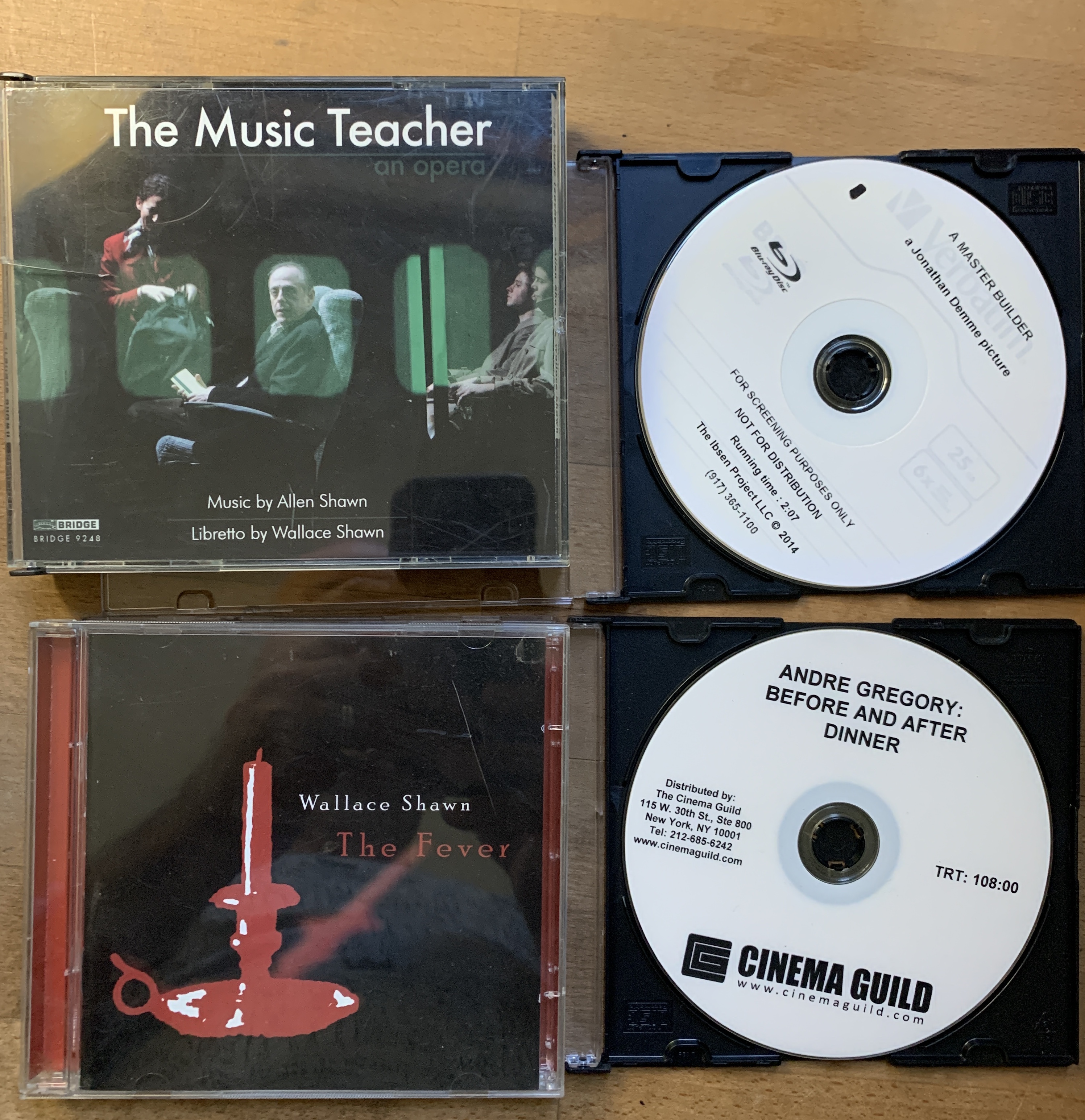
I still cling fondly to the memory of the last time The Fever was produced in New York, when Scott Elliott directed Shawn in a beautifully nuanced staging that explicitly conjured a connection to the existential starkness of Samuel Beckett’s monologues that I’d never previously perceived in Shawn’s work. (During the pandemic, Elliott created a Zoom version of Waiting for Godot, in which Shawn gave an astonishing performance as Lucky to Tariq Trotter’s Pozzo, with Ethan Hawke and John Leguizamo as Didi and Gogo.) In the intimacy of the Minetta Lane, Taylor occasionally spoke so softly that passages got lost, including the powerful last couple of lines. All the more reason to anticipate the audio version when it’s released by Audible. Shawn himself recorded the play in 1999 for a 2-CD package released in 2006 that is now out of print, but apparently some used copies are available online through Amazon.

Speaking of audio versions, a huge mid-pandemic gift to theatergoers in general — and Wally Shawn fans in particular — arrived this year in the form of six-part podcast versions of his plays The Designated Mourner and Grasses of a Thousand Colors. These productions reunite Shawn with director Andre Gregory and the original New York casts of the plays. In collaboration with sound designer and composer Bruce Odland, they’ve created exquisite “theater of the ear” to match the best Broadway original cast recordings (especially those of Stephen Sondheim’s musicals).

David Hare first staged The Designated Mourner in London with three actors sitting at a bare table and filmed that production, which featured Mike Nichols in the title role. In New York, the play ran for a few months at a 30-seat theater in a disused gentlemen’s club in the Wall Street area, exquisitely directed by Andre Gregory and performed by Shawn, Deborah Eisenberg (extraordinary writer and Shawn’s longtime companion), and Larry Pine. That production was revived in 2013 at the Public Theater (a co-production with Theater for a New Audience), and that’s the production captured for the podcast edition.

Some people, including myself, consider The Designated Mourner to be one of the most profound pieces of writing created for any medium in the last 20 years. It is a bleak, dread-inducing meditation on the decline of Western civilization delivered through monologues by three inhabitants of a politically repressive country where intellectual freedom has effectively been persecuted out of existence. To indulge in Wally Shawn-like hyperbole, I would go so far as to say that the world would be a better, though not necessarily happier place, if all students, teachers, politicians, fornicators, and Netflix subscribers put down their magazines, turned off their cel phones and TV sets, and read, re-read, studied and discussed The Designated Mourner for the next year. Written 25 years ago when it seemed like a dystopian fantasy, the play depicts all-too-recognizably the inexorable drift toward anti-intellectual authoritarianism that we’re viewing today not just in Russia and China but in Brazil, Turkey, Hungary, and that roguest of rogue nations, the United States of America.

Grasses of a Thousand Colors is a different animal altogether. First produced at the Royal Court Theatre in London (where My Dinner with Andre also got its start), Grasses made its American debut at the Public Theater as part of the same deal with Theater for a New Audience. It’s a big, long, crazy, intense three-act fantasia about a famous scientist named Ben who’s overwhelmingly fixated on his penis – the sort of thing that never happens in real life — and his relationships with three different women (his wife, his mistress, and his girlfriend, named for three shades of red: Cerise, Robin, and Rose) and a mysterious shape-shifting cat named Blanche who may be the shamanic double of Cerise and/or possibly God. It’s set in some apocalyptic near-future when some initially successful experiments with increasing the world’s food supply have gone dreadfully wrong. And the stories that Ben and his playmates tell – addressing the audience directly, as is usually the case in Shawn’s plays – teem with images of animals. Eating and fucking. Dick and Pussy. Humans and animals. Wally himself plays the main character, known as Ben or the memoirist, who says things like, “When I was a boy, parents never masturbated in front of their children. In fact, children never masturbated in front of their parents! And God knows children would never make out with their parents or fuck them, ever, because that would have been seen as utterly shocking…So, you see, for me, the way things are now still seems astonishing – I mean, the fact that people talk about their penises and vaginas in public, at dinner parties, in magazines, and newspapers. I can’t get over it. Ha ha ha!”

In London, Miranda Richardson played both Cerise (live and aglow with flecks of glitter oiled into her skin) and Blanche (exclusively on film, often with a red ribbon tied around her neck); in New York, those roles were played by Julie Hagerty. A surprising presence was Jennifer Tilly as Robin, who brings a fascinating and unpredictable mixture of vulgarity and enigma to the role. And Emily McDonnell, a young actress from the Richard Maxwell downtown theater world, played Rose. (Pictured above) This strange strange play, which is a bizarre combination of fairy tale, fever dream, and The Story of O, is quite unlike any other play I’ve seen before, except that it bears a distinct family resemblance to other wild, linguistically pungent, sexually transgressive, disturbing and disorienting Wally Shawn plays (Our Late Night, Marie and Bruce, The Music Teacher, The Designated Mourner). The audio version is a wild ride, alternately hilarious and grotesque, poetic and appalling, outrageous and riveting.

Critics and commentators have often noted that Shawn’s plays tend to gravitate toward long monologues, sometimes elaborate storytelling, sometimes deeply internal reveries, imparting a literary, novelistic flavor. That’s what makes the audio versions really work – there’s very little action that you’re missing. I’ve saved the best news for last: these podcasts are available for free from Apple Podcasts. Check them out and let me know what you think.

Culture Vulture: ONE IN TWO, FEFU AND HER FRIENDS, HALFWAY BITCHES GO STRAIGHT TO HEAVEN, and other plays

December 11, 2019

For a three-actor one-set 85-minute no-intermission play, there’s A LOT going on in Donja R. Love’s one in two, which just opened in a production by the New Group at the Pershing Square Signature Theater.

It’s part of the single most exciting development in contemporary American theater, the explosion of productions by playwrights of color who are not only telling stories we otherwise wouldn’t be hearing but conveying them in convention-smashing, formally inventive ways that are reconfiguring our fundamental ideas of what theater can be. As a 60-something white cismale theater maven, I love watching the trickle of once-a-generation innovators like Maria Irene Fornes, Adrienne Kennedy, Suzan-Lori Parks, Lin-Manuel Miranda, and Young Jean Lee turn into a torrent of fiercely talented, jaggedly individual poets of time-space-language (Jackie Sibblies Drury, Aleasha Harris, and Brandon Jacobs-Jenkins, to name just a few of an emerging fertile crop). Donja R. Love belongs to a subset of that group, the tribe portraying queer black male experience with tremendous courage, humor, and sexual honesty (cf. Robert O’Hara, Jeremy O. Harris, and Michael R. Jackson). Even within that group, Love steers into a much smaller subset of writers dealing with the ongoing impact of HIV on black gay lives; most of the others that come to my mind (Marlon Riggs, Essex Hemphill, Assotto Saint) were swept away at the height of the epidemic.

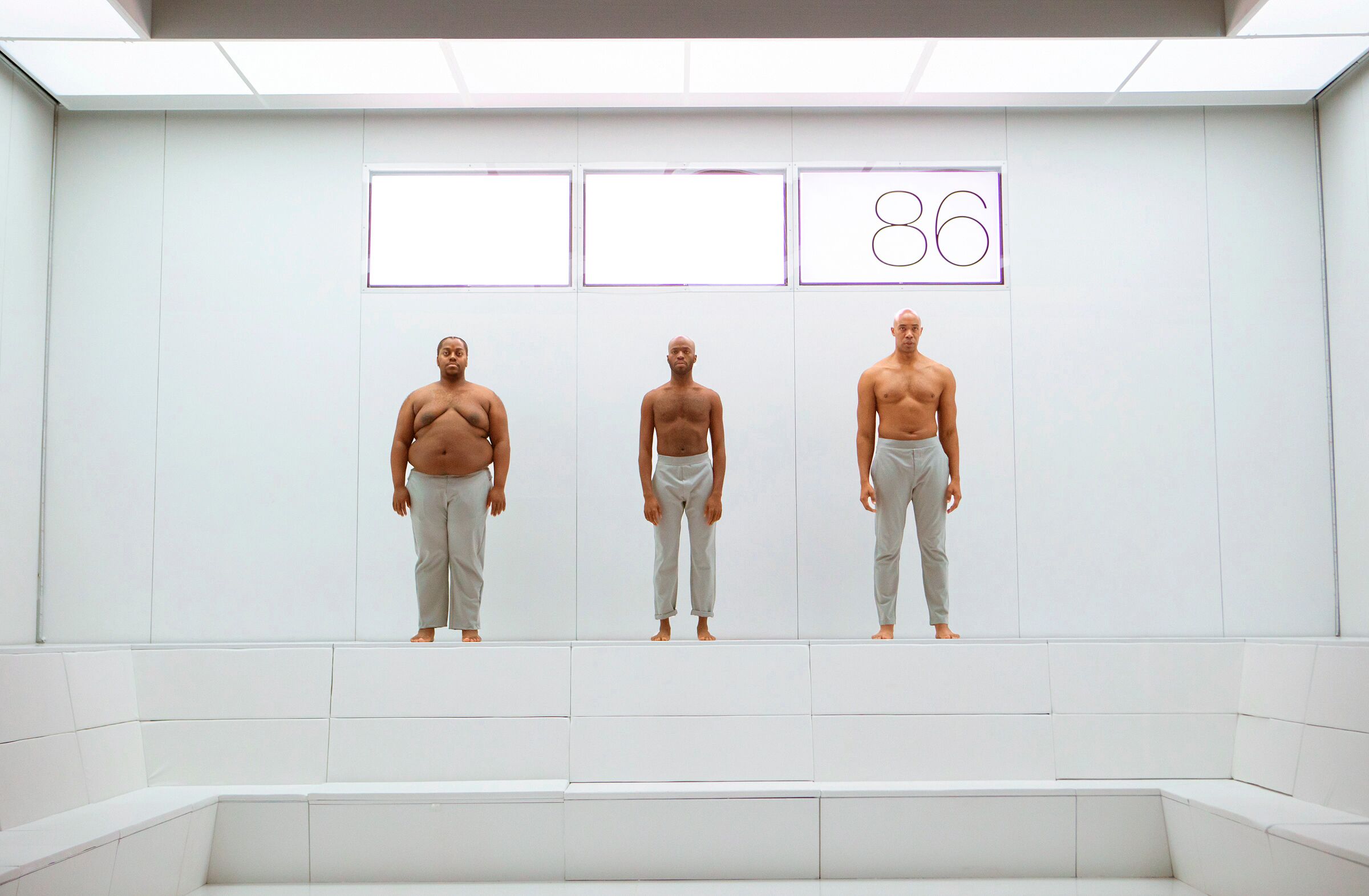
The title refers to a study published by the Centers for Disease Control and Prevention in 2016 that chillingly asserts that “one in two Black gay men will be diagnosed with HIV during their lifetime.” (By comparison, the stats are one in eleven for white gay or bisexual men, one in four for gay or bisexual Latino men.) Numbers figure heavily in the play. When the audience enters, the three actors sit silently on the austere white set (by Anulfo Maldonado) under screens racking up numbers at an alarming rate. When the play starts, their first action is to “take a number” like from a deli counter, and then they engage the audience in an applause-o-meter process of deciding which of them will play characters #1, #2, and #3. Jacobs-Jenkins used a similar ploy with his play Everybody, in which certain roles were assigned by lottery, but after seeing one in two it’s even more mind-boggling to realize that all three actors have the entire script memorized and are ready to play any of the characters at a moment’s notice.

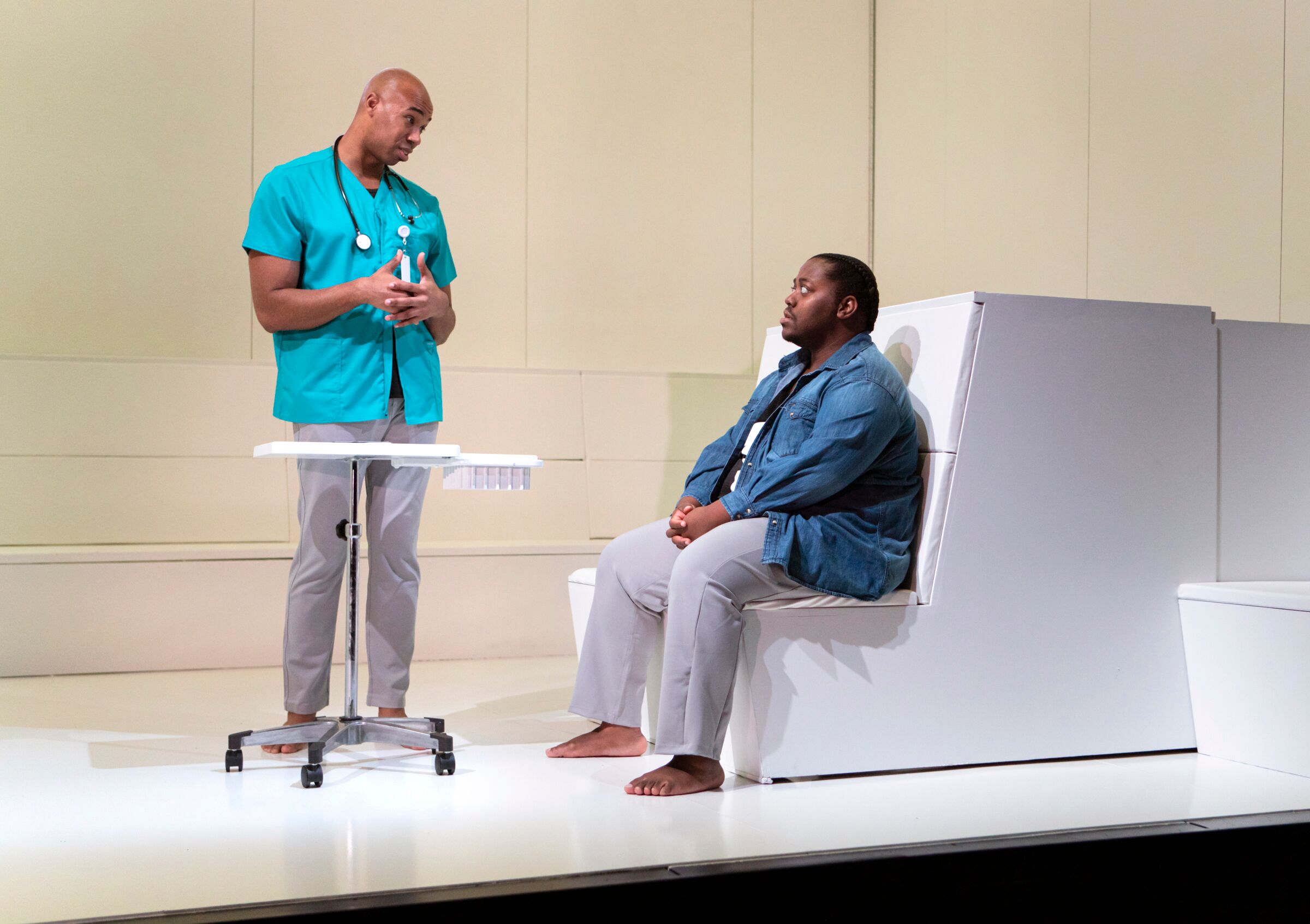
The main character, #1, has a name (Donté), while the other two actors play all the people he encounters on his journey from HIV diagnosis through all the hurdles of denial, depression, telling your family, getting treatment, joining a support group, contemplating suicide, negotiating hook-ups, the solace of substances. These fleetly morphing scenes are skillfully staged by Stevie Walker-Webb with minimal props and Cha See’s evocative, precise lighting. At the performance I saw, chubby, dark-skinned Edward Mawere played #1 (below, right, photos by Monique Carboni), while willowy, light-skinned Jamyl Dobson was #2 (below, left) and buff, scruffy Leland Fowler was #3. All three were excellent, brave, and beyond vanity. One provocative aspect of the show is contemplating how different certain scenes might have looked if the roles were switched around.

A statement by the playwright, handed out with the program as the audience leaves, reveals to what extent the play is autobiographical and how much speaks for the community of his peers. Because like the earliest AIDS plays (I’m thinking of William M. Hoffman’s As Is and Larry Kramer’s The Normal Heart),  one in two functions as potentially life-saving community education. It’s easy to be blasé about HIV these days. I mean, everyone knows it’s evolved into a manageable chronic disease, treatable like diabetes, right? And everyone knows that there’s this miraculous new drug regimen called PREP (pre-exposure prophylaxis) that pretty much guarantees you will never contract HIV, right? Well…not so fast. Not everybody has the same access to information, resources, community support, and internal wherewithal.

Watching the play I was haunted by a disturbing op-ed piece by a young black gay writer named Daryl Hannah that ran in the New York Times in September 2017 with the headline “Why Anti-HIV Medicine Isn’t For Me.” Much as I wanted to argue with Hannah, I couldn’t contest his personal feeling of lacking a community of peers with whom he could sort out his anxieties and hesitations, any more than I could dismiss the widespread suspicion the black Americans have toward doctors and Western medicine, given the Tuskegee syphilis trials and other hideous historical abuses. And not just black Americans. Hannah’s op-ed piece appeared the same week that the supernaturally gifted theater composer Michael Friedman died of AIDS at age 41. You would think such a death would be preventable in this day and age, in New York City…and yet I just heard another sad story of a biracial 32-year-old suicide in Brooklyn, too isolated and too scared to share his HIV status with his family.

one in two doesn’t traffic in preachiness or Pollyanna attitudes. It lays out messy scenes from Donté’s dilemma in the manner of Brechtian lehrstücke (learning-plays). I can imagine a peer-group discussion minutely dissecting the scene in which Donté fumbles his way through questions about disclosure and condom use with a Grindr hookup who calls himself Trade Hung Like Horse Underscore 99 (one of many hilariously meta touches in the play).

The playwright impressively omits easy conclusions. As soon as I saw the set, I noticed there were no exits onstage. Besides referencing Jean-Paul Sartre’s existentialist drama, Maldonado’s set also reminded me of Adrian Piper’s stark-white installation What It’s Like, What It Is #3, with its evocation of prison surveillance panopticons. And the play doesn’t wrap things up with a tidy ending because, guess what, the story of HIV isn’t over.

Other Culture Vulture expeditions in brief: among the seven other shows I saw in the last two weeks, the only one that really left me cold was 32 rue Vandenbranden by the Flemish company Peeping Tom at the BAM Next Wave Festival, an acting-school exercise in competing for attention onstage. I didn’t love Jagged Little Pill, the Alanis Morissette musical on Broadway I had such high hopes for (mainly out of admiration for book writer Diablo Cody), though I completely dug Lauren Patten’s understated performance as teenage lesbian Jo, whose literally show-stopping rendition of “You Oughta Know” (above, photo by Matthew Murphy) has Tony Award written all over it. (Director Diane Paulus engineered that for Andrea Martin in her staging of Pippin.) Oskar Eustis’s revival of Tony Kushner’s A Bright Room Called Day at the Public Theater is as clunky and unsatisfying as the original was, but Crystal Lucas-Perry is dazzling as Zillah, and Jonathan Hadary as Xillah speaks not just for the playwright but for the audience when, pointedly likening the current political atmosphere to German in the 1930s, he delivers the raw cry, “What are we going to do? What are we going to do?”

I very much admired Thomas Ostermeier’s well-acted production of History of Violence at St. Ann’s Warehouse, my introduction to hotshot young French literary star Edouard Louis. I loved seeing the multimedia spectacle Come Through at the Kings Theater in Brooklyn (above, photo by Eric Timothy Carlson), a strange and sublime collaboration between the St. Paul-based company TU Dance and adventurous experimental rocker Justin Vernon, whose band Bon Iver shared the stage performing a mixture of songs from their latest album and odd numbers written just for this piece.

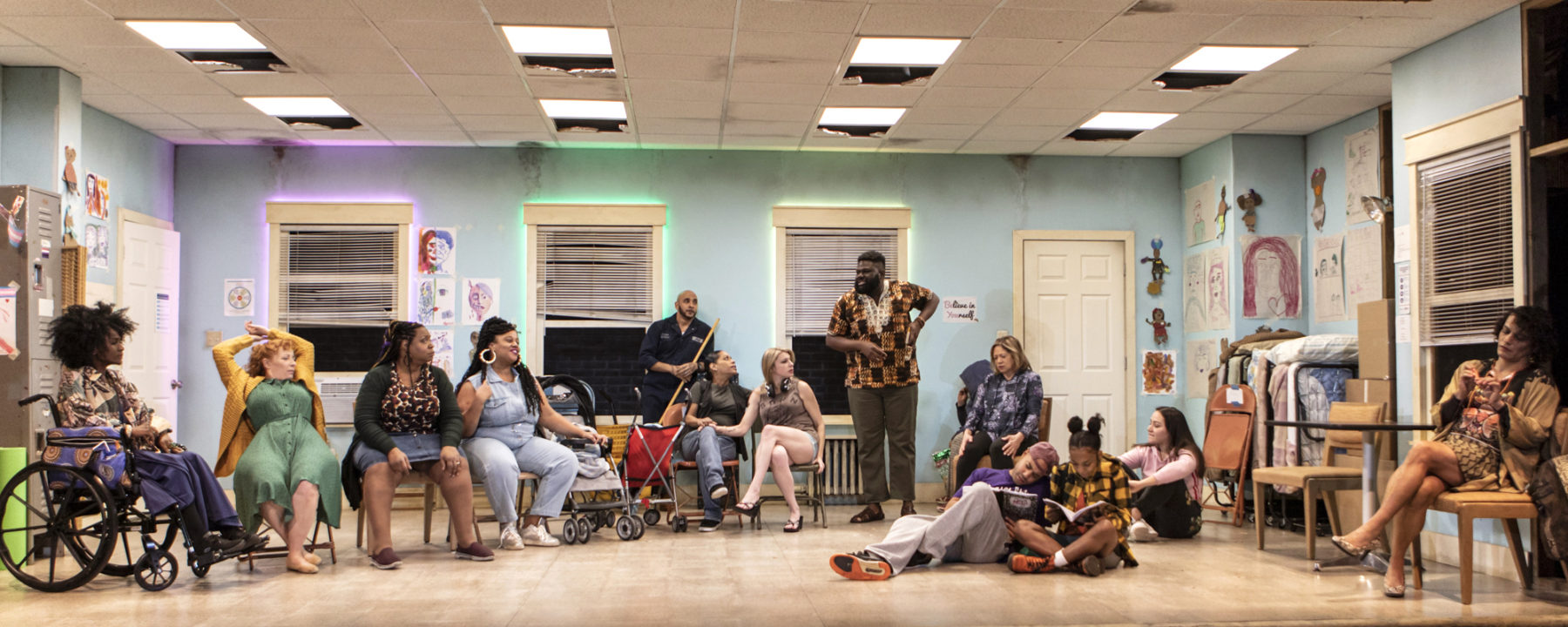
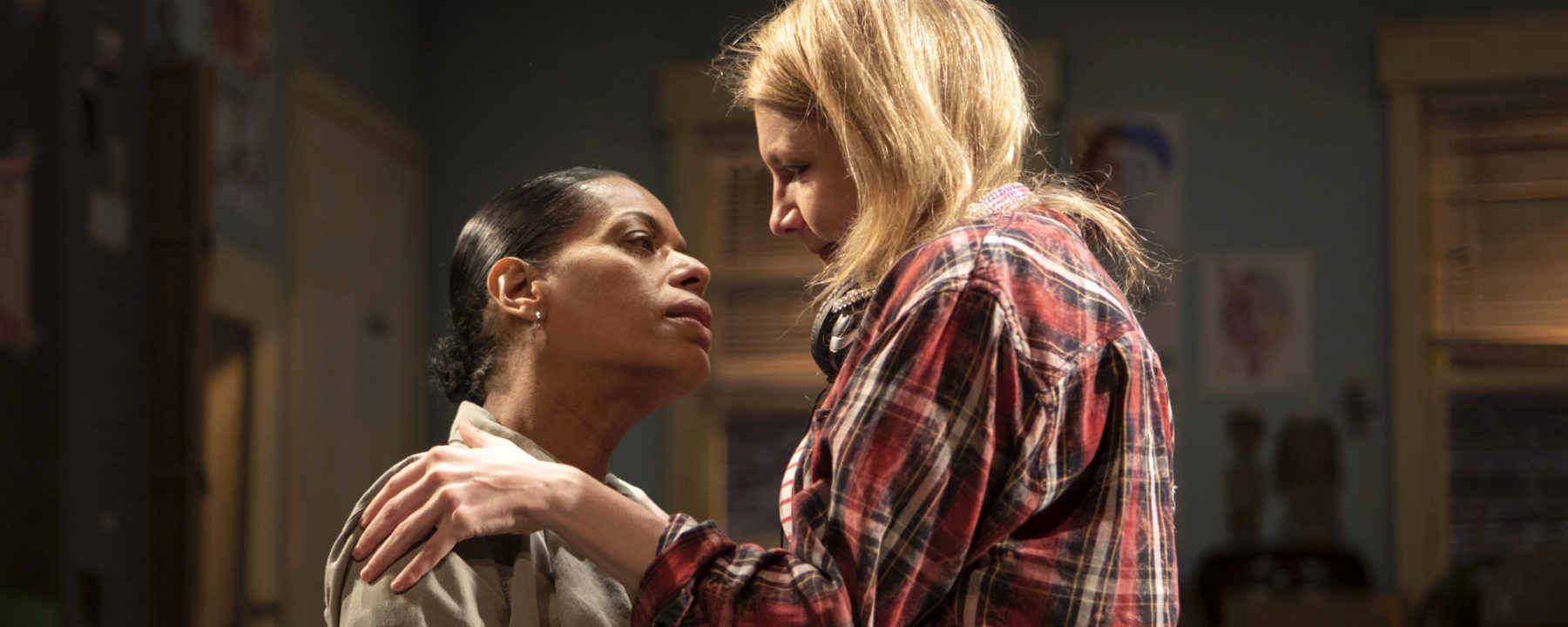
I also loved Stephen Adly Guirgis’s rambling, raggedy Halfway Bitches Go Straight to Heaven (above, photos by Ahron R. Foster), with its crazy, beautiful, harrowing, poignant scenes of life in a Harlem women’s shelter and a gigantic ensemble of amazing actors, including LAByrinth Theater Company superstar Liza Colón-Zayas (below left, with Andrea Sygowski), who I think is one of the finest actors onstage today.

Best of all was Lileana Blain-Cruz’s revival of Irene Fornes’s Fefu and Her Friends at Theatre for a New Audience. I’m one of the dinosaurs who can boast of having seen the legendary original 1977 production at the American Place Theatre, directed by Fornes herself, most memorable of course for its unprecedented middle section, which shuffled the audience through four scenes taking place simultaneously in different areas of the theater. Talk about breaking the fourth wall! Blain-Cruz’s production, though, is better in every way. Sleek, beautiful, wittily designed (count the animal images hidden like Hirschfeld Ninas among Adam Rigg’s set and Montana Levi Blanco’s costumes — see below, photo by Gerry Goodstein), wonderful performances by excellent actors, all of it perfectly preserving the enigmatic poetry of Fornes’s play.

I enjoyed having dinner afterwards with my friend Jay (at the delicious new Mexican gastropub around the corner, Las Santas) and parsing the echoes of Mabel Dodge Luhan (intimate friend of Gertrude Stein’s) in Fefu, expounding on how the final image of the play influenced Sam Shepard’s Buried Child, and counting the number of lesbians onstage.


Theater Review: INTIMACY

March 6, 2014

intimacy logo
I’ve mostly cycled out of writing theater reviews, in an effort to concentrate my writing energy in the direction of my therapy practice. But I couldn’t resist writing about Thomas Bradshaw’s latest play,  Intimacy, because of the issues it raises, particularly about how pornography has become an integral part of our lives in a way that hardly anyone talks about. Directed by Scott Elliott for the New Group, the show is finishing up its run — the last performance is Saturday night. It’s really worth seeing and discussing.

Here’s my first paragraph: Thomas Bradshaw is a 33-year-old black American playwright who might as well have his middle name legally changed to Provocative, because no one seems to be able to talk or write about his work without conjuring that adjective. The most recent of his 11 plays, “Intimacy,” has been playing Off Broadway for the last two months; the production at the New Group concludes its run March 8. I’m fascinated by this play not just as a theater scholar but also as a sex therapist. Bradshaw’s plays almost always address hot-button issues of race, class, and sexuality very directly and explicitly. His previous play, “Burning,” performed at the New Group two years ago, took off from the Marquis de Sade’s “Philosophy in the Bedroom” and included several extremely graphic scenes of simulated sex by naked actors only a few feet away from the audience. “Intimacy” goes even further by taking as its main subject the prevalence of pornography in American culture, specifically as it plays out among three suburban families.

You can read the entire review for CultureVulture online here. Check it out and let me know what you think.

Theater review: BURNING

December 2, 2011

My review of Thomas Bradshaw’s mind-boggling new play Burning, directed by Scott Elliott at the New Group, has just been posted on CultureVulture.net. Check it out and let me know what you think.

The play is strong stuff but had a big impact on me. “The 30-year-old author of ten plays (including “Strom Thurmond Is Not a Racist”), Bradshaw does not, I think, set out primarily to shock, although shock he does…His remarkable accomplishment is to build a clear-eyed contemporary narrative that is as matter-of-fact about sex, drugs, and violence as it is about death, art, and politics. And he does so in a way that makes other playwrights look coy, cowardly, or faint-hearted.” You can read the full review online here.