May 13 – Yes, it’s Family Week (heard from all my sisters on my birthday yesterday and went out for dinner with Andy’s mom, whom I met for the first time). But all that was much more cheerful than the milieu of Beth Henley’s play, produced by MCC Theater at the Lucille Lortel. Set in an expensive treatment center out in the Arizona desert, it focuses on Claire, a 40-ish woman whose life fell apart when her teenage son got murdered. Not that her life was going so great otherwise – she and her abusive husband teeter on the verge of divorce, her daughter is an adolescent hellcat, one sister leans on her for money all the time, the other stays as far away as she can (allergic to emotional distress), and their belittling mother expends all her energy maintaining denial about her horrendous parenting skills. Very short (70 minutes) and delivered in very short scenes, the play is both a smart writer’s supercilious take on the banalities of pop psychiatry and a sensitive playwright’s portrait of a hurting person’s effort to find hope and healing in the face of life’s torrential devastations. It’s a tricky balancing act, not successfully managed by Jonathan Demme in his debut as a stage director. He cast as Claire Rosemarie DeWitt, who played Rachel in Rachel Getting Married, and she delivers the same kind of blank performance she gave in the movie, entirely unsuitable as the grieving Claire (although she manages to produce tears on demand – a good trick, but not enough). Sami Gayle as the obnoxious teenage daughter Kay is obnoxious. Kathleen Chalfant and Quincy Tyler Bernstine are both very good actors doing what they’re asked to do – be bluntly selfish and oblivious to the harm they cause others. But the production winds up feeling empty at the core and unsatisfying.
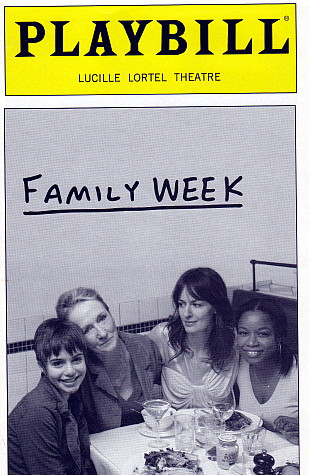
I vividly remember the original New York production of Family Week and share Jonathan Demme’s fondness for the play based on that production, staged by Ulu Grosbard with an honest respect for struggling people as well as the absurdities and cruelties of family life. I saw the show with Sarah Schulman, and we were both impressed with it and a little surprised that it didn’t get more acclaim. The cast included Rose Gregorio (Grosbard’s wife) as Claire’s mother, insanely insistent on the credentials of everyone in sight, and Carol Kane as the ne’er-do-well sister, who flouts all the rules of the treatment center, smoking and drinking and wearing inappropriately sexy outfits. (I’m not generally a fan of Kane and her mannerisms but thought she wielded them in that production with a strong artistic sense of character portrayal.) Most of all, Sarah and I were riveted by the central performance of Angie Phillips as Claire. From the moment she walked onstage, you wanted to cry looking at her – a woman profoundly collapsed in on herself, devastated with grief and self-ignorance. The detail I’ll always treasure is that, during the series of excruciating confrontations with family members when Claire is asked what she’s feeling, she often had to turn around in her chair and look at the list on the blackboard of primary emotions (anger, pain, shame, guilt, fear, loneliness) to identify which she was experiencing. It’s very easy for pop culture to mock psychotherapy and the notion of family interventions – but anyone who’s actually lived through one knows that they can be not only shattering but healing and life-altering. And I respect Beth Henley for wanting to capture that in a play.
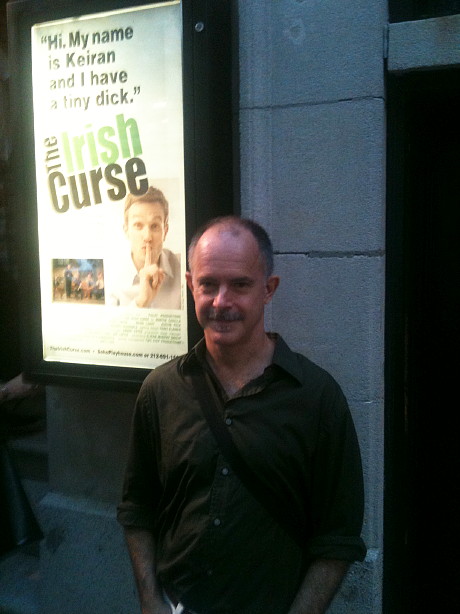
May 14 – I have similar feelings for Martin Casella, author of The Irish Curse. His play is really crude and sit-commy, and the production is almost unbearable. Directed by Matt Lenz, the actors overact outrageously in a tiny Off-Broadway theater (the Soho Playhouse). The worst offender is Dan Butler, whom I always used to like seeing onstage; here he shouts almost all his lines, in one of the worst Southern accents I’ve ever heard an actor assume. Nevertheless, the brave enterprise of the play is that it depicts a support group for men who have small penises to talk about it. (Much is made of this as an anatomical feature disproportionately visited on Irishmen, though that was news to me until this play came along.) This is a subject no one ever talks about publicly except as a joke. But clearly for guys with really small dicks, it’s no joke. And for all the clowning around, clumsy exposition, and Odd Couple histrionics, the playwright does manage to cram into his play a lot of what guys with small dicks struggle with: not feeling like a man, avoiding sex, compensating through drinking or bragging or compulsive sex, feeling cheated by life to the point of despair. Certainly, as a sex therapist I’ve heard plenty of stories just like these and can vouch for their veracity. I just wish they’d been embedded in a better play.
-
Subscribe
Subscribed
Already have a WordPress.com account? Log in now.
 another eye opens