Posts Tagged ‘rebecca mead’

In this week’s New Yorker

September 3, 2011


After reading most of this week’s issue on my iPad, it finally showed up in my mailbox. But I’m glad it worked out that way because otherwise I wouldn’t have seen the coolest thing: the video that accompanies Ian Frazier’s piece about Theo Jansen’s mind-blowing wind-powered kinetic sculptures (he calls them Strandbeests), which I guess you can’t see unless you’re a subscriber. But you can see a bunch of other videos on YouTube, including this BMW commercial. (He’s also done a TED talk.) Very cool.

Then there’s the ever-droll Rebecca Mead’s profile of Timothy Ferriss, author of best-selling self-help books, most recently The Four-Hour Body. “The book, which is five hundred and forty-eight pages long, contains a lot of colorfully odd advice—he recommends increasing abdominal definition with an exercise he calls ‘cat vomiting’—but it also reassures readers that they need not go so far as to have Israeli stem-cell factor injected into the cervical spine, as Ferriss did in the name of inquiry. Nor need they necessarily incorporate into their regimen Ferriss’s method for determining the effectiveness of controlled binge eating: weighing his feces to find out exactly what kind of shit he was full of.”

I’m not sure why, but I read all of Larissa MacFarquhar’s piece on an Oxford philosopher named Derek Parfit and also Tad Friend’s heart-sinking report on how the town of Costa Mesa, California, has gone broke and alienated its working people. Like the best (read: most depressing) documentary films, Friend’s story gives you a new person to hate, a Costa Mesa city council member named Jim Righeimer.

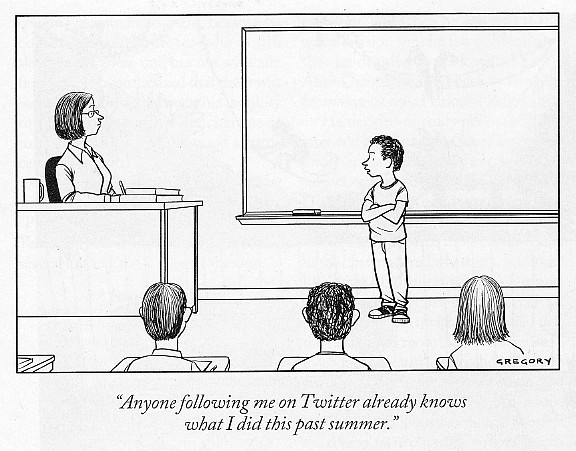
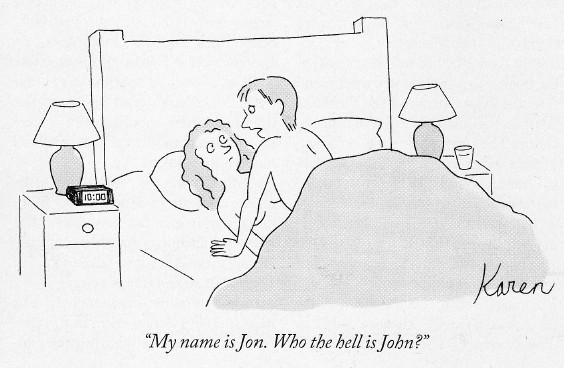
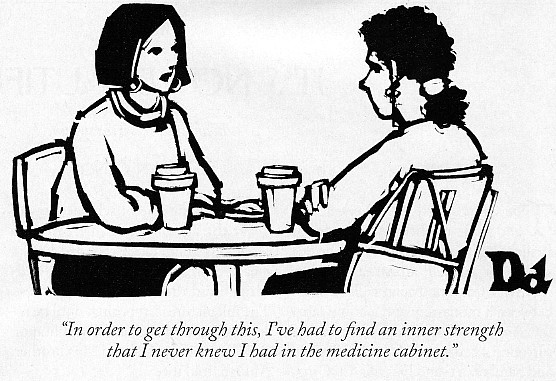
And then of course, as ever, the cartoons. Thank you, Alex Gregory (above) and Karen Sneider (below) .

In this week’s New Yorker

June 20, 2011

I had the luxury today of sitting on my veranda for several hours this afternoon reading the entire issue of the New Yorker the day it arrived in the mail.  Unprecedented! A slightly guilty pleasure but a reward to myself after a period of many days hard work without a break.

Some good stuff I might have skipped on a busier weekday: Rebecca Mead’s profile of Alice Walton, the Wal-Mart heiress who’s building an American art museum in Bentonville, Arkansas; Joan Acocella’s profile of American Ballet Theater’s new artistic director, the Russian emigre Alexei Ratmansky, whose work I now feel compelled to check out; and Adam Gopnik’s personal essay about taking drawing lessons, a humbling experience for a seasoned art critic.

And then there’s Alice Munro’s short story, “Gravel,” as deft and light-handed and remarkable as any Munro story (with the ultra-casual introduction of the central character’s lesbianism a typical Munro touch). I would love to know which editor matches up the New Yorker’s fiction with the photographs that illustrate them — it’s almost always a mysterious and perfect selection.

And Margaret Talbot’s commentary in Talk of the Town, in contrast to most of the media whirl, speaks sensibly about l’affaire Anthony Weiner: “If you were Anthony Weiner’s wife, you’d have your own concerns. But if you were his constituent, and thought he was doing a good job representing you, maybe you’d just as soon ignore his Internet amusements. That’s different from saying that what a politician does in private is never our business. It’s more a tacit acceptance that some of the qualities that launch people into public office—self-regard bordering on narcissism, risk-taking—can also launch them into risks of a more personal kind, and that this doesn’t inevitably reflect on their ability to govern. Maybe it’s an acknowledgment that sometimes there are more important things to talk about. “

In this week’s New Yorker

November 14, 2010

The best thing is this week’s issue is the very first thing: Hendrik Hertzberg’s editorial in Talk of the Town analyzing the results of this year’s midterm election.

As for “the American people” themselves, it seems clear enough that their rejection of the Democrats was, above all, an expression of angry anxiety about the ongoing economic firestorm. Though ignited and fanned by an out-of-control financial industry and its (mostly) conservative political and intellectual enablers, the fire has burned hottest since the 2008 Democratic sweep. By the time the flames reached their height, the arsonists had slunk off, and only the firemen were left for people to take out their ire on. The result is a kind of political cognitive dissonance. Frightened by joblessness, “the American people” rewarded the party that not only opposed the stimulus but also blocked the extension of unemployment benefits. Alarmed by a ballooning national debt, they rewarded the party that not only transformed budget surpluses into budget deficits but also proposes to inflate the debt by hundreds of billions with a permanent tax cut for the least needy two per cent. Frustrated by what they see as inaction, they rewarded the party that not only fought every effort to mitigate the crisis but also forced the watering down of whatever it couldn’t block.

Part of the Democrats’ political problem is that their defense, confusingly, depends on counterfactuals (without the actions they took in the face of fierce Republican opposition, the great slump would have metastasized into a Great Depression), deferred gratification (the health-care law’s benefits do not kick in fully until 2014), and counterintuitive propositions (the same hard times that force ordinary citizens to spend less money oblige the government—whose income, like theirs, is falling—to spend more). Another part of the problem, it must be said, is public ignorance. An illuminating Bloomberg poll, taken the week before the election, found that some two-thirds of likely voters believed that, under Obama and the Democrats, middle-class taxes have gone up, the economy has shrunk, and the billions lent to banks under the Troubled Asset Relief Program are gone, never to be recovered. One might add to that list the public’s apparent conviction that illegal immigration is skyrocketing and that the health-care law will drive the deficit higher. Reality tells a different story. For ninety-five per cent of us, taxes are actually lower, cut by around four hundred dollars a year for individuals and twice that for families. (The stimulus provided other tax cuts for people of modest means, including a break for college tuition.) The economy has been growing, however feebly, for five straight quarters. Most of the TARP loans have been repaid and the rest soon will be, plus a modest profit for the Treasury. And the number of illegal immigrants fell by close to a million last year, thanks in part to more energetic border enforcement. The health-care law, the nonpartisan Congressional Budget Office says, will bring the deficit down.

But why don’t “the American people” know these things? Could it be because the President and his party did not try, or try hard enough, to tell them?

Hmmm…are “the American people” ignorant because the President hasn’t properly educated them? Isn’t it much more likely that they’ve been successfully fear-mongered by Fox News into believing falsehoods and overlooking truths they don’t want to see? Fear creates more biochemical reaction in the body than appeals to calm and rationality do — that’s just survival, and that’s how demagogues and screamers get their way over the steady-speakers. Depressing.

Alec Wilkinson writes terrific profiles of musicians for the New Yorker. This week we read his report on Bettye Lavette, a minor soul singer overlooked for decades who’s had a resurgence of critical acclaim in recent years. I’m not a big fan of her singing, and the article makes her sound quite unpleasant to be around. But I had to chuckle at the frankness of this particular self-assessment: “I really don’t have a lot of talents. I can cook, and I can fuck, and I can sing. And I’m proud of all of them.”

I doubt if I would like Lena Dunham’s feature film debut as writer/director/star, Tiny Furniture, but I enjoyed reading Rebecca Mead’s profile of Dunham and her description of the movie. “In its merciless investigation of its creator’s character flaws, Tiny Furniture resembles Larry David’s Curb Your Enthusiasm mashed up with Whit Stillman’s Metropolitan, or Manhattan if it had been directed by Mariel Hemingway rather than by Woody Allen.”

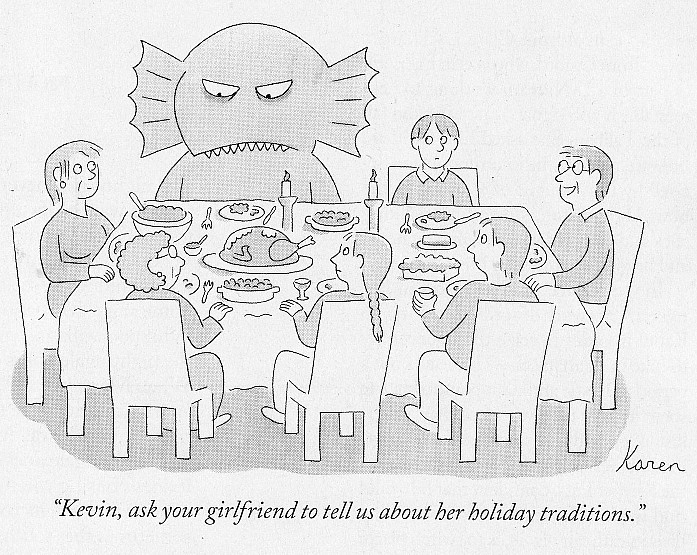
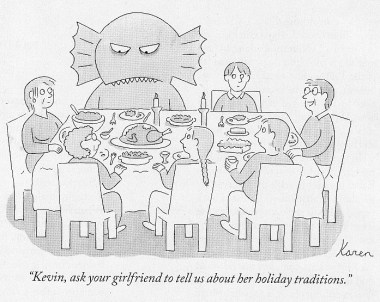
And then there’s this delightful cartoon by Karen Sneider:
In this week’s New Yorker…

May 19, 2010

…I learned about two media celebrities I’ve never encountered and would be happy to remain unacquainted with: Fox News blowhard Andrew Breitbart (cannily eviscerated by the ever-sharp Rebecca Mead) and Chelsea Handler, who somehow has managed to sell out two shows at Radio City Music Hall.

And then there’s this Drew Dernavich cartoon:
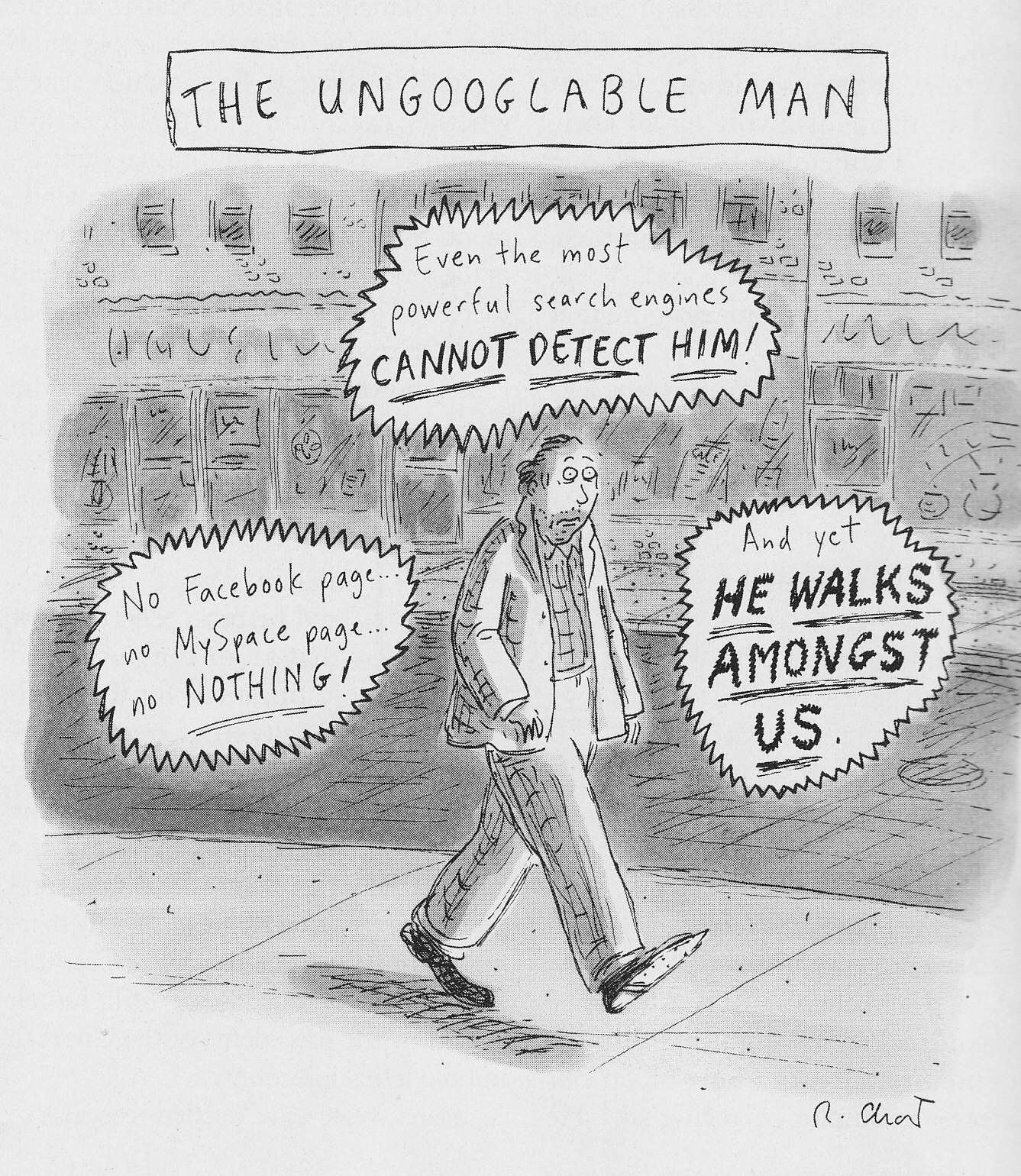
And this from Roz Chast:

In this week’s New Yorker

March 17, 2010

The “bumper stickers” below make me exquisitely aware of what a bubble I live in, informed primarily by the writing and reporting every week in The New Yorker. And thank God and Lady GaGa for that! In this week’s issue, there’s a terrific profile by Rebecca Mead of the red-diaper baby who runs the Public Theater (Oskar Eustis) and a profile by Jeffrey Toobin of John Paul Stevens that answers the musical question, “How did a moderate Republican appointed by Gerald Ford wind up firmly esconced in the liberal wing of the Supreme Court?”

There’s also a hilarious Shouts & Murmurs piece by Paul Rudnick that characteristically takes what might seem like a tired subject (“Don’t Ask Don’t Tell”) and pushes it to extremes: “If I were to serve openly as a homosexual, nothing would be the same. Slaughtering terrorists just wouldn’t feel special. It would be, like, Yeah, so today I detonated a bunker filled with snipers, and then I texted my boyfriend, and I agreed that we should only use cerulean for an accent wall. Big whoop. But now, when I have to be more coded and paranoid, every time I strap on my body armor and hoist my M16 I can think, Hey, Mr. Jihad, how about a brunch date with my rocket launcher? I’m not an openly gay soldier; I’m a secret gay soldier, and that makes me fierce! I’m Project Gunway!”

And then there’s this delicious Roz Chast cartoon: