Posts Tagged ‘rebecca mead’

In this week’s New Yorker

September 22, 2013

new yorker goings on cover
The Style Issue contains a bunch of stories in a row that I found engrossing, often to my surprise:

bryan goldberg
Lizzie Widdicombe on Bryan Goldberg, a cocky young entrepreneur (above) who is launching an online magazine for women, Bustle.com, that he hopes becomes as popular and financially successful as his sports site, Bleacher Report, was with men;

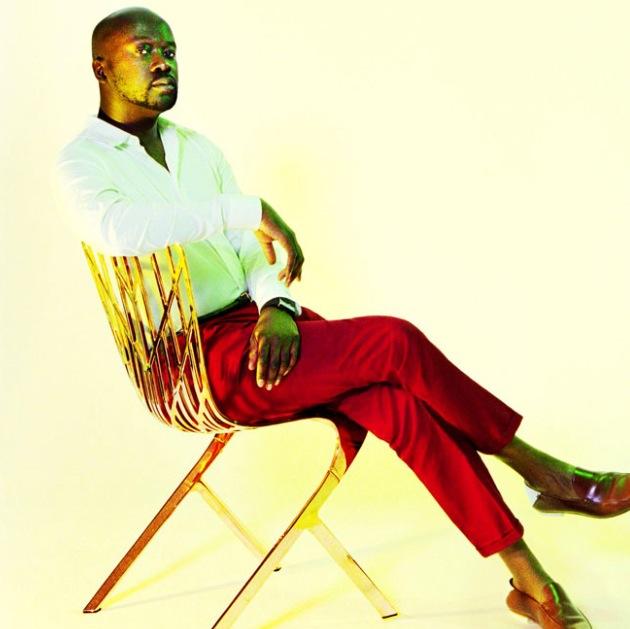
david adjaye
* Calvin Tomkins on David Adjaye, the Ghanaian-British architect (above) who is designing the National Museum of African American History and Culture in Washington, DC, which made him sound so appealing that I ordered his book of photographs of the architecture of African capitals;

* Rebecca Mead on Andrew Rosen, the schlubby founder of the fashion company Theory, a profile that doubles as a succinct history of the garment district;

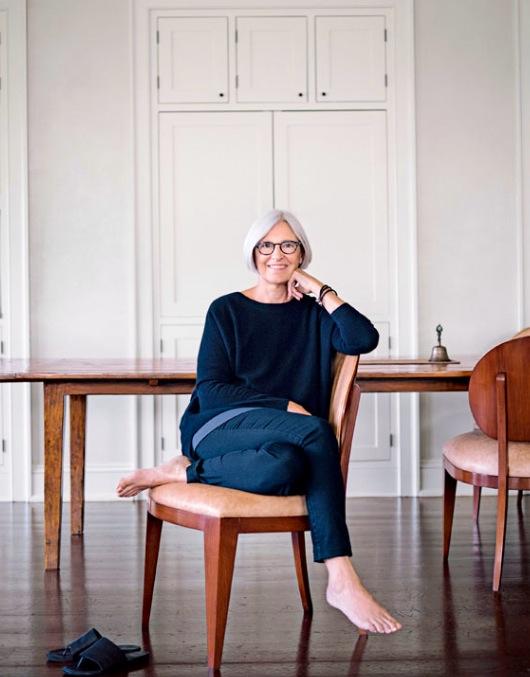
eileen fisher
and a fascinating profile of modest but chic women’s clothing designer Eileen Fisher by Janet Malcolm. Fisher is a smart feminist who runs her company according to principles of non-hierarchical management and simple Buddhist kindness, and Malcolm plays a strange game with her of pretending not to understand the language she uses to describe how the business runs. Her language is slightly vague not not jargonistic, and it’s curious to watch Malcolm play dumb in print. But she is one of the New Yorker’s shrewdest veteran writers who is very open with her subjects about the duty of journalists to betray the people they write about, so I suppose it’s part of her strategy. On the New Yorker’s Page Turner blog, editor-in-chief David Remnick’s Letter from the Archive acknowledges that readers may be surprised to see Malcolm writing about a fashion designer. But Remnick also reminds us that she wrote the shopping column, On and off the Avenue, for a while. He steers Malcom fans to a couple of other surprising profiles from years past, “The Window Washer” and “A Girl of the Zeitgeist” (a memorable story about Ingrid Sischy, then-editor of Artforum, in which the august New Yorker published the word “asshole” for the first time, in a direct quote). Remnick also mentions Katie Roiphe’s Paris Review interview with Malcolm, which I have bookmarked to read very soon.

The New Yorker has done a major redesign, especially in the front of the book. I’m not sure I like it, and the iPad app is very buggy. But I’m prepared to wait and see how it shakes out over the next weeks and months.

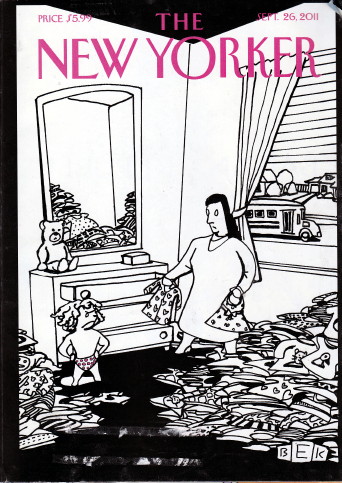
twitter cartoon

Quote of the day: GARMENT DISTRICT

September 22, 2013

GARMENT DISTRICT

A century and a half ago, New Yorkers had a much more intimate connection with their clothes, because New Yorkers were making them. The garment industry was established in the mid-nineteenth century. Then, as now, immigrants supplied the labor, doing piecework at home or working in the small factories for which the term “sweatshop” was coined.

Initially, garment manufacture centered on the Lower East Side, where the labor pool was based. Around the turn of the century, with the arrival of department stores, the garment factories moved to the West Twenties and into the West Thirties, the better to supply Ladies’ Mile, the shopping corridor along Sixth Avenue between Fourteenth and Twenty-third Streets. The loft buildings there provided comparatively airy work environments. A hundred years or so ago, the first zoning laws were introduced, with the goal of preventing the manufacturing industry from encroaching on residential districts. By the nineteen-twenties, the West Thirties had become home to thousands of factories, showrooms, and offices dedicated to the garment trade. More than three-quarters of the nation’s clothing was made in New York City.

Today, only three per cent of the clothes we wear are made in America. New York’s garment district has undergone a parallel decline. Fifty years ago, there were two hundred thousand industry jobs in the neighborhood; now there are about twenty-one thousand, fewer than half of them in manufacturing.

— Rebecca Mead, “The Garmento King,” The New Yorker, September 23, 2013

Garment_District_NYWTS_crop

In this week’s New Yorker

May 19, 2013

new yorker innovators
At first glance, I didn’t think I had the time or interest to absorb the key features in the annual Innovators issue — but I did. They’re all worth it:

* Susan Orlean’s American Chronicles piece on treadmill desks, which made me want to buy one;

* Ian Frazier’s “Form and Fungus,” about a couple of dudes disturbed by all the crappy non-biodegradable Styrofoam in the world who figured out how to grow an all-natural substitute for plastic out of mushroom tissue;

* John Seabrook’s “Network Insecurity,” basically on the hopeless dream of cybersecurity;

* Michael Specter’s “Inherit the Wind,” about another pair of young guys who’ve figured out how to generate electricity from wind energy using kites, as opposed to the wind turbines that even green energy supporters like cartoonist Lynda Barry have catalyzed huge populist activism to oppose;

* Nathan Heller’s “Laptop U,” about the budding field of MOOCs (massive open online courses), which all the big schools are getting into — despite my instinctive revulsion against it, this phenomenon apparently does have some pedagogical advantages; and

* Rebecca Mead’s Reporter-at-Large story, “The Sense of an Ending,” which moved me to tears several times with its reporting on specialists at the Beatitudes Campus, a retirement community in Phoenix, who have found compassionate, humane ways to treat elderly patients with dementia and Alzheimer’s.

The iPad…excuse me, Tablet edition also features a hilarious interactive version of the Christoph Niemann cover illustration (above). And I’m going to let Ben Marcus read his story “The Dark Arts” aloud to me.

et tu killbot

In this week’s New Yorker

March 28, 2012

Hilton Als lets us know that he loves Jesus, the same way Patti Smith does, but boy, does he not love Des McAnuff’s production of Jesus Christ Superstar on Broadway.

Rebecca Mead provides a coolly factual portrait of Christine Quinn, who may well be the next mayor of New York City.

David Sedaris writes a Personal History essay about his favorable experience with socialized medicine (specifically his dentist) in France, in contrast to current American preconceptions: “One thing that puzzled me during the American health-care debate was all the talk about socialized medicine and how ineffective it’s supposed to be. The Canadian plan was likened to genocide, but even worse were the ones in Europe, where patients languished on filthy cots, waiting for aspirin to be invented.”

But the highlight of the issue by far is “The Transition,” an excerpt from the great Lyndon B. Johnson biographer Robert A. Caro’s next volume microscopically detailing the events of the morning of November 22, 1963. Even though the outline of that infamous day in American history is known to one and all, not so well-known aspects to the story are:  the brewing financial scandal LBJ was facing (quickly squashed when he became president), exactly how miserably he hated being Vice President, what happened inside the cars in the presidential motorcade in Dallas, how delicately thoughtful and solicitous LBJ was of Jackie Kennedy, and all the logistical details that led up to his being sworn in after the assassination. A must-read.

Then there’s the cover by George Booth, titled “Rite of Spring.” As Andy noted, what the hell are we supposed to think is going on here?

In this week’s New Yorker

September 24, 2011

This week’s Style Issue is one of those exceptional issues, stuffed with goodies, that reminds me why I revere this magazine. The writing is so excellent that the magazine frequently serves as a writing manual. This issue alone has five exemplary non-fiction reporting stories that are marvels of fine prose that I would hand out to students if I were teaching a writing class.


Take, for instance, the lead of David Owen’s “Survival of the Fitted”: “On my first day in Colombia, two women in an old Toyota drove me to an industrial park on the outskirts of Bogota. There, in a building that from the outside looked like a warehouse, the man I’d come to interview — early forties, black hair, not tall — shot me in the abdomen with a .38-calibre revolver.”  The story is about bulletproof couture, and it’s vintage David Owen, who has made a name for himself by focusing on fascinating and unpredictable array of little-scrutinized pockets of contemporary culture. His writing style is both crisply journalistic and full of facts but also endearingly droll. For instance, he discusses cultural differences in armored clothing, which cultures have to deal with knife attacks more than gun attacks, and casually mentions that “Most ammunition used by soldiers…goes right through the kinds of bulletproof material that are worn by cops and recording artists.”

I’d never heard of Daphne Guinness and wouldn’t have thought I would be interested in reading about an eccentric aristocratic fashionista, but Rebecca Mead is such a good writer that I never lost interest in reading her engrossing story about this creature who clomps through the world in crazy designer shoes without heels, who was a close friend and customer of the late Alexander McQueen, and whose grandmother was Diana Mitford. Mitford, Mead reminds readers, married Sir Oswald Mosley, the founder of the British Union of Fascists, at the home of Joseph Goebbels. Among the wedding guests was Adolf Hitler, with whom Diana’s sister Unity was very close. Mead reports: “When [World War II] broke out, Diana spent three years in London’s Holloway prison. ‘She told me she read a lot of Racine,’ Guinness said. Meanwhile, when Britain declared war on Germany, Unity Mitford short herself in the head. ‘Why didn’t Unity shoot Hitler instead of herself?’ Guinness said. ‘Then we’d be descended from heroes instead of villains.’ ”


Whenever this annual issue rolls around, I always think to myself, “I don’t care about fashion,” and I don’t really. But again I could not resist reading every word of Susan Orlean’s profile of Jean Paul Gaultier (above). Among the exotic creatures we meet in this story are Donna and Meghan Spears, who own a designer boutique called Consortium, in Oklahoma City, and Gaultier is the best-selling designer in the store. “I admitted to the Spearses that I wouldn’t have guessed that Gaultier had many fans in Oklahoma, but Donna said, ‘Oklahoma City is much more progressive than people think. In our target market, everyone has more than one home, more than one airplane. In the past, everyone went to Dallas or Aspen or La Jolla to shop. Now they come to us. At the end of the season, we never have any Gaultier left.’ ” Plus — and I guess this is a generational thing — I never get tired of noticing how matter-of-factly fashion writers for the New Yorker and the New York Times (most of them women) write about the personal lives of famous designers (most of them gay men). There was a time when gay private lives were just never mentioned in the pages of these magazines. Just saying.

There are also two emotionally affecting gay life stories mentioned in passing in Peter Hessler’s terrific article “Dr. Don,” which focuses on a small-town pharmacist in a hippie-dippie utopian enclave in southwestern Colorado, a world I would never have imagined or known about before reading this story.

Anytime Janet Malcolm writes something for the New Yorker, you know that inevitably she will find some way of referencing some awkward complicated relationship between the journalist and her subject, and that does indeed show up halfway through her profile/essay about German photographer Thomas Struth, whose portrait of the Queen of England and the Duke of Edinburgh she dissects meticulously. I also learned from her the typically German compound expression Vergangenheitsbewältigung, which means “comes to terms with the past.”

Hilton Als has been thinking a lot about Stephen Sondheim recently. His Critic-at-Large piece about Diane Paulus’s new production of Porgy and Bess carefully and thoughtfully rebuts Sondheim’s now-famous letter disparaging the remarks Paulus and playwright Suzan-Lori Parks made about the Gershwin opera in a New York Times Arts & Leisure story several weeks ago. Perhaps not surprisingly, he sides with Paulus and Parks in their revisionist take on Porgy and Bess and ever-so-gently trashes Sondheim for championing DuBose Heyward. That doesn’t stop Als from also writing a beautifully considered review of the current Broadway revival of Follies.

I also liked Jenny Diski’s piece on the history of shoplifting and Anthony Lane’s review of Drive. And, of course, there’s always Roz Chast: