Posts Tagged ‘playwrights horizons’

Culture Vulture: 2023 YEAR IN REVIEW

December 22, 2023

YEAR IN REVIEW

Top 10 Theater

  1. The Beautiful Lady – Anne Bogart’s triumphant staging at La Mama brought Elizabeth Swados and Paul Schmidt’s 1984 cabaret musical about the Russian revolutionary poets to fiery life with across-the-board fine performances.

 S T A R R Busby in The Beautiful Lady

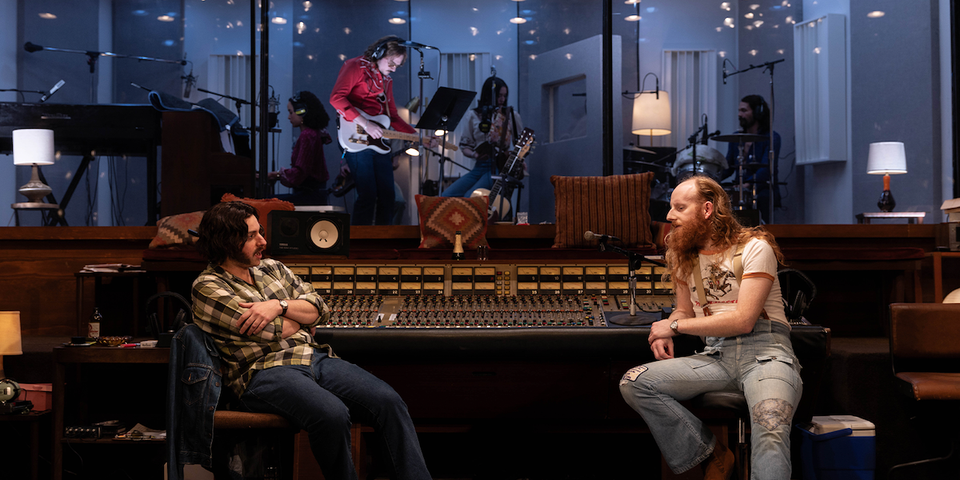
2. Stereophonic – David Adjmi’s play meticulously reproduced the creativity and tension of life in a recording studio, focusing on a Fleetwood Mac-like band, with an excellent cast who play and sing songs by Will Butler (of Arcade Fire) beautifully directed by Daniel Aukin on David Zinn’s astonishing set. 

Eli Gelb and Andrew R. Butler and the cast of Stereophonic

3. Buena Vista Social Club – This thrilling new musical at Atlantic Theater Company, developed and directed by Saheem Ali, wove together the histories of five Cuban musicians featured on the 1996 album (and the Wim Wenders documentary). The hot band, excellent singers, and exciting dancers combined to blast the audience with joy.

4. Infinite Life – Annie Baker’s characteristically spare and profound play about pain, time, and health used six superb actors masterfully directed by James Macdonald to cast a spell at Atlantic Theatre Company.

Kristine Nielsen, Brenda Pressley, Christina Kirk, Marylouise Burke, and Mia Katigbak in Infinite Life

5. Jaja’s African Hair Braiding – playwright Jocelyn Bioh knows her characters (the staff and clientele of a Harlem hair salon) and director Whitney White knows her audience – together with an exciting and hilarious cast, they blew the roof off of the Samuel Friedman Theatre on another dazzling David Zinn set.

Lakisha May (in chair) and Nana Mensah in JaJa’s African Hair Braiding

6. Sad Boys in Harpyland — Alexandra Tatarsky’s demonic cabaret/existential clownshow transformed the tiny upstairs space at Playwrights Horizons into a hilarious, theatrical, and dangerous hellscape, abetted by sound generator Shane Riley and director Irish McCloughan.

7. True West – I’ve seen many stagings of Sam Shepard’s famous play but this one stood out for its innovative all-Asian cast directed by Mei Ann Teo at People’s Light in Pennsylvania.

8. Days of Wine and Roses – Brian d’Arcy James and Kelli O’Hara dived deep into this intense chamber opera about a couple’s descent into alcoholism by Adam Guettel and Craig Lucas, directed by Michael Greif at Atlantic Theater Company.

9. Helen. – Violeta Picayo’s production at La Mama of Caitlin George’s play for En Garde Arts rang many surprising twists on familiar figures from Greek mythology.

10. (tie) Ecosex and the City – Annie Sprinkle and Beth Stephens created a luscious three-day festival of panels, films, and live shenanigans at Performance Space New York “exploring the earth as lover.”

Bob Dylan’s Philosophy of Modern Song – always-inventive filmmaker Michael Almereyda staged this one-night-only tribute to Dylan’s quirky survey of 20th century pop led by the great Meshell Ndegeocello and her band with the legendary André De Shields as magisterial master of ceremonies.

Best Music: boygenius, The Record; Romy, Midair; Everything but the Girl, Fuse; the National, First Two Pages of Frankenstein; Fred again… Tiny Desk Concert

Best TV: The Bear (great cast of rising stars – Jeremy Alan White, Ayo Edebiri, Ebon Moss-Bachrach, Liza Colon-Zayas – and phenomenal guest stars like Jamie Lee Curtis, below), Somebody Somewhere, Reservation Dogs.

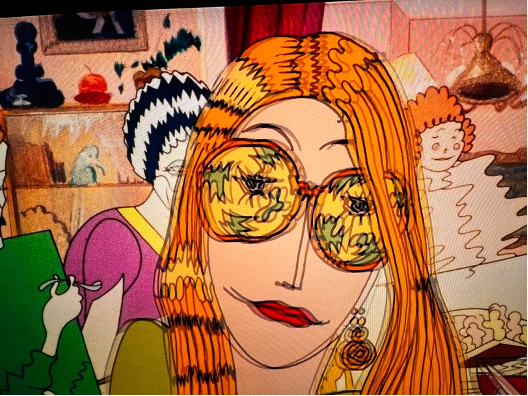
Best Films: I didn’t see a lot of blockbusters. Barbie, of course, and Oppenheimer, but neither of them blew me away as much as the wildly underrated Spider-Man: Across the Spider-Verse. I admired documentaries galore: The Disappearance of Shere Hite, All the Beauty and the Bloodshed, Navalny, Leaning into the Wind – Andy Goldsworthy, 32 Sounds.But my movie-watching this year largely revolved around my MUBI subscription, which got me to see tons of quirky vintage foreign films (the 1980 Hungarian animated feature Bubble Bath, below) and fascinating indie gems I otherwise would have missed, many of them international films directed by women. Some favorites: Rotting in the Sun, Kokomo City, The Five Devils, The Sweet East, Ava, Fremont, Amanda, Joyland, Tori and Lokita.
Culture Vulture: HELEN., SABBATH’S THEATER, and STEREOPHONIC

October 31, 2023

Cultural weekend! Friday night, Andy and I met friends for dinner at The Smith in the East Village in honor of a recently departed college chum. It was Hallo-weekend and the streets were full of costumed revelers. We were most amused to see a couple dressed as tourist (him in I ❤️ NY t-shirt) and the Statue of Liberty.

Saturday – beautiful day, up to 80 degrees. We took part in the Gays Against Guns action in response to the mass shootings in Lewiston, ME. I had a Google Hangout conversation with Alastair Curtis, a young theater artist in London who’s just discovered the work of Harry Kondoleon and wanted to talk to me in preparation for a reading he’s doing of Christmas on Mars. In the evening, Andy and I were back in the East Village to see Helen., the SuperGeographics production of Caitlin George’s play directed by Violeta Picayo. In the lobby we chatted a little with producer Anne Hamburger (whose En Garde Arts brought the show to La Mama), Linda Chapman, Chay Yew (looking very buff), and two young artists Anne is cultivating. I enjoyed the play, a dense, poetic, cheeky, queer/feminist riff on Greek mythology that reminded me of Young Jean Lee’s Lear the way it played fast and loose with familiar stories. In this version, Helen and her twin sister (!) Klaitemnestra and their sibling Timandra operate under the supervision of Elis, god of discord. This restless Helen isn’t waiting around to be abducted from her husband – she’s got wanderlust and knows how to use it. Picayo’s excellent production – light, fun, funny – made extensive use of quirky props (crowns, marbles, a barbecue) and almost continuous underscoring (by the great sound designer Darron L. West) with terrific performances, especially by charismatic Constance Strickland as Eris and Lanxing Fu as Helen (below center, with Grace Bernardo as Klaitemnestra and Melissa Coleman-Reed as Timandra).

Sunday afternoon we saw Sabbath’s Theater, Philip Roth’s late novel adapted for the stage by John Turturro with Ariel Levy. I never read the novel but the promotional material and the advance feature in the New York Times built up my expectations for a sexier/ filthier event than the New Group production turned out to be. But I guess for some (straight?) people any reference to masturbation comes off as racy rather than (as Roth has always demonstrated) a typical feature of most people’s sex lives. For all its lustiness, the play is primarily a melancholy contemplation of loss, desire, and death as the title character Sabbath (played by the brave, inventively comic, ever-watchable Turturro, below), a former puppeteer brought down by arthritis and a sex-with-student scandal, recalls the lovers, friends, and relatives he’s lost and considers joining them by throwing himself out the window of his high-rise apartment or walking naked into the sea. Jason Kravits and the great Elizabeth Marvel have fun playing all the other characters with distinctly different costumes, voices, and body habitus. Jo Bonney’s production struck me as tame, and in contrast to Helen., the sound score (by Mikaal Sulaiman) came off as intrusive and annoying at times rather than evocative or scene-setting. I pointed out to Andy that the fine-print trigger warning in the program (“This production contains nudity, sexual situations, strong and graphic language, and discussion of suicide.”) could apply to virtually every show at the New Group.

photo by Jeenah Moon for the New York Times

I loved Rob Weinert-Kendt’s succinct summary: “If Robert Altman directed a Chekhov play about a 1970s rock band struggling to perfect their next album, it might look (and sound) something like David Adjmi’s STEREOPHONIC.” I saw the play a couple of weeks ago and it’s stuck with me like few plays I’ve seen in recent years. A three-hour play can seem a little daunting these days, but Daniel Aukin’s production at Playwrights Horizons casts a spell. When I try to name the unusually evocative atmosphere to myself, I keep coming back to Fassbinder – the intense attention to tiny increments of human behavior, the honesty about intertwined love and depravity, artists at work, extraordinary design on every level, occasional longeurs but that being part of the astonishing success of capturing life in its complexity. Pop music was my first love, and I related to the play’s deep immersion in rock music culture much the same as Todd London did in his terrific essay on the PH website. (There you can also read commentary by David Byrne, who happened to be in the audience for the performance I attended; my friends and I noted how remarkably friendly and chatty Byrne was with the people sitting around him. One member of my posse is a hardcore Fleetwood Mac nerd and regaled us at intermission and afterwards with all of his observations about the Easter eggs hidden throughout the play – for instance, that Lindsay Buckingham has a brother who’s an Olympic swimmer, like the LB character in the play. And he knew exactly which Steve Nicks song was deemed too long to be included on Rumours.) The set designed by David Zinn manages to look completely natural and lived-in while being actually insanely meticulous in its creation of an artificial environment that works as an additional character in the play. Ditto the impossibly intricate sound design by Ryan Rumery. The performers are uniformly excellent, all playing their own instruments on ingenious original songs by Will Butler of the Arcade Fire. But what impressed me most of all is how the playwright, the director, and Tom Pecinka, the actor who plays Peter (the Lindsay Buckingham stand-in), collaborated to create the most nuanced and compassionate portrait of a perfectionist I’ve seen in any medium.

Culture Vulture: Jean Genet, Shirin Neshat, IT’S A SIN, and NOMADLAND

February 21, 2021

I have a theory that we will look back on this winter as the hardest time of the pandemic, second only to March and April of last year when it first came crashing down. Starting in November, when the weather started to turn cold, and lasting through whenever spring starts to thaw us out, we’ve been confined to quarters, enduring horrible news, ongoing dreadful death rates, excruciating isolation, mind-numbing boredom, and pretty universal depression. In New York City, Andy and I have been combating that somewhat with weekend art excursions.

We started our Saturday afternoon art adventure by watching the first explicitly erotic gay film – Jean Genet’s Un chant d’amour (1950), a silent film about prisoners and the sadistic guard who spies on them masturbating (an astringent sound score by Simon Fisher Turner was added later) – and ended the evening watching the latest gay erotic show, It’s a Sin, the latest HBO series by Queer As Folk creator Russell T. Davies.

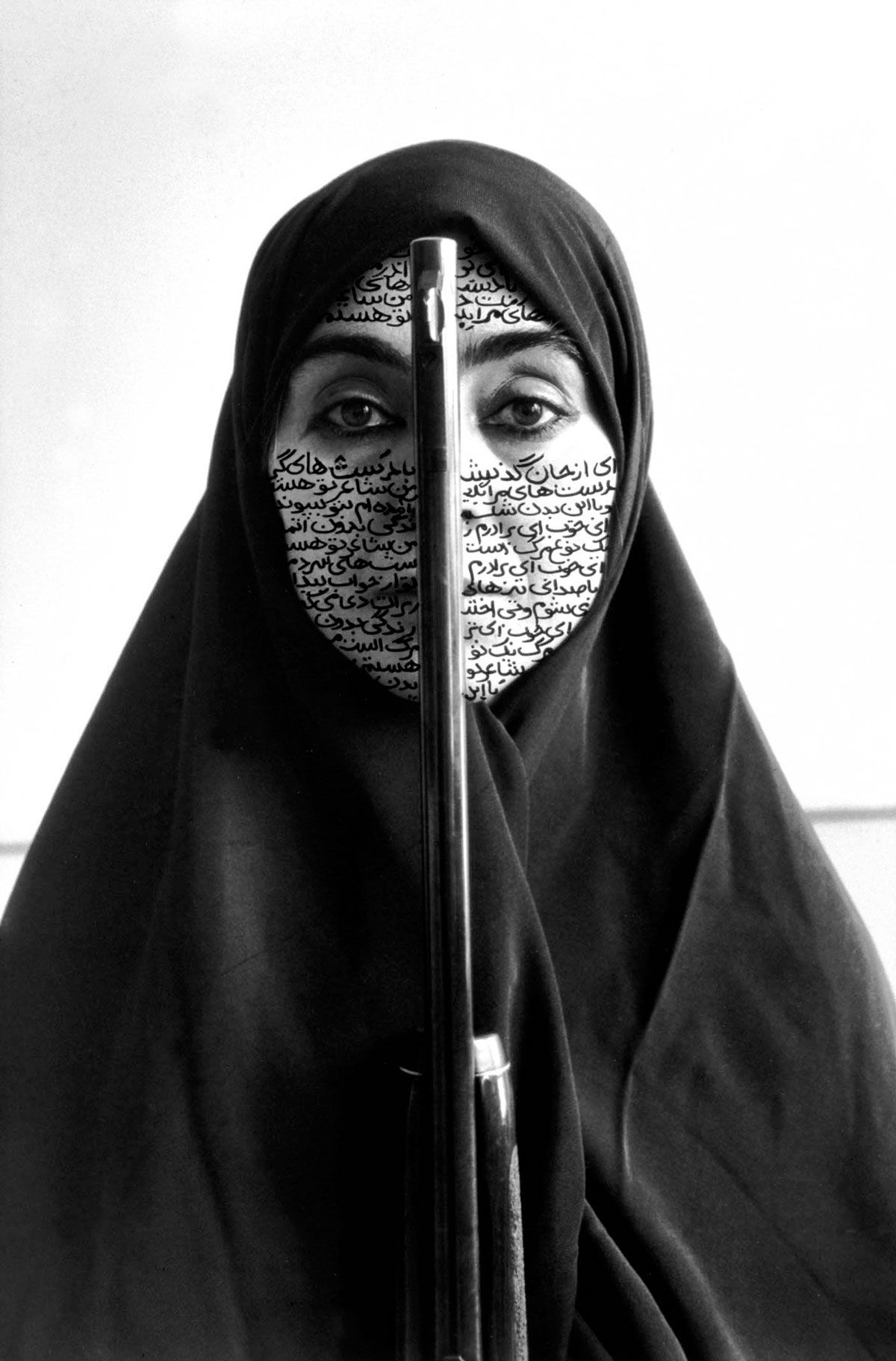
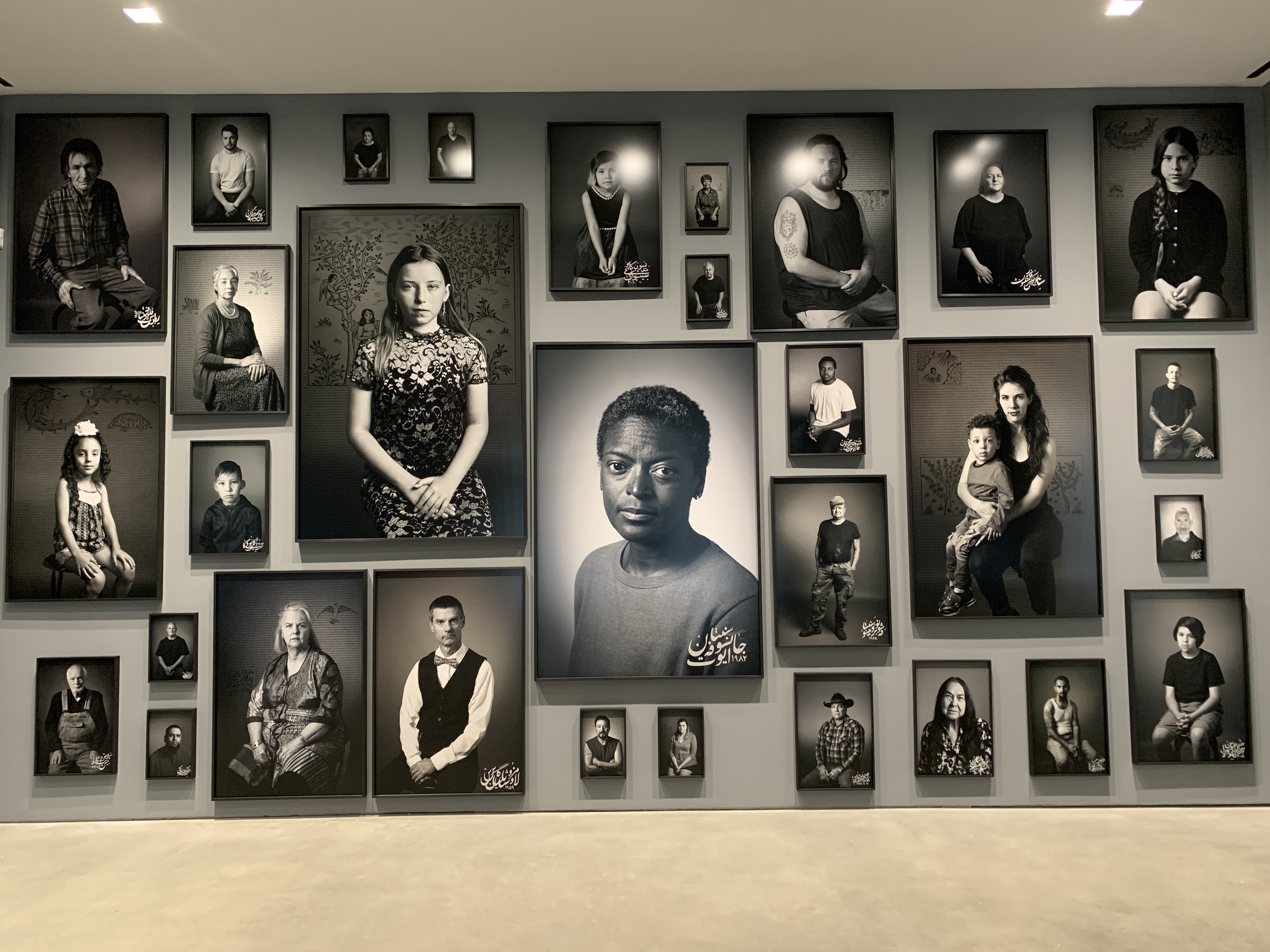
In between we trekked to the Chelsea art district to see Shirin Neshat’s show “Land of Dreams” at the Gladstone Gallery. I’ve been a huge fan of Neshat’s work since I first saw her images combining veiled Muslim women holding weapons and Persian calligraphy. Neshat’s Iranian parents sent her to Los Angeles to attend high school, and she was enrolled at the University of California at Berkeley when the Iranian revolution occurred. She has not been back to Iran since 1996 and currently lives in New York.

For her latest show, she travelled around New Mexico meeting people, taking their photographic portraits, and asking them to tell her their latest dream. At the gallery 111 of these portraits hang, each of them with calligraphic additions – their names, their birthdates, sometimes the text of their dreams, sometimes images from their dreams.

In an adjacent gallery, Neshat shows a two-channel video installation that is a fictionalized version of her travels through New Mexico, juxtaposed with scenes from a sinister sort of factory employing dozens of lab-coated “dream scientists.”

Shortly after we walked into the gallery, a woman asked Andy to snap a picture of her and a male friend of hers. It turned out to be Neshat, who showed up to rendezvous with her friend and collaborator Youssef Nabil, an Egyptian photographer (above). So we got to meet the artist and chat with her a little bit, which excited the fanboy in me. I can’t remember if she told us this or if we heard her say it in one of the several YouTube videos we watched later, but she doesn’t actually think of herself as a photographer. She said she doesn’t own a camera, and indeed in videos she’s seen directing a cameraman who actually takes the photos. She has made a number of films, most of them – like the one playing in the gallery – pristinely shot in black and white, juxtaposing weathered unusual faces with wide-open stark landscapes. The two-channel video can be viewed on the gallery’s website at certain hours of the week, along with a 25-minute documentary about the making of the show.

While we were in Chelsea, we poked our noses into a couple of other galleries. The Jack Shainman Gallery is hosting “Half and the Whole,” a show by photographer and filmmaker Gordon Parks of images from 1942-1970 that document the civil rights movement, including some beautiful candid shots of Malcolm X. I was struck by this curious, anomalous image from 1962 called “Invisible Man Retreat, Harlem, New York.”

Some dazzling and trippy geometric prints caught our eye at the Dobrinka Salzman Gallery. They turned out to be early works by an Italian artist named Riccardo Vecchio.

Once you’re in the art trance, even trash on the street starts looking like readymades.

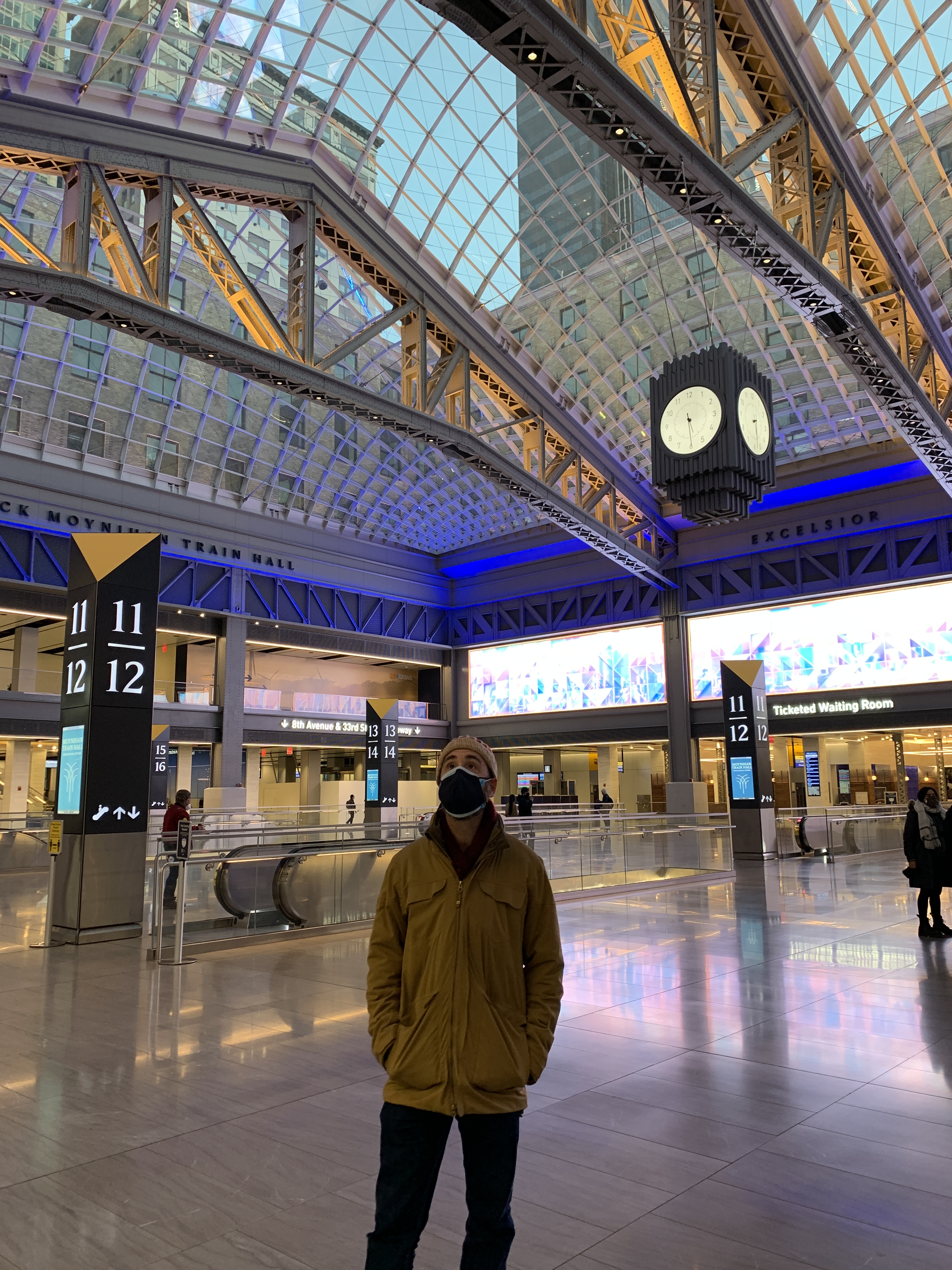
We had two more predetermined destinations. One was the new Daniel Moynihan Train Hall, with its gleaming interiors (currently sparsely populated of course, but envisioned to be teeming with commuters sometime), spectacular skylights, and all kinds of artwork including this colorful three-part stained-glass piece by Kehinde Wiley called “Go” on the ceiling of the 35th Street entrance.

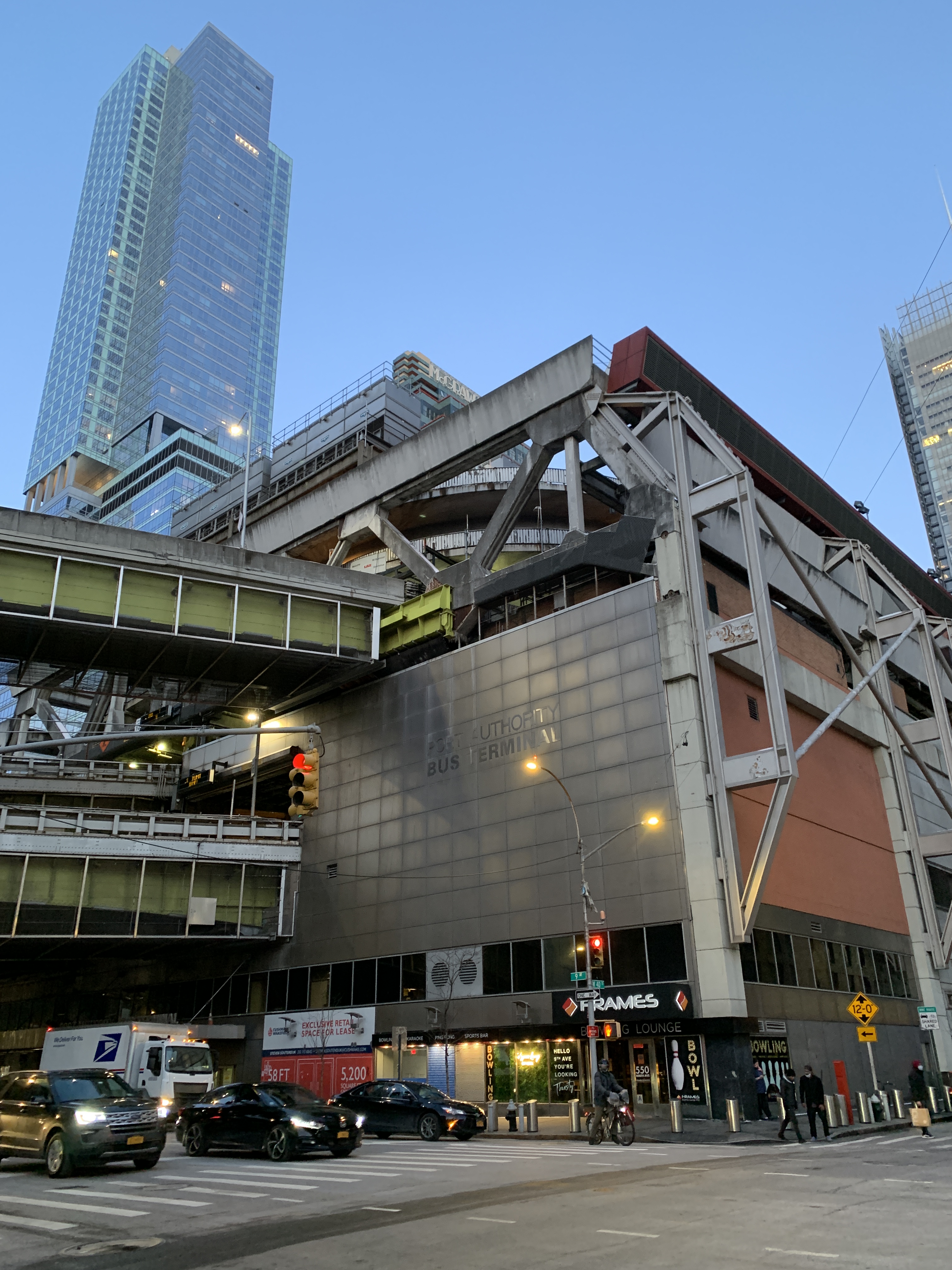
After that spectacle, a walk up Ninth Avenue brought us into the armpit of Times Square, the stunningly ugly backside of the Port Authority Bus Terminal.

In the grimy underpass across the street, one of several vacant storefronts in the neighborhood featured artwork sponsored by Chashama, the public art project enterprising curator Anita Durst operates using disused corners of her family’s vast real estate empire.

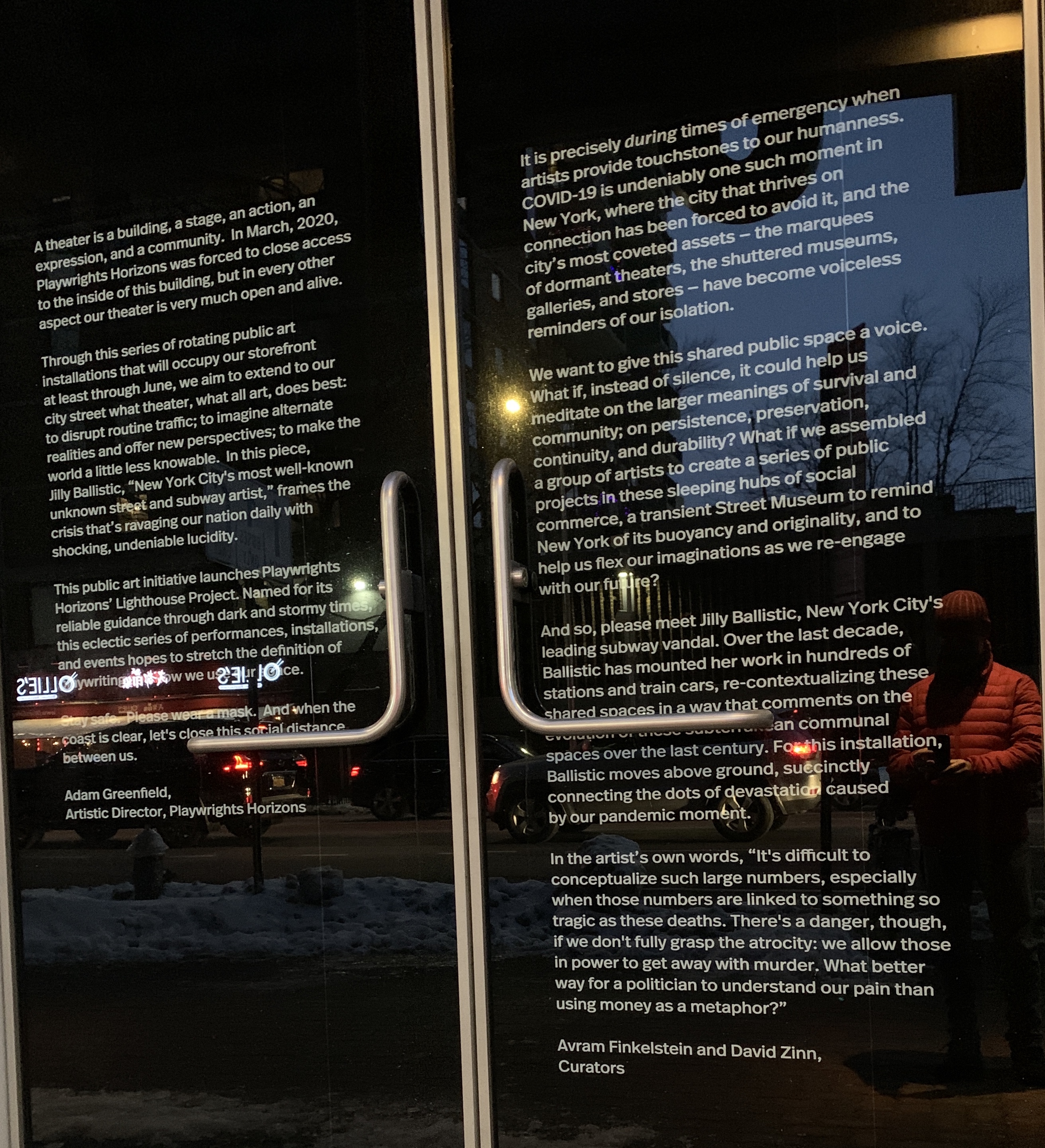
Our final art destination was the storefront for Playwrights Horizons, one of NYC’s great Off-Broadway theaters. It’s been shuttered since last March, like all theaters in the city, but incoming artistic director Adam Greenfield enlisted our friend David Zinn, the Tony Award-winning set and costume designer, and Avram Finkelstein, one of the founders of the AIDS-era art collective Gran Fury, to curate a lively public art project keeping the block activated.

The first artist they commissioned was Jilly Ballistic, who created a gigantic mural in the form of a dollar bill regularly updated with a reference to the number of Americans who have died of covid-19.

Being on Theater Row at dinnertime led us to one of our favorite local restaurants, Mémé Mediterranean on 10th Avenue at 44th Street. They were being scrupulous about allowing indoor dining with a limited capacity; there were only two other tables dining when we sat down for a delicious tagine and a shawarma royale.

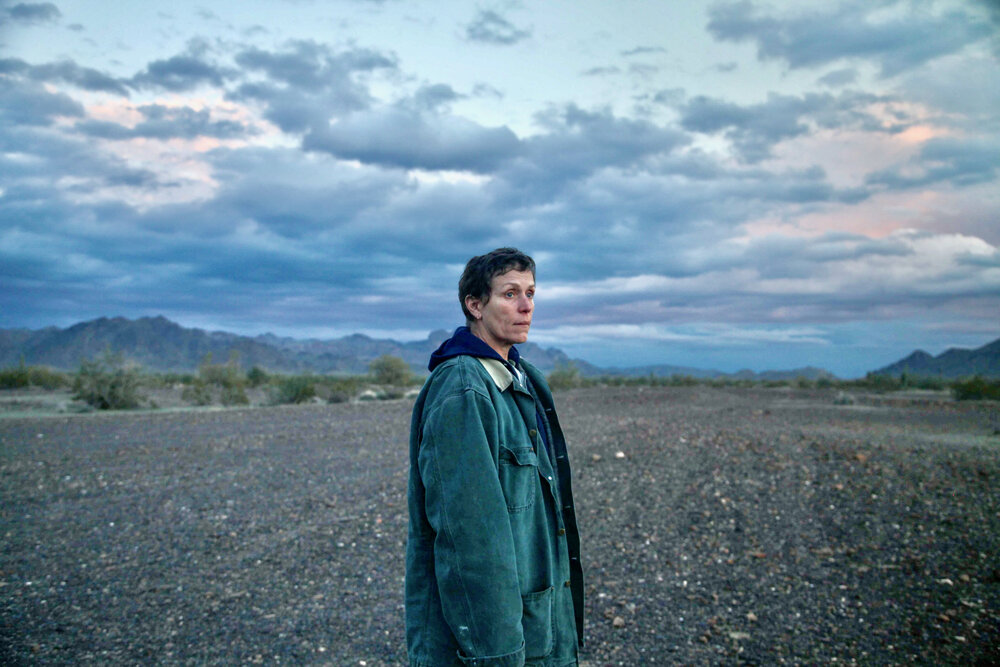
It was a very satisfying expedition. We spent the after-dinner hours with It’s a Sin (just the first episode) and Shirin Neshat interviews on YouTube. Sunday afternoon we watched Chloe Zhao’s new film Nomadland on Hulu, an extraordinarily beautiful and moving collaboration between the director (I recently saw and loved her Songs My Brother Taught Me) and actress/co-producer Frances McDormand, who gives yet another spectacular, vanity-free performance as a miner’s widow living in her van barely scraping by as a day laborer on a series of hard low-paying jobs. Long wordless scenes of her rolling through Nevada, Arizona, Nebraska, and South Dakota eerily echo the wide-open spaces we saw in Shirin Neshat’s film the day before.

And then, as we generally do, we repaired to our separate abodes to cook food for the week. Andy set about making a big pot of jambalaya, and I applied myself to following Gabrielle Hamilton’s recipe from last week’s New York Times Magazine for Russian salad, which is refrigerating overnight and gave me a chance to sample a new taste treat I discovered at the farmer’s market yesterday – pickled hard-boiled eggs.

Culture Vulture: Adam Bock’s A LIFE at Playwrights Horizons

December 4, 2016

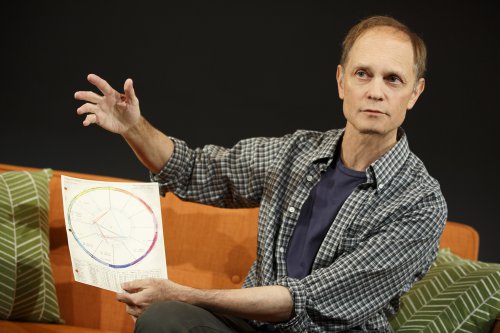
I saw Adam Bock’s tremendous new play A Life at Playwrights Horizons for the second time yesterday. It impressed me again with its deep humor and humanity and with the playwright’s amazing skill at creating characters, writing amazing scenes, and taking unbelievable freedom for himself in shaping the narrative. The first half hour of the play is an extraordinary long monologue by the main character, played by David Hyde Pierce. When I first saw the play in previews, the audience in the intimate Peter Sharp space upstairs at Playwrights was pretty quiet. This time, after stellar reviews, the audience was quite excited, plus clearly many were there who were major David Hyde Pierce fans (including Andy’s friends from London whom we took to see it). And the way he responded to every tiny little ripple in the audience — including instantly saying “Bless you” when somebody sneezed — was fantastic to witness. Tonight is the final performance.

david-hyde-pierce-in-a-life-joan-marcus
One of the things I always love about seeing shows at Playwrights Horizons is that almost always you can pick up in the lobby afterwards a simple Xeroxed copy of an interview with the playwright conducted by either artistic director Tim Sanford or the literary manager Adam Greenfield. These smart, in-depth interviews almost always tell you everything you want to know about the show you’ve just seen. The interview with Bock doesn’t answer ALL my questions but it’s a fascinating conversation nevertheless. You can read it online here. Check it out and let me know what you think. There’s also a ton of other intriguing stuff about the playwright and the play on the theater company’s website — see here. adam-bock


Performance diary: THE (CURIOUS CASE OF THE) WATSON INTELLIGENCE, Taymor’s DREAM, and THE HABIT OF ART

December 8, 2013

12.5.13The (Curious Case of the) Watson Intelligence by Madeleine George at Playwrights Horizons is one of those plays with an interesting theme – the search for mechanized perfection – and a clever conceit through which to pursue it. A super-smart computer programmer named Eliza is creating a robot-helper (picture a life-sized full-bodied Siri) whom she has named Watson, and her quest is bounced off historical scenes featuring other Watsons: Sherlock Holmes’s sidekick and Alexander Graham Bell’s right-hand man, with glancing reference to the IBM computer of the same name who famously beat human contestants on Jeopardy. Ultimately, though, the play devolves into a kind of heterosexual soap opera about Eliza, her ex-husband Merrick, and the computer repair guy – also named Watson – he hires to spy on her. The clever contrivances don’t actually deliver believable human truth, though. The actors have fun playing several roles in several periods.

curious case
I found Amanda Quaid (above) appealing and persuasive, and John Ellison Conlee (above) inhabits all the Watsons beautifully, but David Costabile might have been miscast as Merrick – he’s so high-strung that there’s no way to take him as anything other than The Bad Guy, which quickly gets tedious.

12.7.13 — Julie Taymor’s Midsummer Night’s Dream, at Theater for a New Audience’s splendid new theater down the street from the BAM Opera House, is fantastic – spectacular design, hugely inventive staging, stuffed with terrific performances. I’ve seen any number of productions over the years, and by halftime I was already convinced this is the best ever. Each scene came with some original, funny, sexy, visually stunning, or otherwise delightful element. Some that stayed with me: at the very top of the show, out comes Puck – a very small androgynous creature (renowned British performer Kathryn Hunter) in clown makeup, bowler hat, and a suit that might fit an organ-grinder’s monkey made of soft rumpled gray fabric (the first of what seems like hundreds of amazing costumes designed by Constance Hoffman). The only thing onstage is a bed, Puck lies down to sleep, and the bed rises up with tree branches underneath. The guys who will later turn out to be the “rude mechanicals” come onstage, saw the tree branches loose from the bed, which flies to the ceiling and disappears behind a white sheet, on which the title of the play appears. I’ve never seen a production frame the entire play as Puck’s dream and was curious if we would come back to that at the end. Not exactly. Taymor comes up with another beautiful, quiet, unexpected image involving a sleepy girl and a dog mask, coming back to the sleepy/dreamy image but transformed. And so it is throughout the production, one transformation after another.

MIDSUMMER-art-website
The fairies are played by a rambunctious batch of 20 children (Taymor originally wanted 100), who sing, dance, do acrobatics, manipulate scenery and props, wear masks, scream like banshees, and sometimes get hauled around like real-life bunraku puppets by black-clad manipulators. David Harewood and Tina Benko, both great actors, make the most striking Oberon and Titania I’ve ever seen – he’s black black black, with spiky gold armor and gold tattoos across his chest and down his back; she’s white white white with boob-lights on antennas and transparent clamshell wings. Taymor dresses the rude mechanicals like working men and cast them with some great veteran actors who can play broad comedy without making it stoopid, most notably Max Casella (unforgettable as Timon in the original cast of Taymor’s The Lion King) as Bottom.

A-Midsummer-nights-Dream-slide-9G71-articleLarge
The whole sequence at the end of the first half is thrilling: Bottom is transformed with a donkey’s head with creepily human nose and lips which Casella manipulates with hand-held remotes; smitten Titania invites him into her hammock bed, which drapes across the entire stage; and their union is consummated with an explosion of color and light that is funny, sexy, ecstatic, and mythological all at once. The young lovers give the weakest performances in the large cast, but once they’re all in the forest in the middle of the night they wind up stripping down to their underwear and having a pillow fight, which is not a chore to watch at all (especially hunky hunky Zach Appelman as Demetrius). The puppets, masks, and constantly morphing sets are clearly a collaboration between Taymor and her designers (scenic designer Es Devlin is clearly some kind of theatrical genius himself), and Eliot Goldenthal’s music contributes numerous perfect multiflavored touches. For all of its fun, sexiness, and visual splendor, this is no dumbed-down Shakespeare for the masses but a smart and deep interaction into the dangerous fields of love, where casual cruelty often masquerades as play. I’d like to see this production two or three more times. It only runs til January 12 and I suspect there are very few tickets left. What are you waiting for?

By the way, Theater for a New Audience has made available online a free PDF of an extensive study guide to A Midsummer Night’s Dream that includes some terrific essays an an in-depth interview of Taymor by Alisa Solomon.

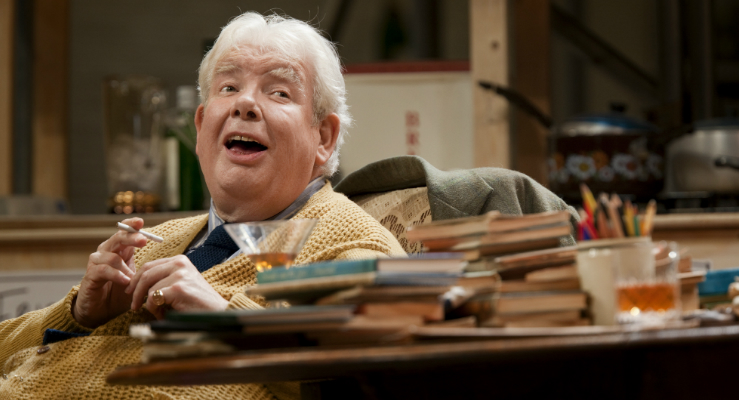
12.8.13 – The live broadcast of The Habit of Art, Alan Bennett’s play about actors rehearsing a play about W. H. Auden and Benjamin Britten at Oxford, showed up for one screening in New York as part of the National Theater’s 50th anniversary celebration. It’s one more brilliant play from the author of The History Boys, The Madness of King George, Bed Among the Lentils, and so many others. And another extraordinary production directed by Nicholas Hytner with a superb cast headed by the late great Richard Griffiths (below) as a fat, shambling, supernaturally eloquent Auden, Alex Jennings as Britten, and the amazing Frances de la Tour as the stage manager who keeps the rehearsal going. On the National Theater Live’s website, you can also download a free PDF of a lavish 33-page programme with essays about Auden and Britten as well as an introduction by Bennett.

habit of art