Posts Tagged ‘harry kondoleon’

Culture Vulture: HELEN., SABBATH’S THEATER, and STEREOPHONIC

October 31, 2023

Cultural weekend! Friday night, Andy and I met friends for dinner at The Smith in the East Village in honor of a recently departed college chum. It was Hallo-weekend and the streets were full of costumed revelers. We were most amused to see a couple dressed as tourist (him in I ❤️ NY t-shirt) and the Statue of Liberty.

Saturday – beautiful day, up to 80 degrees. We took part in the Gays Against Guns action in response to the mass shootings in Lewiston, ME. I had a Google Hangout conversation with Alastair Curtis, a young theater artist in London who’s just discovered the work of Harry Kondoleon and wanted to talk to me in preparation for a reading he’s doing of Christmas on Mars. In the evening, Andy and I were back in the East Village to see Helen., the SuperGeographics production of Caitlin George’s play directed by Violeta Picayo. In the lobby we chatted a little with producer Anne Hamburger (whose En Garde Arts brought the show to La Mama), Linda Chapman, Chay Yew (looking very buff), and two young artists Anne is cultivating. I enjoyed the play, a dense, poetic, cheeky, queer/feminist riff on Greek mythology that reminded me of Young Jean Lee’s Lear the way it played fast and loose with familiar stories. In this version, Helen and her twin sister (!) Klaitemnestra and their sibling Timandra operate under the supervision of Elis, god of discord. This restless Helen isn’t waiting around to be abducted from her husband – she’s got wanderlust and knows how to use it. Picayo’s excellent production – light, fun, funny – made extensive use of quirky props (crowns, marbles, a barbecue) and almost continuous underscoring (by the great sound designer Darron L. West) with terrific performances, especially by charismatic Constance Strickland as Eris and Lanxing Fu as Helen (below center, with Grace Bernardo as Klaitemnestra and Melissa Coleman-Reed as Timandra).

Sunday afternoon we saw Sabbath’s Theater, Philip Roth’s late novel adapted for the stage by John Turturro with Ariel Levy. I never read the novel but the promotional material and the advance feature in the New York Times built up my expectations for a sexier/ filthier event than the New Group production turned out to be. But I guess for some (straight?) people any reference to masturbation comes off as racy rather than (as Roth has always demonstrated) a typical feature of most people’s sex lives. For all its lustiness, the play is primarily a melancholy contemplation of loss, desire, and death as the title character Sabbath (played by the brave, inventively comic, ever-watchable Turturro, below), a former puppeteer brought down by arthritis and a sex-with-student scandal, recalls the lovers, friends, and relatives he’s lost and considers joining them by throwing himself out the window of his high-rise apartment or walking naked into the sea. Jason Kravits and the great Elizabeth Marvel have fun playing all the other characters with distinctly different costumes, voices, and body habitus. Jo Bonney’s production struck me as tame, and in contrast to Helen., the sound score (by Mikaal Sulaiman) came off as intrusive and annoying at times rather than evocative or scene-setting. I pointed out to Andy that the fine-print trigger warning in the program (“This production contains nudity, sexual situations, strong and graphic language, and discussion of suicide.”) could apply to virtually every show at the New Group.

photo by Jeenah Moon for the New York Times

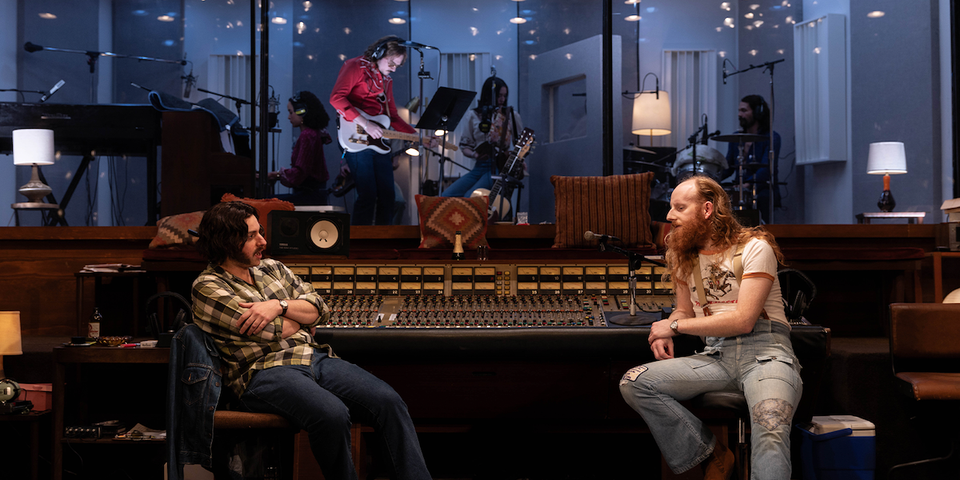
I loved Rob Weinert-Kendt’s succinct summary: “If Robert Altman directed a Chekhov play about a 1970s rock band struggling to perfect their next album, it might look (and sound) something like David Adjmi’s STEREOPHONIC.” I saw the play a couple of weeks ago and it’s stuck with me like few plays I’ve seen in recent years. A three-hour play can seem a little daunting these days, but Daniel Aukin’s production at Playwrights Horizons casts a spell. When I try to name the unusually evocative atmosphere to myself, I keep coming back to Fassbinder – the intense attention to tiny increments of human behavior, the honesty about intertwined love and depravity, artists at work, extraordinary design on every level, occasional longeurs but that being part of the astonishing success of capturing life in its complexity. Pop music was my first love, and I related to the play’s deep immersion in rock music culture much the same as Todd London did in his terrific essay on the PH website. (There you can also read commentary by David Byrne, who happened to be in the audience for the performance I attended; my friends and I noted how remarkably friendly and chatty Byrne was with the people sitting around him. One member of my posse is a hardcore Fleetwood Mac nerd and regaled us at intermission and afterwards with all of his observations about the Easter eggs hidden throughout the play – for instance, that Lindsay Buckingham has a brother who’s an Olympic swimmer, like the LB character in the play. And he knew exactly which Steve Nicks song was deemed too long to be included on Rumours.) The set designed by David Zinn manages to look completely natural and lived-in while being actually insanely meticulous in its creation of an artificial environment that works as an additional character in the play. Ditto the impossibly intricate sound design by Ryan Rumery. The performers are uniformly excellent, all playing their own instruments on ingenious original songs by Will Butler of the Arcade Fire. But what impressed me most of all is how the playwright, the director, and Tom Pecinka, the actor who plays Peter (the Lindsay Buckingham stand-in), collaborated to create the most nuanced and compassionate portrait of a perfectionist I’ve seen in any medium.
Culture Vulture: PLAY YOURSELF benefit reading

October 9, 2019

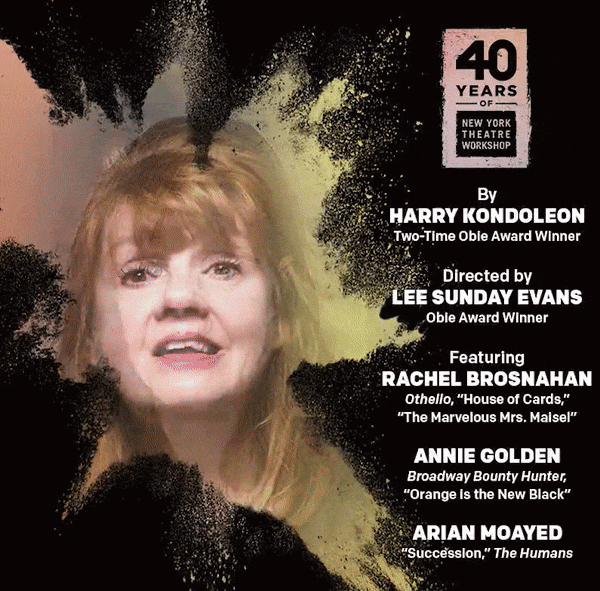
Fresh on the heels of its latest Broadway transfer (Jeremy O Harris’s edgy Slave Play), New York Theatre Workshop launched its 40th anniversary season Monday night October 7 with a benefit reading of Harry Kondoleon’s Play Yourself. In a program note and at the reception afterwards, the company’s quiet powerhouse of an artistic director, Jim Nicola, acknowledged that “Harry Kondoleon has been at the heart of New York Theatre Workshop longer than I have.” Indeed, Kondoleon’s 1983 Christmas on Mars was NYTW’s first production (in partnership with Playwrights Horizons), and Nicola produced the New York premiere of Play Yourself in 2002 in a beautiful staging by Craig Lucas starring the late great Marian Seldes and the phenomenal Elizabeth Marvel.

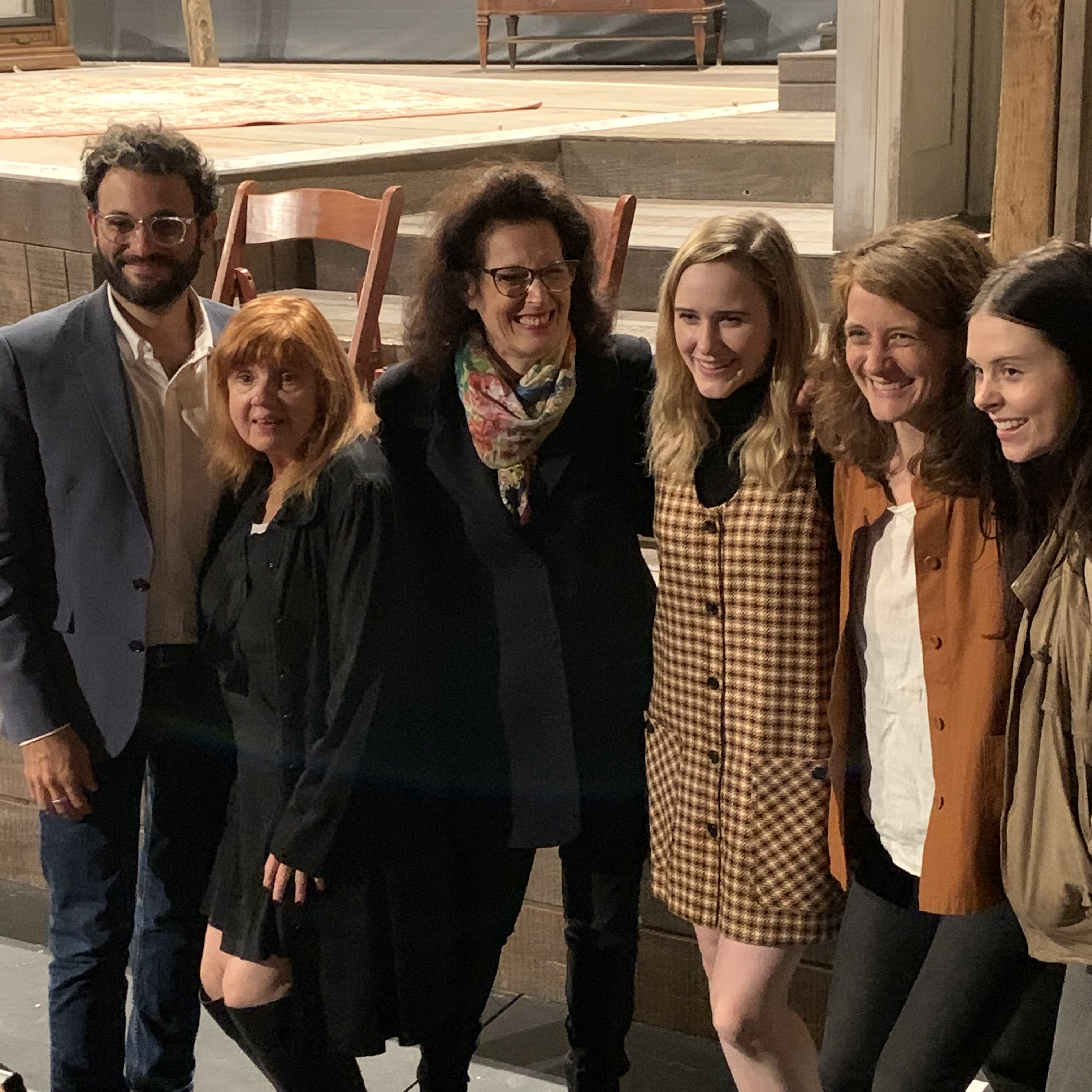
For this reading, Lee Sunday Evans (who directed one of last season’s most remarkable shows, Clare Barron’s Dance Nation) assembled a fascinating cast. Off-Broadway veteran Leslie Ayvazian played the role of Jean, an aged former Hollywood B-movie starlet who’s now long retired, half-blind, living in happy obscurity with Yvonne, her former East Village club-kid daughter, now a depressed stay-at-home. Yvonne was played by Rachel Brosnahan, who last appeared at NYTW as Desdemona opposite David Oyewolo’s Othello and Daniel Craig’s Iago, but of course is better known as the star of The Marvelous Mrs. Maisel. They were joined by the adorable comic character actor and former rocker Annie Golden playing Selma, an ardent fan who tracks Jean down, bringing along with her Brother Harmon, the charismatic founder of a “home for the hopeless,” played by Arian Moayed, who appeared on Broadway in The Humans and is currently on the TV show Succession. Having only had three hours’ rehearsal, the actors did an amazing job of conjuring the play to life.

Play Yourself has all the ingredients that make Harry Kondoleon’s plays distinctive — the vibrant voice, the laugh-out-loud one-liners, the off-handed poetic diction (death is referred to as “oblivion’s lily pad”), the magical transformations, the delicate evolution from familiar living-room comedy to something deeper, stranger, philosophical. At the benefit reading it sounded as fresh and funny as it was when it was written in 1986, and possibly even more pertinent now in the #MeToo/Time’sUp era with its knowing depiction of Hollywood’s callous treatment of women. I attended the reading with the Harry Kondoleon posse — his family (represented by his nephew Lucas Wittmann and his wife Victoire), his William Morris agent Jonathan Lomma, and his best friend and literary executor Stephen Soba.

Afterwards Stephen and I had a fun, spirited conversation with Ayvazian, who knocked us out playing Jean. It turns out Ayvazian knew Harry and a lot of his work. “He wrote great parts for women,” she declared. “He gave them teeth! And cunts!”

At the reception around the corner at Nai Tapas, I chatted up the delightful Ari Moayed, who reminded me that he’d been in the reading of Harry’s Zero Positive at the Public Theater a few years ago. And I had an extended passionate, intimate conversation with Annie Golden about the intense years of the AIDS crisis in NYC and the loved ones we lost to the plague (including her brother and our Harry). Big gratitude to Jim Nicola, Linda Chapman, and all the folks at New York Theatre Workshop for making this one of those fun, crazy nights that make life in New York so special.

Culture Vulture: A TASTE OF HARRY Queer/Art salon

April 6, 2019

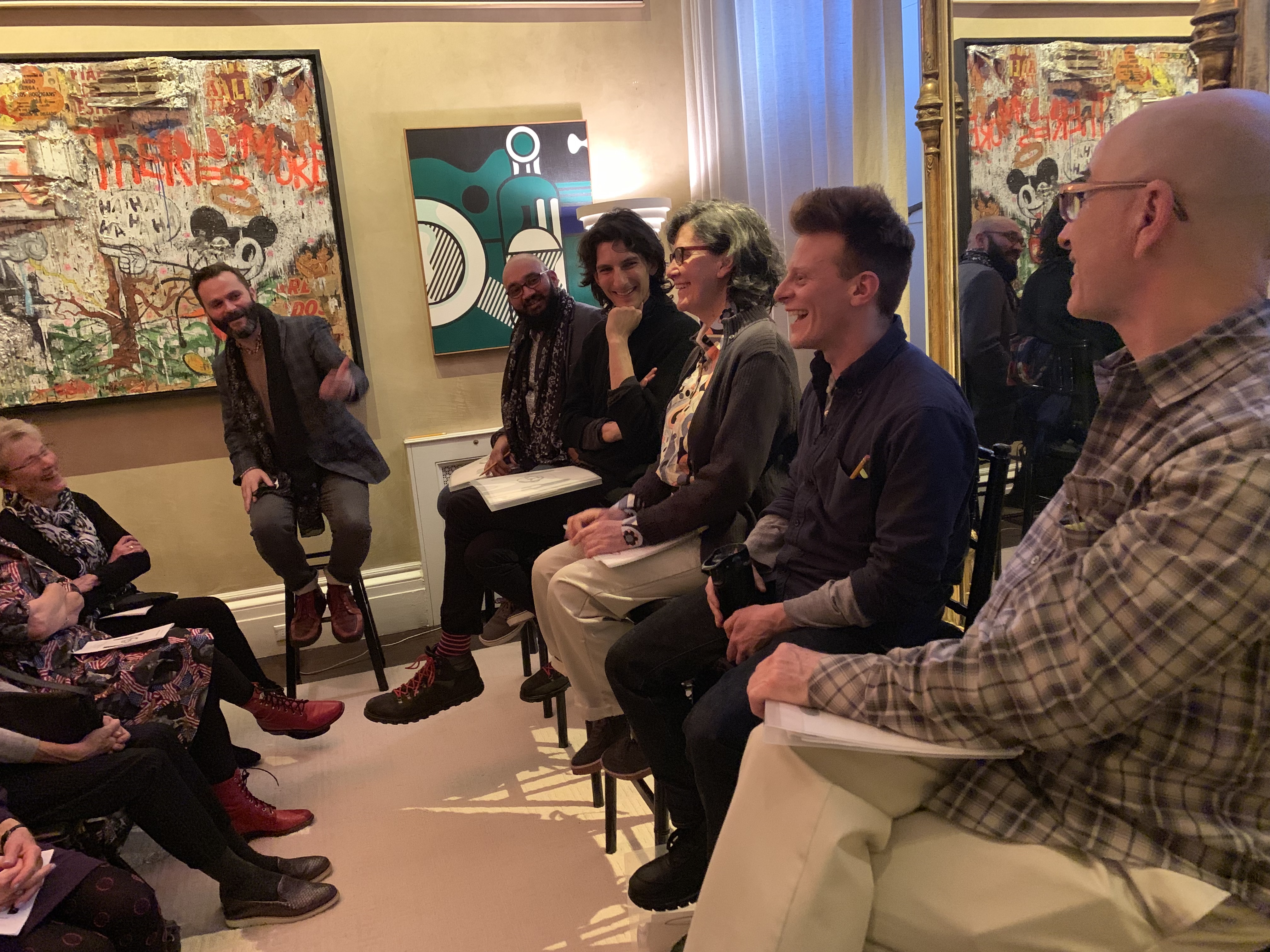
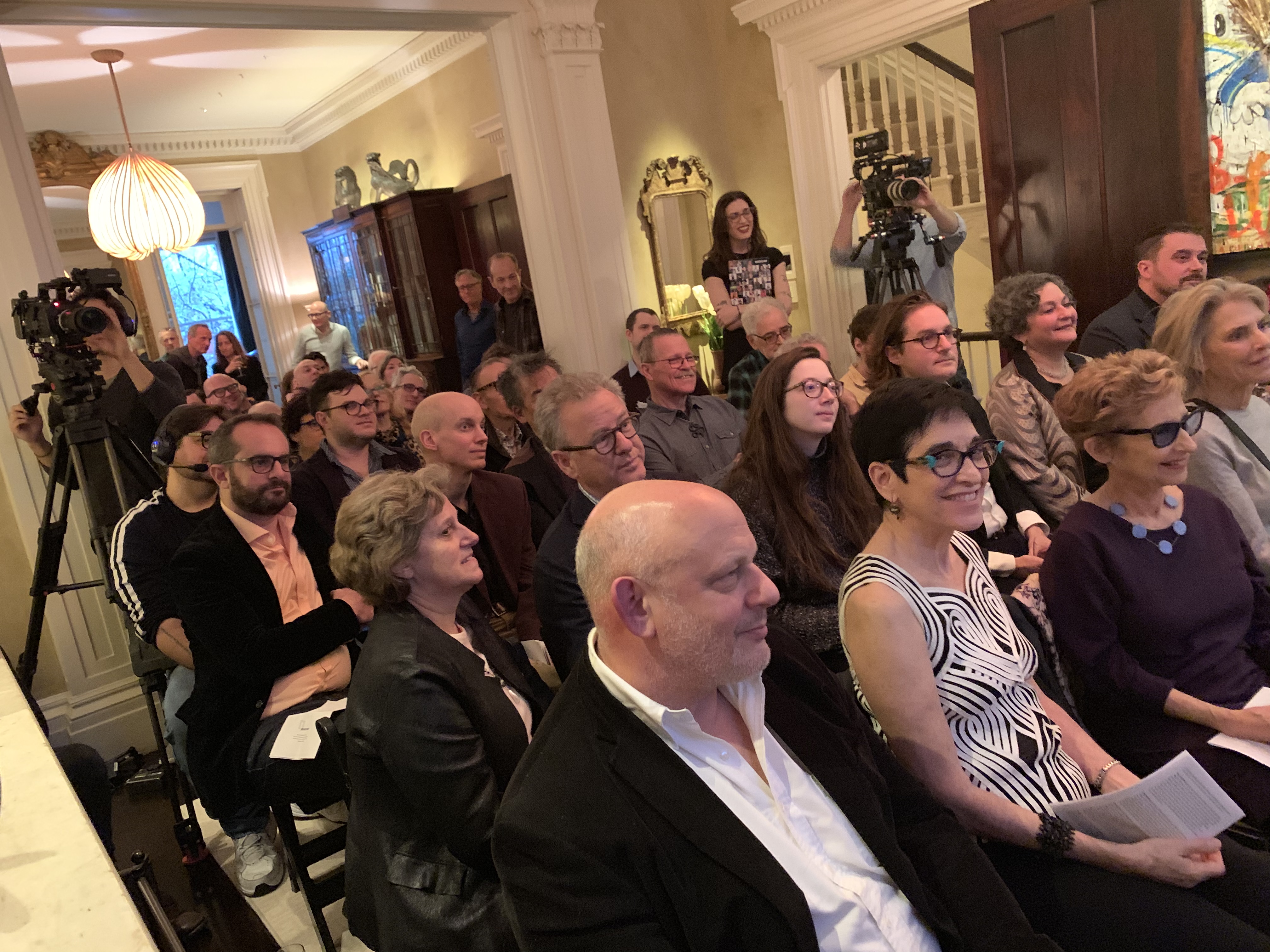
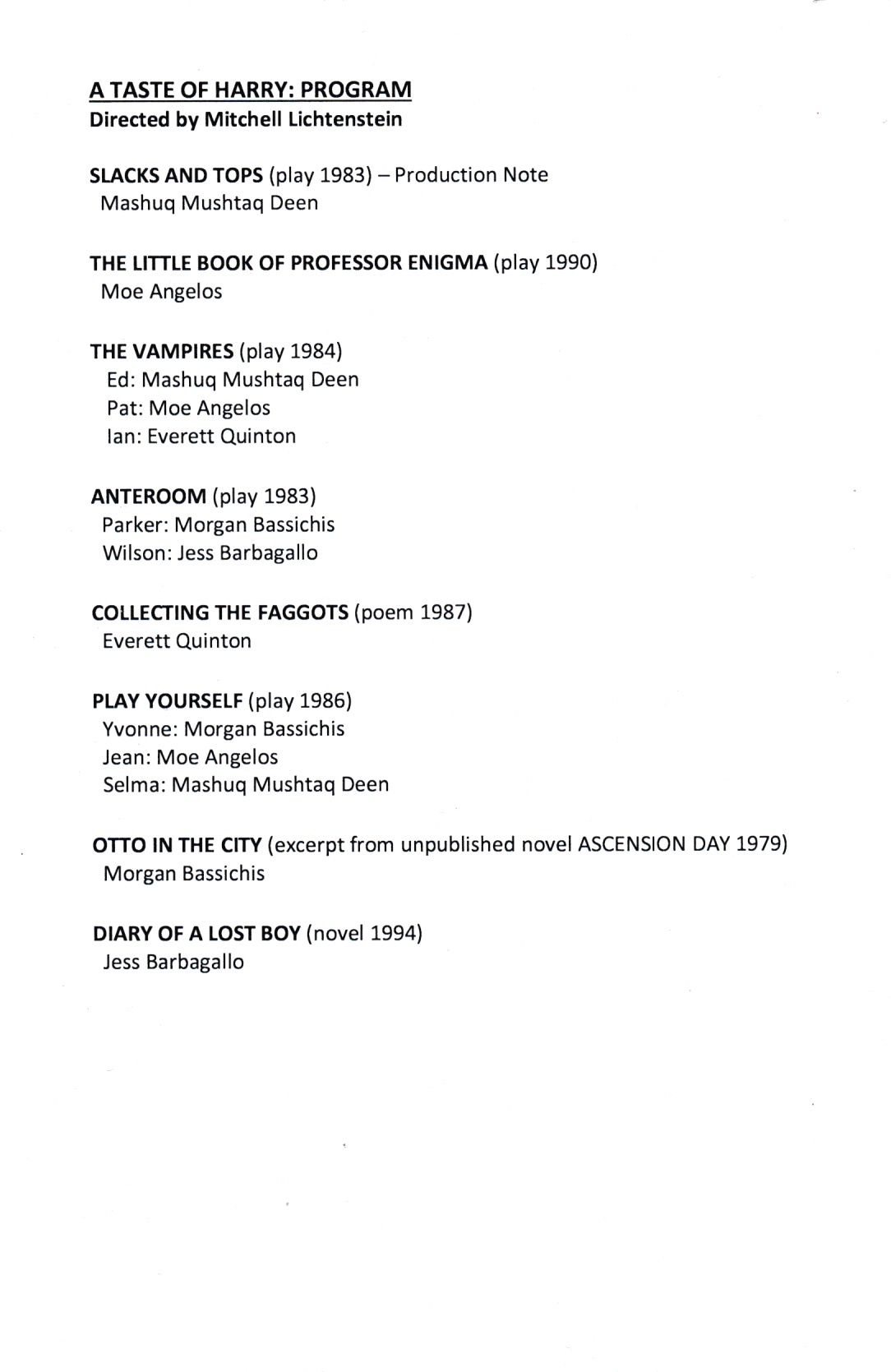
Last Sunday, March 31, Queer | Art presented a salon called “A Taste of Harry: Selected Readings from the Work of Harry Kondoleon” hosted by Mitchell Lichtenstein at his lovely townhouse in the West Village. Five artists from Queer | Art’s mentorship program – Moe Angelos, Jess Barbagallo, Morgan Bassichis, Mashuq Mushtaq Deen, and Everett Quinton – performed a series of excerpts from Harry’s work for an invited audience of 50 guests that included family and friends, theatrical luminaries (John Guare, David Henry Hwang), and Queer | Art supporters.

The very entertaining program comprised excerpts from plays, poems, and fictional work selected by Harry’s good friends Mitchell, Don Shewey, and Stephen Soba. Mitchell directed the reading, and Don co-facilitated a discussion afterwards with Queer | Art’s managing director Travis Chamberlain. For fans, it was fun to revisit Harry’s work; for others in the room, it was a revelatory introduction to his distinctive voice. Big gratitude to Mitchell and his partner Vincent Sanchez for hosting and providing delicious hors d’oeuvres and beverages, to Travis and his staff for shining a light on an artist who has been gone for 25 years but whose work lives on, and to Ira Sachs for conceiving the mission of Queer | Art – see the mission statement reprinted in the program (below).

R.I.P.: 25th anniversary of Harry Kondoleon’s death

March 21, 2019

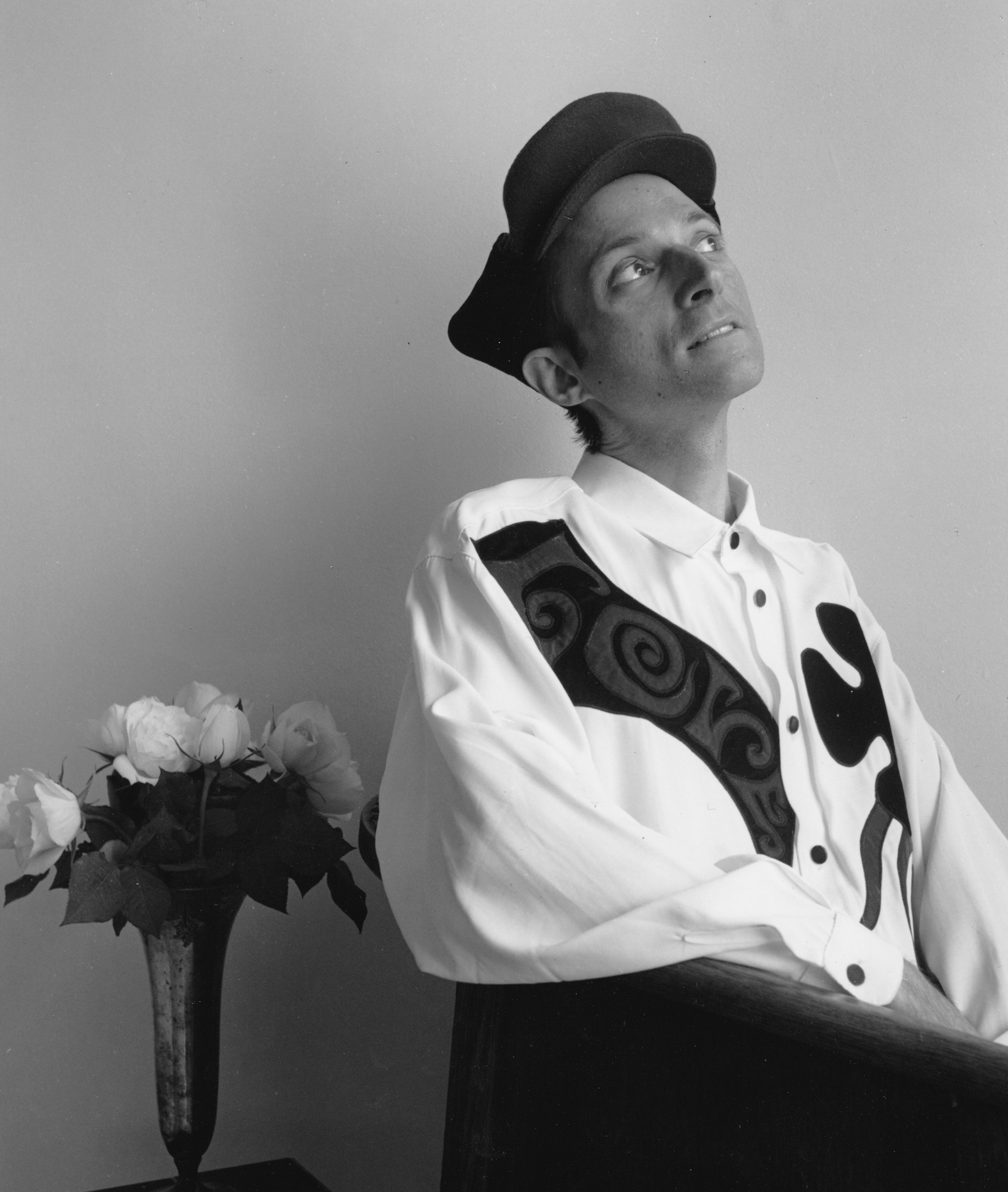
Harry Kondoleon left this plane of existence 25 years ago, March 16, 1994. Like so many of our friends who were casualties of the AIDS epidemic, at the end of his life he was blind in one eye, skeletally thin, and in a lot of pain. He passed away in his bed holding his father’s hand. (portrait above by Robert Giard)

In the last year of his life, Harry published DIARY OF A LOST BOY, his surrealistic novel about living with AIDS. The book was very well published (by Alfred A. Knopf, no less!) and well-received critically. Most important, Harry performed a spectacular act of grace and self-healing by envisioning his own demise.

The book ends with a quote from Meister Eckhart: “Listen then to this wonder! How wonderful it is to be both outside and inside, to seize and to be seized, to see and at the same time to be what is seen, to hold and to be held — that is the goal where the spirit remains at rest, united with our dear eternity.”

Just before that, the final paragraph of Harry’s text reads:

“My face is down in the dirt, but make no mistake, it is a beautiful place. Even the little bowls of bread soaked in milk Kim has left near the oak tree for me only enhance the landscape which is God’s presence. Even the dead flowers must be groomed and honored, and by leaving them we leave death, and those are the attachments of this world. Fear be gone! Please do not feel sorry for me — I go to some place thrilling!”

Performance diary: Harry Kondoleon’s ZERO POSITIVE at the Public Theater’s New Work Now

September 13, 2013

9.11.13 — The Public Theater’s New Work Now series has started including a play from the past, and this year’s selection was Harry Kondoleon’s Zero Positive, which Joseph Papp originally produced in 1988. Published in M. Elizabeth Osborn’s anthology The Way We Live Now, Zero Positive was part of the second wave of plays about AIDS, a lyrical and theatrically free-wheeling step beyond informative first-line dramas such as As Is and The Normal Heart. It’s one of the strongest plays in the body of work by Kondoleon, who sadly died of AIDS in 1994 at the age of 39. The original production was a troubled one in that the playwright became dissatisfied with the actor in the central role, Reed Birney, and fired him, which made the director, Mark-Linn Baker, resign in solidarity. Birney’s replacement was no slouch – David Hyde Pierce – and director Kenneth Elliott picked up the pieces, but the show didn’t make much of an impact, and the play remains one that is more admired than produced.

zero positive
Sarah Benson, artistic director of Soho Rep, assembled a fantastic cast for this one-night-only reading, which served the purpose of establishing that the play has lost none of its emotional resonance in the intervening years. Himmer lives with his father, Jacob Blank, a poet and philanderer whose estranged wife has very recently died, sending him into a grief-stricken time warp. Himmer’s BFF Samantha arrives with the news from her doctor that she and Himmer have both tested positive for HIV. Their friend Prentice, who is probably infected but is opposed to taking the test, insists, “It doesn’t mean anything.” Himmer knows different. “It’s a death sentence,” he says – a bit dramatic but not an untypical response in the dark ages before new treatment options made HIV manageable.

As a tribute to his mother, Himmer decides to put on a verse play called The Ruins of Athens he’s found among her papers and approaches his actor friend Patrick for help. Patrick is so spectacularly self-absorbed he can do little except complain about how his brilliant auditions never get him hired. He does know a woman named Debbie Fine who’s recently come into several million dollars from her family, and he enlists her to bankroll putting on the play. When Debbie Fine arrives, Jacob mistakes her for a nurse, she plays along, and they improbably fall in love. She makes a big donation to a local hospital to convert a conference room into a solarium that serves as theater for the play, in which they all perform.

I got to have a conversation after the reading with Benson, who told me she came across Harry Kondoleon’s plays when she was a young theater artist in her teens and twenties growing up in Scotland and eager to learn about American theater. We talked about what a strange play Zero Positive is – how it begins in a kind of living-room naturalism but then progressively departs from the mundane reality of clothes and food (the stage direction “It is lunchtime. It is always lunchtime” is a classic Kondoleon) until it arrives at a timeless theatrical zone. A toy train set figures heavily in act one and poetically implants a disorienting sense of scale. Each of the five scenes takes a slightly different form, almost becoming its own play. The fourth scene in particular becomes a kind of existential way station – the characters are ostensibly having an indoor picnic in the bare hospital room that will become their theater, yet they end up acting like they’re outdoors. And Kondoleon’s writing rises to exquisiteness as each character reveals something of his or her essence.

Debbie Fine describes her generic life before meeting Jacob Blank: “I had other boyfriends. We did things together, looked at movies, ran around tracks, ate unusual flavors and discussed fluctuations of all kinds.” Jacob, who seems crusty and cruelly remote until her arrival on the scene, surprisingly announces, “My childhood was only good, glorious I’d go as far as to say. I found two pearls on the open clam of my arrival: I called them my parents. They called me their prize.” Himmer reveals in one outburst his bedrock weltschmerz: “Enough of all these flowers – flowers are no more than, at their best, bright little sex organs hoodwinking insects into their sticky business and passing themselves off then hypocritically at holidays as fit subjects for centerpieces.”

Rehearsal for the original production at the Public Theater: Edward Atienza as Jacob Blank, playwright Harry Kondoleon, director Mark-Linn Baker, and Reed Birney as Himmer

Rehearsal for the original production at the Public Theater: Edward Atienza as Jacob Blank, playwright Harry Kondoleon, director Mark-Linn Baker, and Reed Birney as Himmer

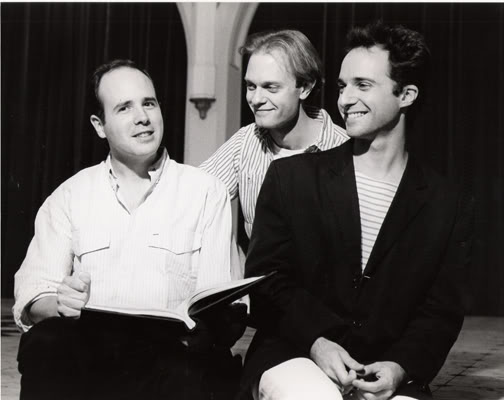
Director Kenneth Elliott, David Hyde Pierce as Himmer, and Kondoleon

Director Kenneth Elliott, David Hyde Pierce as Himmer, and Kondoleon

Benson, who directed Reed Birney in a blazing award-winning production of Sarah Kane’s Blasted, was aware of his unhappy history with the play and attempted to provide closure by casting him as Jacob Blank, but ultimately he wasn’t available and the great Larry Pine played the role in the reading. Himmer’s barely contained hysteria was suitably conveyed by the great Taylor Mac – the first time I’ve ever seen him not in elaborate drag (he returns to the Public Theater later this fall with a revival of Lear de Bessonet’s terrific production of Brecht’s The Good Person of Szechuan). Two wonderful actors, B.D. Wong and Ana Reeder, played Prentice and Debbie Fine, and two young actors new to me, Gayle Rankin and Arian Moayed, played Samantha and Patrick. Moayed (who appeared on Broadway in Bengal Tiger in Baghdad Zoo) blew me away with his quick-study portrait of Patrick, a tricky role to pull off with his two crazy a capella songs and easily parodied actor-ish narcissism. Tony Shalhoub played this role originally, magnificently, but I found Moayed especially touching in scene 4, when his self-centeredness became a poignant existential cry: “I just want a big part. I just don’t want to come on with very little to say and then go off. I’ve done that. I want to make a difference. I want to know when I go off it makes sense that I came on in the first place.” Don’t we all want that? And Rankin, playing a role first performed by Frances Conroy, assumed a transcendent radiance when Samantha, as the goddess in the play-within-the-play spoke lines that connected all the dots from ancient Greece to the AIDS epidemic to the aftermath of 9/11:

I answer your call

although the city is alive in death

with screams for salvation barely audible

as the walls are torn down to

the merry whistle of the flute.

Death’s caprice is playing there;

empires dissolve in song.

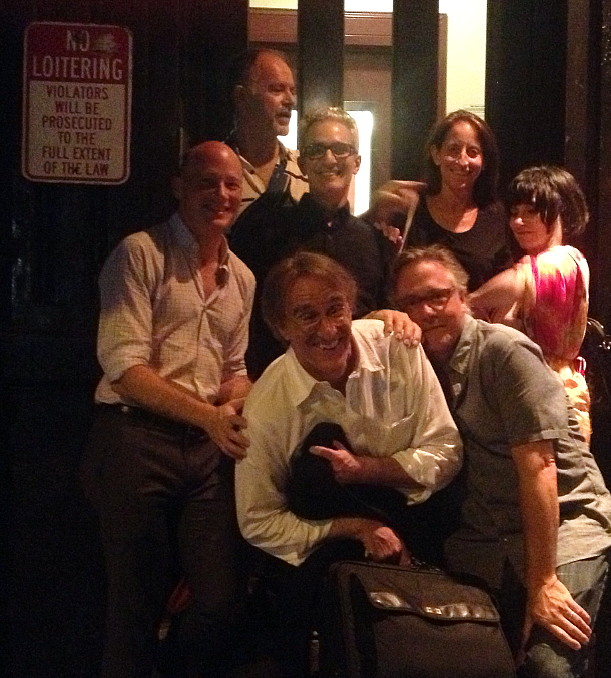
Many longtime Kondoleon fans and followers attended the reading. A bunch of us went out to dinner afterwards (Stephen Soba and his partner Jonathan, Mitchell Lichtenstein, Rita Ryack and her partner Porter, Ellen and Judy Dennis) for delicious food and wine at Aroma, where we reminisced about Harry and exchanged notes on the real-life experiences that fed into the writing of Zero Positive. We were all very grateful to Jonathan Lomma, the William Morris agent who represents Harry’s work, for instigating this return visit to a beautiful play.

9-11 zero positive posse on doorstep