Posts Tagged ‘gays against guns’

Culture Vulture: HELEN., SABBATH’S THEATER, and STEREOPHONIC

October 31, 2023

Cultural weekend! Friday night, Andy and I met friends for dinner at The Smith in the East Village in honor of a recently departed college chum. It was Hallo-weekend and the streets were full of costumed revelers. We were most amused to see a couple dressed as tourist (him in I ❤️ NY t-shirt) and the Statue of Liberty.

Saturday – beautiful day, up to 80 degrees. We took part in the Gays Against Guns action in response to the mass shootings in Lewiston, ME. I had a Google Hangout conversation with Alastair Curtis, a young theater artist in London who’s just discovered the work of Harry Kondoleon and wanted to talk to me in preparation for a reading he’s doing of Christmas on Mars. In the evening, Andy and I were back in the East Village to see Helen., the SuperGeographics production of Caitlin George’s play directed by Violeta Picayo. In the lobby we chatted a little with producer Anne Hamburger (whose En Garde Arts brought the show to La Mama), Linda Chapman, Chay Yew (looking very buff), and two young artists Anne is cultivating. I enjoyed the play, a dense, poetic, cheeky, queer/feminist riff on Greek mythology that reminded me of Young Jean Lee’s Lear the way it played fast and loose with familiar stories. In this version, Helen and her twin sister (!) Klaitemnestra and their sibling Timandra operate under the supervision of Elis, god of discord. This restless Helen isn’t waiting around to be abducted from her husband – she’s got wanderlust and knows how to use it. Picayo’s excellent production – light, fun, funny – made extensive use of quirky props (crowns, marbles, a barbecue) and almost continuous underscoring (by the great sound designer Darron L. West) with terrific performances, especially by charismatic Constance Strickland as Eris and Lanxing Fu as Helen (below center, with Grace Bernardo as Klaitemnestra and Melissa Coleman-Reed as Timandra).

Sunday afternoon we saw Sabbath’s Theater, Philip Roth’s late novel adapted for the stage by John Turturro with Ariel Levy. I never read the novel but the promotional material and the advance feature in the New York Times built up my expectations for a sexier/ filthier event than the New Group production turned out to be. But I guess for some (straight?) people any reference to masturbation comes off as racy rather than (as Roth has always demonstrated) a typical feature of most people’s sex lives. For all its lustiness, the play is primarily a melancholy contemplation of loss, desire, and death as the title character Sabbath (played by the brave, inventively comic, ever-watchable Turturro, below), a former puppeteer brought down by arthritis and a sex-with-student scandal, recalls the lovers, friends, and relatives he’s lost and considers joining them by throwing himself out the window of his high-rise apartment or walking naked into the sea. Jason Kravits and the great Elizabeth Marvel have fun playing all the other characters with distinctly different costumes, voices, and body habitus. Jo Bonney’s production struck me as tame, and in contrast to Helen., the sound score (by Mikaal Sulaiman) came off as intrusive and annoying at times rather than evocative or scene-setting. I pointed out to Andy that the fine-print trigger warning in the program (“This production contains nudity, sexual situations, strong and graphic language, and discussion of suicide.”) could apply to virtually every show at the New Group.

photo by Jeenah Moon for the New York Times

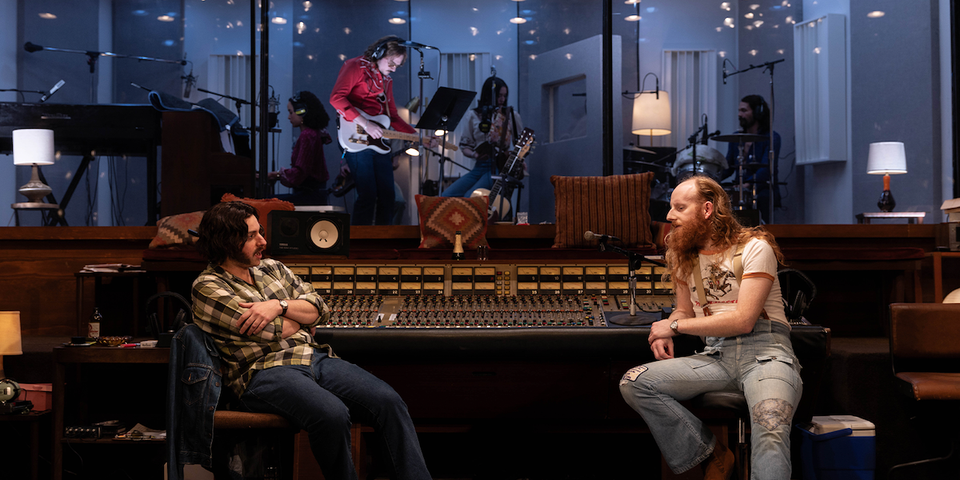
I loved Rob Weinert-Kendt’s succinct summary: “If Robert Altman directed a Chekhov play about a 1970s rock band struggling to perfect their next album, it might look (and sound) something like David Adjmi’s STEREOPHONIC.” I saw the play a couple of weeks ago and it’s stuck with me like few plays I’ve seen in recent years. A three-hour play can seem a little daunting these days, but Daniel Aukin’s production at Playwrights Horizons casts a spell. When I try to name the unusually evocative atmosphere to myself, I keep coming back to Fassbinder – the intense attention to tiny increments of human behavior, the honesty about intertwined love and depravity, artists at work, extraordinary design on every level, occasional longeurs but that being part of the astonishing success of capturing life in its complexity. Pop music was my first love, and I related to the play’s deep immersion in rock music culture much the same as Todd London did in his terrific essay on the PH website. (There you can also read commentary by David Byrne, who happened to be in the audience for the performance I attended; my friends and I noted how remarkably friendly and chatty Byrne was with the people sitting around him. One member of my posse is a hardcore Fleetwood Mac nerd and regaled us at intermission and afterwards with all of his observations about the Easter eggs hidden throughout the play – for instance, that Lindsay Buckingham has a brother who’s an Olympic swimmer, like the LB character in the play. And he knew exactly which Steve Nicks song was deemed too long to be included on Rumours.) The set designed by David Zinn manages to look completely natural and lived-in while being actually insanely meticulous in its creation of an artificial environment that works as an additional character in the play. Ditto the impossibly intricate sound design by Ryan Rumery. The performers are uniformly excellent, all playing their own instruments on ingenious original songs by Will Butler of the Arcade Fire. But what impressed me most of all is how the playwright, the director, and Tom Pecinka, the actor who plays Peter (the Lindsay Buckingham stand-in), collaborated to create the most nuanced and compassionate portrait of a perfectionist I’ve seen in any medium.
Culture Vulture/Photo Diary: CAROLINE, OR CHANGE, Jasper Johns, Jennifer Packer, THE POWER OF THE DOG, and more

November 22, 2021

November 14 – Michael Longhurst’s revival of Caroline, or Change has had its delayed opening at Studio 54 under the auspices of Roundabout Theatre Company. Originally mounted in London, the show did nothing to erase my memories of the virtually impeccable original production that George C. Wolfe staged first at the Public Theater and then on Broadway. But Sharon D Clarke is indeed remarkable in the title role of Tony Kushner and Jeanine Tesori’s beautiful, strong musical play.

November 15 – I’ve been on a Paul Bowles roll recently, happily making my way through a massive volume of his letters (In Touch, edited by Jeffrey Miller). Bowles occupied one of the more fascinating corners of 20th century art as a novelist, composer, musical anthropologist, and photographer. He married Jane Bowles — both of them deeply idiosyncratic fiction masters, both of them queer — and for a time they lived in the famous house in Brooklyn also occupied by the likes of W. H. Auden and Chester Kallman, Benjamin Britten and Peter Pears, Carson McCullers, and Gypsy Rose Lee. He had to be one of the most pretentious/precocious teenage artists who ever lived — his first day in Paris he hung out with Jean Cocteau AND Gertrude Stein (who took him under her wing for a while and called him “Freddy”). The letters include a long missive he wrote to Ned Rorem while having a not-very-enjoyable trip of mescaline.

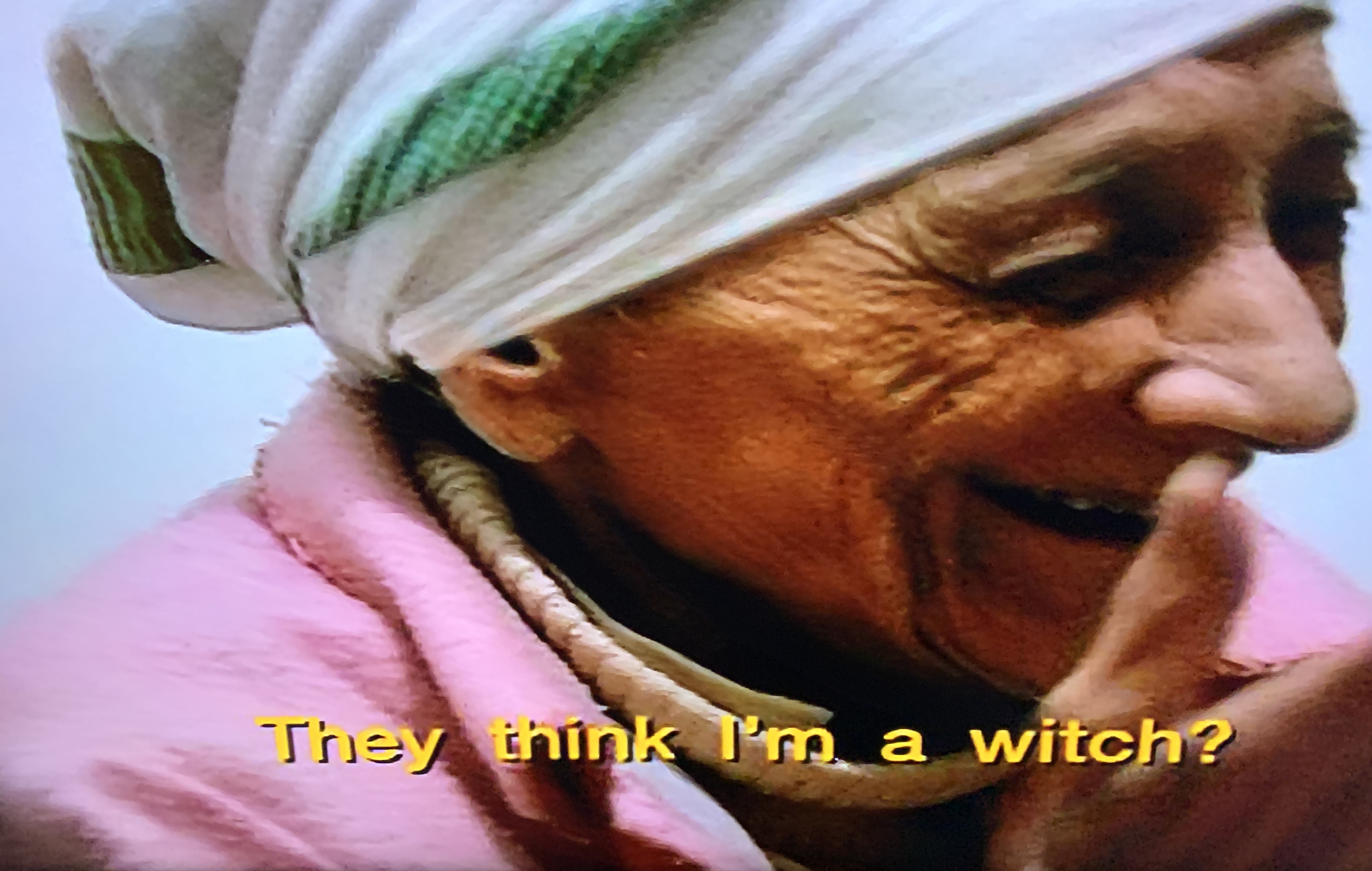
Jennifer Baichwal’s documentary Let It Come Down (available on DVD from Netflix) fed me plenty of tidbits. The filmmaker managed to get footage of a NYC hotel room meeting between Bowles (above), William S. Burroughs, and Allen Ginsberg, the last time those literary lions all met. Burroughs pronounces The Sheltering Sky “an almost perfect novel” (I agree) while also referring to Without Stopping, Bowles’ memoir, as Without Telling, because he’s so maddeningly discreet about anything having to do with sex, romance, or actual people (in contrast to Gore Vidal’s memoirs, which Burroughs appreciates for dishy gossip on every page). Bowles has nothing good to say about Bertolucci’s film version of The Sheltering Sky. I was also intrigued to see footage of Cherifa, Jane Bowles’s mysterious partner, as an old woman (below) repeating without denying rumors that she was a witch who exerted strange powers over JB.

November 18 – I don’t have anything nice to say about Lynn Nottage’s new play Clyde’s, directed by Kate Whoriskey for the Second Stage at the Helen Hayes Theatre, so I’m not going to say anything at all.

November 19 – I dutifully showed up at the Whitney Museum to check out Jasper Johns: Mind/Mirror (the other half of this retrospective is at the Philadelphia Museum of Art), which only confirmed the inability of Johns’ work to move me at all. His imagery (flags, numbers, maps, etc.) has always landed on me as extremely banal and ugly. The one piece that stood out for me in this show is Field Painting, probably because it looks a lot like the kind of multimedia “combine” that was the specialty of Robert Rauschenberg, his former partner and an artist whose lively, restless, generous creativity has always excited me.

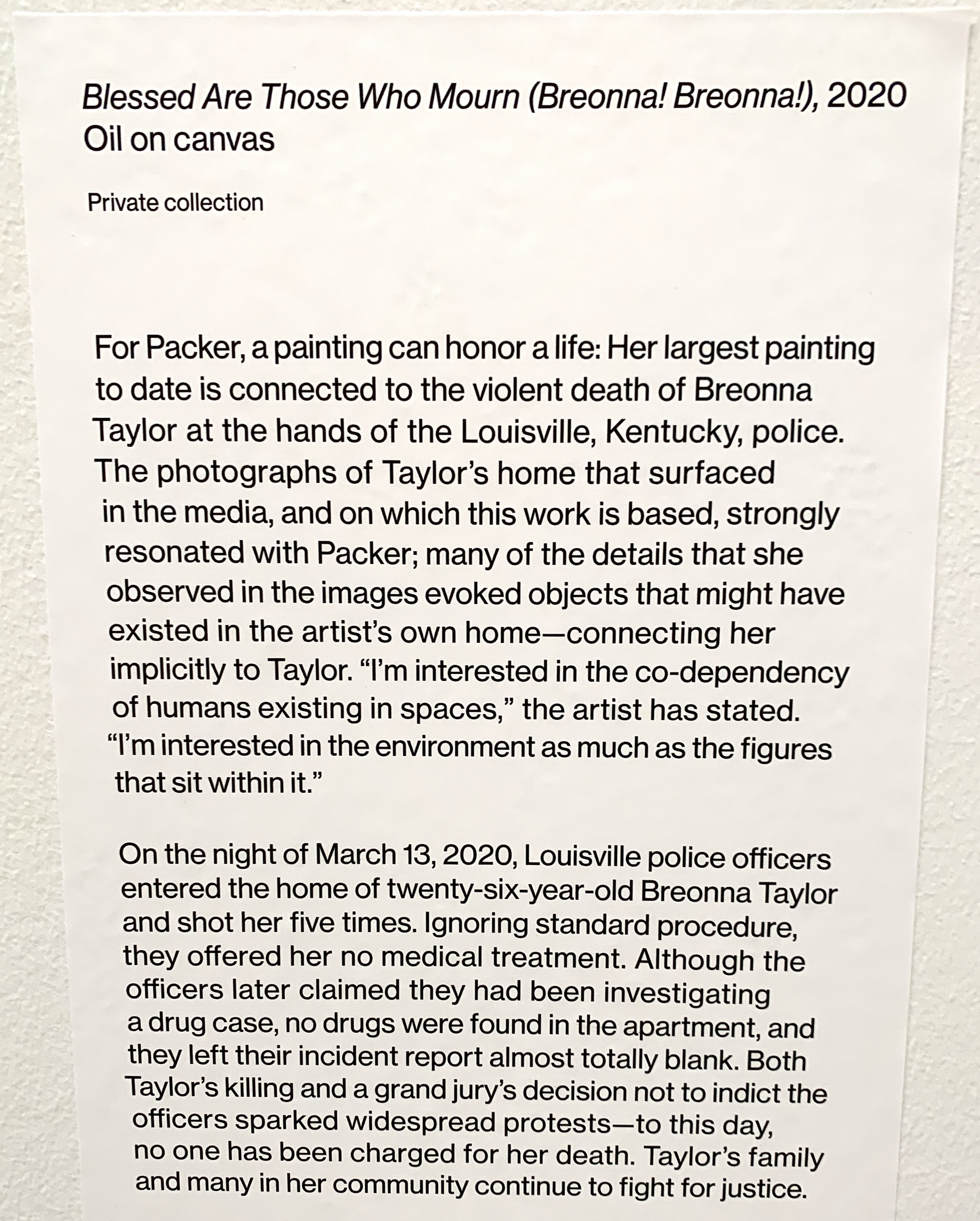
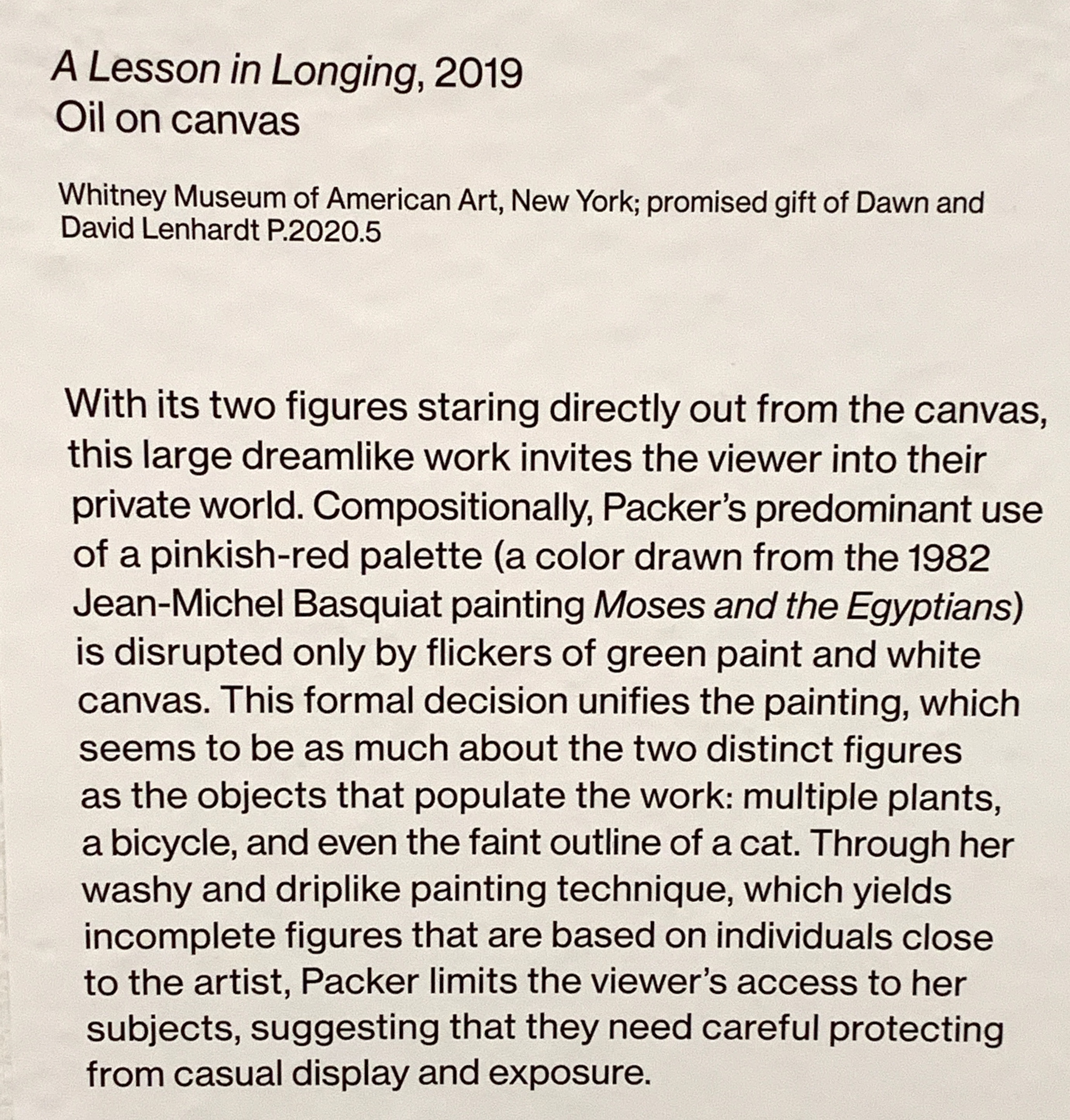
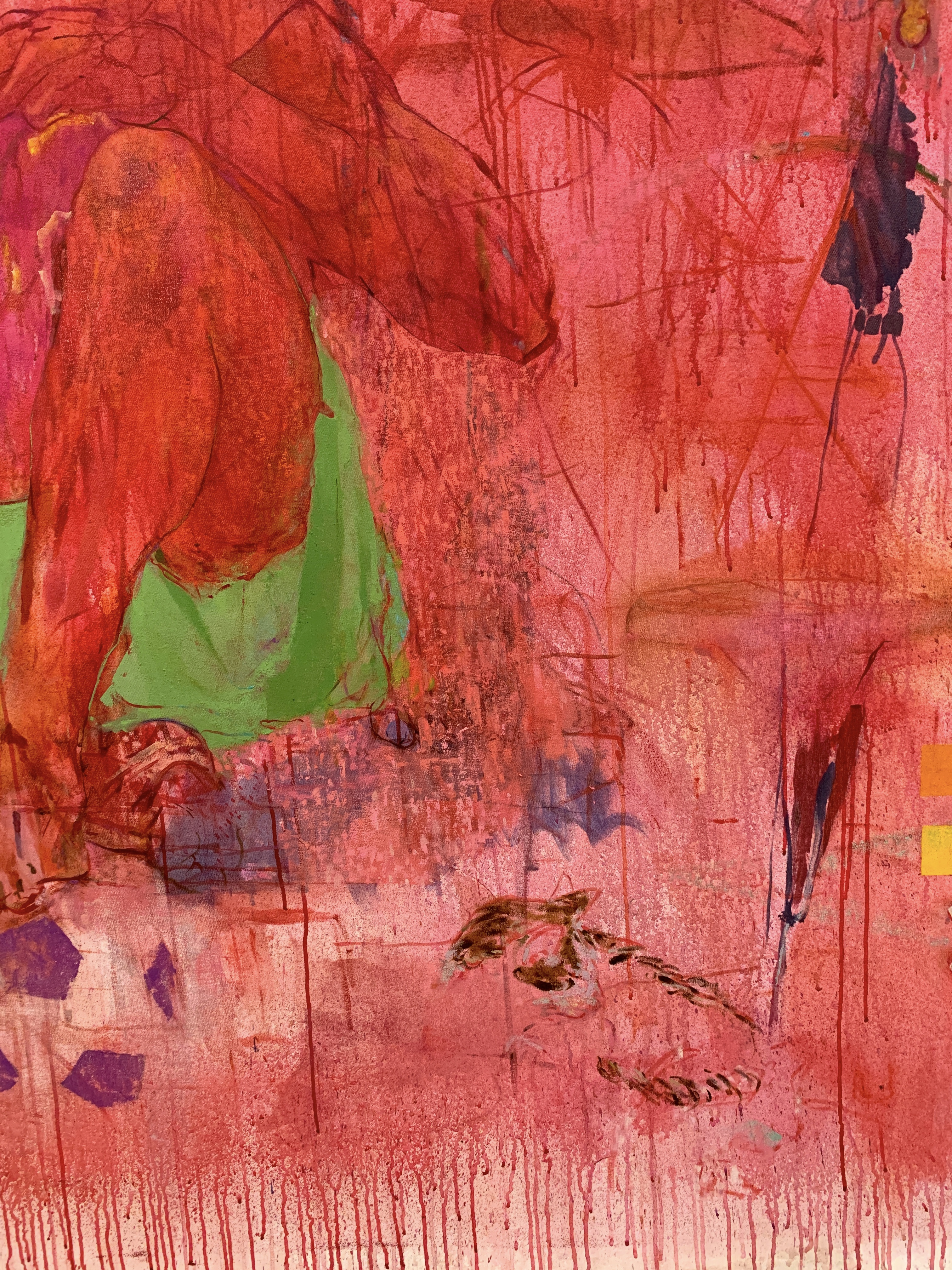
The real reward of this expedition was encountering the splashy exhibition by a painter new to me: Jennifer Packer: The Eye Is Not Satisfied With Seeing. Her large multilayered canvases merge representation and abstraction in unusual and beautiful ways.

I’d also never heard of My Barbarian, the Los Angeles-based art collective, whose installation on the first floor is small but dense and fun and alive with film and animation.

November 20 – Today was National Trans Day of Remembrance. As I’ve done numerous times in the past, I gathered with Gays Against Guns – the activist organization formed after the Pulse massacre in Orland in 2016 – and manifested as one of the Human Beings, silent veiled figures dressed in white representing victims of gun violence. I held placards commemorating Tiara Banks and Dominique Lucious, two of the 34 trans Americans killed by guns this year alone (more have been murdered through other means).

We stood in front of the Washington Square Arch as passersby read and absorbed the stories of these lives lost to senseless violence, and then we processed across the park to Judson Memorial Church, where there was a ceremony and service honoring trans lives.

Among the other Human Beings were two artist friends who’d never met. I got to introduce Paul Wirhun (aka Rosie Delicious aka Egmananda), a radical faerie artist who specializes in psanky (eggshell painting), to Antonius Wiriadjaja (aka Oki), whose Instagram #foodmasku (“I make my meals into masks and then I eat them”) went from pandemic pastime to online sensation. Oki, whom I met playing with Gamelan Kusuma Laras, is also a victim of gun violence (innocent bystander to a drive-by shooting in Brooklyn) and tireless advocate for better gun control laws.

I also got to meet Camille Atkinson (below right), who’s from New Orleans and knows how to rock a memorial outfit.

I wasn’t chomping at the bit to see Lin-Manuel Miranda’s film version of Jonathan Larson’s musical tick…tick…BOOM, mostly because I’m not a fan of Andrew Garfield (still haven’t forgiven him for his shallow performance in Angels in America on Broadway – minority opinion, I know, since he walked away with the Tony Award). Nor was I a big fan of Rent, of which TTB is kind of a rough draft. But it was Saturday night on Netflix, so we tuned in. The first 10-15 minutes were tough going, with all the selling-it-to-the-rafters Broadway-style singing we’ve been overdosing on lately. What kept us going were the cameos – I kept exclaiming with delight spotting New York theater treasures among the supporting cast and background players (see the complete list online here), and Andy had fun spotting familiar geographical landmarks and vicariously inhabiting cramped Village apartments recognizable from when he himself was a lad in the early ‘90s finding his way through NYC.

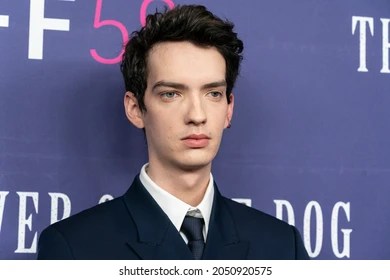
November 21 – MUBI is yet another curated streaming platform for arcane art cinema from all around the world. I’ve encountered some gems and a lot of quirky curiosities there, and just when I think “Is this really worth $10.99 a month?” they’ve sweetened the deal by offering subscribers a free ticket to a brand-new art film playing in theaters. I might not have gotten to Jane Campion’s new film The Power of The Dog so quickly if it hadn’t been playing two blocks from my house at the Paris Theater, FOR FREE. But wow, so glad I did! I’ve loved a lot of Campion’s work, and this one is right up there. I’m never drawn to any movie that falls in the category of “Western” – even one set in Montana but shot in the hills of New Zealand – but this one is exceptional. I had flashes of thinking about There Will Be Blood and Days of Heaven and Brokeback Mountain and even A Streetcar Named Desire but then the film (based on a novel by Thomas Savage) goes several places I would never have guessed. I say no more except to recommend it to anyone who has the patience for a slow-moving but intensely emotional drama. Among the strong performances is one you won’t quickly forget by this kid named Kodi Smit-McPhee.

Opinions are not ideas. I wish I had more ideas than I do. But I do have positive opinions about three other shows playing right now, shows that would surely never be produced on Broadway if it weren’t for the ruptures we’ve seen in the last couple of years. I highly recommend the two downtown hits playing in rep at the Lyceum Theatre, Tina Satter and Half Straddle’s Is This a Room and Les Waters’ production of Lucas Hnath’s Dana H. (with quietly astonishing lead performances by Emily Davis and Deirdre O’Connell, respectively). Ditto Alice Childress’s Trouble in Mind, a trenchant and still pertinent play about racial politics in New York theater finally having its Broadway premiere at the American Airlines Theatre, elegantly staged by Charles Randolph-Wright for the Roundabout, with especially fine performance by LaChanze, Chuck Cooper, and Michael Zegen.

Quote of the day: GAYS AGAINST GUNS

December 14, 2019

GAYS AGAINST GUNS

I’m a proud GAG member — Gays Against Guns. I’ve even marched with them. I don’t have the right to own any gun, even for hunting, and I say this in the show. Go give the animals in the woods a gun and teach them to shoot back. Then we’ll call it a sport.

John Waters, interviewed by Randy Schulman for Washington DC’s Metro Weekly