Posts Tagged ‘elizabeth swados’

From the Deep Archives: LIZ SWADOS and “Nightclub Cantata”

May 18, 2023

ELIZABETH SWADOS

Under the modest guise of an evening’s entertainment, Nightclub Cantata is a radical reconsideration of the musical theater form. The production, which originated at the Lenox Arts Center and won a 1977 Obie Award at New York’s Village Gate, compresses into 75 minutes a cross-cultural musical/emotional experience so stimulating and adventurous it reduces the average Broadway musical to a McDonald’s jingle.

As the title suggests, Nightclub Cantata is a hybrid of cabaret revue and classical recital, encompassing, among other things, a 1950s doo-wop number and a Sylvia Plath poem, a ridiculous takeoff on daredevil acrobatics and a terrifying reminiscence of Auschwitz. In other words – those of Elizabeth Swados, who conceived, composed, and directed the show – ”it combines the seriousness of a cantata with the frivolousness of a nightclub.” On the whole, it is the virtuosic Swados who provides the seriousness (not to be confused with solemnity) and the exuberant young company that contributes the flashy fun, but neither of these elements hints at the emotional depth of Cantata.

Early on the choral cry goes up: “I want to know this world!” And in its own way each of the 21 selections reiterates that desire. The words – some written by Swados, most by assorted 20th century poets – describe looking inward or outward for love, support, identity, knowledge. Verse by the Turkish poet Nazim Hikmet opens and closes the show with fierce affirmations of life (“Even though you fear death, you do not believe in it”), but this is not Up with People. The last hurrah is arrived at only after a zigzag journey full of tensions, struggles and epiphanies, expressed in the words of Plath, Muriel Rukeyser, Delmore Schwartz, Pablo Neruda, Carson McCullers, Frank O’Hara and others.

The poetry alone covers a vast terrain, but Swados’s eclectic score, which is far more than accompaniment, plays an active, often aggressive role, supplying irony, subtext, extra emphasis, cross-associations. She draws on natural sounds (bird calls, animal cries) and ethnic modes (Indian, Greek, Caribbean, tribal drum codes) as well as on familiar rock, blues and vaudeville forms to create a composite of musical fragments against which words or sounds are sung, chanted or delivered in unorthodox ways. The elements of Swados’s music, scored for piano, bass, and acoustic guitar, are not new, but their combination in Nightclub Cantata has few precedents, and Jacques Brel is not one of them.

Swados’s conceptual approach incessantly integrates words, music, and movement. A prime example is her treatment of Delmore Schwartz’s “In Dreams Begin Responsibilities,” Cantata’s longest and most ambitious segment. Sing-speaking the words and accenting them with simple but evocative gestures, the cast dramatizes Schwartz’s surreal short story: a young man dreams he is in a movie theater watching a silent film about his parents’ courtship. The tricky problem of maintaining a tight dramatic focus while skipping through various levels of reality is solved largely by Swados’s musical manipulations. The recitation begins in counterpoint to a steady rhythmic accompaniment, which switches to syncopation, then takes off into ricky-ticky silent-movie piano music, boogie-woogie, and finally a waltz. The music and text continually diverge and recombine without transition, preparation, or apparent logic, except that the result always seems appropriate to the moment.

The whole of Nightclub Cantata is like this: a barrage of images, musical patterns, visual embellishments and emotional disclosures. In her directorial debut, Swados has made staging choices as effective and as varied as hr material. She doubles up actors for a split-screen effect, scatters them around the theater at various levels, drives the show at a brisk pace. Sometimes, indeed, it’s too brisk; insights speed by unheard, unabsorbed. The lack of breathing space is uncomfortable at first – one wishes for the luxury of a long, lush melody or some restful repetition. Cantata requires concentration, for Swados is intent on making every detail count, on staying “in the dramatic moment” – a phrase she often uses in discussing her music, and a perfect description of the point where Nightclub Cantata’s words, music, and actors converge.

At 26, Elizabeth Swados has already established a formidable reputation on the basis of her collaborations with Rumanian director Andrei Serban. His experimental stagings of Greek tragedies (Medea, Electra, Trojan Women, and Agamemnon) have relied heavily on Swados’s knowledge of non-verbal communication and ethnic musics to recreate the power of ancient drama. When the collaboration began, Swados was a 19-year-old undergraduate at Bennington College, where her all-American pop, folk, and classical background had been eclipsed by a passion for ethnic music.

“Something in that music really moved me,” she recalls. “There was something dramatic in it that we didn’t have in our music.” Asked to score a Grotowski-style production of Everyman at Bennington, Swados created a sensation by incorporating the Indian and Polynesian music she was studying at the time. The success of Everyman led to an introduction to Ellen Stewart, founder of La Mama, New York’s experimental theater complex, and she in turn brought Swados to Serban.

“I felt like what Serban was trying to do with Greek was just what I had been looking for,” Swados says. “I was very willing to just learn and do what I was told, because I had access to a whole lot of strange music and I knew how to apply it to theatrical situations by some intuition. And that combination was good for what he wanted.” The 1972 Medea (which earned her an Obie) began a fruitful five-year period during which she collaborated with Serban on the tragedies, wrote incidental music for his productions of The Good Woman of Setzuan and The Cherry Orchard, toured Europe with several Serban productions, and traveled through Europe and Africa with Peter Brook’s Center for International Theater. She absorbed the work of these two major avant-garde directors and soaked up the music and language of various cultures.

In contrast to all this, Nightclub Cantata was “a rebellion,” Swados says. “It was a combination of paying respect to everything that I’ve learned from Brook and Serban, but it was also saying, ‘Enough of these classics! Let’s do something about people now.’ My whole sensibility has been based on non-verbal communication and ancient languages, and I don’t deny the absolute value of that, but I had to do something more political, more contemporary, something that relates on a more overt level.”

One wonders how the creator of such an uncommon musical entertainment relates to traditional Broadway fare. “I love it if it’s good. I can’t stand it if it’s bad. Literally, I get – you don’t want to print this, but I get diarrhea if I go to a musical that’s bad. I get so angry that head doesn’t register it – my stomach does and I have to leave and go shit my guts out. Because it’s more bad information going into the human system that’s already been poisoned beyond belief. There’s so much in American musical theater that’s just schlock that gets across as art because somebody can whip out an easy tune or has a cute psychological insight into sex or drugs or something modern like that. And they rip people off, because people see it and think, ‘Oh, I’m enlightened.’ There’s this kind of easy psychology that gets sent back and forth between audience and performer, and everybody gets away with nothing and nobody learns anything.”

Swados’s resistance to “easy” music-making is also the source of her main limitation, one to which she readily admits. “I haven’t found a way to compose something with an extremely rich melody, a tune. I think it’s very important because it soothes people, but I always prefer a kind of percussive performance of things. I think because I’m young, I’m angry-ish, I’m a little nervous, my music tends to be overly energetic sometimes. I’ve just sort of snobbed myself out, and I’m working on that. The next project I’m doing is with kids – 16, 17, 18 – and I hope I’ll unsnob myself. I’ll be using whatever music they like: salsa, punk rock, whatever.”

ADDITIONAL INTERVIEW:

What kind of music did you study and write when you were a kid?

I wrote calypso music, for some strange reason, and horror-movie music. We had piano, and when I was 12 I got a guitar. My family listened to Kurt Weill and Frank Sinatra, Harry Belafonte, and my mother loved this group called the Eloise Trio, which she played all the time. She’s flippo about Barbra Streisand. It wasn’t until I got to college that I got into ethnic music. There was something dramatic in it that we didn’t have in our music. Our pop singers seem to be emotionally rather vapid, and I wasn’t really moved. So I got really excited when I went to Africa and heard all this Arabic music with all these complexities.

I went to Bennington for three years, but they’re very supportive of students who have good things to do. They gave me a grant to go down to West Virginia to live with a family and explore the mining situation. Then I wanted to go to Wesleyan and study Indian music, because they had an ethnic music program, and Bennington gave me credit for that. When I went to La Mama and started living in New York half the time, they gave me credit. I didn’t ever really finish there, but they gave me a degree. There was a time after the Kent State massacre that I felt very absurd being in Vermont. I felt the guilt of all middle-class children at that time. But I was already aligned with non-violence. I wrote to Pete Seeger, and he invited me to come work on his sloop, and Bennington let me go. In some way my life has been graced by very understanding, supportive people, because what they’ve gotten in return has been a lot of hard work. I have a gift, you know. But I’ve also been lucky, because there are lots of people who have gifts who don’t get the breaks I have.

How did you get involved with La Mama?

There was a Grotowski teacher at Bennington, a Belgian guy, and I was taking acting at the time. He was doing all these headstands and shoulder-stands and back-stands and nose-stands, inner leaps, and physically, I couldn’t do it. It was killing me. So I said to him, “I would still like to work with you, but I don’t want to do this anymore.” He said, “Why don’t you write music for my play?” He was doing Everyman, and that was really the beginning of it, because I was studying the South Indian vina, so I put that in the show and this thing called a kinjura – sort of an Indian tambourine – and kalimbas, things that were very unusual for 1971, and he was very excited that I was applying this strange music to Western theater. His next stop after Bennington was La Mama, and he took me along and introduced me to Ellen Stewart. She “beeped” on me, as she calls it, and she said I would be one of her babies and supported me for five straight years. She introduced me to Andrei Serban and just made me alive.

With Serban, it just worked automatically. There was no conflict of territories at the time, until I got older and more ornery. I was 19 when we met, and I was very willing to just learn and do what I was told.

The whole idea of what a musical is is something that really fascinates me. You go to Brazil during Carnival – that’s the kind of musical event that really fascinates me. And like in Africa, they dance our stories and stuff like that. People here have begun to pick up on that kind of thing, like the Bread and Puppet Theater. I’m also interested in how to use a song for storytelling and humor. I’m interested in redefining the conventions of musical comedy, although I don’t really know what those are.

Boston Phoenix, November 1977

Performance diary: Rude Mechs’ DIONYSUS IN ’69, the Wooster Group’s HAMLET, and Toneelgroep Amsterdam’s ROMAN TRAGEDIES

November 20, 2012

Thursday November 8 at New York Live Arts I saw the Austin-based company Rude Mechs’ recreation of Dionysus in ’69, one of the most famous experimental theater pieces of the 1960s. An adaptation of Euripides’ The Bacchae by the Performance Group under Richard Schechner’s direction, the production became famous for two things: its environmental set (a series of multilevel platforms rather than seating for the audience) and the frequent nudity of the young performers. It was also one of the first shows mounted at the Performing Garage on Wooster Street in Soho, now the headquarters of the Wooster Group, Elizabeth LeCompte’s company, which evolved out of the Performance Group. Rude Mechs has attempted to reconstruct the semi-improvised audience-participatory Dionysus in ’69 by closely imitating the performances filmed back in the day by then-emerging filmmaker Brian De Palma. Which is a very Wooster Group sort of thing to do – the Woosters’ 2004 production Poor Theater resurrected another legendary avant-garde production, the Polish Theater Lab’s Akropolis (directed by the lab’s founder, Jerzy Grotowski), on the basis of snippets seen in a documentary film – although I once heard LeCompte joke about reviving Dionysus in ’69 with its original cast, sagging bodies, bad knees, and all. On Saturday November 10 I found myself back at the Performing Garage to see the Wooster Group’s Hamlet, itself another sort of recreation. The conceit of this production (first performed in 2007) is that the group, directed by LeCompte, is reconstructing John Gielgud’s 1964 Broadway production starring Richard Burton, which was videotaped and shown for two days only in 2000 movie theaters across the U.S.


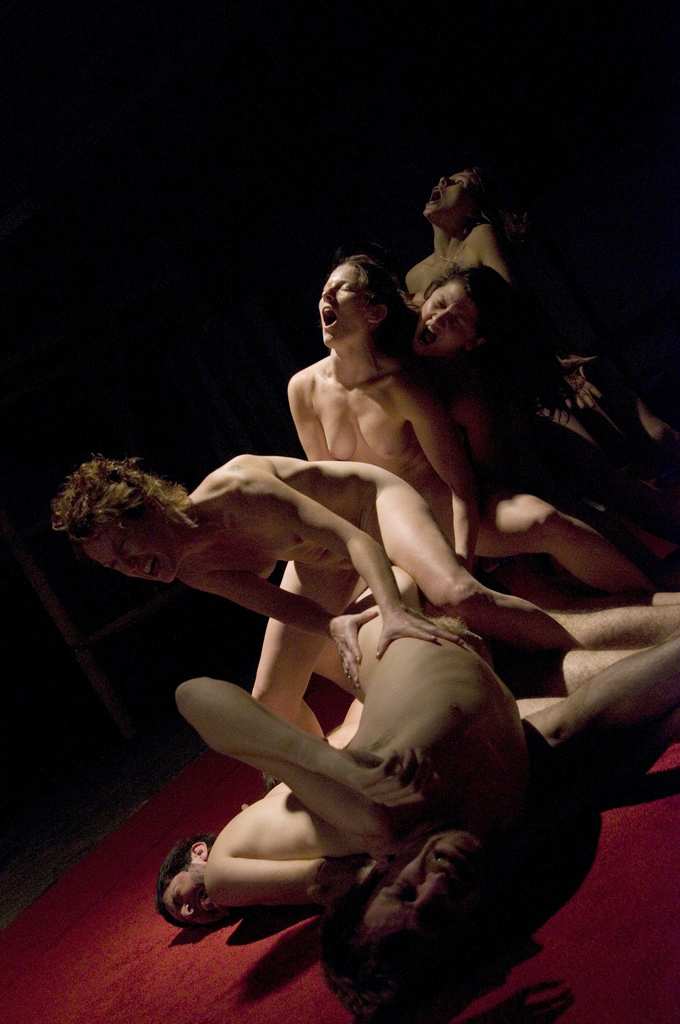
Never having seen Dionysus in ’69, I was fascinated to experience the Rude Mechs’ version, which was partly scholarly homage to and partly knowing send-up of the earnest and self-conscious edginess of the original production. We’ve now seen lots of nudity onstage and lots of productions where the audience gets to mingle with the performers. (Only a month ago on the same stage, in fact, was Keith Hennessy and Circo Zero’s Turbulence, the legacy of which includes NYLA asking audience members to sign waivers legally indemnifying the theater in case someone falls off a platform and breaks something.) Still, actors stripping naked in close proximity to the audience is never really old-hat. As soon as the show began, the Austin performers all shed their clothes, and the moment felt slightly racy, slightly tense, slightly brave, and slightly sacred – they proceeded to perform a kind of birth ritual, with the men lying face-down, the women straddling them, and the actor playing Dionysus sliding through the tunnel created by the other bodies (see above). The script wanders between clumps of Euripides and self-referential bantering among the actors (who use both their real names and those of the Performance Group actors they’re impersonating). Twice the show instigated rituals involving the audience in an attempt to evoke the Eleusinian revels that The Bacchae references: a drumming-and-dancing circle and an “orgy,” both of which were fairly tentative and lame. (Peering down from my perch on the highest platform like Pentheus spying from his tree, I was tickled to see my old buddy Jim O’Quinn, editor of American Theatre magazine, rolling around on the floor making out with two shirtless actors.)

The original production attempted to conjure contemporary resonances with the Euripidean drama about Apollonian restraint and Dionysian release, the politics of ecstasy, and the dangers of excess in either direction. Dionysus punishes Pentheus for disrespecting him by having him torn to pieces by his mother and her fellow cultists, but the tragedy redounds onto his followers as well, leaving Dionysus looking like a cruel, never-satisfied god. I kept hoping for the Rude Mechs to let us know what was important to them about reviving Dionysus in ’69 right now, and that never really came, which is why it remained an academic stunt for me. The pile of blood-smeared bodies made me think of the Hollywood murders committed by Charles Manson’s drug-addled followers as a deluded commentary on American society and the Vietnam war (those murders took place in 1969, the same year that the Rolling Stones’ concert at Altamont turned into a melee where Hell’s Angels killed an audience member – all of which happened after Dionysus in ’69 was already being performed). It also made me think about Abu Ghraib and how American soldiers turned torturing Afghan prisoners into a giddy festival. But the show stuck pretty much to its ‘60s bubble. The performers dutifully maintained their sense of ensemble, and their unbuff natural bodies seemed true to the period. But the original cast included some powerhouse actors, including Joan MacIntosh and Priscilla Smith (and later replacements included Spalding Gray and Liz LeCompte), whom none of these kids matched in intensity. There was a moment that I appreciated for the way it captured theater’s economical transformation of time and space – Cadmus is leading the blind Tiresias to a mountaintop. They simply make one orbit around the small stage area. Tiresias says, “Are we there?” Cadmus says, “We are there.” And we are there.

I blogged about the Wooster Group’s Hamlet when I saw it twice in 2007 (see here).  As usual with the Wooster Group, there’s much to be gained from seeing productions repeatedly. They’re always shifting and morphing, and I see the same things differently. The first showings in New York were at St. Ann’s Warehouse, when the piece was still developing. Later in the year it played at the Public Theater, where it seemed fully complete, plus there was the delicious resonance of its appearing under the auspices of the New York Shakespeare Festival. Now, after five years of periodic national and international tours, LeCompte wants to create a film version of the production (just to add one more layer of tech texture), so the company scheduled a few weeks of performances back at the Performing Garage for the first time since 2005’s Poor Theater.

I walked away from this viewing with a stronger sense of the show’s origin in Scott Shepherd’s wanting to play the role that is every young actor’s Mt. Everest and therefore the production as a fertile and intimate dance between him and LeCompte. Many Wooster Group pieces have been explicitly about recreations, and LeCompte has mastered the fine art of the theatrical mash-up and the remix as well as any of the coolest hiphop DJs. This show began with a more extended verbal introduction by Shepherd and a different program note capitalizing on how the Richard Burton Hamlet production was marketed in 1964 as a new form (“Theatrofilm”) made possible through “the miracle of Electronovision” – Shepherd suggested that the Wooster Group was experimenting with “Reverse Theatrofilm”: turning the filmed document of a live performance back into a live performance (and then, you know, FILMING IT). Throughout the show he calls out cues and instructs the video operator to fast-forward through scenes. You could say he turns Hamlet into Our Town, and he’s the Stage Manager, the narrator, the Master of Ceremonies, roles that Spalding Gray and Ron Vawter played in earlier Wooster Group shows. As Shepherd says, “We’re channeling ghosts.”

What propels the show is a tension among several different intentions: 1) the conceptual intention of recreating the Burton production live, which is the simplest and shallowest task; 2) Shepherd’s effort to both mimic Burton and to create his own visceral performance while sorting out strands from other filmed versions of the play (Kenneth Branagh’s, Michael Almereyda’s starring Ethan Hawke); 3) LeCompte’s contribution, which is to the keep the visual field lively and interesting and beautiful, with little regard for telling Shakespeare’s story or formulating coherent characterizations; and 4) the other actors’ battle to formulate some version of coherent characterizations while simultaneously performing the non-narrative tasks thrust upon them by LeCompte and Shepherd. And these performers (Wooster veterans Kate Valk and Ari Fliakos with a handful of guests) love nothing more than that kind of challenge. Valk gets to play both Gertrude and Ophelia, Fliakos plays Claudius and the Ghost of Hamlet’s father and the gravedigger. (My boyfriend Andy, who’s relatively new to the Wooster Group, said, “I don’t remember there being a nurse in Hamlet…” Which reminded me that I’m so used to seeing a nurse character running around making adjustments, as Koosil-ja does in this version, that I forget it’s LeCompte’s representation of herself, not a character in the actual play.)

As with my first viewing, this time I found the constant shifting set pieces slightly to match camera shots tedious after a while. But I continued to admire the visual field, especially the use of the closeup screen (picking out details such as the crucifix around Claudius’s neck) against the larger background screen (which LeCompte played with even more aggressively and brilliantly in her staging of Tennessee William’s Vieux Carre). And the performances by all the actors have gotten even stronger, freer, and more individual.

Since the performances functioned as a sort of fundraiser to subsidize the film, I bought high-priced “patron tickets,” which gave me “good seats” (in the tiny Garage) and the option to go upstairs and have a glass of champagne with LeCompte at intermission – a hilarious and somewhat awkward invasion of corporate style in the funky setting of the Garage. I did chat with LeCompte briefly about how Hurricane Sandy affected them (they kept rehearsing during daylight, and since their security gate is electronic, someone had to stay on the premises all night to keep intruders out) and met Jonathan Mills, director of the Edinburgh International Festival and a fellow big-time Wooster groupie.

The essence of the Wooster Group’s Hamlet is its ingenious, original way of upholding what Shakespeare calls “the purpose of playing, whose end was and is to hold as twere the mirror up to nature…to show…the very age and body of the time.” The time we live in, where more and more of our intellectual and interpersonal experience is mediated by electronic devices, is reflected even more pointedly, using many of the same technological strategies, in Belgian director Ivo van Hove’s ambitious and awe-inspiring Roman Tragedies, which his company Toneelgroep Amsterdam performed three times at BAM’s Next Wave Festival. (I saw the final show on Sunday November 18.)

First mounted in 2007, Roman Tragedies consists of three Shakespeare plays about politics – Coriolanus, Julius Caesar, and Antony and Cleopatra – performed back-to-back, without intermission, running about six hours. The costumes are contemporary business suits, and the set looks like the lobby of some sort of conference hotel – industrial gray carpeting, many sofas, flat screens everywhere. The audience is invited, even encouraged to sit onstage, where there are two bars serving continuously throughout the show, to take pictures with smartphones, and to post on Twitter (#romantragedies); they form a throng through which the actors move, followed by cameramen. A wide screen over the stage becomes a major staging area, with a steady mixture of video being mixed live from various parts of the stage, English subtitles (some but not all of it from Shakespeare), and dramaturgical footnotes delivered on a LED ribbon. The whole thing is timed and counted down as precisely as a live network TV show, and the actors (equipped with body mikes) fight, scream, love, and die their way through text that switches the gender of many characters (Cassius and Octavius Caesar, most notably, are played by women). In Olympic judging terms, the degree of difficulty for this undertaking is 9.9, and van Hove and company walk off with gold medals.

As with the Wooster Group’s Hamlet, the Toneelgroep actors do yeoman’s jobs of meeting the challenges of Shakespeare’s characters while rising to the demands of van Hove’s tech-savvy staging. The fighting that erupts between Coriolanus (a strong performance by Gijs Scholten van Aschat) and the nerdy bureaucrats serving as tribunes looked remarkably like the melee that broke out in the Ukraine parliament earlier this year. The indisputable star of the show is Hans Kesling as Marc Antony; in Julius Caesar, he gives an intensely original, deeply distraught reading of the famous funeral oration that shames Caesar’s killers into exile, but then in Antony and Cleopatra we see him as a road-weary politician-as-movie-star right out of Entourage, living in his own debauched bubble with Cleopatra (Chris Nietvelt, unlikely but inspired casting) and limping back to Rome to undertake a political marriage with Octavius Caesar’s sister that has all the sincerity of a reality-TV show.

The show has numerous points to make about how politics play out in public and in private, some of them bludgeoningly obvious in their irony (the pre- and post-show loop of Bob Dylan crooning “The Times They Are A-Changin’” becomes irritating), some of them subtle and clever, many of them deep and, indeed, timeless. It’s a huge, relentless feast, difficult to digest while you’re watching, and van Hove doesn’t let up even with the curtain call. As the audience is leaving, a long list of questions scrolls across the screen (does freedom exist? is political charisma a virtue? when do principles become unreasonable?) – part study guide to Shakespeare, part talking points for a civic dialogue, extremely pertinent in an election year though just as likely to provoke viewers at the end of this exhausting election year to cry “Enough already!”


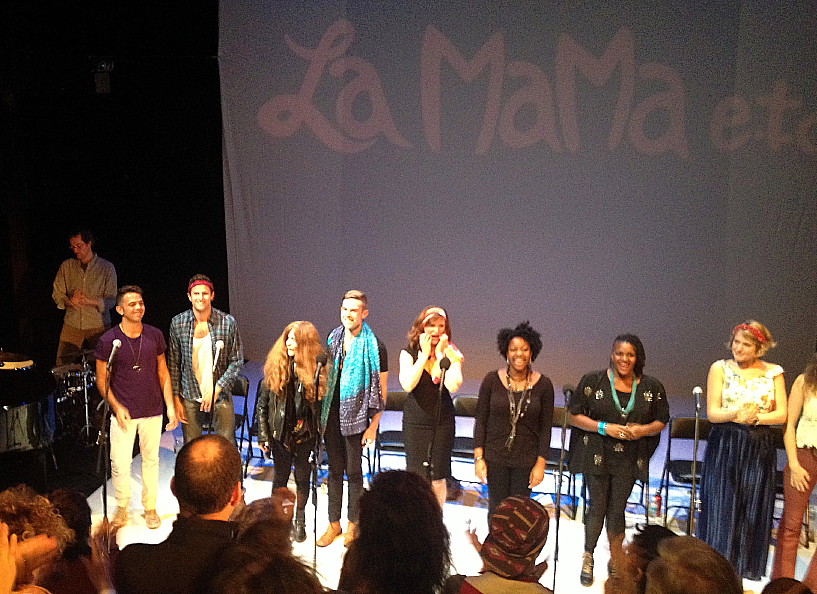
One last performance to make notes about, before the moment passes into history: a year ago Elizabeth Swados created La Mama Cantata, her tribute to Ellen Stewart, the legendary off-Off-Broadway pioneer who died in January of 2011 at age 91. The show had a run at La Mama ETC and then toured to Italy, Croatia, and Serbia before returning for a homecoming October 1. The text consisted of stories by and about Stewart – sentimental, inspiring, hilarious, intimate – and the music was some of Swados’s best in years, succinct and dense, well-performed by nine young La Mama babies. Two stories stood out for me, both touching and emblematic of Stewart’s spirit. During a tense press conference at the height of the deadly ethnic war that splintered Yugoslavia, Ellen said, “Look, I remember when you were all one thing – and you all can start loving each other any time you want.” And against a video of burning candles representing the AIDS crisis that devastated the East Village, she is quoted as saying, “How we got through that time, I don’t know.”