
July 8 – Andy’s job at the United Nations these days required him to compose talking points for UN Secretary General Ban Ki-Moon (above) to deliver at a screening of Jennifer Arnold’s documentary A Small Act, so he got invited to the screening at HBO and I tagged along as his plus-one. The film tells one of those classic inspiring stories. Decades ago, a Swedish schoolteacher named Hilde Back, who’d fled Nazi Germany as a child (her parents did not survive), signed up for one of those programs where a small monthly donation subsidizes the education of a specific child in Africa – in this case, Chris Mburu from a small village in Kenya. Mburu went on to the University of Nairobi and Harvard Law School and has worked as a human rights activist ever since. The film tracks his efforts to create a scholarship fund in Hilde Back’s name and the competition among village schoolchildren for the three available slots in a given year. As the title suggests, the essence of the film is to demonstrate how one small commitment has unforeseen resonance in the world. Arnold’s documentary tells that story modestly, with a minimum of generic sentimentality and an honest attention to the ambiguities and contradictions of cross-cultural philanthropy and the challenges of education in developing countries. Arnold, Mburu, camerawoman Jennifer Lee, and producer Jeffrey Soros were on-hand for a Q&A afterwards. And in lieu of goodie bags, HBO distributed $10 Good Cards, which allow you to donate money to your favorite charity via the website Network for Good (which they astutely market with the headline “When the people in your life don’t need more STUFF as a gift….”).

July 9 – I’m mildly interested in the story of Katharine (“Kit”) Cornell, one-time first lady of the American theatre, her gay director-husband Guthrie McClintic, and her lesbian lover Gertrude Macy, but A.R. (Pete) Gurney wouldn’t be my first choice of playwright to deliver that story with the panache, understanding, and dishy detail that would satisfy me. The Grand Manner, at Lincoln Center Theater, is based on the author’s brief meeting of these folks backstage at the Martin Beck Theatre during the run of Antony and Cleopatra, back when he was a teenaged autograph hound preceded by a handwritten note of introduction from his grandmother back in Buffalo. Out of this fleeting anecdote Gurney has fashioned a 90-minute drama whose central character is…Pete, the schoolboy. It is a typically tame Gurney drama. The actors show up and do well. Brenda Wehle gets to play Cornell’s tough protective butch girlfriend who says things to the kid like “I’m her great, good friend – do you know what that means?” Boyd Gaines as McClintic gets to stagger around saying “fuck” a lot (not the way we usually experience Gaines, who’s never been invited into David Mamet’s cherished circle). Kate Burton gets to, well, pretend to be grand while describing herself as “a dumpy middle-aged lesbian.” (Her best performance is actually being interviewed in the fascinating edition of the Lincoln Center Theater Review about her own family’s theatrical dynasty. Pick it up when you walk by the theater. ) Bobby Steggert plays Pete, and he’s charming. But oh, so tame.
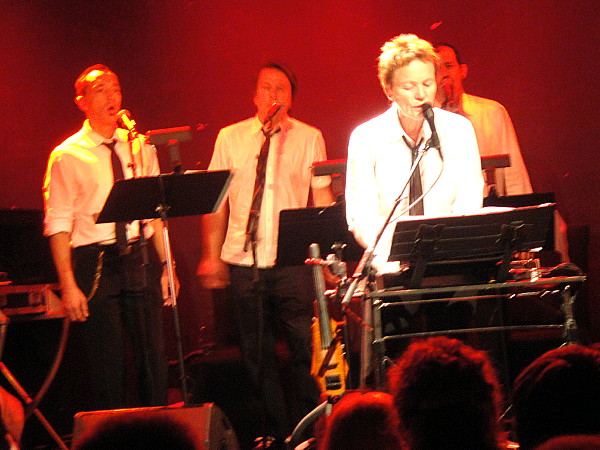
July 13 – When I heard that Laurie Anderson would be playing at Le Poisson Rouge, I thought it might be really great to see her in such an intimate club setting. But I forgot how much I hate concerts where you have to stand the whole time (after standing in line for 45 minutes waiting to get in). And the gig stood as a promo party for her new Nonesuch CD Homeland, which is not one of her most compelling outings. The songs are minor, meandering, not especially melodic. And the club environment didn’t seem to open up any new possibilities. In fact, weirdly, Laurie seemed to retreat, barely making eye contact with the audience, reading from the script on her music stand. Perhaps she needs the distance of a stage to connect, or seem to connect. Plus, these days she performs without visuals, and I realize only in retrospect that the visuals always added a poetic element that made her songs so much more than the sum of the words and the music. So it was a somewhat disappointing evening. But I suppose it’s the disappointment of a longtime fan whose mind has been blown many times by her wit and invention – how many artists can keep that up for three decades? She had a fascinating band that consisted of a keyboardist, a handsome sax player, three nerdy-boy backup singers (all dressed like Laurie in white shirts and skinny black ties), and one of my culture heroes, the legendary producer Bill Laswell, on bass (a sweaty night in Manhattan, and this stocky hipster was wearing a suit jacket and wool cap – whew). There were a few appearances of Fenway Bergamot, the name Laurie has given to the male character she creates by running her voice through a filter that drops the pitch an octave. And her encores were fascinating, weird, beautiful bursts of solo violin improve. The best songs in concert, as on the new album, were the up-tempo “Only an Expert” (see Laurie’s website for the results of a competition for best remix) and the mournful “Dark Time in the Revolution.” The latter, with its refrain of “they keep calling ’em, calling ‘em up,” seems to belabor the obvious point that wars are fought by kids – but it’s hard to argue with the truth of it, and the refrain gets more emotionally affecting as it goes along, and as the wars drag on.
 another eye opens