Events: Gamelan Kusuma Laras concerts, May 30-31

May 28, 2015

You may or may not know that I’ve been playing gamelan for several years now.  You may or may not know what gamelan music is….
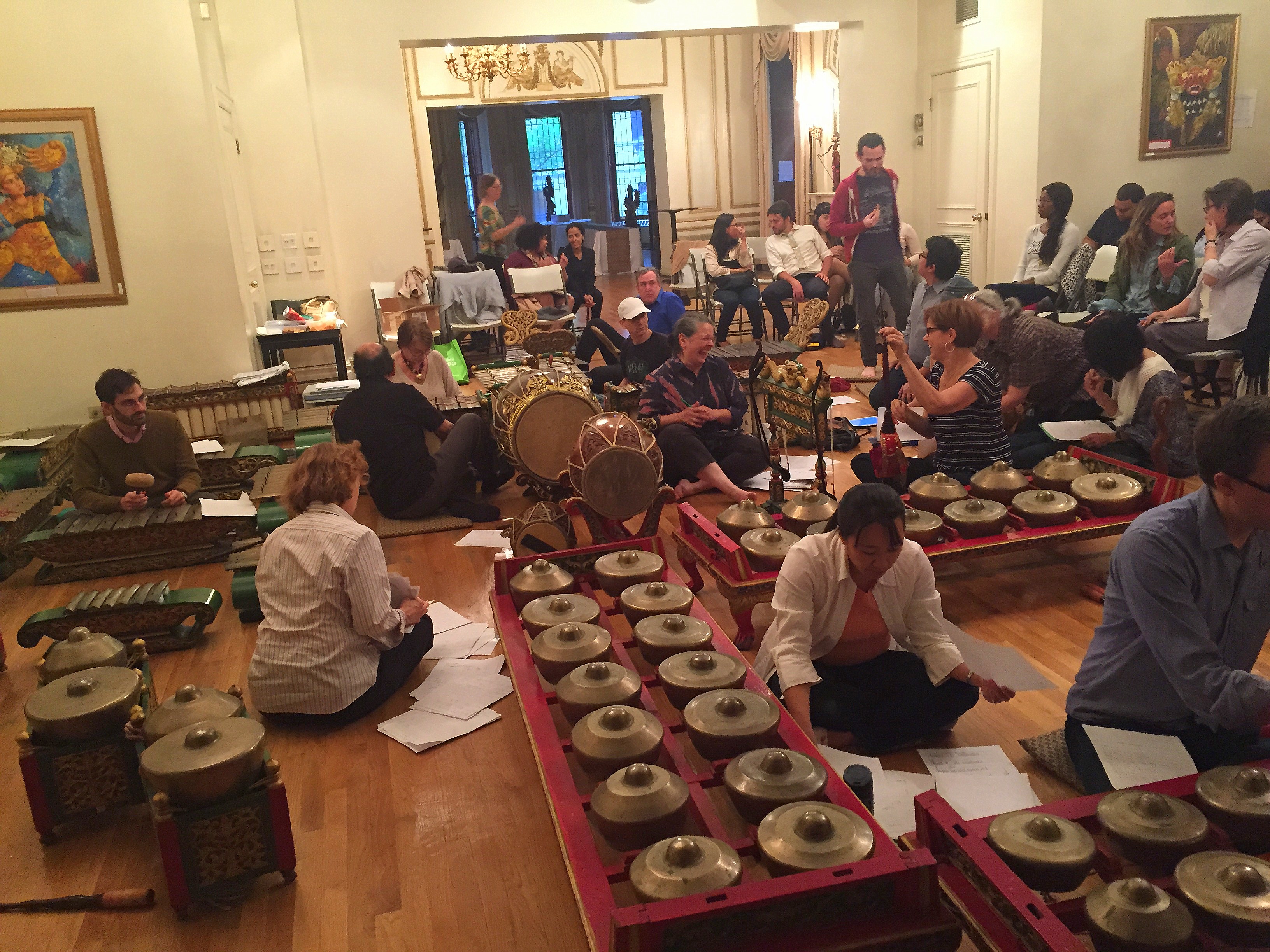
Gamelan Kusuma Laras in rehearsal

Gamelan Kusuma Laras in rehearsal

Gamelan is an Indonesian percussion ensemble that comes in two varieties, Balinese and Javanese. Our group, Gamelan Kusuma Laras, is Javanese and specializes in music specifically from Solo, one of the cities in Central Java.  Javanese gamelan music is rich, dense, polyphonic, precise, meditative, quite exotic. There’s also a fair amount of singing, for solo voice and choruses, but the singing is part of the orchestral blend, not front and center the way it is in a lot of Western vocal music. Hearing recordings of gamelan music, it’s almost impossible to imagine how it is produced. Seeing the various instruments and how they’re played is a treat in itself.

Gamelan is definitely not for everyone. But if you’re curious about music from other cultures or know a little bit about gamelan, this would be a great opportunity to experience the music live.

The concert is about two hours long and is  preceded by 15 minutes of “welcoming music.” The
program includes a bunch of unusually intricate and cool pieces, and I’m delighted that I’ll be playing on all the pieces we’re playing. One of the guest  vocalists will be the extraordinary Jessika Kenney, and we will also be joined by a terrific dancer performing in full makeup and costume.

The concert takes place at the Indonesian  Consulate, a beautiful old New York mansion at 5 E. 68th Street. At intermission, very delicious Javanese snacks will be served free of charge. And the tickets are only $20. (You can buy them online here.) Check it out and let me know what you think.
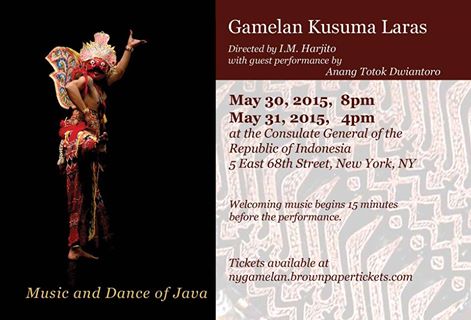
concert postcard


Culture Vulture/Photo Diary: inaugural visit to the new Whitney Museum

May 27, 2015

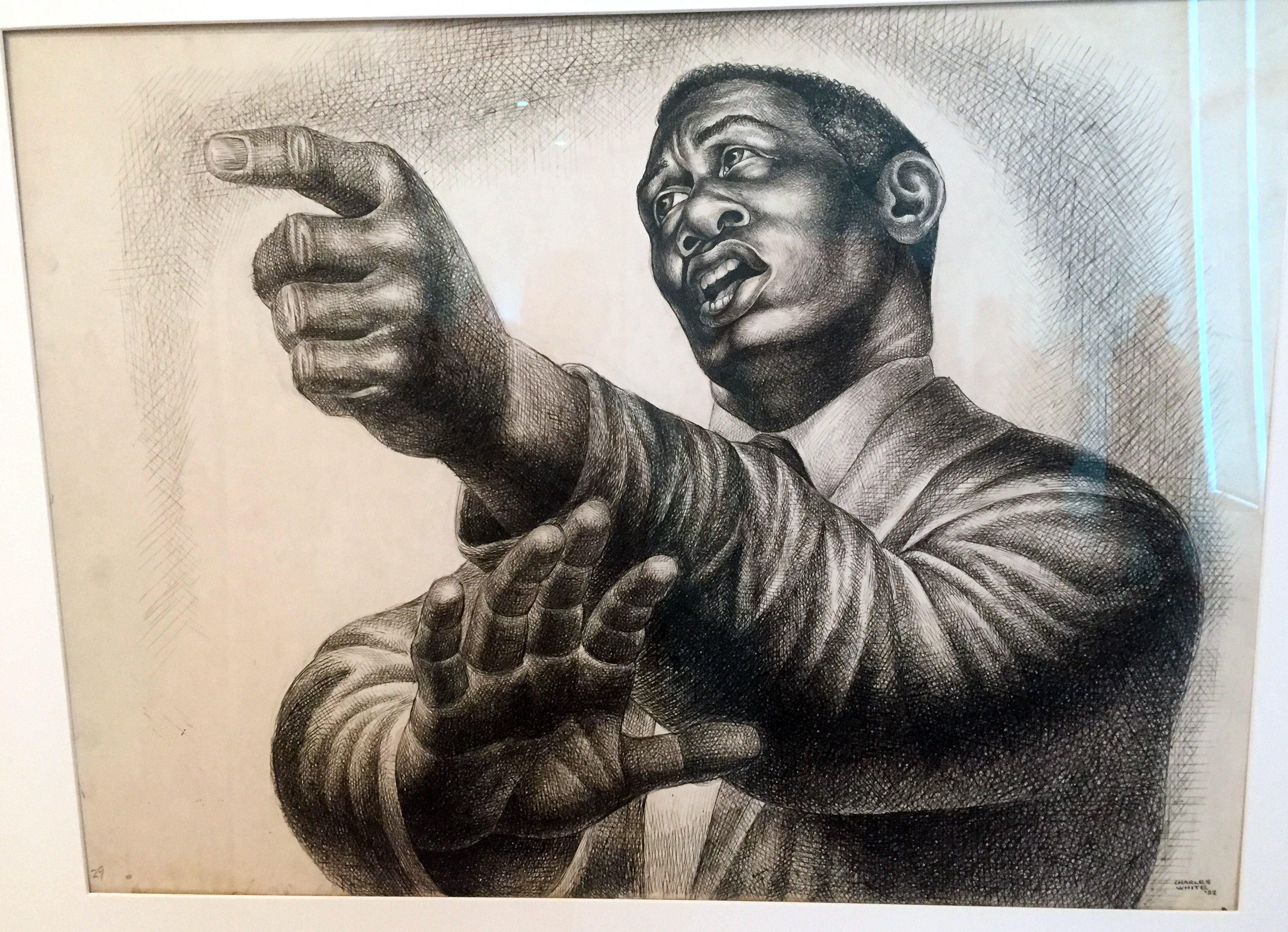
Sunday afternoon of Memorial Day weekend seemed like a perfectly good time to check out the new downtown West Village Whitney Museum, trying hard not to gloat too much as we floated past the long line of people waiting to get in to flash our press passes for immediate admission. All the reviews you’ve read are accurate. The building is a triumph — as art barn, as public space, as neighborhood hub, as people-watching hotspot, as all-round groovy destination. The outdoor spaces are unexpectedly brilliant, welcome opportunities to catch your breath from the overstimulation from the art on display and fun to look out and around from. Meanwhile, the opening exhibition — “America Is Hard to See” — is an ambitious, thoughtful, often revelatory selection from the Whitney’s vast permanent collection. I’ll go back and revisit, but on the first pass here are a few works new to me that caught my eye and dragged me ten feet:

Charles White's 1952 drawing "Preacher"

Charles White’s 1952 drawing “Preacher”

Lamar Baker's 1936-37 etching and aquatint "Fright"

Lamar Baker’s 1936-37 etching and aquatint “Fright”

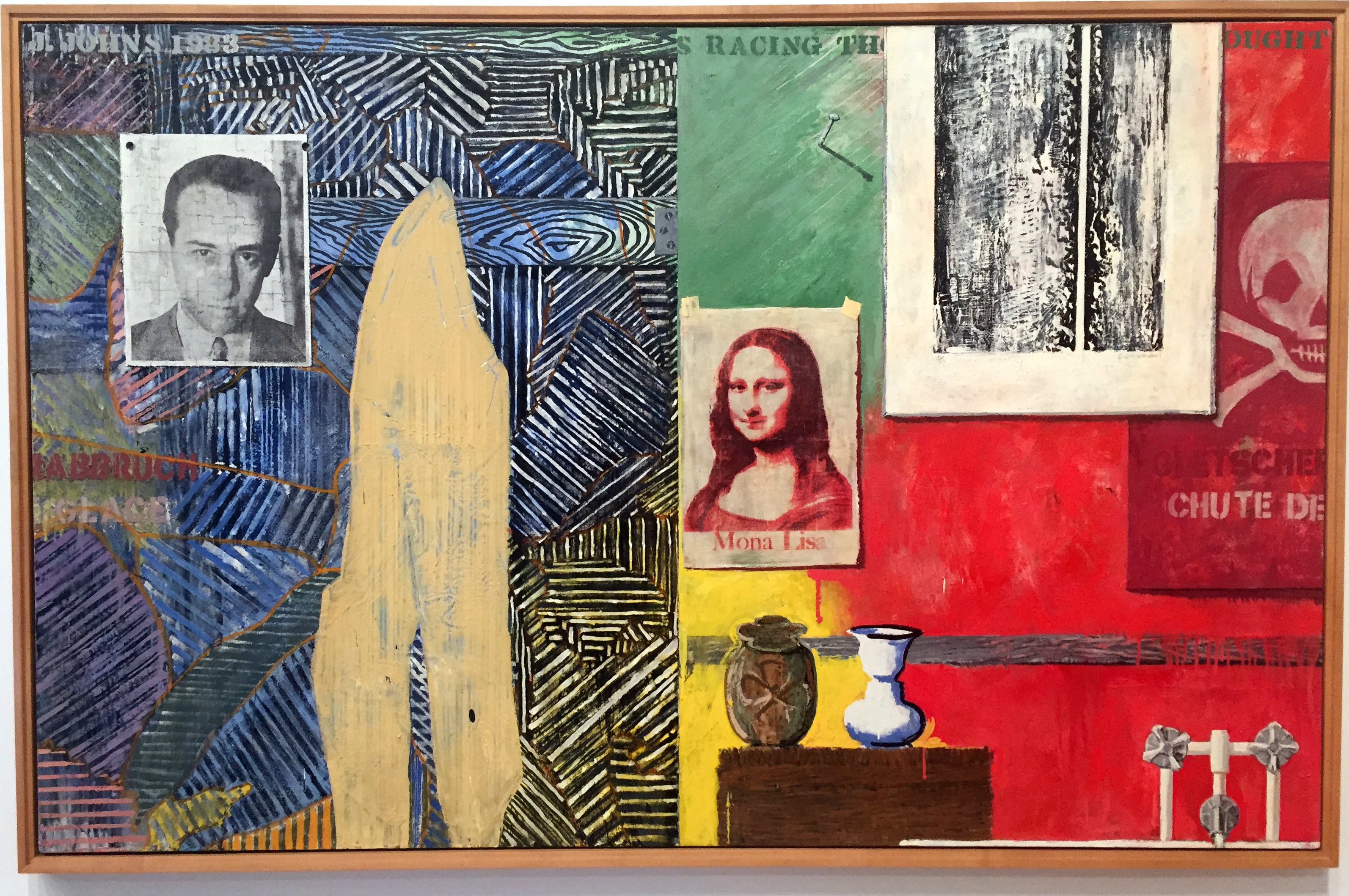
I'm mostly not a fan of Jasper Johns' banal Americana but this canvas called "Racing Thoughts" captivated me

I’m mostly not a fan of Jasper Johns’ banal Americana but this canvas called “Racing Thoughts” captivated me

view of the High Line from one of the four outdoor terraces

view of the High Line from one of the four outdoor terraces

many opportunities for incongruous selfies

many opportunities for incongruous selfies


Playlist: new releases 2015 on iPod shuffle, 5/27/15

May 27, 2015

“Rise,” Todd Rundgren
“IKB,” Fort Romeau
“Charming Disease,” Gabariel Kahane
“I’m Writing a Novel,” Father John Misty
“A Band,” Powell
“Demon,” Shamir
11183_JKT
“I Don’t Know,” Ghost Quartet OCR
“09,” Powell
“Four Friends,” Ghost Quartet OCR
“Back to the Future (Part I),” D’Angelo
“Miles from the Sea,” Calexico
“Under a Rock,” Waxahatchee
“Sixteen,” My Name Is Gideon
“Merrit Pkwy,” Gabriel Kahane
“Tee Pees 1-2,” Father John Misty
“Bullets & Rocks” and “Tapping on the Line,” Calexico
“Blue Moon,” Beck
“Stonemilker,” Bjork
“In for the Kill,” Shamir
“Shake and Tremble,” Django Django
“Not a Word,” Fort Romeau
“Nothing Good ever Happens at the Goddman Thirsty Crow,” Father John Misty
“Lights Out,” Ghost Quartet OCR
“Notget,” Bjork
“Only Son of the Ladiesman,” Father John Misty
“War Machine,” Bill Fay


Quote of the day: REINVENTION

May 27, 2015

REINVENTION

Anna Leonowens, apparently addressed as “Sir” in the Siamese court, was…adept at reinvention. Conversant in Hindi, Marathi, Sanskrit, and Persian, to take on the role of royal governess she adopted the clipped tones of a dyed-in-the-wool English school ma’am. She had not yet stepped foot in England and remains the only foreigner to have lived inside the court of Siam.

The truth about Anna Harriet Emma Edwards, as she was christened, is buried beneath a palimpsest of fictions, many of which she herself propounded…Born in Bombay in 1831 to an Indian or half-Indian mother, who was thirteen years old when she married, and a father who was a lowly employee of the East India Company, Anna later doctored her biography so that her maiden name became Crawford, her birthplace Caernarfon, in Wales, and her father’s rank that of a major. “The most important thing in your life,” she noted, “is to choose your parents.” That observation, which might have been made by Oscar Wilde, was typically resourceful. At the age of seventeen, Anna married he sweetheart, Thomas Leon Owens, and they moved to Australia, then Malaysia, and finally to India, where, in 1856, he died, leaving behind an impoverished widow and two young children. For many women in her position – poor, unprotected, not entirely white – the only direction would be down. Remarriage was the only viable option, but Anna, who would never marry again, instead worked her way upward as a widow. Blending together her deceased husband’s middle and last names to form the exotic “Leonowens,” she elevated his status from clerk to English army officer and knocked three years off her age…
anna-mccordmuseum
Practical in her ambitions, Anna Leonowens sought neither to propagate new religion nor to purify the earth, but she did win her soul in a harem consisting of nine thousand children, wives, sisters, consorts, and concubines. As well as teaching rational thought to the King’s eighty children and English grammar to his scores of wives, she introduced both underwear and silverware to court life and advised His royal highness on matters of state policy. After five years, she left Siam – a court built on what she dramatically described as “slavery, polygamy, flagellation of women & children, immolation of slaves, secret poisoning and assassination” – and immigrated to America, via England and Ireland. Ever restless, Leonowens then crossed Russia and settled for a time with her daughter in Nova Scotia and her grandchildren in Germany…

Few women lived as inventively as Anna Leonowens, who blew about the globe like chaff…In 1870, she wrote her memoir, The English Governess at the Siamese Court. Seventy years later, the book was turned by Margaret Landon into the best-selling novel Anna and the King of Siam, which was itself transformed, in 1951, into the legendary Rodgers & Hammerstein musical The King and I.

lct review cover king and i
It is fitting that a shape-shifter like Anna Leonowens should find her life story morphed into so many genres. And equally fitting, for a woman with her sense of theater, that she should count among her nephews a boy named William Pratt, who would grow up to be the actor Boris Karloff!

–Frances Wilson, “A Woman Adventurer,” Lincoln Center Theater Review, Spring 2015


Culture Vulture/Photo Diary: an afternoon at MOMA

May 24, 2015

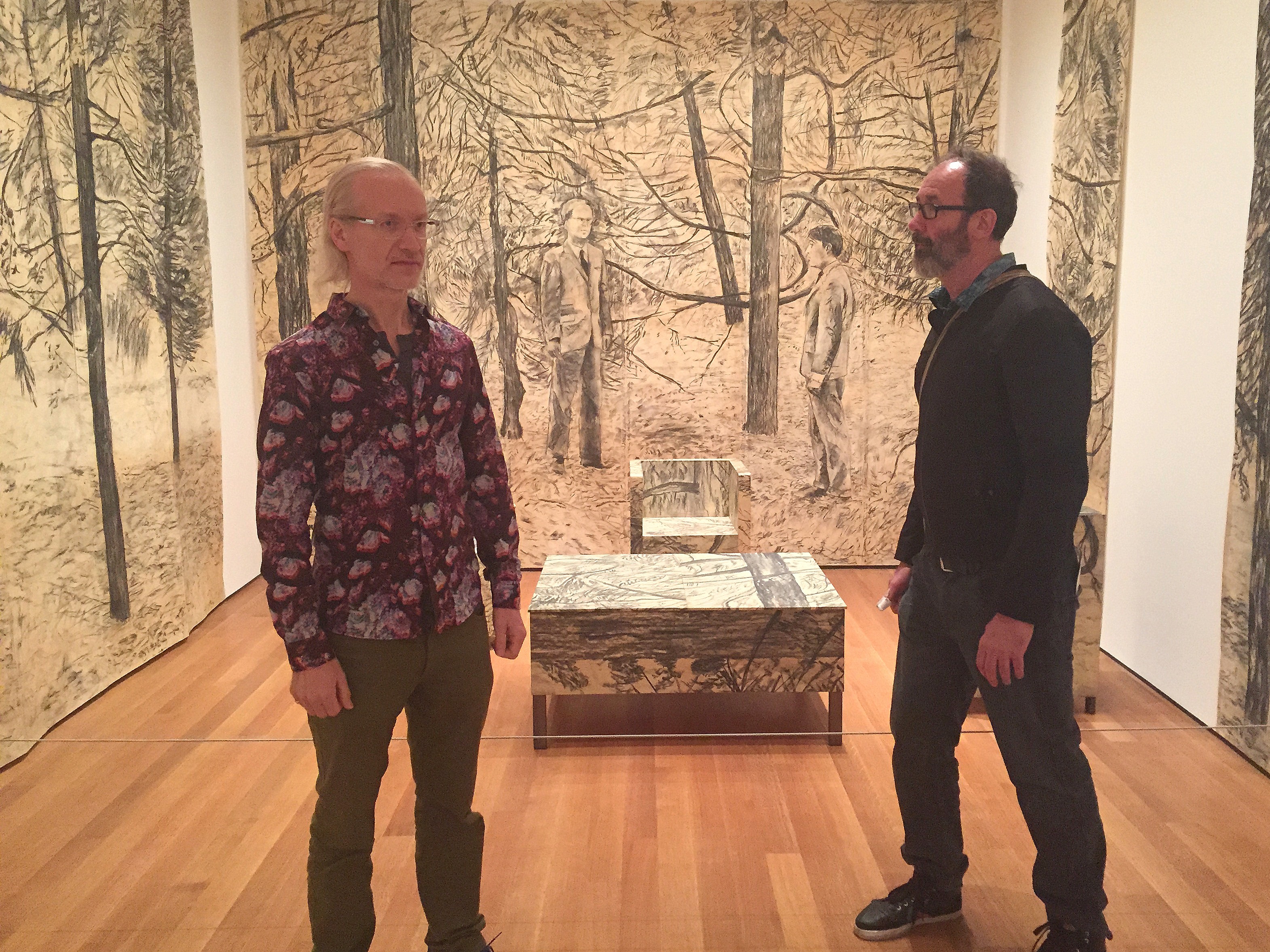
My friends Robert and Achim, artists who live in Berlin, visited New York for a week and we spent part of a Friday afternoon walking through the Museum of Modern Art. I was eager to check out the Yoko Ono retrospective, since she has been an art hero of mine since I first heard of her when she and John Lennon got together and brought politically active anti-war performance art to front pages and evening news all over the world. As a precocious 15-year-old experimental art maven, I eagerly bought her book Grapefruit when it became available and loved its impy mixture of poetry and conceptual art.

5-24 grapefruit two virgins5-24 water piece5-24 burn this book
It took a while but I eventually got my hands on a copy of John and Yoko’s Two Virgins album with the famous controversial naked pictures on the cover. The John Cage-like meanderings and Yoko’s shrill bleating were hard to love as “music,” but for a kid growing up on Air Force bases they were windows onto a wider, crazier, freer world. And I did sometimes enjoy putting a quarter in a jukebox, cuing up “Don’t Worry Kyoko” (the B-side of the Plastic Ono Band’s “Cold Turkey”), and walking out before her intense screaming filled the air. Art pranks are timeless. Ask Dada.

5-22 bag piece
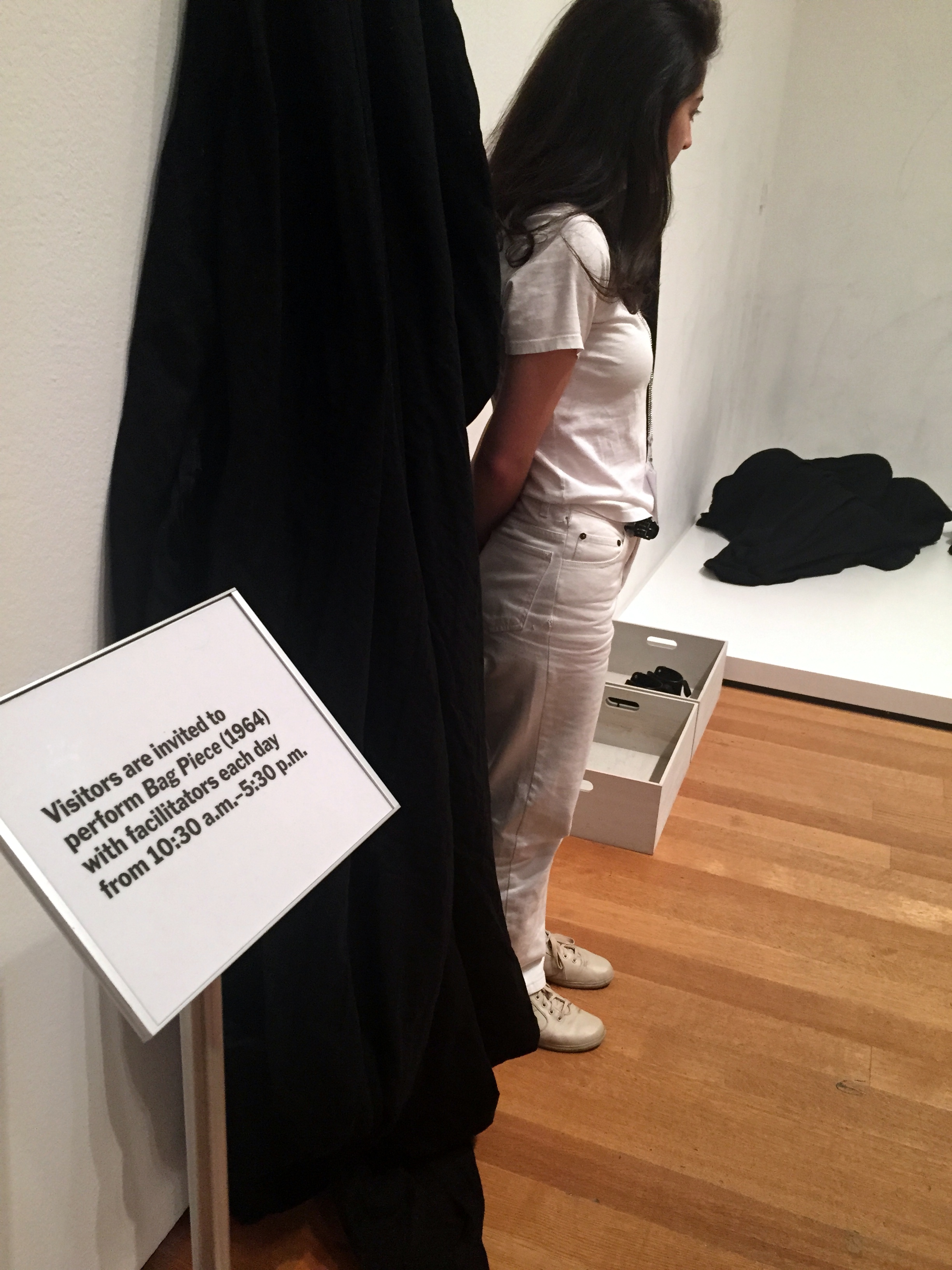
The MOMA show gives museumgoers plenty to see and think about and participate in. You can perform the “Bag Piece” yourself, alone or with a friend. The conceptual pieces are as fresh and witty as ever — even if you’re only looking at framed index cards with a sentence or two typewritten on them, your mind fills up with the actions she invites you to imagine. The video of her performing “Cut Piece” is riveting, impressive, and unnerving all at once.

5-22 touch each other
I didn’t even notice the room devoted to “Touch Poem for a Group of People” until Robert pointed it out: a gray-carpeted room with a standing sign reading “touch each other.” This became the most fascinating (and sad) social experiment. Most people would peer in but be afraid to enter. Or maybe a group would walk in, jokingly poke one another in the arm with one forefinger, and leave. Robert and Achim and I decided to do a little massage, a little contact improv — passersby would peek in, see us, and walk away. Finally, a young  couple from Nova Scotia came in and we engaged them in conversation about the shyness and awkwardness of public touching, and we all held hands for a moment.

5-22 forest foursome
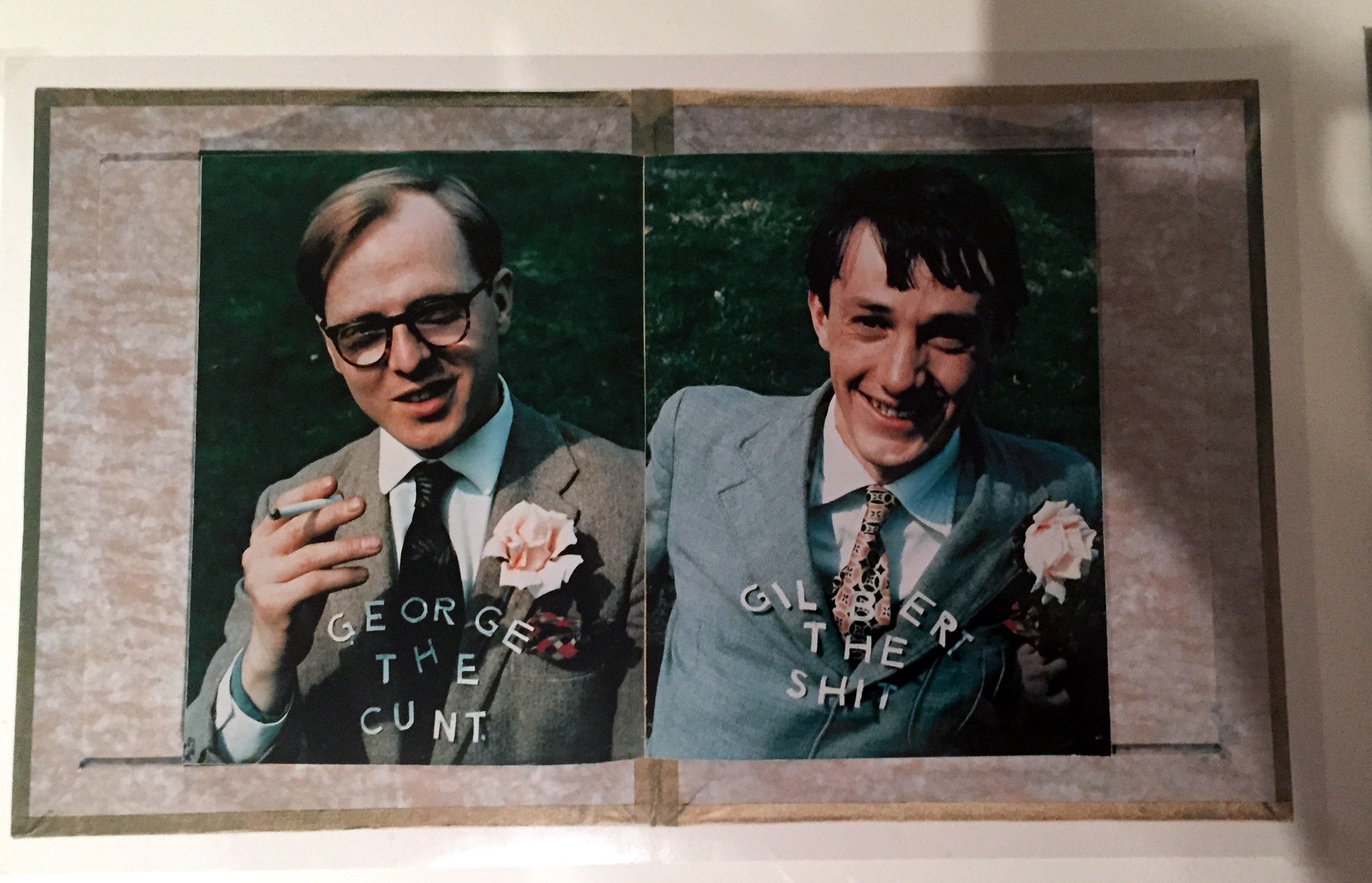
At the moment MOMA is full of conceptual art — early drawings by British dandy pranksters Gilbert and George

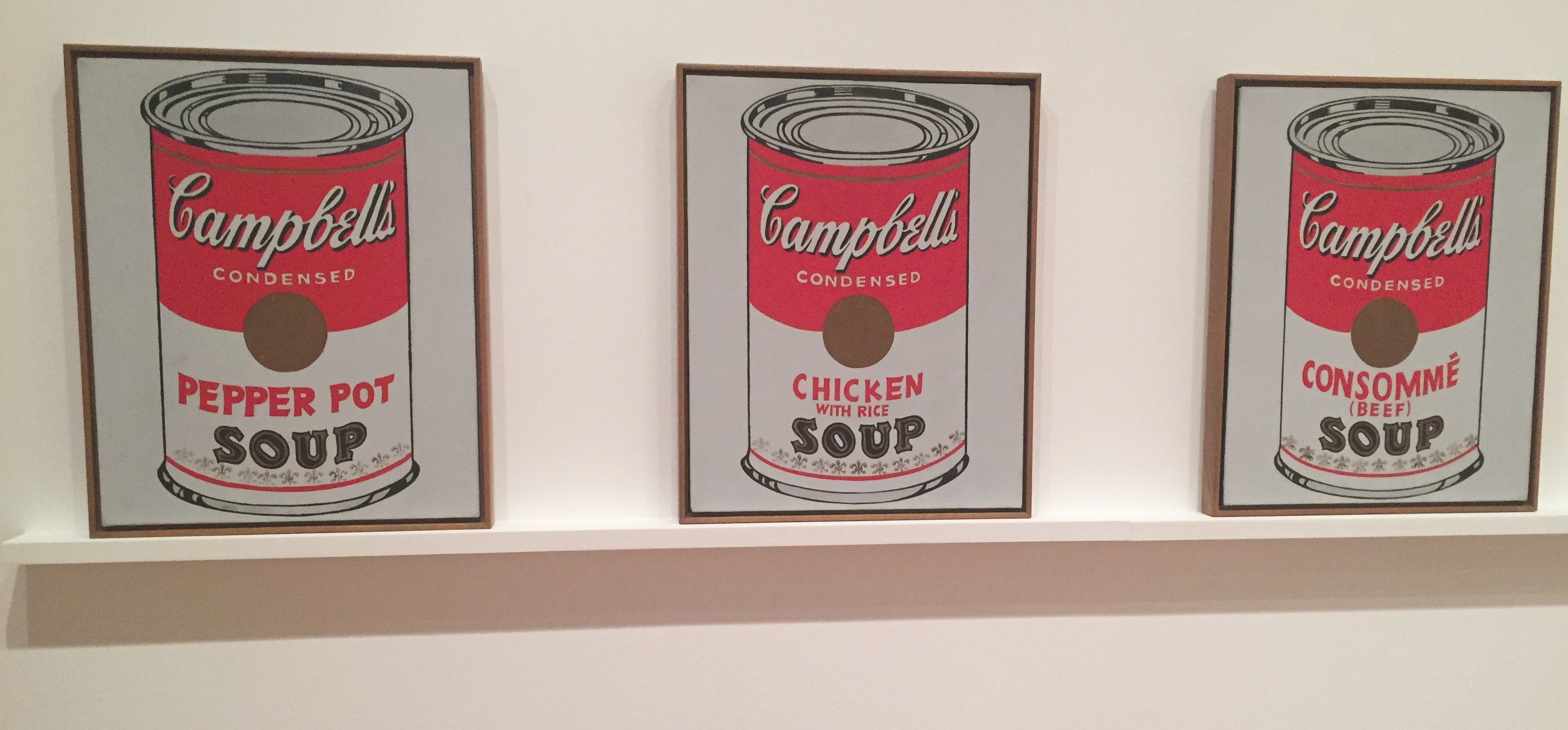
5-22 gng cuntshit5-22 gng censoreda room full of Warhol’s Campbell Soup can paintings

5-22 warhol soup cans
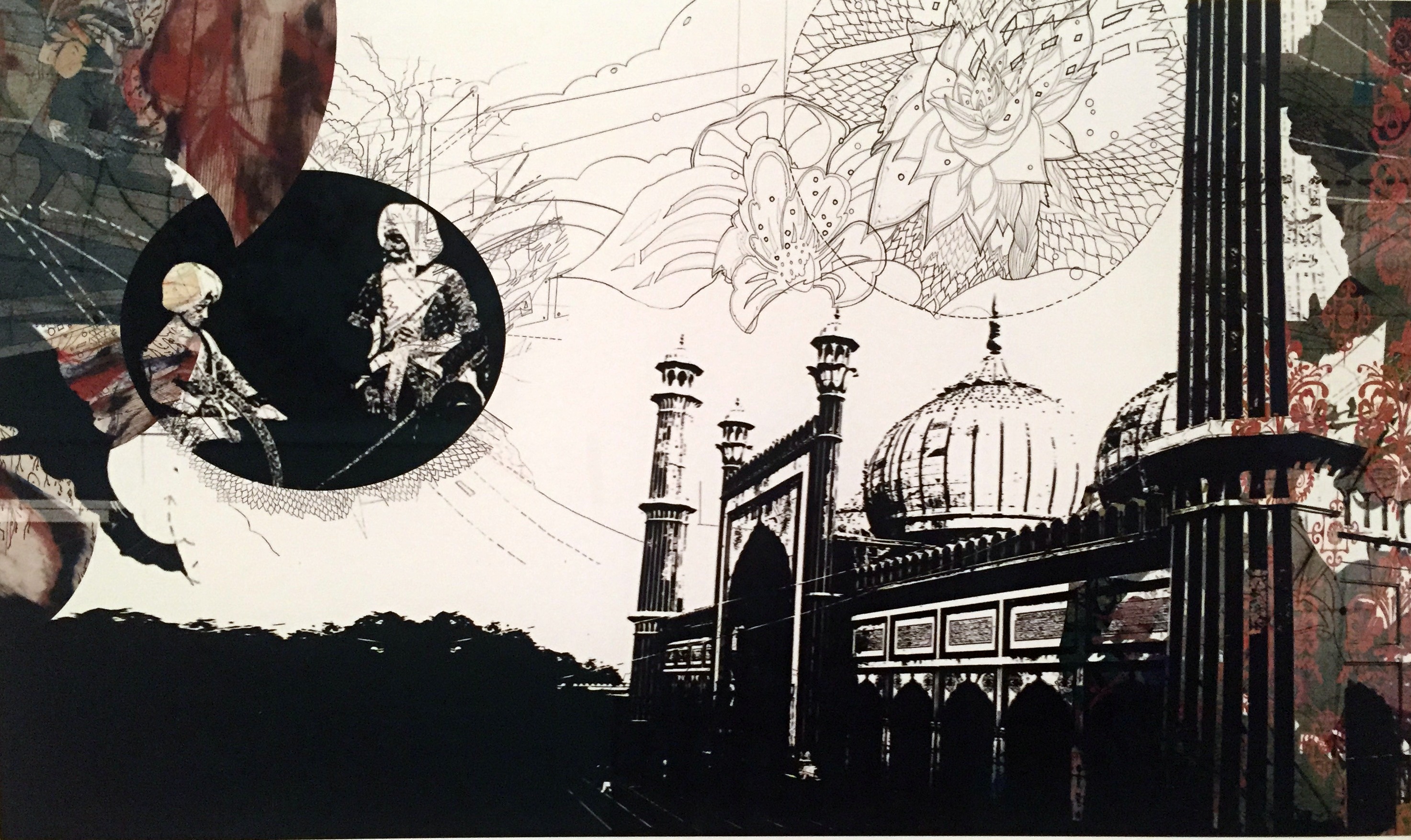
and a hodgepodge of stuff in “Scenes for a New Heritage: Contemporary Art from the Collection,” my favorite of which was “The Black Star,” a portfolio of digital prints by Seheh Shah, a Pakistani artist now living in Brooklyn.

5-22 seher shah 3 5-22 seher shah 2 5-22 seher shah 1
I also dug seeing a very large Jean-Michel Basquiat canvas I’d never seen before (Glenn) displayed in a hallway as well as the huge painting by Kerry James Marshall called Untitled (Club Scene) in the entrance hall.

5-22 basquiat glenn detail 5-22 kerry james marshall untitled club scene