Culture Vulture/Photo Diary: The Whitney Biennial

May 2, 2017

(click photos twice to enlarge)

To be honest, the 2017 Whitney Biennial tried my patience. I had the experience of wading through acres of mediocre painting, ugly sculptures, and twee conceptual art to find a handful of works that pleased me aesthetically and intellectually. The show, curated by Christopher Y. Lew and Mia Locks, features a lot of painting on canvas, almost always multiple pieces by the same artist, which gave me an opportunity to get to know several intriguing artists new to me.

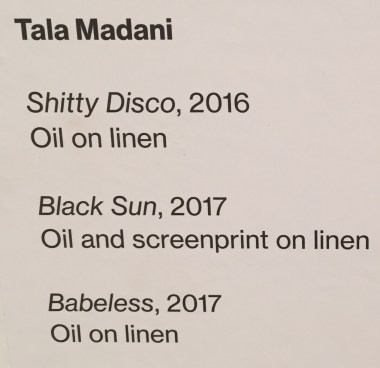
I found Tala Madani’s work edgy and amusing, especially Shitty Disco.

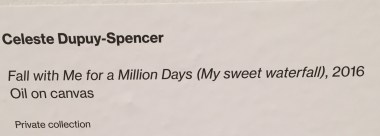
I very much liked Celeste Dupuy-Spector’s stuff, and not only because I loved this DJ’s playlist.
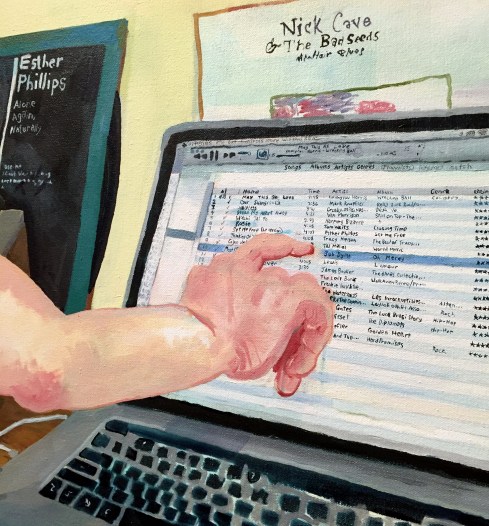
Of the three-dimensional work, my favorites were the black-magic melon piece out on one of the roofdecks – a wonderful bit of political dada by a Middle Eastern artist collective known as GCC – and Jon Kessler’s constructions, Exodus and (below) Evolution.

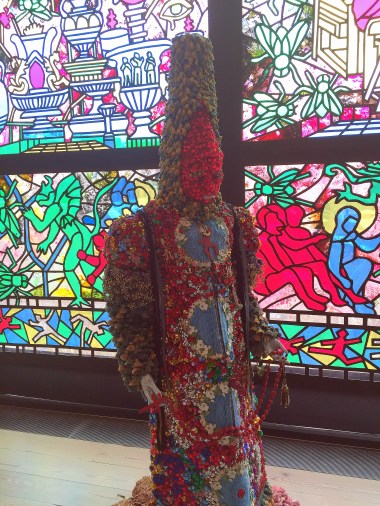
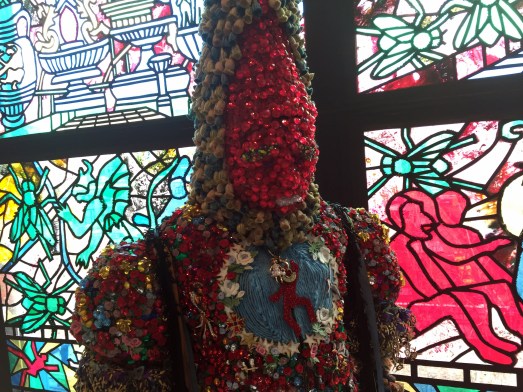
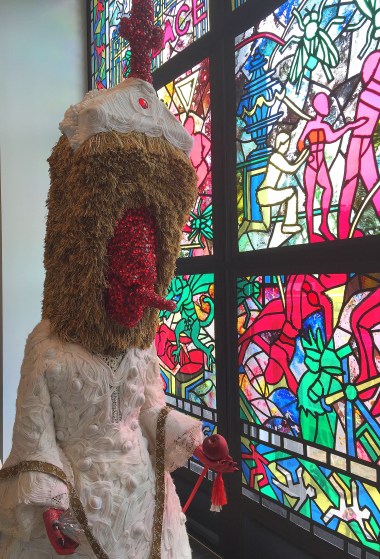
Also fun: Raul DeNieves’s rococo figures, which dance entertainingly between shamanism and kitsch.
On the down side: Samara Golden’s elaborate multi-level piece is undeniably impressive but emotionally opaque.
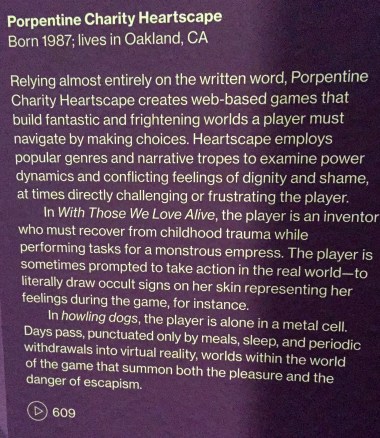

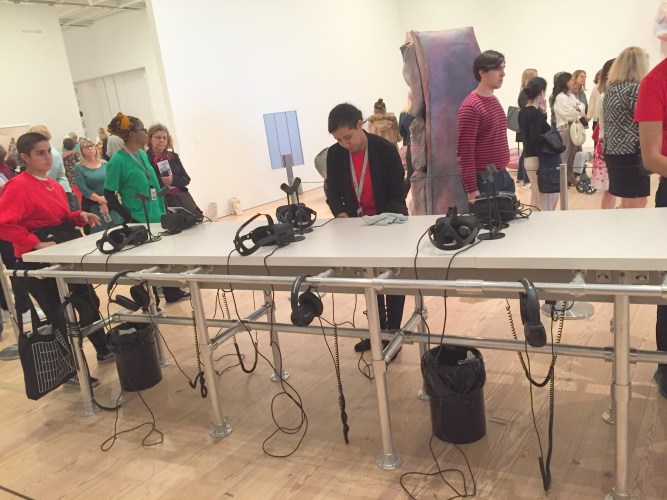
I found the amount of effort that went into Porpentine Charity Heartscape’s computer word games mystifying to the point of exasperating (and pretentious as the artist’s name); doubly true of Jordan Wolfson’s brutal virtual-reality audience abuser, Real Violence (below).
I walked out most impressed with two artists. Dana Schutz, whose controversial Open Casket has a devastating impact when you actually witness it in person (alongside the artist’s statement).

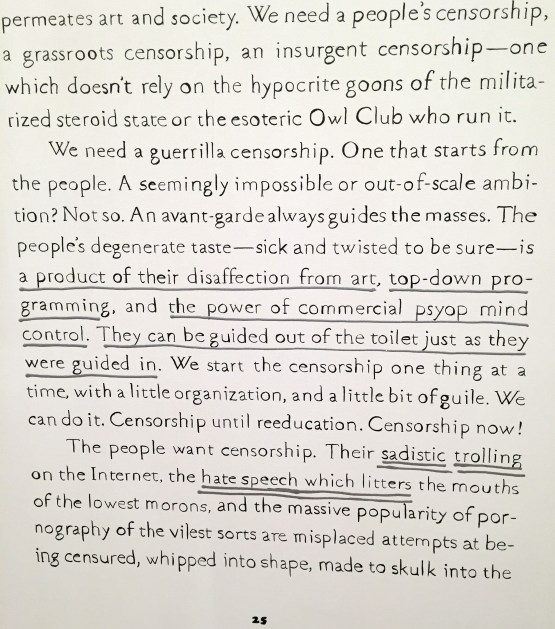
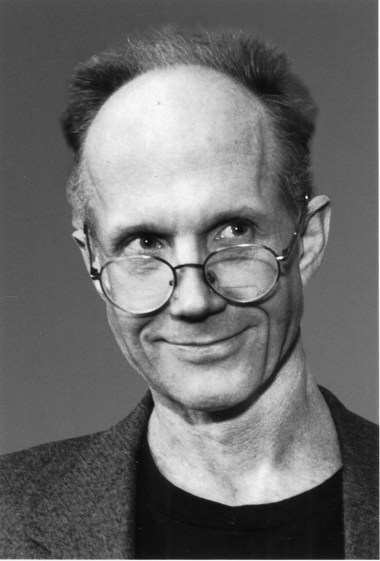
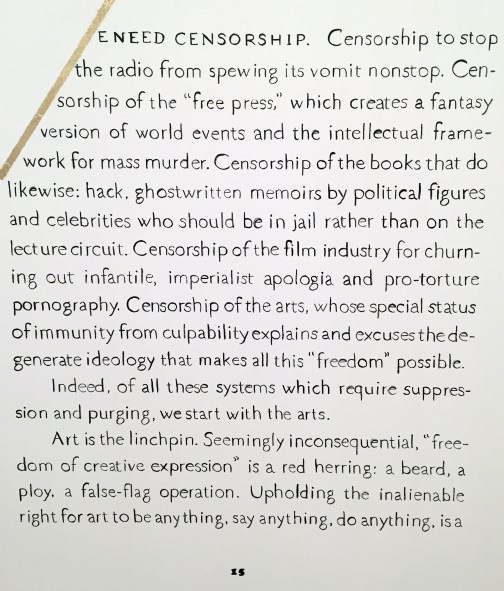
And Francis Stark, who created a roomful of paintings reproducing a provocative essay about censorship by post-punk essayist Ian F. Svenonious.


Quote of the Day: FLORIDA

May 1, 2017

FLORIDA

I just got back from the Florida Panhandle, near Pensacola, and to me it was something like poetry. On the one hand, the reality of the Arby’s and the parking lots and the tattoo parlors and the clam shacks. One hundred feet away, on the other hand, was the beach, the impossible sugar-white sand, and the turquoise, crystal-clear ocean. It was spring break and I know that, a block away, a sophomore named Nancy from Tallahassee was vomiting under a Ferris wheel, and some other kid named Todd was jumping off the balcony of his third-floor room into the hotel swimming pool, and the ambulance was already on its way, and the blue blue ocean was minding its own eternal business. That catches the coexistence of the sacred and profane, which makes the world and makes poetry too. That juxtaposition of beauty and ugliness, of the precious and the appalling, is really important to my poetry. It’s a description of the world, and, to me, also a description of human nature, of psychological reality.

–Tony Hoagland


Culture Vulture: Okwui Okpokwasili’s POOR PEOPLE’S TV ROOM

April 30, 2017

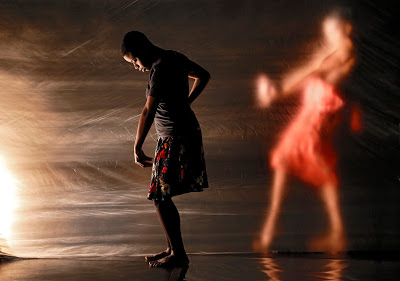
April 29 – Thrilling to see the final performance of Okwui Okpokwasili’s Poor People’s TV Room at New York Live Arts. Devised in collaboration with director-designer Peter Born, this extraordinary performance created a highly sophisticated dreamscape that sustained separate physical, verbal, visual, and sonic tracks for 90 minutes. Not a narrative but a theatrical symphony of themes and variations about women’s bodies, doubles, shape-shifting, this world, the other world…oh, and Oprah. Two pairs of women enacted a series of rituals elliptically stitched together, as if the piece were inventing itself moment by moment. (The riveting performers represent a wide age range – Katrina Reid and Nehemoyia Young are younger than Okpokwasili, and the resident elder is quietly monumental Thuli Dumakude, whom New Yorkers first glimpsed in 1982’s Poppie Nongena)  Lots of dense poetic text, sometimes two people speaking at once, not always meant to be heard. “She used quiet like a cobra in the market.” “How do we know her perpetual transformation isn’t just stagnation?”

In interviews Okpokwasili has talked about the piece as a response to Black Lives Matter, to the abduction of 270 Nigerian schoolgirls by Boko Haram, and Nigerian women’s protest practices in the early 20th century. (She herself comes from a Nigerian family though she was born and raised in the Bronx.) But none of that is foreground in the piece. Instead the performance takes viewers on a deep psychic journey through black women’s bodies. Not quite like anything else I’ve seen before. I’d love to see it again. Here’s a fascinating video about the rehearsal process.


Quote of the day: SONGWRITING

April 27, 2017

SONGWRITING

There’s this sadness about [Katy Perry’s hit song “Teenage Dream”], where you feel young listening to it, but you feel impermanence at the same time. When I put that song on, I’m as moved as I am by anything by David Bowie, by Fleetwood Mac, by Neil Young. It lets you feel something you didn’t know you needed to feel. There’s something holy about it.

–Lorde, interviewed by Jonah Weiner in the New York Times Magazine


Quote of the day: NAMES

April 16, 2017