From the deep archives: Kate Valk and BRACE UP!

June 18, 2017

I have no idea what to expect from A PINK CHAIR (IN PLACE OF A FAKE ANTIQUE),  the new piece that the Wooster Group is developing in honor of Polish theatermaker Tadeusz Kantor, but I’m eagerly anticipating getting a peek at it when it has its world premiere at Bard College’s SummerScape festival next month. Meanwhile, I find myself rooting around in my various writings about the Wooster Group over the years, much of which I’ve already posted in my online archive. But then there’s this brief interview with Kate Valk that I did in 1991 when I was writing a column for the Village Voice called Playing Around. The Wooster Group was in the midst of developing Brace Up!, its layered adaptation of Chekhov’s Three Sisters.
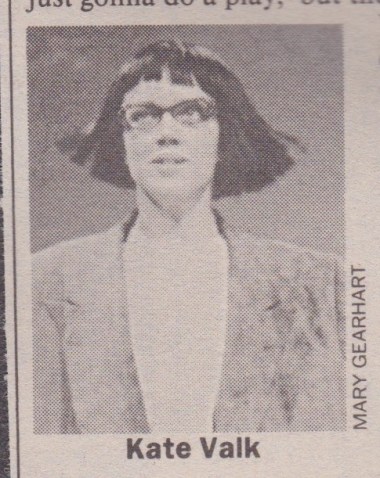
Brace Up! was a star turn for Kate Valk, who served as master of ceremonies, androgynously attired in a chopped-off black “Japanese” wig and a man’s suit (Dafoe’s costume from Route 1&9, actually).

Her role corresponds to that of the maid in Chekhov’s play, she said when I interviewed her at the Garage one afternoon during wartime, which in turn refers to her own history with the Wooster Group. “I started off doing costumes, then props, then stage managing. Now that’s my role onstage.” But her performance is also based on two Japanese forms of presentational acting: the clowns in kyogen (the comic interludes in Noh theater) and the benshi (performers who narrated silent films and sometimes became more popular than the films’ stars). Japan became a fixation after Valk and director Elizabeth LeCompte stopped in Tokyo on their way back from a Wooster Group tour of Australia; the group spent a year studying Japanese movies (anything starring Toshiro Mifune) and tapes of Noh and kyogen. They used that research to create a mask through which to perform Three Sisters.

Going back and re-reading the column now, I’m struck by two things: I refer to the interview taking place “during wartime.” This was during the presidency of Bush Senior and the short-lived skirmish we now refer to as the Gulf War, a big deal at the time that now feels like a faint footnote compared to everything that has happened since then. Later in the column, talking about theater auteur Richard Foreman, I report that he is planning to collaborate with William Finn (of Falsettos fame) on a musical called Eating Yourself Alive. The musical never happened, perhaps needless to say, and I had forgotten all about its fleeting existence until this very minute.

You can read the whole column online here.


Good stuff online: Lincoln Center Theater Review’s OSLO issue

June 16, 2017

Lincoln Center Theater’s in-house journal, LCT Review, consistently assembles high-quality interviews, excerpts, and tangential background information to illuminate the plays that the theater produces. The issue devoted to J. T. Rogers’s Oslo, which just won the Tony Award for best play of the season, is an especially good example. You can pick up a copy of the journal in the lobby of Lincoln Center Theater (you can toss in a “suggested donation” if you like) or read it online here.

The play dramatizes the real-life story of two Norwegian diplomats who stage-managed the secret negotiations between Israel and Palestine that led to the Oslo Accords — a brief, probably never-to-be-repeated moment of international diplomacy that led to a famous handshake between Yitzhak Rabin and Yasir Arafat in 1990. The play builds to that shining moment of hope, and the audience is left both with a feeling of joy at the sense of possibility and a sinking feeling of hopelessness, because we know that we are no closer than ever to seeing a resolution of the long-standing conflict between Israel and Palestine.

The journal goes way beyond duplicating the themes and facts of the play but surrounds it with alternate perspectives. “You in the Wrong Place,” a beautiful piece of writing by Naama Goldstein, captures tiny moments of the author’s journey through uncomfortable shifts in her identities as both Israeli and outsider. Raja Shehadeh’s “The Peace That Ended Peace” arms Oslo audiences with a grain of salt with which to measure the sweet conclusion at which the play arrives. Milbry Polk’s “The Love of Desert Lands” introduces Gertrude Bell, the extraordinary British woman who helped organize the Arab revolt against the Ottoman Turks, sometimes called the Mother of Iraq. And Chris Voss’s “The Art of Negotiation” offers practical advice useful not just for international hostage crises but for everyday life:

“Whether it’s in the office or around the family dinner table, don’t avoid honest, clear conflict. Engaging in it will get you the best car price, the higher salary, and the largest donation. It will also save your marriage, your friendship, and your family. One can be an exceptional negotiator, and a great person, only by both listening and speaking clearly and empathetically, by treating one’s counterparts — and oneself — with dignity and respect, and, most of all, by being honest about what one wants and what one can — and cannot — do. Every negotiation, every conversation, every moment of life is a series of small conflicts that, managed well, can rise to creative beauty. Embrace them.”


Interviews: La Revista Diversa

June 15, 2017

Luis Antonio Capurro is a friendly, enterprising young blogger and informal minister of culture to the gay male community in Lima, Peru. He recently interviewed me (by email) for his online magazine La Revista Diversa. Check it out here and let me know what you think.


Quote of the day: BOOKS

June 7, 2017

BOOKS

What do you read for solace? For escape? For sheer pleasure?

I read Alice Walker for solace. I love a great deal of her writing, but I always go back to The Color Purple. When I couldn’t afford therapy, I’d read about Celie and her depressing life that was somehow still filled with hope and color. “This life soon be over. Heaven last all ways.” Just reading those two sentences would make me feel better about my own troubles.

For escape, I read David Sedaris. It feels like I’m always on a six-hour plane ride, and I love to take that time to listen to a Sedaris audiobook. His tales about his family, or living in Japan or France, or his part-time job as an elf during Christmas, whispered in my ear as I try my best to sit still and pretend I’m not smelling a million farts trapped in business class, are very soothing.

I read Zane for straight-up pleasure. She is one of my favorite writers for erotica. I’m secretly a weirdo, and I really like reading about people making panicked love to each other when they really shouldn’t. I feel like a lot of Zane’s stories are about forbidden romance, one way or another, and I live for it! Her books always have interesting titles and covers. I remember when I worked in an office as a phone sex operator, I would read her book “Gettin’ Buck Wild” on the train on the way to work while feeling embarrassed when other commuters would see the cover of the book and wink at me. But also I’d be getting some great ideas about what to say to callers once I got to work. The embarrassment was worth it. I made pretty good money on the phones.

What book might people be surprised to find on your shelves?

I have a picture book of X-rays of different household items that people have gotten stuck up their butts. That’s pretty surprising.

If you could require the president to read one book, what would it be?

The president cannot read.

–Gabourey Sidibe, “By The Book,” New York Times


Quote of the day: HOPE

June 6, 2017

HOPE

And we know that by fighting, against all odds, we who had nothing, not even our real names, transformed the universe. Our ancestors did this with very little, and we who have more must do the same. This is the joyous destiny of our people—to bury the arc of the moral universe so deep in justice that it will never be undone. But all the fighting in the world will not help us if we do not also hope. What I’m trying to cultivate is not blind optimism but what the philosopher Jonathan Lear calls radical hope. “What makes this hope radical,” Lear writes, “is that it is directed toward a future goodness that transcends the current ability to understand what it is.” Radical hope is not so much something you have but something you practice; it demands flexibility, openness, and what Lear describes as “imaginative excellence.” Radical hope is our best weapon against despair, even when despair seems justifiable; it makes the survival of the end of your world possible. Only radical hope could have imagined people like us into existence. And I believe that it will help us create a better, more loving future.

–Junot Diaz