In this week’s New Yorker

April 1, 2018

Two pieces you have to read:

Margaret Talbot’s simple and clear and devastating reporting about Scott Pruitt and how as head of the Environmental Protection Agency he is pursuing an agenda in favor of big business and its heedless attitude toward environmental protection. Key passage:

In November, Pruitt proposed the repeal of an Obama-era rule that imposed Clean Air Act emissions standards on glider vehicles—heavy-duty trucks that pair new cabs and chassis with older, dirtier engines. Gliders are slightly cheaper than all-new trucks, in part because they aren’t equipped with modern pollution controls. They make up only five per cent of the heavy-duty-truck fleet, but they emit a disproportionate amount of dangerous pollution. Steve Silverman, a former E.P.A. attorney, who retired in January, worked on the glider rule. “We’re not talking only about greenhouse gases,” he said. “These trucks put out diesel particulate matter, a human-lung carcinogen.” In 2016, an agency analysis concluded that gliders produce almost three hundred thousand tons of nitrogen-oxide pollution a year, along with nearly eight thousand tons of diesel-particulate pollution. Agency scientists estimate that a single year of glider pollution causes as many as sixteen hundred premature deaths.

At a public hearing in December, environmental and public-health groups such as the American Lung Association sent representatives to speak for keeping the rule. That was expected. But so did Volvo Group North America, which produces both Volvo and Mack trucks. Susan Alt, Volvo North America’s vice-president of public affairs, testified that the proposed repeal “makes a mockery of the massive investments we’ve made to develop low-emission-compliant technology.” The American Trucking Association also testified against a repeal. Bob Nuss, whom the association named the 2017 Truck Dealer of the Year, flew at his own expense from Minnesota to Washington, D.C., to attend the hearing. Nuss said, “I told them, ‘Maybe it’s only five per cent of the trucks, but how would we all feel if five per cent of the trucks didn’t have to stop for a school bus or obey the speed limit?’ Sneaking around, avoiding emissions compliance, filling the air with soot—it’s just not right.”

The strongest support for rescinding the rule comes from the largest producer of gliders, Fitzgerald. Last year, Fitzgerald, which is based in Tennessee, hosted a campaign event for Trump. In May, Pruitt met with the company’s founder and C.E.O., Tommy Fitzgerald. Two months later, Fitzgerald and two glider dealers wrote a letter to Pruitt contending that the agency lacked the authority to regulate gliders under the Clean Air Act, because “the engine, transmission, and typically the rear axle” are “not new.”

Pruitt soon announced that the E.P.A. would reconsider the rule, and precisely echoed Fitzgerald’s claim that gliders fell into a regulatory gray area because they contained “new and used” components.

Staff writer Rachel Aviv writes one story after another about people in excruciatingly painful situations. This week she writes (in “How a Young Woman Lost her Identity”) about a woman who suffers from an extreme form of dissociation, which puzzles everyone she knows, especially her devoted mother.

Bonus: the cover illustration by the brilliant Christoph Niemann (“Trompe-l’Oeil”) becomes an animation when you view it in digital form. Check out the story behind that here.


Quote of the day: AVOCADOS

April 1, 2018

AVOCADOS

The precious commodity that drives Michoacán’s economy and feeds an American obsession is not marijuana or methamphetamines but avocados, which local residents have taken to calling “green gold.” Mexico produces more of the fruit than any country in the world — about a third of the global total — and most of its crop is grown in the rich volcanic soil of Michoacán, upland from the beaches of Acapulco. It is one of the miracles of modern trade that in 2017, Mexico’s most violent year on record, this cartel-riddled state exported more than 1.7 billion pounds of Haas avocados to the United States, helping them surpass bananas as America’s most valuable fruit import. Nine out of every 10 imported avocados in the United States come from Michoacán.

The real marvel of Mexico’s avocado trade, however, is not so much its size as the speed of its sudden growth. Avocados have been cultivated in Mexico for around 9,000 years. (When Spanish conquistadors first encountered the oblong fruit in the early 16th century, they called it aguacate, after ahuacatl, an Aztec word that means testicle.) Despite this deep history, Mexico exported very few avocados — and none at all to the United States — through the 1980s, when a California-based company, Mission Produce, opened the first avocado-packing plant in Uruapan. The United States had banned Mexican avocados since 1914 over fears of an insect infestation and cheaper competition. But in 1994, Mexico, Canada and the United States enacted the North American Free Trade Agreement — and soon thereafter the United States began lifting its ban.

An avocado explosion followed. In 1994, Americans consumed a little more than one pound of the fruit per person per year — almost all from California growers, whose harvest comes only in the summer. Today, that figure is up to seven pounds per person year-round. Fueled by a growing Latino community and Hollywood stars promoting the health benefits of the fruit’s unsaturated fats (Miley Cyrus has an avocado tattoo on her arm), America’s avocado craze has intensified every year. An estimated 135 million pounds of avocados were consumed in the weeks leading up to the Super Bowl last month. (The Super Bowl is America’s top avocado day, just ahead of Cinco de Mayo.)

–Brook Larmer, New York Times Magazine

illustration by Andrew Rae


Quote of the day: FAILURE

March 4, 2018

FAILURE

When I first worked in recording studios with Brian Eno in the early 1990s I was unnerved by how much he liked failure. He seemed to look forward to it. Failure gave him the chance to rethink the whole project, to be flexible, to redefine it, to start over. During the long recording process I noticed that often by the time a song was finished it had little to do with the original version. Sometimes it’s painful to discard everything, sometimes it’s exhilarating. But I’ve finally learned that failure is largely a form of perception and definition, the way a dessert can be a complete failure as a cake but a great success when it’s renamed a pudding.

–Laurie Anderson, All the Things I Lost in the Flood


Culture Vulture: New Georges Theater

February 25, 2018

2.25.18

I’ve been making an effort to reserve my increasingly limited theatergoing time for plays and artists that are new to me, bypassing revivals and work by people whose work I know thoroughly. I’ve long admired the idea of New Georges, Susan Bernfield’s theater company devoted to producing work by women, even though I’ve seen little or none of their work, and I’d yet to check out shows at the spiffy new Flea Theater space in Tribeca. So the description of the current double bill of Sound House and This Is the Color Described by the Time called out to me big-time.

We started with the Sunday matinee of Sound House, Debbie Salvetz’s production of Stephanie Fleischmann’s play about British electronic composer and sound designer Daphne Oram. I’d never heard of Oram, and I loved the nerdy non-glam period style of the actress who plays her, Victoria Finney. But the piece as a whole chopped up Oram’s story into incoherent bits shuffled together with an invented and much less interesting narrative about a character named Constance Sneed (Susanna Stahlman) and her stormy relationship with an elderly downstairs neighbor. The three actors (James Himelsbach plays a colleague of Oram’s named Horace Ohm) spend a lot of time arranging and rearranging antique sound equipment around the stage to no great import. I left unsatisfied.

Happily, its companion piece later that evening was a different story. Conceived and directed by Lily Whitsitt and originally developed by a performance lab called Door 10, This Is the Color Described by the Time went much deeper into sound exploration, with the help of Elevator Repair Service’s longtime sound designer Ben Williams. The performance begins with audience members donning individual headsets, which allows us to dive sonically inside the mind of Gertrude Stein (Christina Rouner), holed up with Alice B. Toklas (Stephanie Roth Haberle) in their countryside home in Bilignin during the Second World War. Many layers of atmospheric sound drift through our ears as we watch Stein at her desk writing (the text includes chunks of her play “Mexico”), Toklas cooking, the two of them eating and nuzzling and being domestic, receiving letters from Stein’s friend and protégé Thornton Wilder (played by Williams) and their French protector, gay aesthete Bernard Faÿ (Ean Sheehy).

Capitalizing on recent scholarship (the program includes a substantial bibliography, including Janet Malcolm’s Two Lives: Gertrude and Alice and Barbara Will’s Unlikely Collaboration: Gertrude Stein, Bernard Faÿ, and the Vichy Dilemma), the piece expands beyond familiar portraits of Stein and Toklas to explore the moral complications and vulnerability of two Jewish American lesbians surviving Nazi occupation of France with the help of Faÿ, an official with the Vichy regime who espoused anti-Semitic views and was jailed after the war for his collaboration. Short on verbal narrative and long on theatrical imagery, this beautifully designed (sets by Amy Rubin, lighting by Reza Behjat) and performed show creates an atmosphere of tension and emotional complexity. Watch how a handful of tomatoes stand in for the fowl Toklas cooks for dinner and how a giant misshapen stuffed pillow comes to represent the cancer that killed Stein shortly after the war ended.

Between the two shows, we walked over to the Leslie-Lohmann Museum of Gay and Lesbian Art on Wooster Street and checked out the two shows on display there. “Haptic Tactics” is one of those dense, intellectually rigorous shows with much to admire – I like that almost nothing looked like a conventional painting, photo, or sculpture – but not so much by way of beauty.

Around the corner is a show by Leonard Fink consisting largely of nude self-portraits, many of them shot among the ruins of the West Side piers. I love a guy who’s willing to give his work titles like “Self-Portrait Giving a Blow-Job.”

With both shows, I marveled at the museum’s scrupulous attention to the eccentric materials and pervy preoccupations of LGBTQ artists.

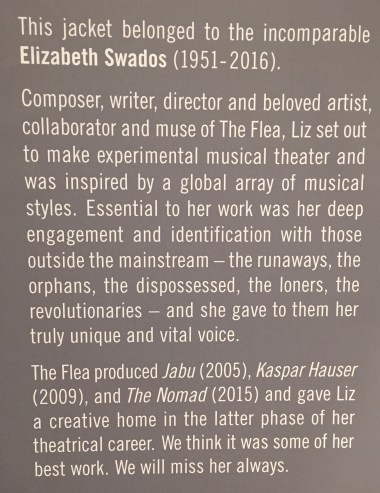
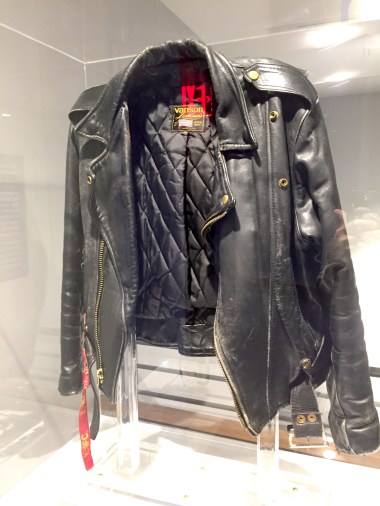
We stopped in for refreshments at the coffee shop Baked on Church Street – I had tea and some little round balls that are the vegan equivalent of doughnut holes – but they closed at 5:00, which left us with a couple of hours to kill. We would have eaten an early supper at the Aussie bistro Two Hands but they also closed at 5, so we ended up happily biding our time at the New Orleans-themed restaurant 1803, where Andy had the pulled pork sandwich and I the Cajun niçoise, both delicious. We got a 15% discount because they have a deal with the Flea Theater, where I was also touched to see Liz Swados’s well-worn leather jacket displayed with suitably fetishistic devotion.


Photo diary: honeymoon in Hawaii, part 4 (Poipu)

February 23, 2018


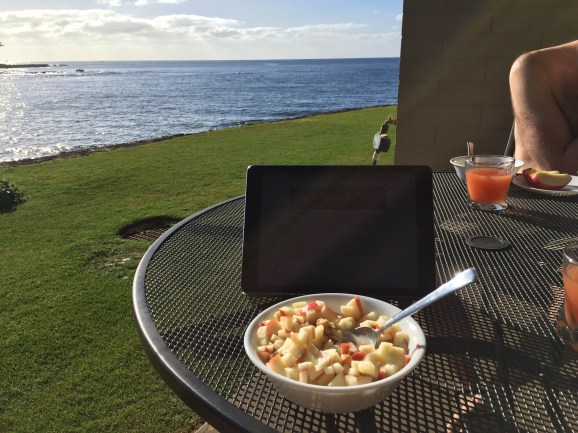
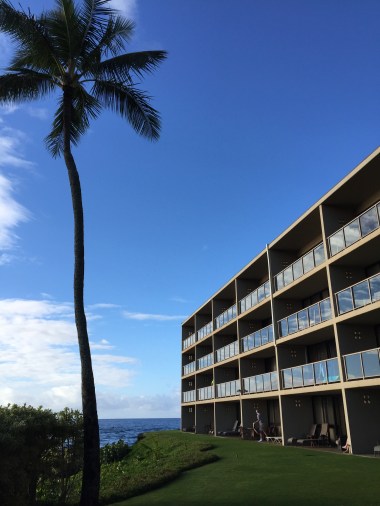
After toodling around the north shore, hiking up at the top of Waimea Canyon, and doing the helicopter tour, we were content to spend the rest of the week holed up at our VRBO (vacation rental by owner) in Poipu on the sunny, dry south shore of Kauai. Our cozy one-bedroom apartment opened right out to this spectacular view at sunrise of a gorgeous bay, just a few steps away from our lanai/breakfast table.

The view and the proximity to the water make it sound like a sweet secluded cottage, maybe…but no. More like:


A condo building full of well-off white people from North America. At least we were on the first floor, second from the end. Elsewhere on the island you could see — and hear — roosters everywhere. Not so much here, though we were visited every afternoon by these friendly critters.


The bay offered spectacular snorkeling. Tons of beautiful, colorful fish — Moorish idols, pufferfish, triggerfish, needlefish — and gigantic sea turtles the size of a coffee table.


All we really wanted to do was lie around and read books.


I finished:
The Secret Chief Revealed — Myron Stolaroff
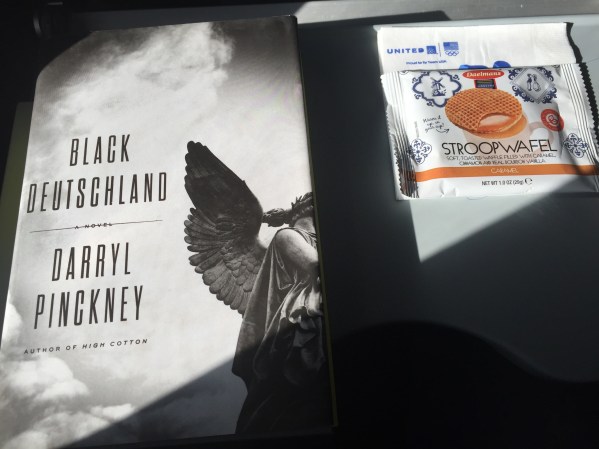
Black Deutschland — Darryl Pinckney
Nietzsche for Beginners (ridiculous and incoherent)
The Marrying Kind — Ken O’Neill
The Spell — Alan Hollinghurst
The Child — Sarah Schulman
Swords in the Hands of Children — Jonathan Lerner

Of course you have to eat, so we checked out the local farmer’s market and stocked up on some fruits new and unusual to us: rambutan (the red spiky-looking balls), chico (the purple ones — they sort of look like kiwi and taste a bit like cinnamon), and dragon’s eyes or langan (inside the thin shell, a slimy pitted fruit that tastes like a cross between a grape and a pear). Plus fresh pineapple and those small, dense, tasty apple bananas.


Right next door to our apartment complex stood the Beach House Restaurant, where people gravitated from miles around to view the sunset.

It’s not unusual to get a brief sprinkle sometime during the day in Hawaii, but you don’t always get a rainbow, let alone a double rainbow.