When I was a wee lad still in drama school at Boston University, I was dazzled by seeing Harvey Fierstein in Robert Patrick’s play THE HAUNTED HOST and became obsessed with the realm of gay theater. Now you can see gay plays everywhere — on Broadway, on TV — but in the mid-’70s it was a pretty tiny if growing field. I started writing reviews and features for Boston’s Gay Community News, and I made a pilgrimage to NYC to interview two of the pioneers of gay theater, Doric Wilson and John Glines. John went on to produce the first commercial production of TORCH SONG TRILOGY, which moved to Broadway and won Tony Awards for all of them. Picking up his Tony, John made it a point to thank his male lover, the first time such a sentiment had been uttered on network TV. John died yesterday morning at age 84 in Thailand, where he’d been living for many years, in the presence of his husband, Chaowarat Chiewvej. Here’s to a lovely man and a courageous pioneer. I went back and posted my 1976 interview with him, which is pretty naive and starry-eyed but hey, those were the days, my friend, those were the days.
Quote of the day: RESISTANCE
July 17, 2018RESISTANCE
What can they do
to you? Whatever they want.
They can set you up, they can
bust you, they can break
your fingers, they can
burn your brain with electricity,
blur you with drugs till you
can’t walk, can’t remember, they can
take your child, wall up
your lover. They can do anything
you can’t stop them
from doing. How can you stop
them? Alone, you can fight,
you can refuse, you can
take what revenge you can
but they roll over you.
But two people fighting
back to back can cut through
a mob, a snake-dancing file
can break a cordon, an army
can meet an army.
Two people can keep each other
sane, can give support, conviction,
love, massage, hope, sex.
Three people are a delegation,
a committee, a wedge. With four
you can play bridge and start
an organization. With six
you can rent a whole house,
eat pie for dinner with no
seconds, and hold a fund-raising party.
A dozen make a demonstration.
A hundred fill a hall.
A thousand have solidarity and your own newsletter;
ten thousand, power and your own paper;
a hundred thousand, your own media;
ten million, your own country.
It goes on one at a time,
it starts when you care
to act, it starts when you do
it again after they said no,
it starts when you say We
and know who you mean, and each
day you mean one more.
–Marge Piercy, “The Low Road”
Books: THE PARADOX OF PORN: Notes on Gay Male Sexual Culture
July 15, 2018I’m delighted to announce the publication of my new book called The Paradox of Porn: Notes on Gay Male Sexual Culture.
Based on my twenty years of experience as a sex therapist/educator and pleasure activist, this book-length essay explores the topic of pornography from a unique, specifically gay male perspective, surveying in depth what’s valuable and what’s problematic about the ubiquitous forms of erotic imagery we encounter on a daily basis.
My intention in writing the book is the same one that drives my professional practice: to encourage and support gay men in having more pleasurable and more satisfying sex. I would like to share more widely the questions, discoveries, curiosities, and wisdom that I encounter every day of my working life.
Pornography is integral to gay male culture: obsessively consumed and almost never discussed, it is the shamefaced step-child of desire and the imagination.
Almost all gay men look at pornography almost every day, whether it’s commercial clips on XTube, handheld homemade videos on Tumblr blogs, or pic-swapping on hook-up apps. Yet we almost never talk about what we watch, what it means, what we like and don’t like. When porn is discussed publicly, it’s often addressed as a problem related to addiction, dysfunction, or exploitation. We nod our heads thoughtfully . . . and then go home and pleasure ourselves to whatever version of porn currently entertains us.
To understand the siren call of pornography, it’s important to consider both what’s valuable and what’s problematic about this alluring form of entertainment. In our heart of hearts, gay men know that pornography has played a special role in our sex lives. It has taught us what desire between two men looks like; it has helped us figure out what turns us on; it has supported us in not feeling so alone; it has gotten us through times of loneliness and isolation, disease and disconnection; and it has contributed to many pleasurable orgasms. At the same time, the images from porn that are now ubiquitous in our lives have shaped and often distorted our ideas about what sex is, what normal bodies look like, how people make connections, and how we feel about ourselves. It has been hugely liberating and hugely oppressive. And that’s the paradox of porn.
This is not a scholarly treatise but an informed, opinionated, open-ended, sometimes extremely graphic meditation on the topic of pornography and its impact on gay male sexual culture. The Paradox of Porn speaks to anyone who wants to explore and expand their understanding of the impact pornography has had in their lives.
Here’s what some eminent authors have said about the book:
“The Paradox of Porn is the best book about pornography, the lives and imaginations of gay men, and state of erotic gay culture written to date.” – Michael Bronski, author of A Queer History of the United States
“Sane, helpful, and fascinating.” – Andrew Holleran, author of Dancer from the Dance
“Don Shewey’s book is wise, informed, and fearless. The Paradox of Porn busts through several closet doors and explodes taboos. A rich and rewarding read.” –Jay Michaelson, author of God vs. Gay? The Religious Case for Equality
“Frank, smart, and unafraid. Definitely a welcome addition to the conversation gay men should be having.” –Wayne Hoffman, author of Hard, Sweet Like Sugar, and An Older Man
You can read an interview with me about the book published by the online magazine Edge here.
The book is available for order online here. It’s being sold at independent bookstores in New York, San Francisco, and Seattle. Ask your local bookstore to order it for you.
In this week’s New Yorker
July 13, 2018For self-protection, I avoid TV news. I’m content to get my news of the world from the kind of deep dives that the New Yorker specializes in.
The current midsummer double-issue is extra-good, in a roller-coaster way.
Adrian Chen’s “No More Secrets,” about a guy who live-streams his mundane existence, reflects up-to-the-minute technology but in a way that fills me with despair — THIS is what people pay attention to? Yuk. But I guess it’s good to know.
David Sedaris writes hilariously, as always, about going to a shooting range with his sister Lisa (“Active Shooter”), where the instructor keeps calling him “Mike,” which he finds an amusing alternative to what he often gets when he presents his credit card (“Are you THE David Sedaris?”).
In “Tunnel Vision,” William Finnegan profiles the new head of the MTA, a Brit named Andy Byford who’s determined to overhaul the NYC subway system as he did in London and Toronto.
How cool to get a look at a mural Charles Addams painted for a Hamptons hotel in 1952, which has been quietly hanging in a library at Penn State.
Ariel Levy writes about a fascinating Iranian-American novelist named Ottessa Moshfegh (below, photographed by Dru Donovan) and her crazy romantic life (“Not From Around Here”).
And Hilton Als pays tribute to Anika Noni Rose, who’s starring in a production of “Carmen Jones” directed by John Doyle that sounds worth seeing at Classic Stage Company (“Working It”).
Culture Vulture/Photo diary: Taylor Mac in Philadelphia part 2
June 14, 2018Saturday June 9 —
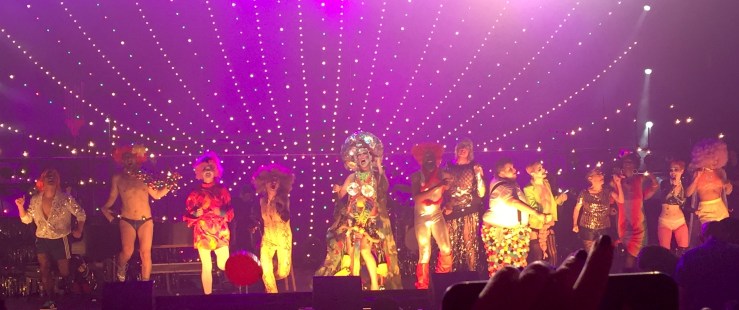
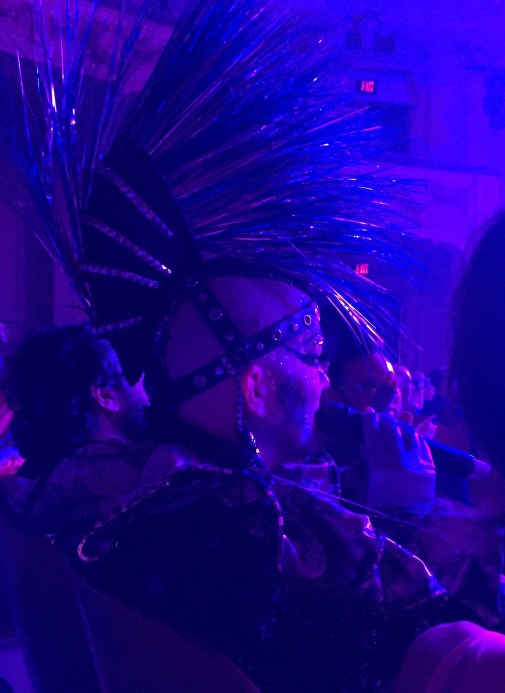
Andy and I returned to Philadelphia for the second half of Taylor Mac’s “24-Decade History of Popular Music.” It seemed like half the crowd had seen the first part, the other half were all new people (including our friends Nick and Jimmy). Taylor said something in judy’s introduction that judy hadn’t said before, that judy undertook this epic theater piece because there’s no way it could be perfect — an exercise in managing The Anxiety of Imperfection. That’s one of many inspiring aspects of the extravaganza.
Some highlights:
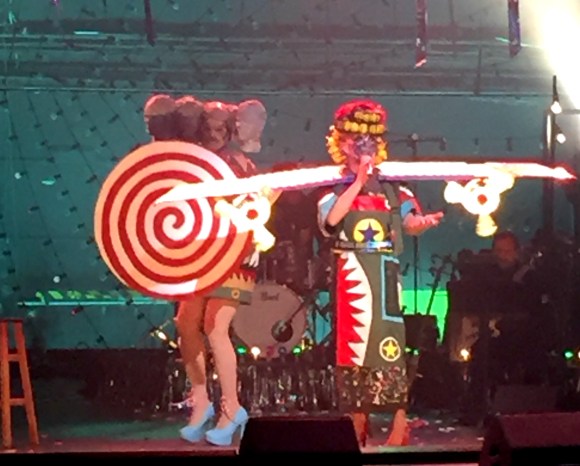
Each decade’s costume was a Machine Dazzle masterpiece, some more dazzling than others, like this simulation of the Wright Brothers’ airplane wings with Machine traipsing around in a Mount Rushmore headdress.
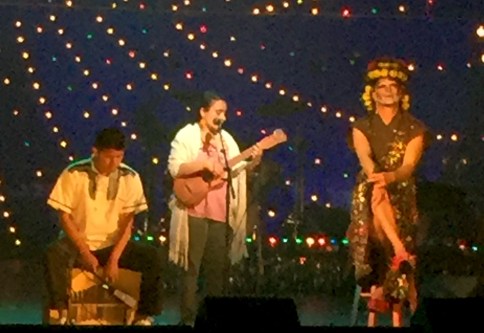
Guest artists included Philadelphia-based immigrant advocacy activist Yared Portillo, accompanied by Erick Pérez.
During the Depression era, the theater became a soup kitchen, as the Dandy Minions served soup to the audience. When the 1950s rolled around, Taylor’s white-picket-fence costume signalled the era of “white flight” to the suburbs. At this point in the show, Taylor had all the white people in the middle section of the orchestra “migrate” to the suburbs and invited all the people of color in the house to take seats in the center, so for the rest of the show they got to sit in the best seats in the house, soon followed by the queers.
Machine Dazzle’s costumes and Matt Ray’s musical arrangements have been widely and deservedly lauded, but I’m not sure enough praise has been heaped on set designer Mimi Lien and lighting designer John Torres, who succeeded in continually transforming the look of the show/concert using the simplest of means. Andy and I had seen the three-hour section covering the ’60s/’70s/’80s at St. Ann’s Warehouse in Brooklyn, a flexible open space. At the Merriam Theater in Philadelphia, the curtain came down as the ’60s rolled in, and it reopened with this grand entrance, to the tune of “Turn! Turn! Turn!”
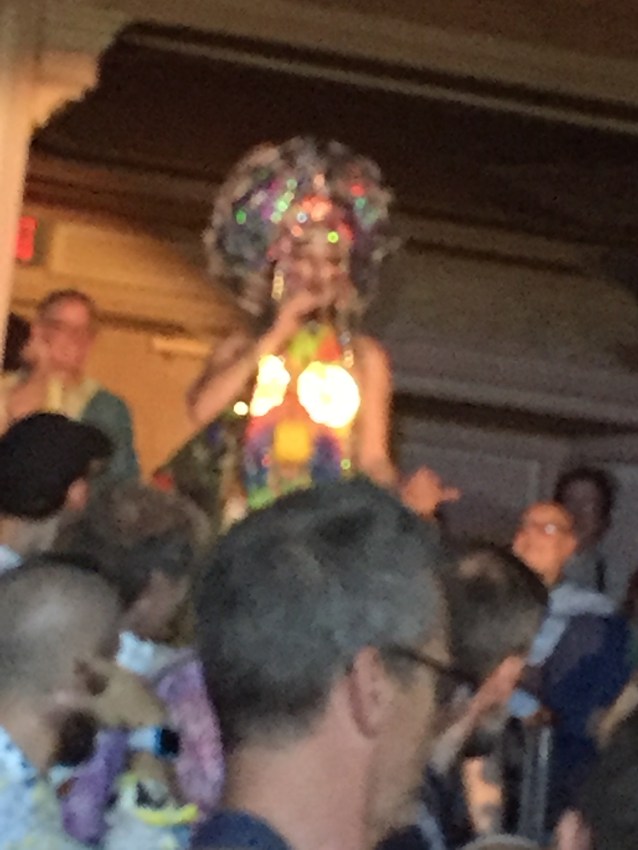
In Taylor’s queer revisionist pop-song history, “Born to Run” became a Stonewall anthem, as Taylor ran around the audience in judy’s disco-ball headdress and light-up brassiere, orchestrating a simulation of Judy Garland’s funeral (with audience members recruited to play La Garland and her pallbearers, which you can see over our shoulders).
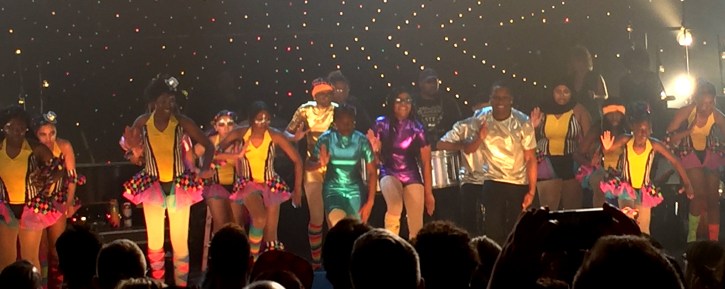
In Brooklyn, Taylor brought on a local youth marching band to signify Black America “Movin’ On Up” at the start of the ’70s. In Philadelphia it was a fantastic local youth dance troupe called Camden sophisticated Sisters/Distinguished Brothers. Notice the hefty gal in the hijab? She did a handstand that turned into a back flip!
And the Dandy Minions got to represent ’70s disco.
The ’80s morphed from a backroom bar into the grim specter of AIDS.
For the oughts, Taylor invited all the lesbians in the house to join him onstage for beer and snacks while judy sang an array of lesbian music (including a sweet rendition of Ferron’s “Girl on a Road,” a duet with Cynthia Hopkins) and brought on Toshi Reagon for a stellar solo.
By the end of the night (the last hour was Taylor solo, singing original songs), I was left with a few strong impressions. Fun and crazy and dazzling as the visuals and the jokes were, this was an incredibly impressive and accomplished musical event. Especially when Taylor slowed things down or stood still to sing ballads, they were overwhelmingly beautiful and emotional, along a fascinating unpredictable spectrum — the country ballad “Ghost Riders in the Sky,” Bob Dylan’s “A Hard Rain’s Gonna Fall,” Patti Smith’s “Birdland.” And I walked away blessed to have inhabited a day in the life of a Temporary Queer Utopia, which is as strong a political statement as an artist can make these days.