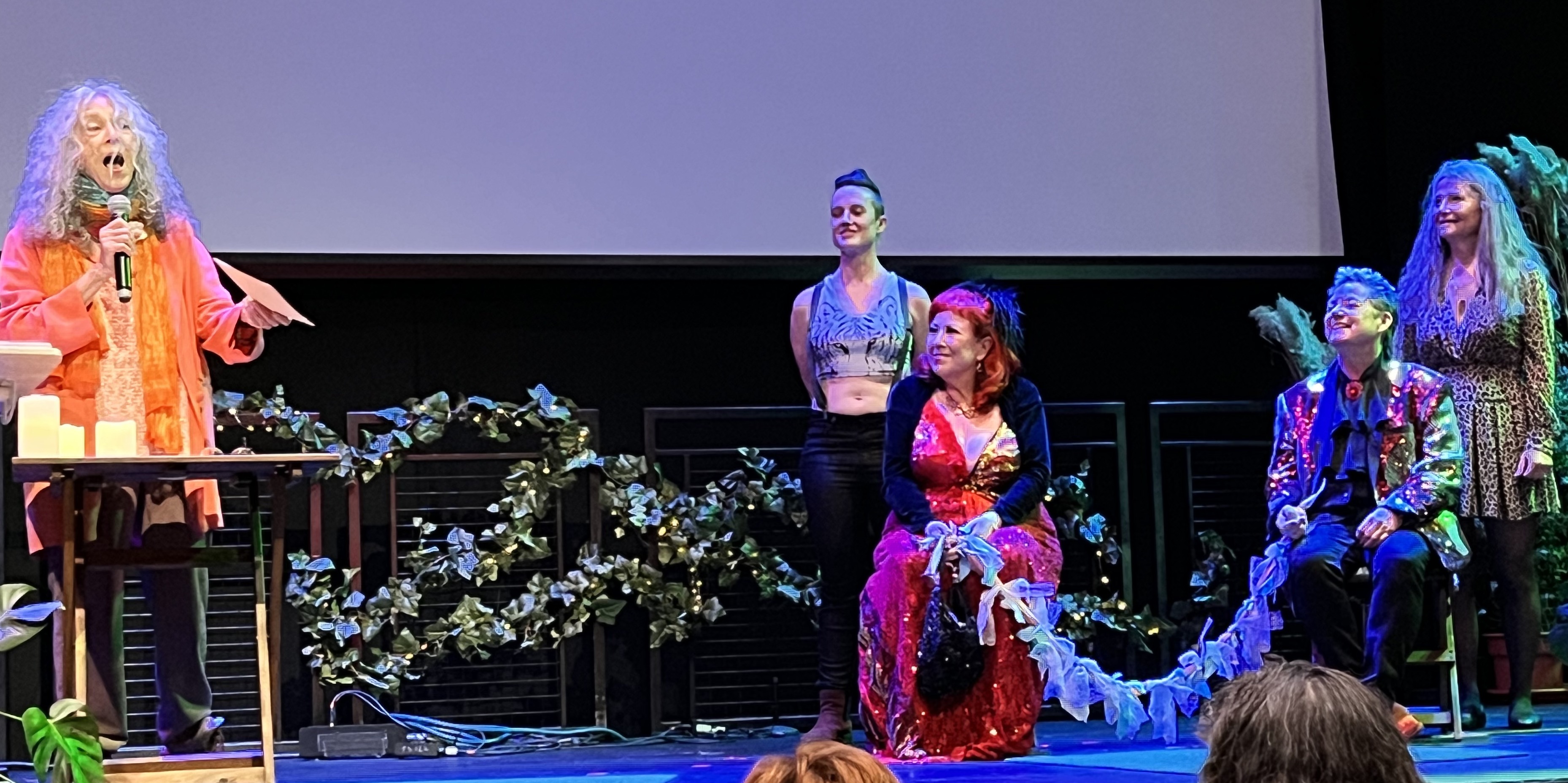
Annie Sprinkle, Beth Stephens, and 100 of their friends took over Performance Space New York (the venue formerly known as PS 122) with “EcoSex and the City: Exploring the Earth as Lover,” which sounded in advance like a wacky weekend of West Coast woo. Andy characterized it as “Witchy Ladies Talking About Their Vulvas, and Trees.” Both descriptions are not inaccurate. But in its sneaky way, it was a profound and timely festival of ideas.
I was going to say they aren’t kidding about being environmental activists, but really they are kidding, and that’s the point. Let’s face it, although it’s possibly the most urgent issue of the day, the language that surrounds environmental justice – climate change, sustainability, infrastructure – can be pretty dull and veer toward solemnity, shouting, and shaming. Annie and Beth bring a lively, loving, queer, body-centered, sensual approach to the topic that doesn’t mean they’re any less serious about it.
Playfulness permeates the language they use. To heal the world, Annie said more than once during the festivities, “It takes a brothel!” Annie of course came to fame in the 1970s as a porn star and sex worker and then evolved into a performance artist and sex educator whose cartoony persona allowed her to smuggle cutting-edge queer/feminist sensibility into an increasingly wider world. She and Beth, whom she met in 2002, identify as “eco-sexual,” meaning “The earth is our lover.” They were married to the earth by shamanic performance artist Guillermo Gomez-Peña, and it’s not a platonic love affair. They get down in the actual dirt, they made a beautiful film called Water Makes Me Wet, they’re working on a new movie called Playing With Fire, and they published a book called Assuming the Ecosexual Position. They model getting very personal and political about saving the planet. But they’re not fundamentalist about it – you can be “eco-romantic” or, if you’re still trying to figure out your entry point to environmental activism, you can be “eco-curious.” Submit to the “eco-sexual gaze”! Find your “e-spot”! Rub up against oaks and call it “Treebadism”!
Friday night Annie and Beth entered like royalty and were greeted as such by friends, fans, and collaborators. Intersectional to the nth degree, the festival opened with veteran life-art practitioner Linda Montano bestowing a ceremonial activation/benediction, followed by a collection of short films laying out the territory.
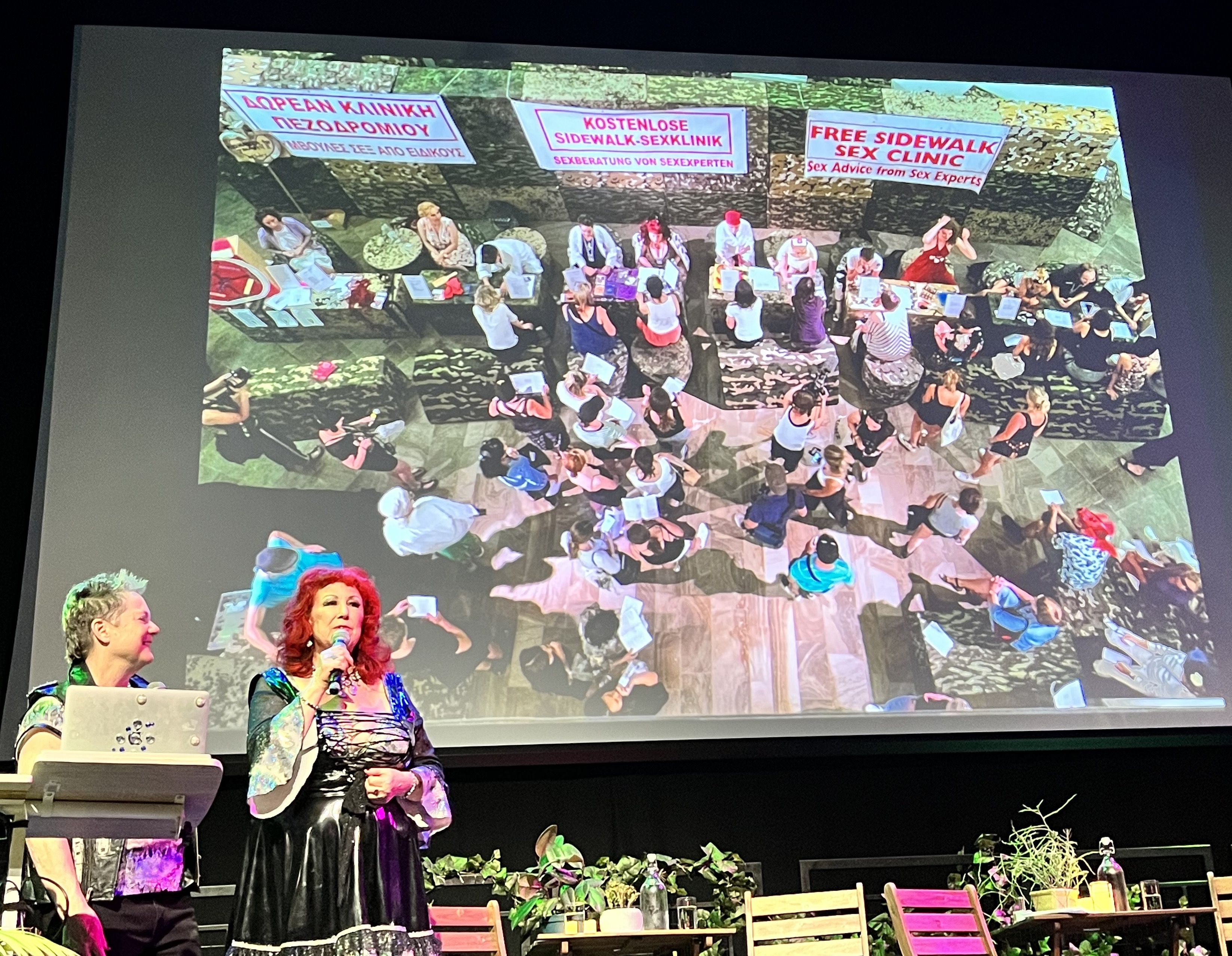
Annie and Beth started off the next morning with a whirlwind tour of their intertwined lives and art work.
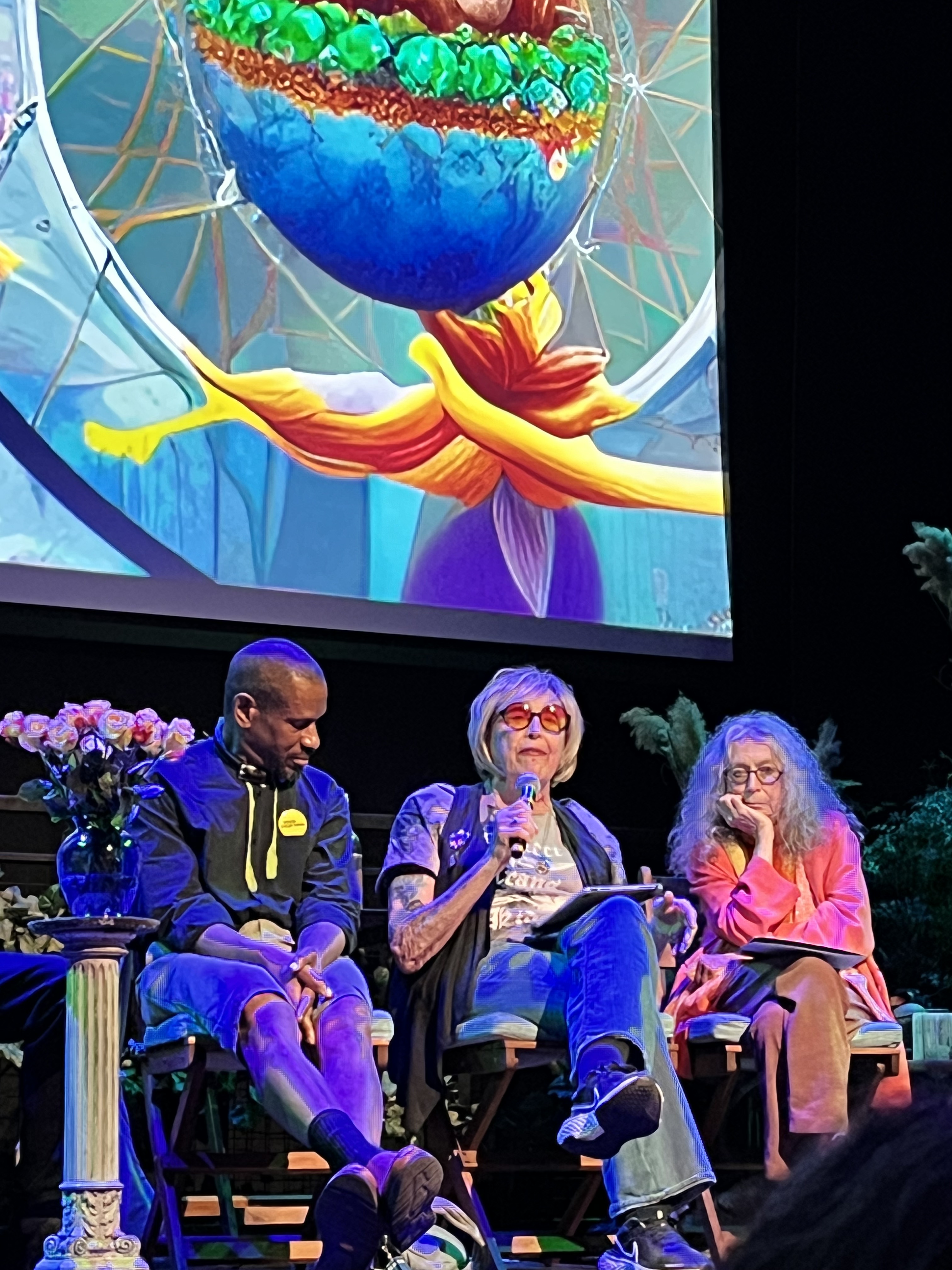
The meat of the program on Saturday were two panels. In the morning, “Strange Kin,” filmmaker Maria Yoon (The Korean Bride) showed excerpts from her new work about marrying the dead (Ghost Wedding). Queer astrologer Michael J. Morris connected the stars to the earth. Scholar Camila Marambio talked about her cancer treatment and generously noted how human researchers and patients have benefited from lab animals who have “a talent for cancer.” Urban Tantra founder Barbara Carrellas showed scenes from her practice of Equine Tantra.
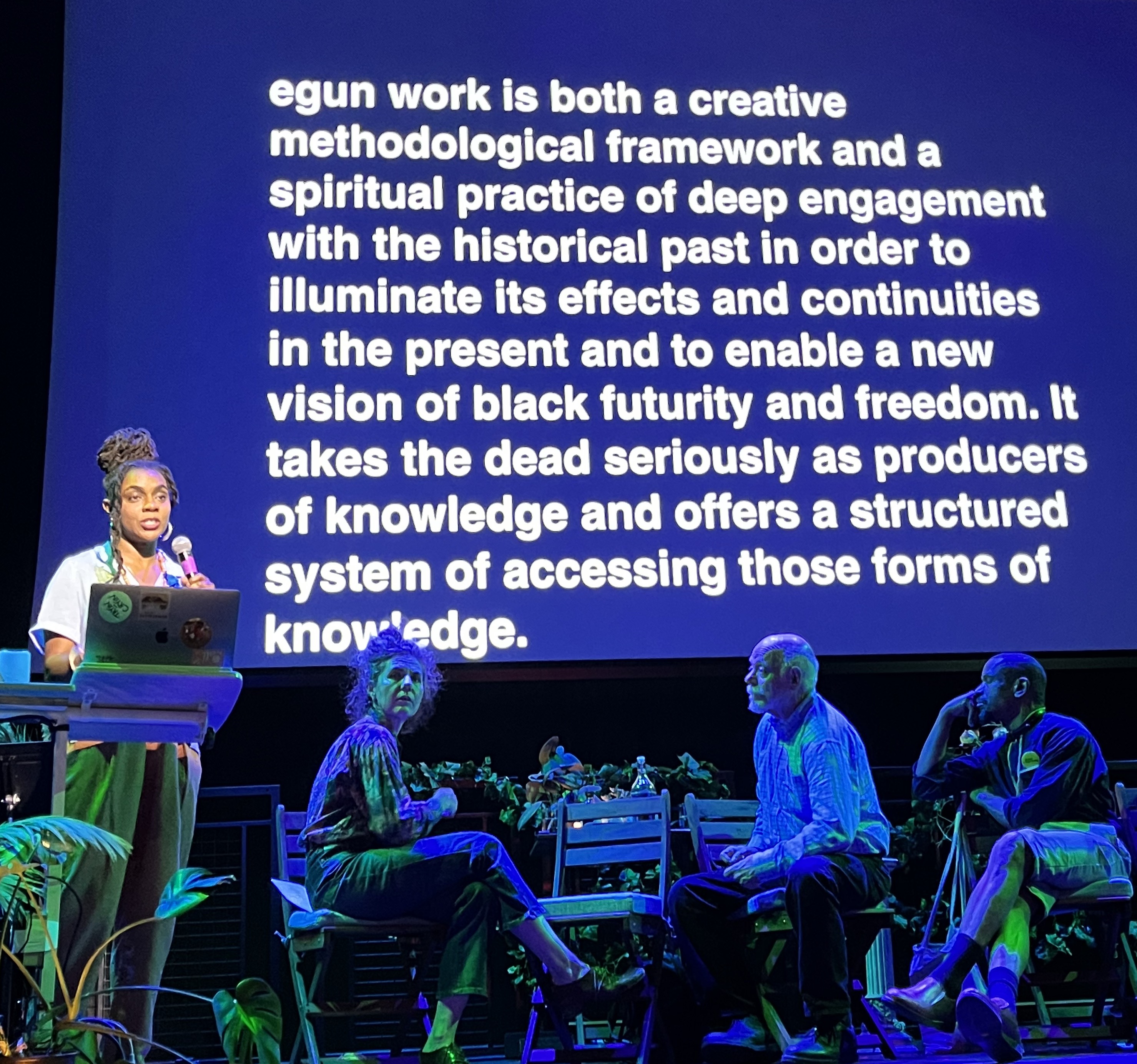
In the afternoon, “Elders & Ancestors,” charismatic Courtney Desiree Morris demonstrated working with egun, which in Santeria is understood to mean the collective spirit of all the ancestors in a person’s lineage.
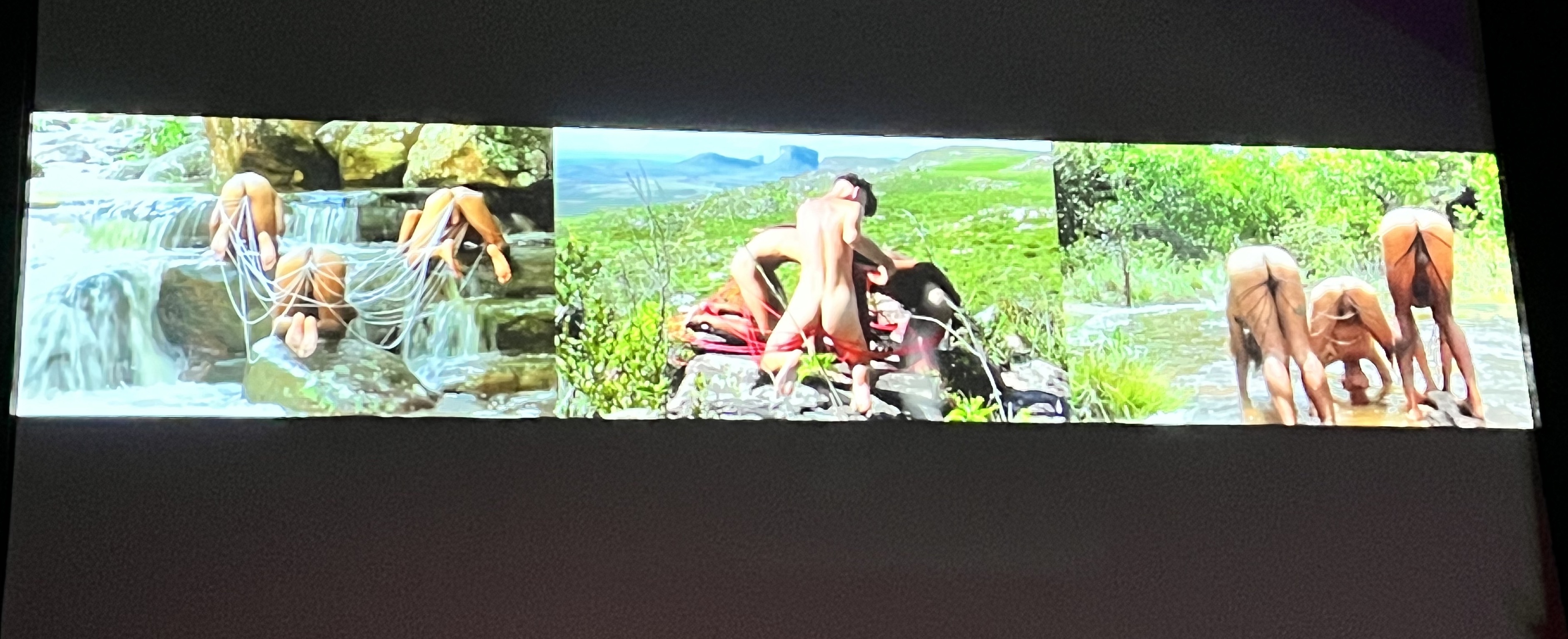
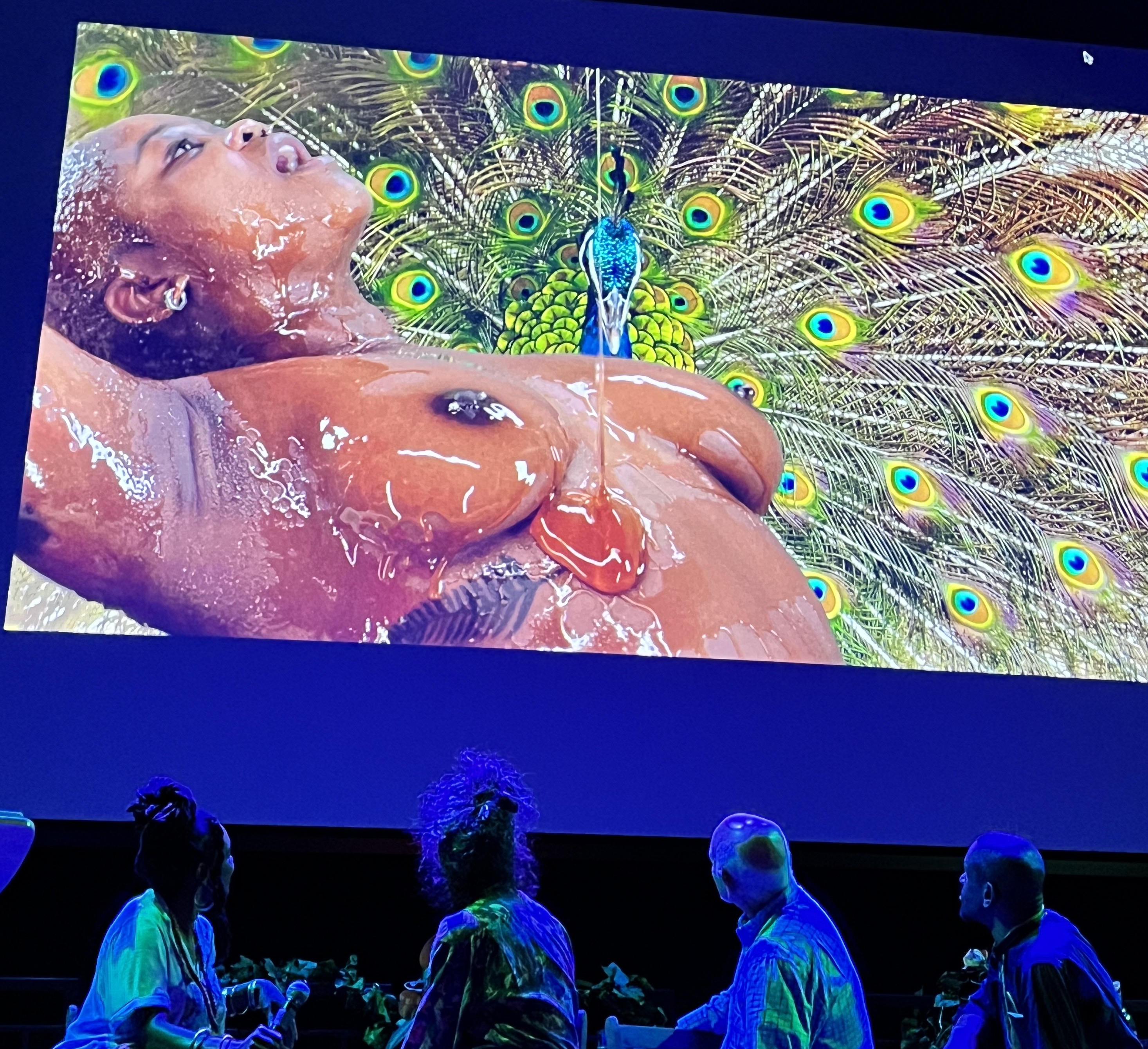
She also showed a clip from her film Oñí Ocan/The Heart of Sweetness, in which a succession of naked black bodies received a sensual libation of honey (she said they used 50 pounds of the stuff!).
Savitri D. spoke about the value of being connected to a place, while video showed a gigantic tree being cut down limb-by-limb in NYC. Sur Rodney (Sur) and Philip Ward spoke about the sacred task of maintaining the archives of departed artists (Fluxus member Geoff Hendricks and writer-performer Quentin Crisp), constantly having to distinguish sentimental value from historical value.
Trans pioneer Kate Bornstein gave an ecstatically received talk on “Exploring Gender in Four Dimensions.”
And Linda Montano, who confessed to having “panel anxiety,” schooled the audience in the art of asking for help and had the others on the panel read the text that she had written.
I was beside myself with joy at the honor of being in a room with such living legends, getting to meet the likes of Veronica Vera and Beth Stephens (in her Vaginas of Anarchy motorcycle jacket), exchanging books with Annie (she emailed in advance to say she was looking forward to fondling my new book, Daddy Lover God, which heavily features Joseph Kramer, whom she and Beth consider their husband), and hanging out with old friends and colleagues like Kim Irwin and C. Carr.
I’ve had the pleasure of communing with Annie Sprinkle at intervals over the years. I have fond memories to hanging out with her, Keith Hennessy, and AA Bronson at the 25th anniversary of Pride celebration in NYC in 1994.
I took part in the wonderfully silly “Liberty Love Boat” action in 1998 (a colorfully costumed queer invasion of the Statue of Liberty) and got to photograph her in her mermaid outfit with the great lesbian writer Sarah Schulman.
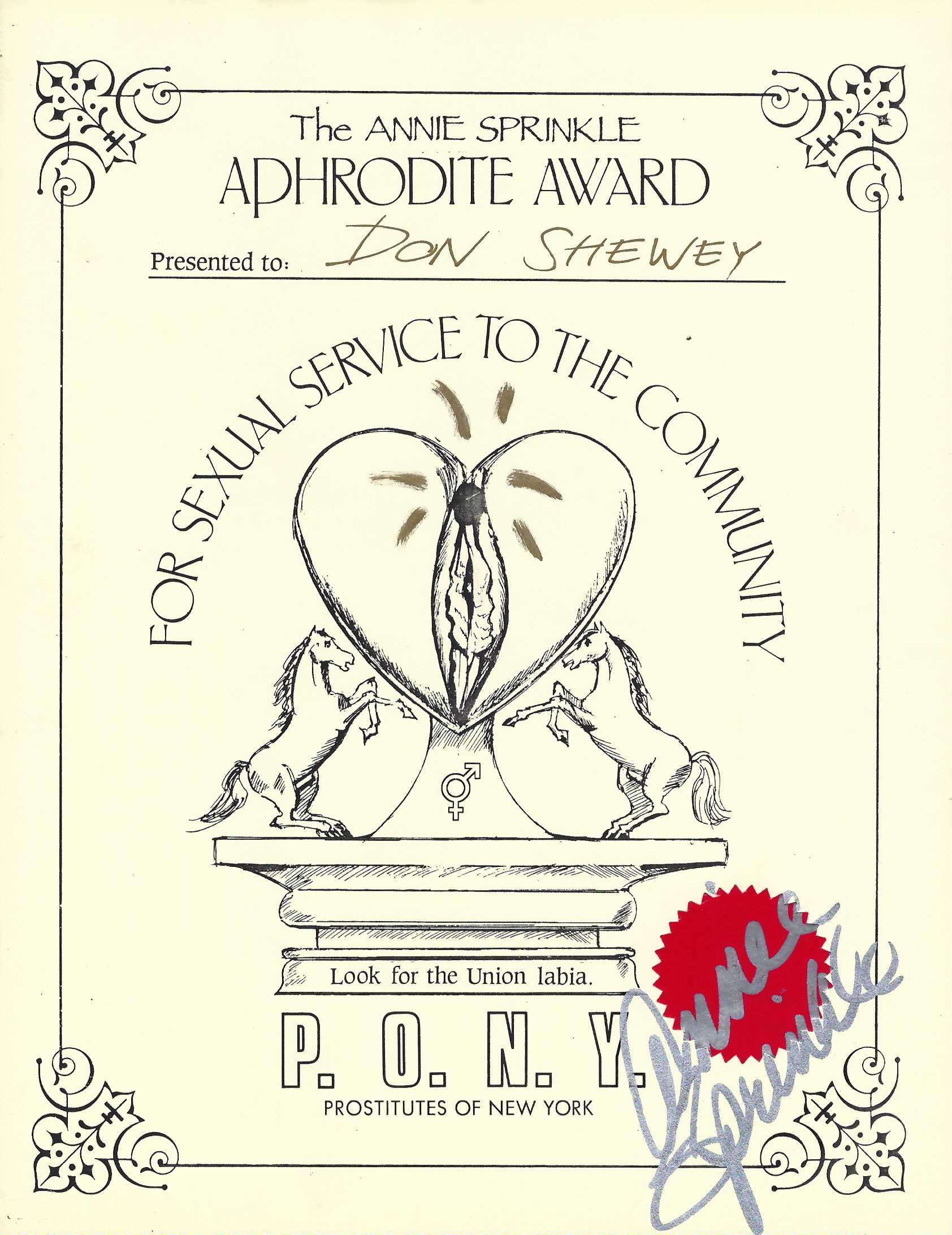
And one of my prize possessions is the Annie Sprinkle Aphrodite Award “for sexual service to the community,” given to participants in Joseph Kramer’s sacred intimate training in 1992.
I love and respect Annie so much for her courage, her honesty, her vivaciousness, her sense of humor, her deep spiritual commitment to nature, and the revolutionary way she gives herself permission to do what she thinks must be done without asking for approval from anyone.
Sad to hear of the death of Treat Williams at 71, from a motorcycle accident in Vermont. I interviewed him in 1986 for Caught in the Act: New York Actors Face to Face, a collaboration with Susan Shacter, who took the most beautiful and sexy portrait of this guy that I’ve ever seen. (A print of it hangs in my hallway art gallery.) When I met him, his hair was just starting to grow out after he shaved his head to play Ernest Hemingway for a movie that never happened. The first thing he did when I arrived for the interview was invite me to run my hand over his buzzcut, which did indeed feel very soft and lovely and, you know, flirtatious all at the same time.
I don’t mind if I’m not being taken advantage of, if they’re really unsure. Nothing’s handed to you. The only things that come easily are the things you’ve already shown you’re capable of doing. In life, you have to struggle to get what you want.
But there are other uses for auditions besides seeing if you’re right for the role. The reason you have so many meetings on a movie is often just to see if you’re emotionally compatible with the director. After all, you’ll be working together five or six months, up to fourteen hours a day.
How do you determine if you’re compatible?
First you see their work. Then you meet them. If you go to dinner with someone you’ve never met, and he starts slapping you on the back and calling you “baby,” something’s wrong. You’re interested in their approach to the work. You’re interested in the unspoken – Is he clearheaded? Is he abusive? Is he a drunk? Will he let me take chances? Will he let me use my sense of humor? Will he force me to play the character the way he sees it? Does he have a discerning eye, or will he edit out the good stuff? Does he know what kind of movie he wants to make, or is he just making a movie? None of those things are talked about, but they’re all going on.
Under the modest guise of an evening’s entertainment, Nightclub Cantata is a radical reconsideration of the musical theater form. The production, which originated at the Lenox Arts Center and won a 1977 Obie Award at New York’s Village Gate, compresses into 75 minutes a cross-cultural musical/emotional experience so stimulating and adventurous it reduces the average Broadway musical to a McDonald’s jingle.
As the title suggests, Nightclub Cantata is a hybrid of cabaret revue and classical recital, encompassing, among other things, a 1950s doo-wop number and a Sylvia Plath poem, a ridiculous takeoff on daredevil acrobatics and a terrifying reminiscence of Auschwitz. In other words – those of Elizabeth Swados, who conceived, composed, and directed the show – ”it combines the seriousness of a cantata with the frivolousness of a nightclub.” On the whole, it is the virtuosic Swados who provides the seriousness (not to be confused with solemnity) and the exuberant young company that contributes the flashy fun, but neither of these elements hints at the emotional depth of Cantata.
Early on the choral cry goes up: “I want to know this world!” And in its own way each of the 21 selections reiterates that desire. The words – some written by Swados, most by assorted 20th century poets – describe looking inward or outward for love, support, identity, knowledge. Verse by the Turkish poet Nazim Hikmet opens and closes the show with fierce affirmations of life (“Even though you fear death, you do not believe in it”), but this is not Up with People. The last hurrah is arrived at only after a zigzag journey full of tensions, struggles and epiphanies, expressed in the words of Plath, Muriel Rukeyser, Delmore Schwartz, Pablo Neruda, Carson McCullers, Frank O’Hara and others.
The poetry alone covers a vast terrain, but Swados’s eclectic score, which is far more than accompaniment, plays an active, often aggressive role, supplying irony, subtext, extra emphasis, cross-associations. She draws on natural sounds (bird calls, animal cries) and ethnic modes (Indian, Greek, Caribbean, tribal drum codes) as well as on familiar rock, blues and vaudeville forms to create a composite of musical fragments against which words or sounds are sung, chanted or delivered in unorthodox ways. The elements of Swados’s music, scored for piano, bass, and acoustic guitar, are not new, but their combination in Nightclub Cantata has few precedents, and Jacques Brel is not one of them.
Swados’s conceptual approach incessantly integrates words, music, and movement. A prime example is her treatment of Delmore Schwartz’s “In Dreams Begin Responsibilities,” Cantata’s longest and most ambitious segment. Sing-speaking the words and accenting them with simple but evocative gestures, the cast dramatizes Schwartz’s surreal short story: a young man dreams he is in a movie theater watching a silent film about his parents’ courtship. The tricky problem of maintaining a tight dramatic focus while skipping through various levels of reality is solved largely by Swados’s musical manipulations. The recitation begins in counterpoint to a steady rhythmic accompaniment, which switches to syncopation, then takes off into ricky-ticky silent-movie piano music, boogie-woogie, and finally a waltz. The music and text continually diverge and recombine without transition, preparation, or apparent logic, except that the result always seems appropriate to the moment.
The whole of Nightclub Cantata is like this: a barrage of images, musical patterns, visual embellishments and emotional disclosures. In her directorial debut, Swados has made staging choices as effective and as varied as hr material. She doubles up actors for a split-screen effect, scatters them around the theater at various levels, drives the show at a brisk pace. Sometimes, indeed, it’s too brisk; insights speed by unheard, unabsorbed. The lack of breathing space is uncomfortable at first – one wishes for the luxury of a long, lush melody or some restful repetition. Cantata requires concentration, for Swados is intent on making every detail count, on staying “in the dramatic moment” – a phrase she often uses in discussing her music, and a perfect description of the point where Nightclub Cantata’s words, music, and actors converge.
At 26, Elizabeth Swados has already established a formidable reputation on the basis of her collaborations with Rumanian director Andrei Serban. His experimental stagings of Greek tragedies (Medea, Electra, Trojan Women, and Agamemnon) have relied heavily on Swados’s knowledge of non-verbal communication and ethnic musics to recreate the power of ancient drama. When the collaboration began, Swados was a 19-year-old undergraduate at Bennington College, where her all-American pop, folk, and classical background had been eclipsed by a passion for ethnic music.
“Something in that music really moved me,” she recalls. “There was something dramatic in it that we didn’t have in our music.” Asked to score a Grotowski-style production of Everyman at Bennington, Swados created a sensation by incorporating the Indian and Polynesian music she was studying at the time. The success of Everyman led to an introduction to Ellen Stewart, founder of La Mama, New York’s experimental theater complex, and she in turn brought Swados to Serban.
“I felt like what Serban was trying to do with Greek was just what I had been looking for,” Swados says. “I was very willing to just learn and do what I was told, because I had access to a whole lot of strange music and I knew how to apply it to theatrical situations by some intuition. And that combination was good for what he wanted.” The 1972 Medea (which earned her an Obie) began a fruitful five-year period during which she collaborated with Serban on the tragedies, wrote incidental music for his productions of The Good Woman of Setzuan and The Cherry Orchard, toured Europe with several Serban productions, and traveled through Europe and Africa with Peter Brook’s Center for International Theater. She absorbed the work of these two major avant-garde directors and soaked up the music and language of various cultures.
In contrast to all this, Nightclub Cantata was “a rebellion,” Swados says. “It was a combination of paying respect to everything that I’ve learned from Brook and Serban, but it was also saying, ‘Enough of these classics! Let’s do something about people now.’ My whole sensibility has been based on non-verbal communication and ancient languages, and I don’t deny the absolute value of that, but I had to do something more political, more contemporary, something that relates on a more overt level.”
One wonders how the creator of such an uncommon musical entertainment relates to traditional Broadway fare. “I love it if it’s good. I can’t stand it if it’s bad. Literally, I get – you don’t want to print this, but I get diarrhea if I go to a musical that’s bad. I get so angry that head doesn’t register it – my stomach does and I have to leave and go shit my guts out. Because it’s more bad information going into the human system that’s already been poisoned beyond belief. There’s so much in American musical theater that’s just schlock that gets across as art because somebody can whip out an easy tune or has a cute psychological insight into sex or drugs or something modern like that. And they rip people off, because people see it and think, ‘Oh, I’m enlightened.’ There’s this kind of easy psychology that gets sent back and forth between audience and performer, and everybody gets away with nothing and nobody learns anything.”
Swados’s resistance to “easy” music-making is also the source of her main limitation, one to which she readily admits. “I haven’t found a way to compose something with an extremely rich melody, a tune. I think it’s very important because it soothes people, but I always prefer a kind of percussive performance of things. I think because I’m young, I’m angry-ish, I’m a little nervous, my music tends to be overly energetic sometimes. I’ve just sort of snobbed myself out, and I’m working on that. The next project I’m doing is with kids – 16, 17, 18 – and I hope I’ll unsnob myself. I’ll be using whatever music they like: salsa, punk rock, whatever.”
ADDITIONAL INTERVIEW:
What kind of music did you study and write when you were a kid?
I wrote calypso music, for some strange reason, and horror-movie music. We had piano, and when I was 12 I got a guitar. My family listened to Kurt Weill and Frank Sinatra, Harry Belafonte, and my mother loved this group called the Eloise Trio, which she played all the time. She’s flippo about Barbra Streisand. It wasn’t until I got to college that I got into ethnic music. There was something dramatic in it that we didn’t have in our music. Our pop singers seem to be emotionally rather vapid, and I wasn’t really moved. So I got really excited when I went to Africa and heard all this Arabic music with all these complexities.
I went to Bennington for three years, but they’re very supportive of students who have good things to do. They gave me a grant to go down to West Virginia to live with a family and explore the mining situation. Then I wanted to go to Wesleyan and study Indian music, because they had an ethnic music program, and Bennington gave me credit for that. When I went to La Mama and started living in New York half the time, they gave me credit. I didn’t ever really finish there, but they gave me a degree. There was a time after the Kent State massacre that I felt very absurd being in Vermont. I felt the guilt of all middle-class children at that time. But I was already aligned with non-violence. I wrote to Pete Seeger, and he invited me to come work on his sloop, and Bennington let me go. In some way my life has been graced by very understanding, supportive people, because what they’ve gotten in return has been a lot of hard work. I have a gift, you know. But I’ve also been lucky, because there are lots of people who have gifts who don’t get the breaks I have.
How did you get involved with La Mama?
There was a Grotowski teacher at Bennington, a Belgian guy, and I was taking acting at the time. He was doing all these headstands and shoulder-stands and back-stands and nose-stands, inner leaps, and physically, I couldn’t do it. It was killing me. So I said to him, “I would still like to work with you, but I don’t want to do this anymore.” He said, “Why don’t you write music for my play?” He was doing Everyman, and that was really the beginning of it, because I was studying the South Indian vina, so I put that in the show and this thing called a kinjura – sort of an Indian tambourine – and kalimbas, things that were very unusual for 1971, and he was very excited that I was applying this strange music to Western theater. His next stop after Bennington was La Mama, and he took me along and introduced me to Ellen Stewart. She “beeped” on me, as she calls it, and she said I would be one of her babies and supported me for five straight years. She introduced me to Andrei Serban and just made me alive.
With Serban, it just worked automatically. There was no conflict of territories at the time, until I got older and more ornery. I was 19 when we met, and I was very willing to just learn and do what I was told.
The whole idea of what a musical is is something that really fascinates me. You go to Brazil during Carnival – that’s the kind of musical event that really fascinates me. And like in Africa, they dance our stories and stuff like that. People here have begun to pick up on that kind of thing, like the Bread and Puppet Theater. I’m also interested in how to use a song for storytelling and humor. I’m interested in redefining the conventions of musical comedy, although I don’t really know what those are.
Everything except language knows the meaning of existence. Trees, planets, rivers, time know nothing else. They express it moment by moment as the universe.
Even this fool of a body lives it in part, and would have full dignity within it but for the ignorant freedom of my talking mind.
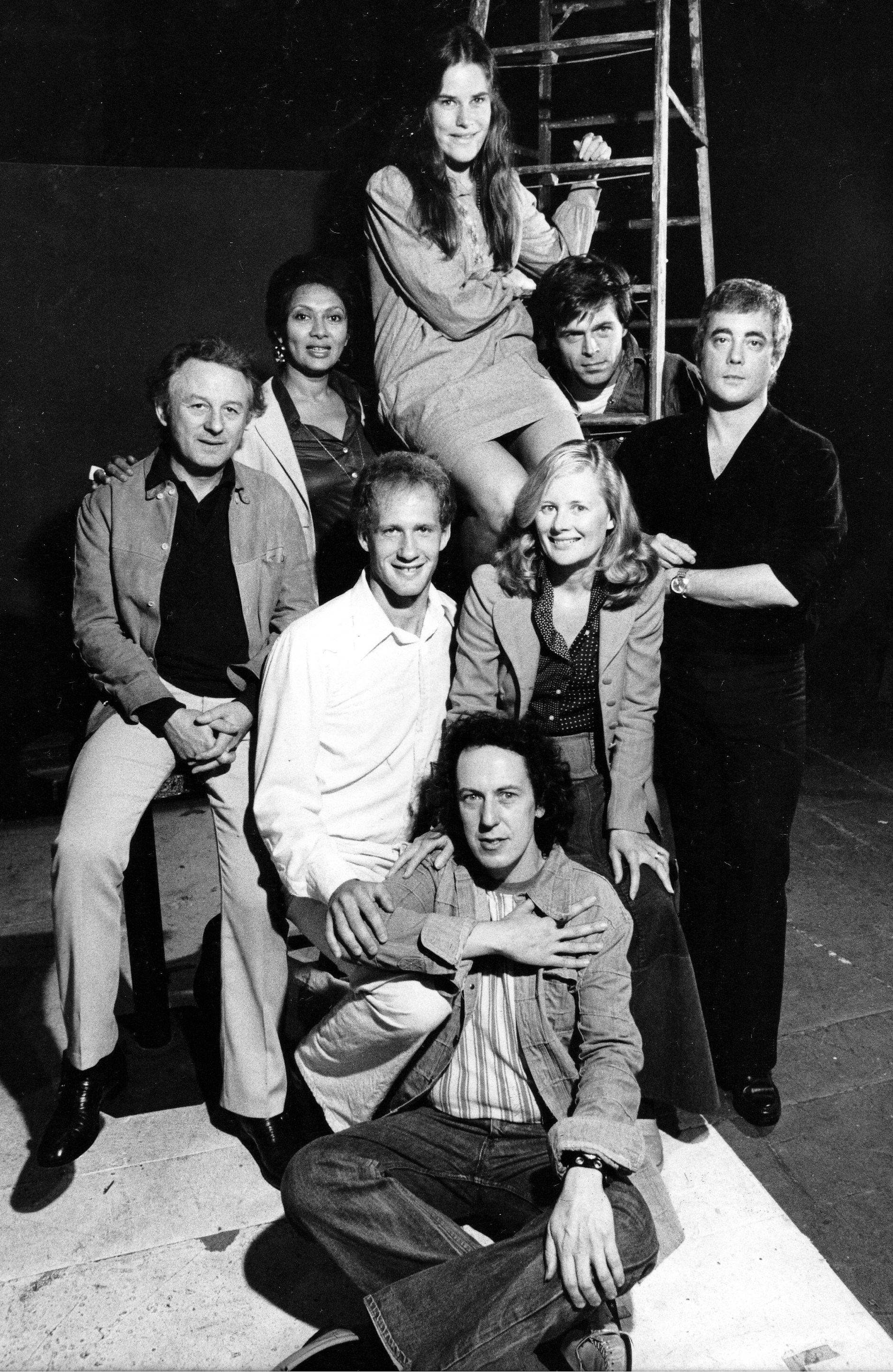
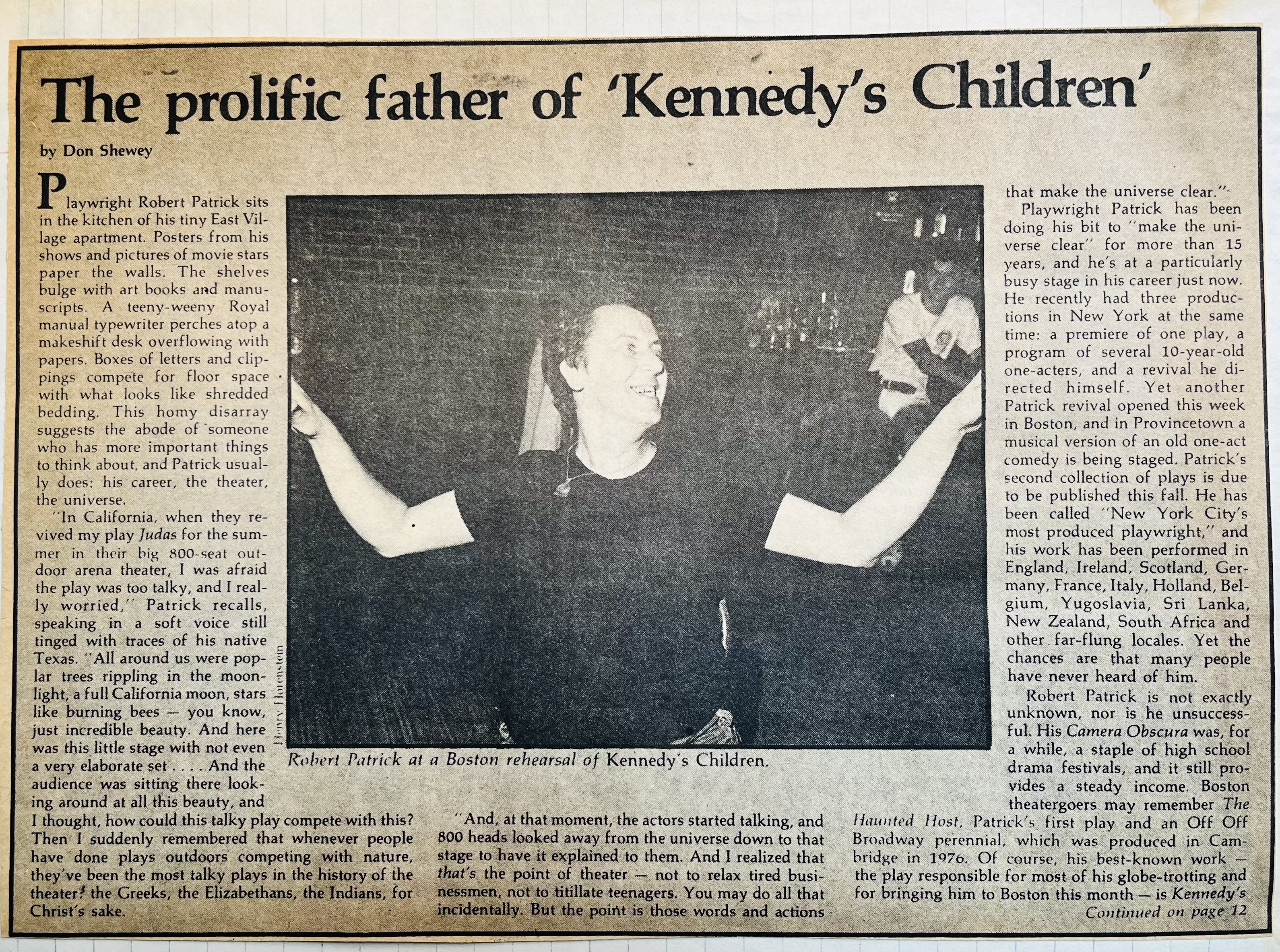
The gay theater pioneer Robert Patrick had a huge impact on me as a young journalist. He was one of the prolific early contributors to Off Off Broadway, but weirdly I first encountered his work at the time of his one and only Broadway production, a wonderful play called Kennedy’s Children, which I saw in its pre-Broadway tryout at the Wilbur Theater in Boston in 1975. (See photo below of the playwright with his cast, which included some legendary performers: Shirley Knight, Barbara Montgomery, Kaiulani Lee.) The following year, someone mounted a revival of his very first play, The Haunted Host, at the equivalent of an Off-Broadway theater in Boston, starring the force of nature that is Harvey Fierstein. That show blew my mind. I got to know Bob a little and saw and admired many of his plays, including Judas, T-Shirts, and My Cup Ranneth Over. He was an unforgettable character who left a big imprint on the gay theater worlds in New York, Los Angeles, and beyond.
Playwright Robert Patrick sits in the kitchen of his tiny East Village apartment. Posters from his shows and pictures of movie stars paper the walls. The shelves bulge with art books and manuscripts. A teeny-weeny Royal manual typewriter perches atop a makeshift desk overflowing with papers. Boxes of letters and clippings compete for floor space with what looks like shredded bedding. This homey disarray suggests the abode of someone who has more important things to think about, and Patrick usually does: his career, the theater, the universe.
“In California, when they revived my play Judas for the summer in their big 800-seat outdoor arena theater, I was afraid the play was too talky, and I really worried,” Patrick recalls, speaking in a soft voice still tinged with traces of his native Texas. “All around us were poplar trees rippling in the moonlight, a full California moon, stars like burning bees — you know, just incredible beauty. And here was this little stage with not even a very elaborate set…And the audience was sitting there looking around at all this beauty, and I thought, how could this talky play compete with this? Then I suddenly remembered that whenever people have done plays outdoors competing with nature, they’ve been the most talky plays in the history of the theater: the Greeks, the Elizabethans, the Indians, for Christ’s sake.
“And, at that moment, the actors started talking, and 800 heads looked away from the universe down to that stage to have it explained to them. and I realized that that’s the point of theater — not to relax tired businessmen, not to titillate teenagers. You may do all that incidentally. But the point is those words and actions that make the universe clear.”
When I interviewed him for this article, we covered a multitude of topics. He did like to talk! I got more material than I could possibly use, but there are a few passages I think are worth sharing — the equivalent of DVD extras.
On Judas: “I wrote the play in one night. I then read books for five years to understand the play. And out of 500 books, for 10 books I would get only one line, but that was all right, it clarified one scene. History, history of religion books, history of history books, Bibles, Korans, Confucius, Tao, Madame Blavatsky, theosophy, Chariots of the Gods, Worlds in Collision, African Genesis, and a million tracts, pamphlets, secret societies, crazy magazines on man, myth and magic, anything anyone handed me on the street. Eventually everything related to it. That’s what happens when you’re really researching. It wasn’t til the very last screaming raving draft of the play that the words finally came into Pilate’s mouth at one time: ‘You may think that a young man’s only concerns are sex and food, sleep and sports, but you are wrong, wrong. A young man’s main concern is morality. A young man wants to be good, to make good. That is why young men are so obsessed with authority, with testing it or protesting. They want someone to show them or tell them how to be or not to be good.’ The point being that people want morality, that morality is a stronger urge than sex, country, race, love, food. People will die to feel they’re doing right. They’ll kill. Convince someone that something is good and he will die trying to do it.”
On the future: “It’s pretty inevitable that we’re in for immense regimentation. But what will happen in our heads? Will the very idea of freedom have any meaning? This is the first age in the history of the world when people have even considered the possibility of freedom or the importance of the individual or the value of the intellect. We’re in the pioneering time as far as the existence of the importance of the individual mind and soul are concerned. And it may be the last. The whole experiment may have failed. The whole renaissance may have been proved to be a very unworkable idea. As more and more people survive and live, it may be absolutely impossible for them to have any individuality. It may be too grating. Too many people go too crazy for us to doubt it. It may be we’re evolving toward termite people – good, solid, unthinking functionaries. The overall sketches of totalitarianism have been made; it works pretty well. All you have to do now is make people love it or take away from them the idea that they need to love anything.
“On the whole I don’t think they’re going to want much thought in the decades to come. As I say, things work pretty well, the machines make enough food for people, etc. etc. I don’t think people want thought beyond that. They want the novelty of art, but even that they’re willing to surrender; after adolescence, they’re content to lull themselves to sleep with slight variations on the TV. Thought is the enemy of the state; and ‘the state’ is the same no matter what it’s called. I don’t like thinking all that, but it seems to be the logical next step unless there’s a war or something that wipes out so many millions of people that a lot of creative thinking is needed. But we certainly do live in an interesting time. A time of collapse like this is fascinating for an artist because when a thing collapses you see its most intimate structure. By the time America collapses, we will see whether the rot is really at the roots or whether it’s some corruption that’s crept into the American idea that’s made everything go wrong.”
On gay life in 1979: “Anyone who spends any time in the gay section of New York comes out of it saying, ‘This can’t go on.’ Not even morally. One reason I live in such isolation in New York is that the alternative, if I were to run around with the people I know – and I know thousands – would be to spend all my time as drugged and drunk as I could financially and physically afford to get every night and be discoing or fucking in backroom bars until I staggered home and got dressed to go to a job. That is how they live. They do not even see the possibility of any other kind of life. And the suggestion that they might be able to lead another kind of life is met with jeering cynicism. I mean, that cannot go on. People will be dying in those bars, if they are not already, from the amount of drugs those people are taking, the amount of sexual exertion. I have no close friends in New York because I’ve stepped out of the drug-and-drink cycle. Almost everyone I know lives for drugs and drink. People keep telling me there’s another world. I don’t know about it. I don’t meet anyone from it.”








 another eye opens