From the deep archives: Chay Yew

April 6, 2010

Seeing Chay Yew’s production of Kia Corthron’s play reminded me that I interviewed him for The Advocate in 1999. I’m re-posting that story here and on my website:

NOTHING COMPARES TO YEW

“Gay theater has become more diverse in terms of aesthetics and stories,” says playwright Chay Yew. “But let’s face it. How many gay plays are being done? Quite a few. Who are they about? Beautiful young white men. And they’re usually not deep. They affirm the image we want of ourselves, or they’re titillating. There’s a place for that, but it’s not my kind of gay theater.”

The 33-year-old playwright, who was born in Singapore but grew up in the U.S., got his first hit of gay theater from seeing Larry Kramer’s The Normal Heart. “I came out utterly moved, rejuvenated, and angry,” he recalls. Still a communications major at Boston University, he wrote his first play, Porcelain, about a young Asian man who kills the would-be lover he meets in a public toilet. His second play, A Language of Their Own (which received a stellar production at New York’s Public Theater in 1995), portrays a gay Asian-American couple who break up when one discovers he’s HIV-positive. Next August the La Jolla Playhouse in San Diego will mount Wonderland, a play in monologue form about an Asian-American couple and their gay son who gets kicked out of the house by his father and takes to drugs and hustling.

Currently on the boards at New York’s Manhattan Theatre Club is Red, in which a best-selling Asian-American novelist tracks down a former star of the Beijing Opera, a gay father famous for playing female roles.

Yew says he originally wanted Red to make a connection between the Cultural Revolution that destroyed a generation of Chinese artists and Newt Gingrich’s attempt to abolish the National Endowment for the Arts. But he also jokes that he wanted to write “a big chinky play” that would impress 60-year-old regional theatergoers. Inevitably, though, “it’s a very gay play,” he says, “because it’s about divas. All the characters are passionate about their art. Sort of like All About Eve.”

April 13, 1999


Performance diary: SONDHEIM ON SONDHEIM, A COOL DIP IN THE BARREN SAHARAN CRICK, and THE BOOK OF GRACE

April 6, 2010


March 31 –
Somehow I thought Sondheim on Sondheim was going to be just a concert, a variation on Side by Side by Sondheim with a somewhat bizarre array of Broadway singers: veteran Barbara Cook, TV star turned trouper Tom Wopat, pop star Vanessa Williams, Taboo star Euan Morton, industry favorite Norm Lewis, and up-and-comers Leslie Kritzer, Erin Mackey, and Matthew Scott. I was shocked when suddenly there was video of Sondheim himself (beautifully shot in high-def) talking about his life, the shows, songwriting, theater, and his collaborators – a cross between a documentary and a master class. It’s a little slow and flat at first. The first act is basically and-then-he-wrote, somewhat generic, a lot of the information pretty familiar to Sondheim fanatics. The second act feels a little less predictable and more substantial. And there are revelations along the way – personal revelations, most notably the composer talking with astonishing intimacy about his relationship with his toxic narcissistic mother Foxy and how Oscar Hammerstein provided the parenting he needed to survive; but also revealing commentary about the shows and his retrospective thoughts about them. Merrily We Roll Along’s Franklin Shepard points directly to Hal Prince (I didn’t realize until intermission that it was a bespectacled and somewhat chubbed-up Euan Morton singing “Franklin Shepard, Inc.” – very well, by the way), and Sondheim says the only song he’s ever written that he would consider strictly autobiographical is “Opening Doors,” which is about his relationship with Mary Rodgers and a composite of Arthur Laurents and Burt Shevelove. He also says that Assassins is the only show of his he can look back on and not find anything he would change – the rendition of “Something Just Broke” delivered by this ensemble is one of several high points. This revue (conceived and directed by James Lapine, whom Sondheim obviously trusts to the nth degree) makes a good case for the underrated Passion in a long sequence featuring Cook as Fosca. She’s ever-so-slightly shaky at times – she is, after all, 82 years old! – but another high point of the evening is Sondheim’s succinct disquisition on the difference between a poem and a song lyric, followed by Cook singing “In Buddy’s Eyes,” which illustrates his points precisely. Vanessa Williams impressively understates “Losing My Mind” (and has the guts to sing it sitting a few feet away from Cook, who’s owned it for years) and does a great job with the song Sondheim wrote for Diana Rigg to sing in the London production of Follies, “Ah, But Underneath.” Andy and I both responded to its fiendishly clever lyric, especially this verse:

In the depths of her interior
Were fears she was inferior.
And something even eerier.
But no one dared to query her superior exterior.

The most emotionally involving portion of the show had to do with the creation of Company, an opportunity for Sondheim to talk about his own experience of relationships, briefly alluding to his conflicted experience of being gay and revealing that he sat Mary Rodgers down and took notes on a yellow legal pad while he interviewed her about her two marriages to collect ideas for the show. And then we get to hear the three different finales he wrote for Company (“Marry Me a Little,” “Happy Ever After,” and “Being Alive”) – something that numerous Sondheim revues have done but never more effectively. I was in tears by the end. For all the zillion times I’ve heard singers belt their way through “Being Alive,” no one has ever sung it better than Norm Lewis (a handsome, super-talented actor-singer who is just one key role away from being a superstar). The climax of the song almost always come across a little screechy, but not in this show – Lewis delivers it so creamily as if the high notes are right in the middle of his range.

April 2 – Kia Corthron takes on one big sociopolitical issue with each of her plays, and with A Cool Dip in the Barren Saharan Crick it’s water, considered from 19 different points of view. A young theology student from a Ethiopian village with no indoor plumbing can’t stop flushing the toilet even though his host family in suburban West Virginia is trying to be super-conscientious during drought season….dams being built to siphon off and sell electricity after flooding towns and relocating whole populations…bottled water and its implications (the fallacy of safety, empties going to landfill rather than recycling, bottling plants creating jobs but also noise and air pollution)…the commodifying of natural resources…baptism and other spiritual uses for water…Dr. Emoto’s experiments with the impact of positive and negative statements on water samples…all this and more is crammed into the two and a half hour play. Not one of Corthron’s finer moments, sorry to say. The dialogue and exposition are unusually clunky, not helped by playwright-director Chay Yew’s clumsy staging. Cool Dip comes across as a somewhat tedious term paper – not scintillating theater, but I will say I got something out of the term paper. I’m definitely on the same page as Corthron about bottled water and have long been on the same campaign against it. New York City tap water is extraordinarily drinkable, and free! Corthron inevitably asserts influence on everybody’s conscience in her vicinity – the concession stand at Playwrights Horizons sells no bottled water but provides free drinking water and paper cups with a bin for not just recycling but composting the used cups. (see below) Who knows how long that system will continue, but I applaud the effort. I went with Marta, the Norwegian sex therapist, who is gratifyingly game to attend serious drama, even when it’s not great, like tonight. We met Andy afterwards at Marseille and polished off two bottles of a delicious white Bordeaux.

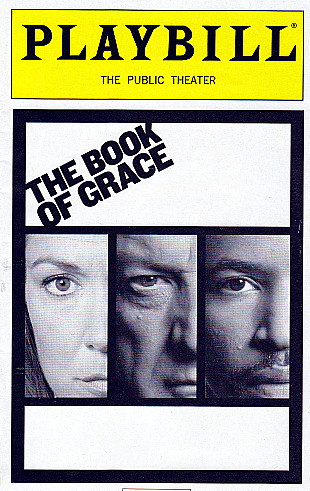
April 3 – Suzan-Lori Parks is another playwright I’m always interested to follow, to see what her quirky poetic theatrical mind is cooking up these days. In recent years she’s veered away from her early Gertrude-Stein-meets-Adrienne-Kennedy explosions toward more conventional drama. She won a Pulitzer for Topdog/Underdog, her most straightforward play, and with The Book of Grace at the Public Theater (formerly titled Snake) she’s strayed into pulpy B-movie territory, fiddling around with clichéd characters in soap-operatic situations with an overlay of less-than-convincing political commentary. I found the play pretty ludicrous and felt sorry for the actors playing Mean White Military Guy (John Doman), Perky Abused-in-Denial Sex-Starved Waitress Wife (Elizabeth Marvel, no less), and Angry Abused Sneaky Criminal Black Guy (Amari Cheatom).


Quote of the day: ANGER

March 30, 2010

ANGER

Focused with precision, anger can become a powerful source of energy serving progress and change. And when I speak of change, I do not mean a simple switch of positions or a temporary lessening of tensions, nor the ability to smile or feel good. I am speaking of a basic and radical alteration in those assumptions underlining our lives.

Audre Lorde


Photo diary

March 28, 2010

my beloved garlic press

Linda Mironti next to her photo, "Porta Rossa," in the Il Chiostro art show

McDonald's has entered the 21st century, design-wise!

Andy on Mulberry Street

detail of NYU monument


Quote of the day: COMMUNICATION

March 28, 2010

COMMUNICATION

In many American universities, there is a course called Communications Skills. I am not certain what they teach, but I hope it includes the art of deep listening and loving speech. These should be practiced every day if you want to develop true communications skills. There is a saying in Vietnamese, “It doesn’t cost anything to have loving speech.” We only need to choose our words carefully and we can make other people very happy. The way we speak and listen can offer others joy, happiness, self-confidence, hope, trust, and enlightenment . . .

Suppose your partner says something unkind to you, and you feel hurt. If you reply right away, you risk making the situation worse. The best practice is to breathe in and out to calm yourself, and when you are calm enough, say, “Darling, what you just said hurt me. I would like to look deeply into it, and I would like you to look deeply into it, also.” Then you can make an appointment for Friday evening to look at it together. One person looking at the roots of your suffering is good, two people looking at it is better, and two people looking together is best.

I propose Friday evening for two reasons. First, you are still hurt, and if you begin discussing it now, it may be too risky. You might say things that will make the situation worse. From now until Friday evening, you can practice looking deeply into the nature of your suffering, and the other person can also. While driving the car, he might ask himself, “What is so serious? Why did she get so upset? There must be a reason.” . . .  Before Friday night, one or both of you may see the root of the problem and be able to tell the other and apologize. Then on Friday night, you can have a cup of tea together and enjoy each other. If you make an appointment, you will both have time to calm down and look deeply. This is the practice of meditation. Meditation is to calm ourselves and to look deeply into the nature of our suffering.

When Friday night comes, if the suffering has not been transformed, you will be able to practice the art of Avalokiteshvara — one person expressing herself, while the other person listens deeply. When you speak, you tell the deepest kind of truth, using loving speech, the kind of speech the other person can understand and accept. While listening, you know that your listening must be of a good quality to relieve the other person of his suffering. A second reason for waiting until Friday is that when you neutralize that feeling on Friday evening, you have Saturday and Sunday to enjoy being together . . .

Loving speech is an important aspect of practice. We say only loving things. We say the truth in a loving way, with nonviolence. This can only be done when we are calm. When we are irritated, we may say things that are destructive. So when we feel irritated, we should refrain from saying anything. We can just breathe. If we need to, we can practice walking meditation in the fresh air, looking at the trees, the clouds, the river. Once we have returned to our calmness, our serenity, we are capable again of using the language of loving kindness. If, while we are speaking, the feeling of irritation comes up again, we can stop and breathe. This is the practice of mindfulness.

The practice of Avalokiteshvara Bodhisattva is to listen very deeply to every kind of sound, including the sound of pain from within and from without. Listening to the bell, the wind, the water, the insects, and all living beings is part of our practice. When we know how to listen deeply and how to breathe deeply in mindfulness, everything becomes clear and deep.

To meditate is to look deeply into the nature of things, including our own nature and the nature of the person in front of us. When we see the true nature of that person, we discover his or her difficulties, aspirations, suffering, and anxieties. We can sit down, hold our partner’s hand, look deeply at him, and say, “Darling, do I understand you enough? Do I water your seeds of suffering? Do I water your seeds of joy? Please tell me how I can love you better.” If we say this from the bottom of our heart, he may begin to cry, and that is a good sign. It means the door of communication may be opening again.

True love includes the sense of responsibility, accepting the other person as he is, with all his strengths and weaknesses. If we like only the best things in the person, that is not love. We have to accept his weaknesses and bring our patience, understanding, and energy to help him transform . .

You may have the impression that you know everything about your spouse, but it is not so. Nuclear scientists study one speck of dust for many years, and they still do not claim to understand everything about it . . . Driving the car, paying attention only to your own thoughts, you just ignore your spouse. You think, “I know everything about her. There is nothing new in her anymore.” That is not correct. If you treat her that way, she will die slowly. She needs your attention, your gardening, your taking care of her.

We have to learn the art of creating happiness . . . The problem is not one of being wrong or right, but one of being more or less skillful. Living together is an art. Even with a lot of good will, you can still make the other person very unhappy. Good will is not enough. We need to know the art of making the other person happy. Art is the essence of life. Try to be artful in your speech and action. The substance of art is mindfulness. When you are mindful, you are more artful.

— Thich Nhat Hanh, Teachings on Love