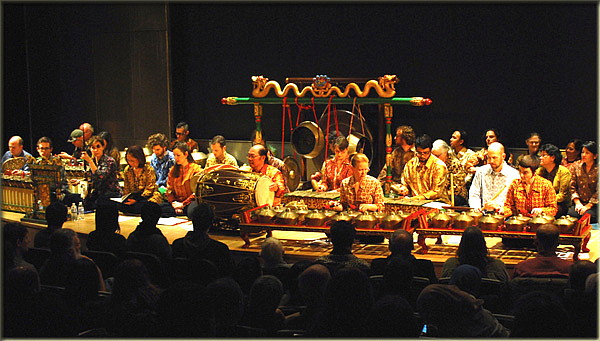
Event: Gamelan Kusuma Laras, December 11 & 12

November 29, 2010


Several months ago, I finally got up the nerve to seriously pursue my interest in learning to play gamelan, which is a kind of Indonesian percussion ensemble that makes a distinct and hauntingly beautiful music. By great good fortune (thanks to Rachel Cooper, director of programming at the Asia Society), I found my way to Gamelan Kusuma Laras (above) and have been studying and rehearsing with this group, which takes its repertoire from Javanese gamelan (specifically from Solo in Central Java). And now I’m getting the chance to perform with the group in two concerts at the Indonesian Consulate on East 68th Street. As a beginner, I will be playing on only one number but singing on three others (in a large chorus — in ancient Javanese!). Please come!

Gamelan Kusuma Laras
New York City’s Premier Javanese Gamelan Ensemble
Presents Music and Dance of Central Java

Directed by I.M. Harjito
with Triwik Harjito and Shoko Yamamura, Guest Dancers

Saturday, December 11 at 8 pm
Sunday, December 12 at 3 pm

Consulate General of the Republic of Indonesia
5 East 68th Street, between Fifth and Madison Avenues
Suggested Donation: $20

Tickets may be reserved by contacting nygamelan@gmail.com

Originally formed 26 years ago, Gamelan Kusuma Laras has entranced audiences in the United States and  Indonesia with its authentic performances of music, dance and theater from the classical repertoire of the courts of Central Java.

The ensemble has been active in the New York City cultural scene since its inception, performing at the Arts at St. Ann’s in Brooklyn, the American Museum of Natural History, the Metropolitan Museum of Art, the Whitney Museum, Symphony Space, Brooklyn Academy of Music, the Bronx Zoo of the Wildlife Conservation Society, Bard College, Vassar College, Wesleyan University, Princeton University, the Cathedral of St. John the Divine, Cooper Hewitt Museum, Lincoln Center Out-of-Doors Festival, and the Jogjakarta International Gamelan Festival, to name a few.

For this concert, Triwik Harjito and Shoko Yamamura will be performing Adaninggar Kelaswara, a Javanese dance that depicts a duel between two female warriors: Adaninggar, a Chinese princess, and Kelaswara, a Javanese princess.

“…shifting timbres that floated and surged in a mesmerizing flow”
-The New York Post

“…a skilled ensemble…a treat to watch.”
-The New York Times


From the deep archives: J. R. Ackerley’s WE THINK THE WORLD OF YOU

November 29, 2010

One of my favorite movies of the year so far has been My Dog Tulip, based on the book by J. R. Ackerley, a somewhat obscure but much-admired gay man of letters in the last half of the 20th century. Watching it twice, thinking about it, and talking it over with friends has sent me back to the review I wrote in the Soho News in 1981 of what was then the newly-issued paperback edition of Ackerley’s novel, We Think the World of You. The novel has since been made into a fine little movie starring Alan Bates and Gary Oldman. My review is one of my favorite things I ever wrote. I happened to have personal connections at the time to the artist Don Bachardy, Christopher Isherwood‘s longtime partner, who I knew had made one of his famous portraits of Ackerley, and I landed what I thought was a major coup by getting Bachardy to let us publish his picture (see below) with my review.


Photo diary: Thanksgiving

November 29, 2010

we had an untraditional Thanksgiving dinner. let's just say it wasn't turkey....

there were a few side effects, but they didn’t last long

Darcy works for Martha Stewart, so she brought the dessert -- a homemade apple crostada

we hired someone from Fleshbot to clean up while we played a board game, Settlers of Catan

it was my first time playing -- and I won!


In this week’s New Yorker

November 28, 2010

Trust Alex Ross to turn me on to some fascinating corner of contemporary classical music previously unbenownst to me. Now I know something about Swiss composer Georg Friedrich Hass, whose Third String Quartet, Ross says, “makes such extreme demands on players and audience alike that at one concert in Pasadena listeners were required to sign a waiver absolving the venue of legal responsibility….”

The work is subtitled “In iij. Noct.,” a reference to the Third Nocturn of the old Roman Catholic Tenebrae service for Holy Week, which marked Christ’s sufferings and death with the gradual extinguishing of candles. Haas, who grew up in Tschaugguns, a Catholic village in the Austrian Alps, asks for total darkness during performances of his quartet, the score specifying that even emergency lights should be covered.
In September I saw, or didn’t see, a performance [by the JACK quartet] at the Austrian Cultural Forum, on East Fifty-second Street. When the blackout began, I initially felt a fear such as I’ve never experienced in a concert hall: it was like being sealed in a tomb. No wonder the members of JACK usually try out a brief spell of darkness with each audience, to see if anyone exhibits signs of distress. (Indeed, one young man sheepishly got up and left.) yet the fear subsides whne the music begins. The perfoemrs who are positione din the corners of the room, seem to map the space with tones, like bats using echolocation to navigate a lightless cave. They have memorized the socre in advance, and it is an unusual document: Haas sets out eighteen musical “situations” — with detailed instructions for improvising on pre-set motifs, chords, and string textures — and a corresponding series of “invitations,” whereby the players signal one another that they are ready to proceed from one passage to the next.
Often, the music borders on noise: the strings emit creaks and groans, clickety swarms of pizzicato, shrill high notes, moaning glissandos. At other times, it attains an otherworldly beauty, as the players spin out glowing overtone harmonies. Toward the end comes a string-quartet arrangement of one of Carlo Gesualdo’s Responsories for the Tenebrae service (“I was like an innocent lamb led to the slaughter…”). That music is four hundred years old, and yet, with its disjointed tonal language, it sounded no less strange than the contemporary score that surrounded it. Weirdness is in the ear of the beholder.


In another direction altogether is “Nutty,” Paul Rudnick’s latest bit of comic ephemera — definitely good for a chuckle.


Quote of the day: HOPE

November 24, 2010

HOPE

Hope is a memory of the future.

— Gabriel Marcel