Quote of the day: DARSHAN

August 9, 2012

DARSHAN

Thanks to Kerouac, Ginsberg and the Beats, notions of karma and dharma had become common currency, but words like moksha, bhakti, and rocana were new to me. Terms like these didn’t lend themselves to straightforward translations because they were ideas that did not have an equivalent in our limited western consciousness. One concept that did make sense was darshan: the act of divine seeing, of revelation. This was what Hindus went to the temple for: to see their god, to have him or her revealed to them. The more attention paid to a god, the more it was looked at, the greater its power, the more easily it could be seen. You went to see your god and, in doing so, you contributed to its visibility; the aura emanating from it derived in part from the power bestowed on it.

It was an easy idea to grasp because of its secular equivalent, the worship of celebrity. The more celebrities were photographed, the stronger their aura of celebrity became. I’d once seen David Beckham step off a coach at La Manga in Spain. Obviously, I’d seen photographs of him before and now the cumulative effect of having seen all those photographs was making itself felt. The flash of camera lights made him radiant, glossy, divine. I saw him in all his Beckhamness and Beckhamitude….

It is not enough to perform a god-like action. It must be seen – ideally, by the gods. I wasn’t sure of the extent to which darshan was a reciprocal idea. Of course the gods needed to be seen, but did they also like to watch? Were they spectators too? Did they look at us with all the love and awe with which we – or some of us – regarded them? If that was the case, then the earlier comparison with Beckham and celebrity was faulty. For the one thing celebrities are not free to do is to look. The sunglasses they are obliged to hide behind are the symbolic expression of the blindness to which they are condemned by always being looked at.

— Geoff Dyer, Jeff in Venice, Death in Varanasi


RIP: Jack Fertig aka Sister Boom-Boom

August 8, 2012

I was sad to learn that Jack Fertig died Sunday August 5 of liver cancer at age 57. In recent years most engaged in his astrology practice and activism in support of queer Muslims, Jack is most famous as Sister Boom-Boom, one of the Sisters of Perpetual Indulgence whose public manifestations at political rallies has always been fun, inspired, and inspiring. As Sister Boom-Boom, Jack ran for mayor of San Francisco, and he became a character in Execution of Justice, Emily Mann’s play about the trial of Dan White, who murdered Harvey Milk and George Moscone. (I published the play in my Grove Press anthology Out Front: Contemporary Gay and Lesbian Plays.)

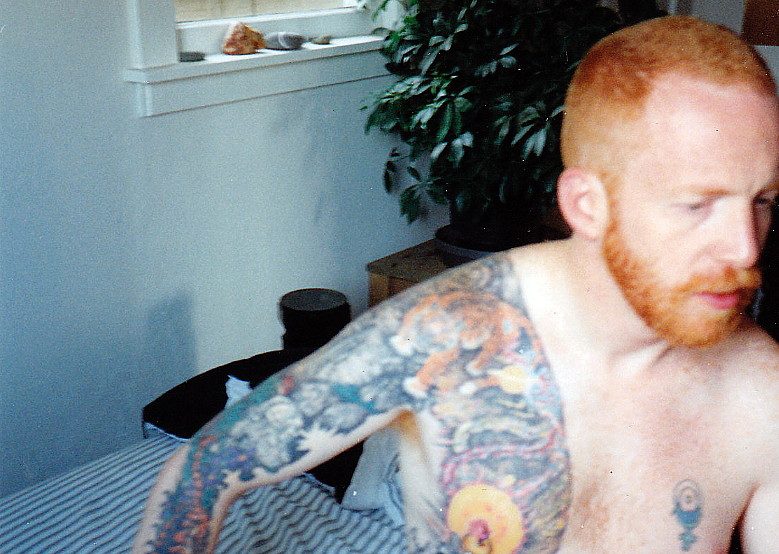
I met Jack in mufti, so to speak, at a head-shaving party in San Francisco in 1992 when I was living in California temporarily. We spent a little time together, and I found him to be a fascinating, complex intellect with a warm dry humor. He had a very straight white-collar job by day, so he had to be able to pull off that form of drag. That meant that all his elaborate tattoos and piercings had to be covered up by work shirt and trousers. He had a gigantic tattoo depicting the astrological chart of the day he got sober — how’s that for commitment to recovery?


Quote of the day: WORK

August 4, 2012

WORK

It may be that when we no longer know what to do
we have come to our real work,

and that when we no longer know which way to go
we have come to our real journey.

The mind that is not baffled is not employed.

The impeded stream is the one that sings.

— Wendell Berry


Photo diary: Colorado — the Huscher/Shewey clan

August 1, 2012

Andy’s cousin Rick graciously offered to drive us back to Denver, all 6 of us jammed into their car: Rick and his wife Kristi, me and Andy, and their daughters Sara and Kara, the latter of whom took the wayback.

We spent the rest of the weekend visiting my sisters Barbara and Joanne, who were meeting Andy for the first time. They live in Aurora, where Barbara and I were born and where I lived for a year while my Air Force father was stationed in Vietnam.

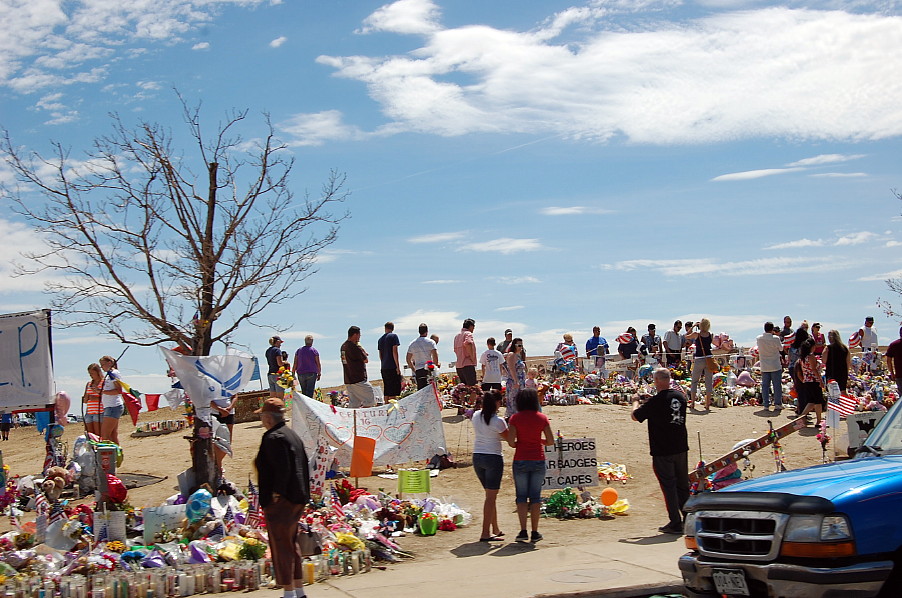
Aurora has long been our family hometown, so it’s quite strange for the city to become overnight an emblem of tragic violence. The Century 16 movie theater, where the crazed gunman murdered a dozen people and injured 58 more, turns out to be right down the street from where we stayed at Barbara’s house (formerly my parents’ residence). A week later, the impromptu memorial to the victims was in full swing.

Barbara and her husband Steve put us up in their guest room, whose decorative motif is Barbara’s favorite animal.

She’s seriously into giraffes.

My niece Carlee hosted a Sunday afternoon gathering, which gave me a chance to see her and her siblings, Jeri and Adam, and to meet Carlee’s new partner Mike and Adam’s new partner Laura.

Long lean Jeri as a hobby hand-paints T-shirts like the one modeled by her long lean son Kody.

Kody has bonded heavily with Mike’s rambunctious and adorably cute four-year-old, Josh.

Barbara’s house is full of pets, especially when Joanne brings her dog Molly over to commune with Barbara’s dog Rusty and her cat Callie. Only once did I manage to sight Lady, Barbara’s other cat who hides out all day under the bed and prowls the house by night. Let’s face it: Lady is a vampire.

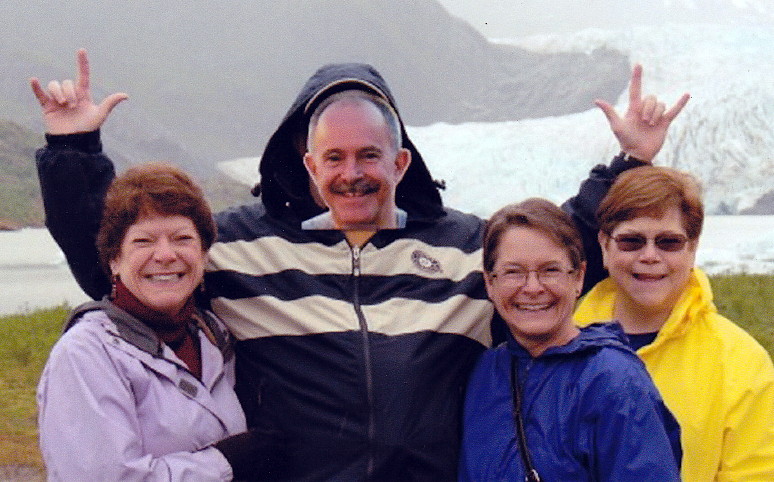
While Andy and I were in Iceland in June, my sisters took a cruise to Alaska to celebrate my older sister Marianne’s 60th birthday. Barbara and Steve gave me a photo album from the trip that contained a big surprise — Barbara had brought along a mask of me that they had themselves photographed with all along the tour, “Where’s Waldo”-style.

And then Barbara got up early to chauffeur us to the flight back to New York. Sisters are great.


Quote of the day: ALCOHOLISM

August 1, 2012

ALCOHOLISM

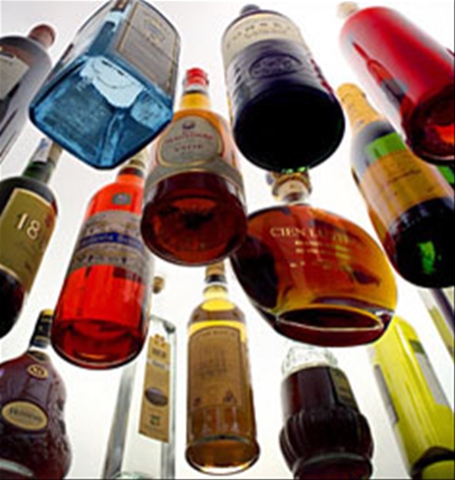
It is certainly true that the Diagnostic and Statistical Manual of Mental Disorders [DSM] overpathologizes the human condition and that psychiatrists and other mental-health professionals may feel obligated to diagnose a patient with something. There is one diagnosis in the DSM, however, that is not given often enough, due to the biases of the clinicians, patients, and insurance and pharmaceutical companies. That diagnosis is alcohol abuse. Other diagnoses, such as depression, anxiety disorder, social phobia, or bipolar disorder, are often given to patients along with the message that they are abusing alcohol to “self-medicate” for their underlying condition. In my opinion the opposite is more often true: The real underlying condition is alcoholism, and the symptoms presented by the patients are largely a response to alcohol abuse – and, to a lesser extent, drug abuse.

I believe that this problem is more deeply entrenched in our society than we like to acknowledge, and it often ends up in the lap of mental-health professionals, masquerading as anything other than itself.

— Stephen Pittelli, MD, letter to the editor in The Sun