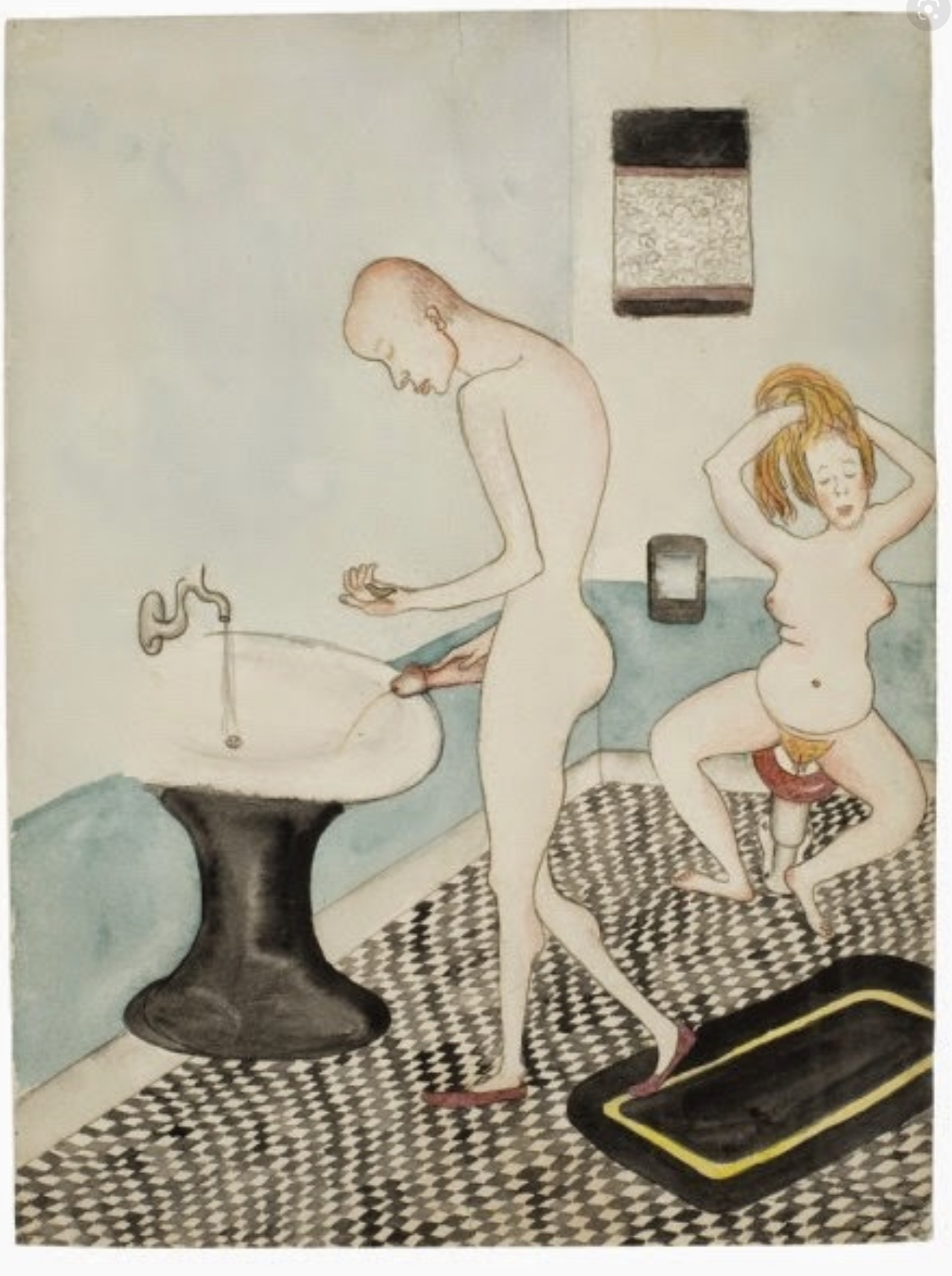
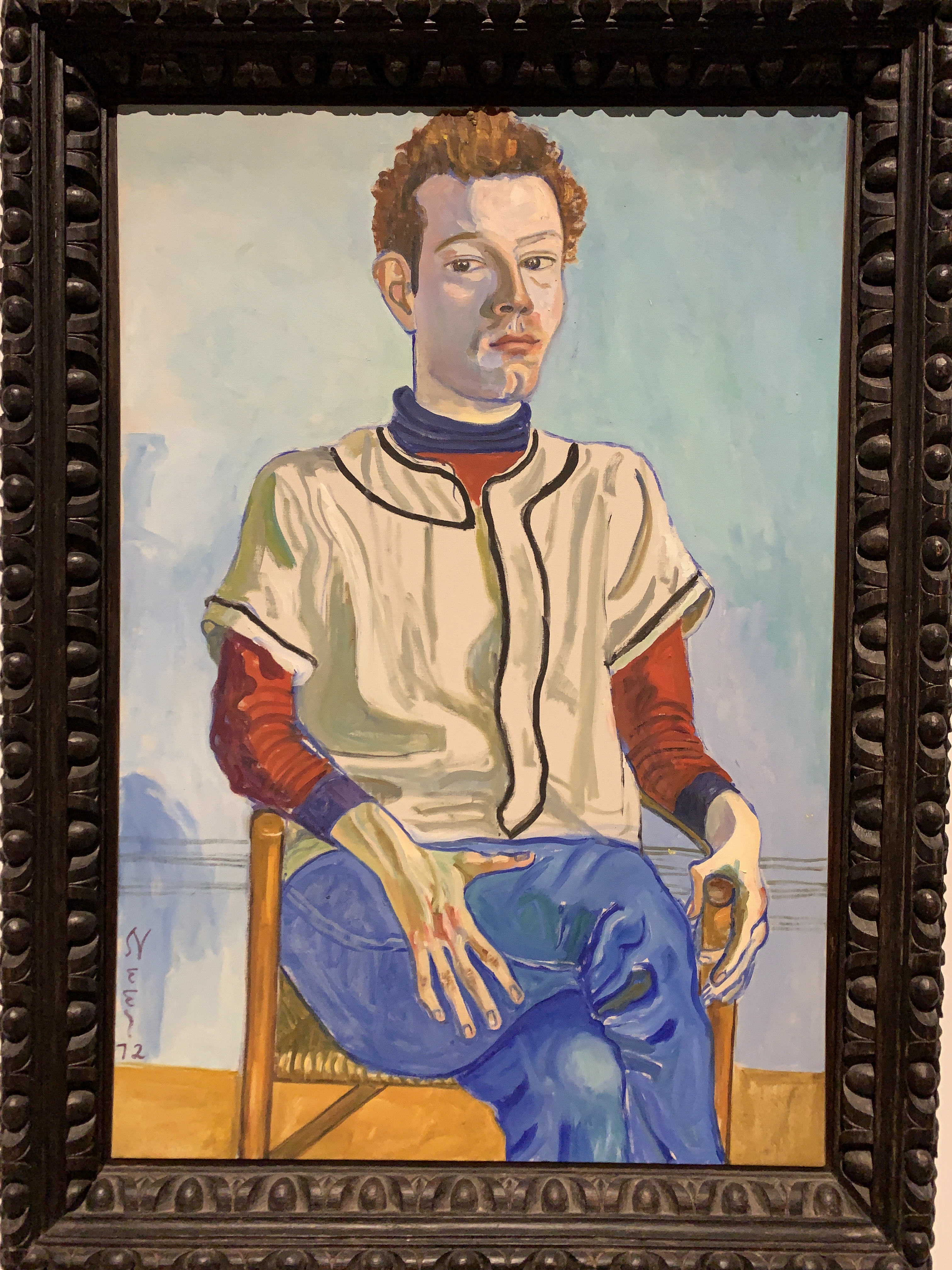
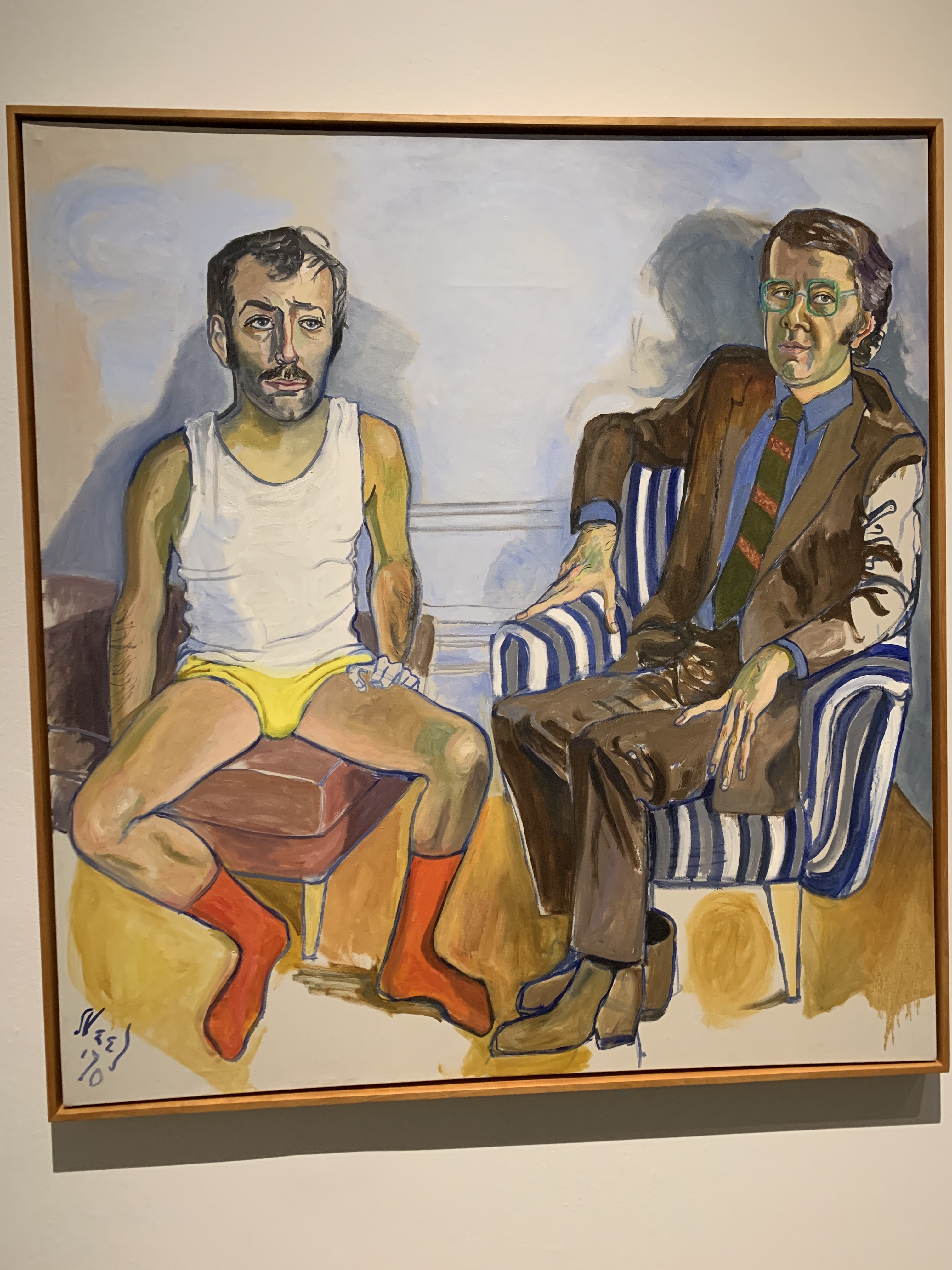
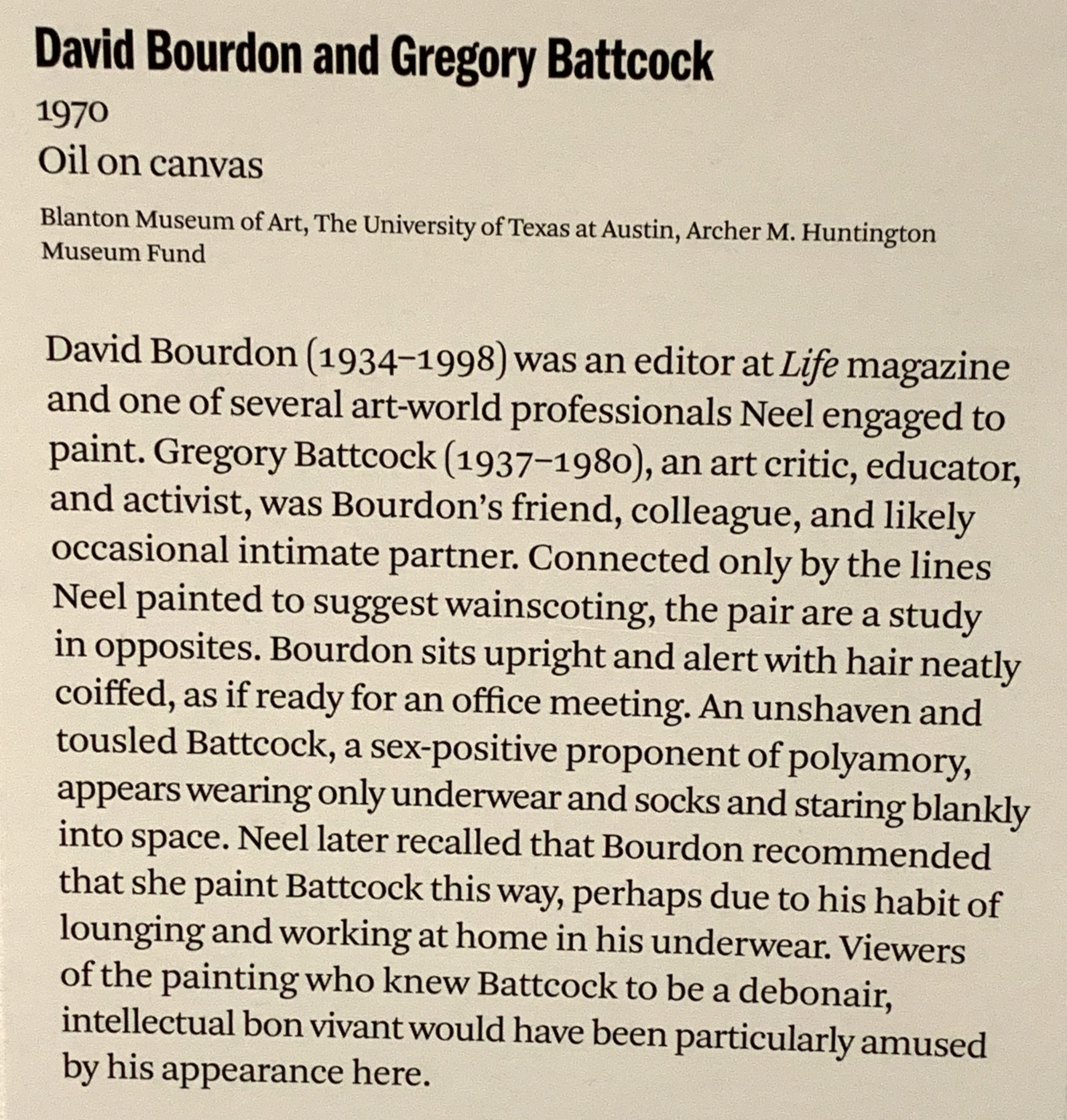
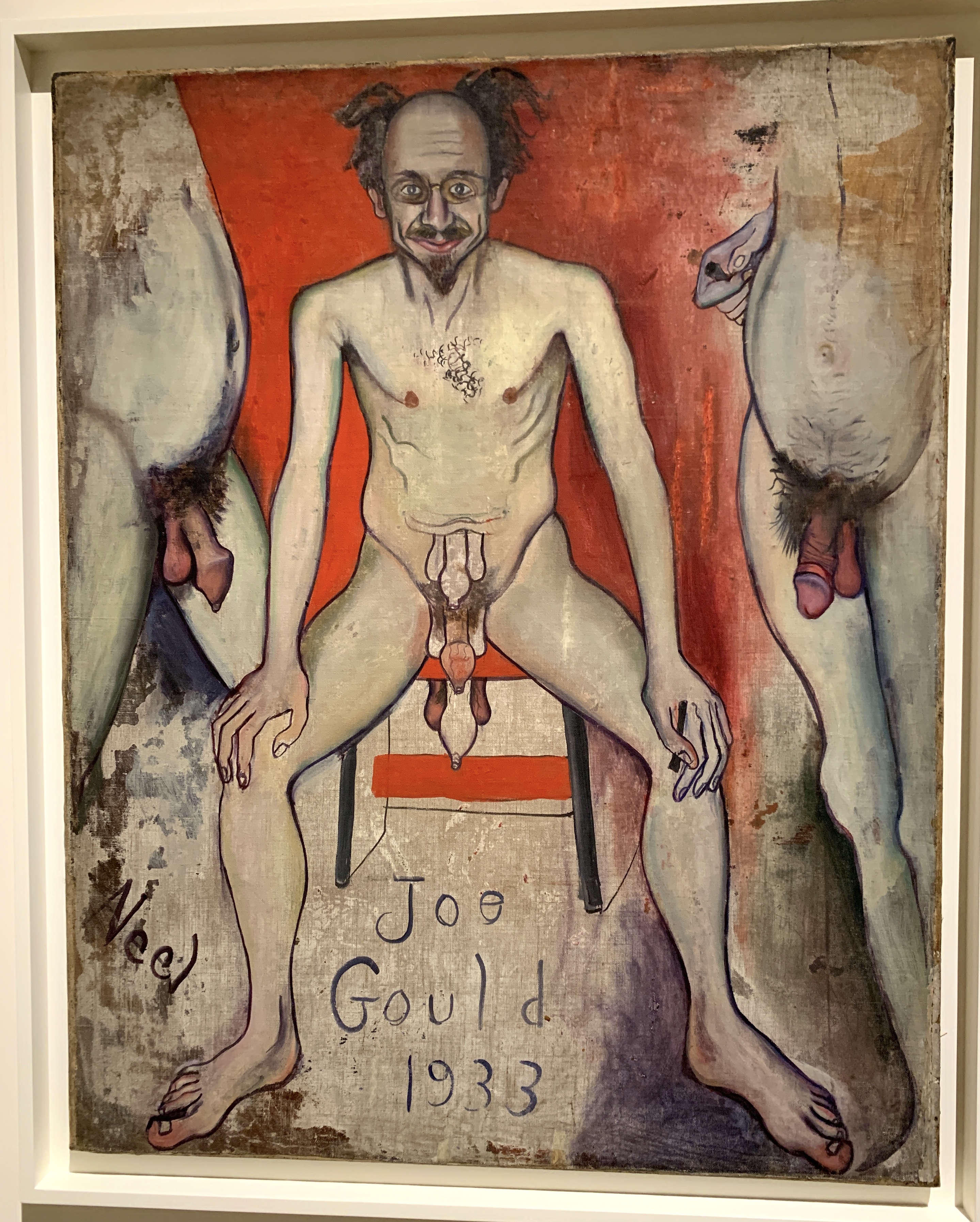
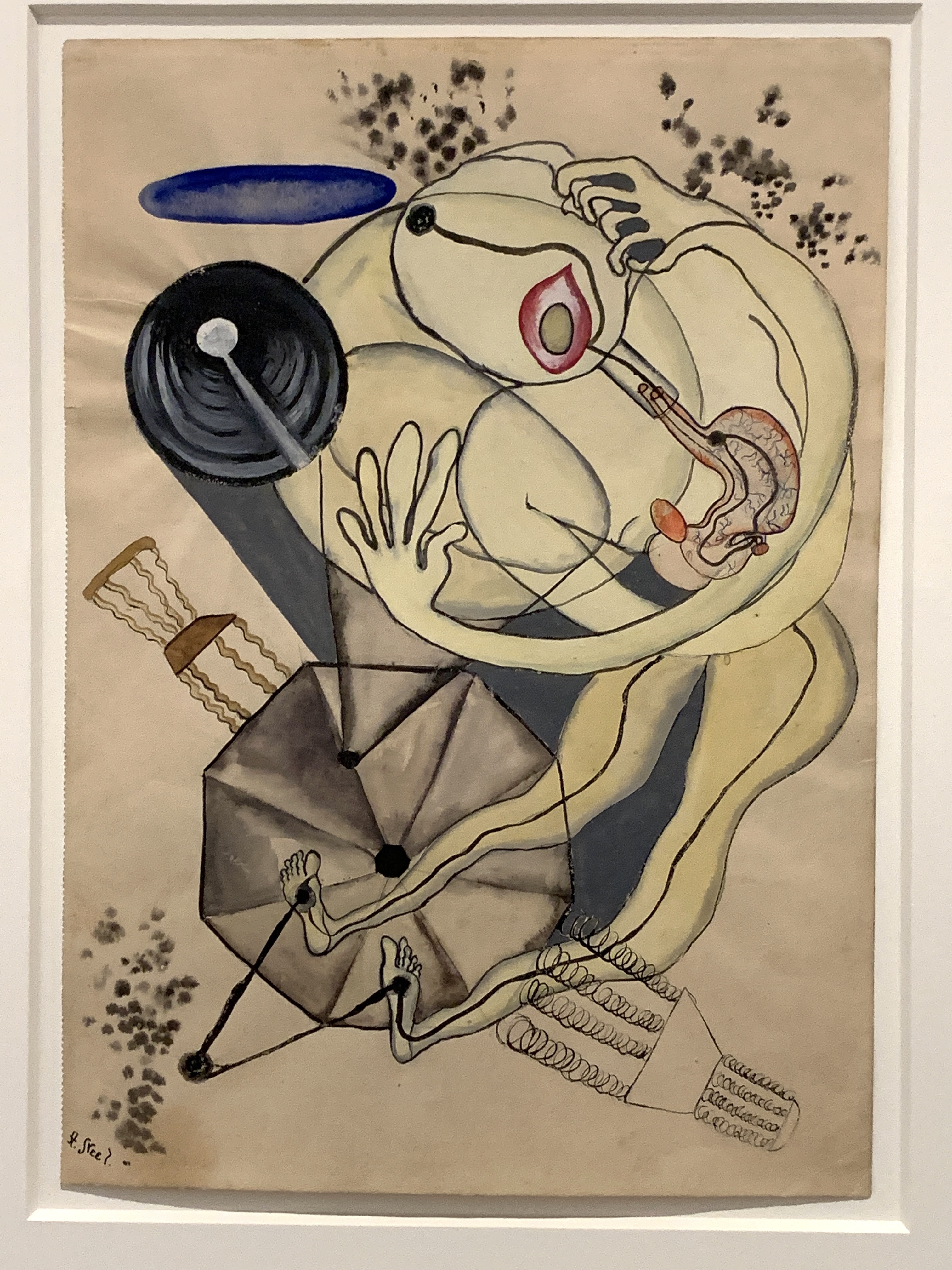
Alice Neel is a name I’ve long been familiar with but, like most people, I suspect, I had no specific file on her painting until the Metropolitan Museum mounted its spectacular show of her work, “People Come First.” We finally got around to seeing it a week before it closed. I love the amazing cross-section of New Yorkers she painted, with a big focus on bohemian life, working people, queer artists, and casually explicit sexuality. Others have written more eloquently and more knowledgeably about the work in this exhibition. I’m just going to share a few of the pictures that called out to me.
Waiting in line to get into the Alice Neel exhibition, everyone got to spend time contemplating this enigmatic canvas:
Streaming movies and TV have been a godsend during the pandemic. Talk about essential services! Over the last few weeks, I’ve been exploring two different avenues – this curious phenomenon called Going To a Movie Theater And Watching On The Big Screen, and in the opposite direction digging around among the kind online cinematic arcana Richard Brody likes to write about in the fine print of the New Yorker.
The first movie we saw in the theater was In the Heights,not a perfect movie but perfect for the moment, a feel-good New York City summertime romance with lots of dancing in the streets. The second theater movie, even more exciting, was Summer of Soul, a meticulous reconstruction and recontextualization of the Harlem Cultural Festival, which took place across six weekends in 1969. After enjoying the incredible line-up of performances – Stevie Wonder, Gladys Knight and the Pips, Sly and the Family Stone, the Fifth Dimension, Nina Simone – I gobbled up every interview I could find with Questlove, who created the film with the freewheeling precision of a genius mixtape. I loved learning that Aretha Franklin was originally supposed to perform the duet with Mahalia Jackson on “Precious Lord, Take My Heart” but cancelled at the last minute, leaving Mavis Staples to step in for a once-in-a-lifetime performance that is the highlight of the film. Also: Jimi Hendrix desperately wanted to be invited to play the festival; he was shut out but instead booked dates at a local blues club just to be in the vibe.
The third film I saw in the theater inhabits a whole other realm of cinema. Zola began life as a series of 148 Twitter posts by exotic dancer Aziah “Zola” King about a crazy road trip from Detroit to Tampa that turns into a much scarier ride than anticipated. David Kushner’s Rolling Stone article “Zola Tells All: The Real Story Behind the Greatest Stripper Saga Ever Tweeted” led to this wildly original film cooked up by director Janicza Bravo with playwright Jeremy O. Harris. Fast, wild, sexy, and nerve-wracking, Zola depends on the brave and hilarious performances of the central quartet – Taylour Paige as Zola, Riley Keough as Stefani (the faux-naif who lures Zola into an elaborate con), Nicholas Braun as her dweeby boyfriend Derrek, and Colman Domingo as Stefani’s pimp, known as X. I thought Keough looked a little familiar; only afterwards, I learned that she was not only the den-mother/gang-boss in American Honey but also the daughter of Lisa Marie Presley (which means her grandfather was Elvis and her stepfather was Michael Jackson). As we left the theater, my friend Ben and I agreed that the movie felt like a mash-up of Tarantino and Tangerine (Sean Baker’s dazzling iPhone-shot film about trans hookers in LA).
Meanwhile, some discoveries from off the beaten path:
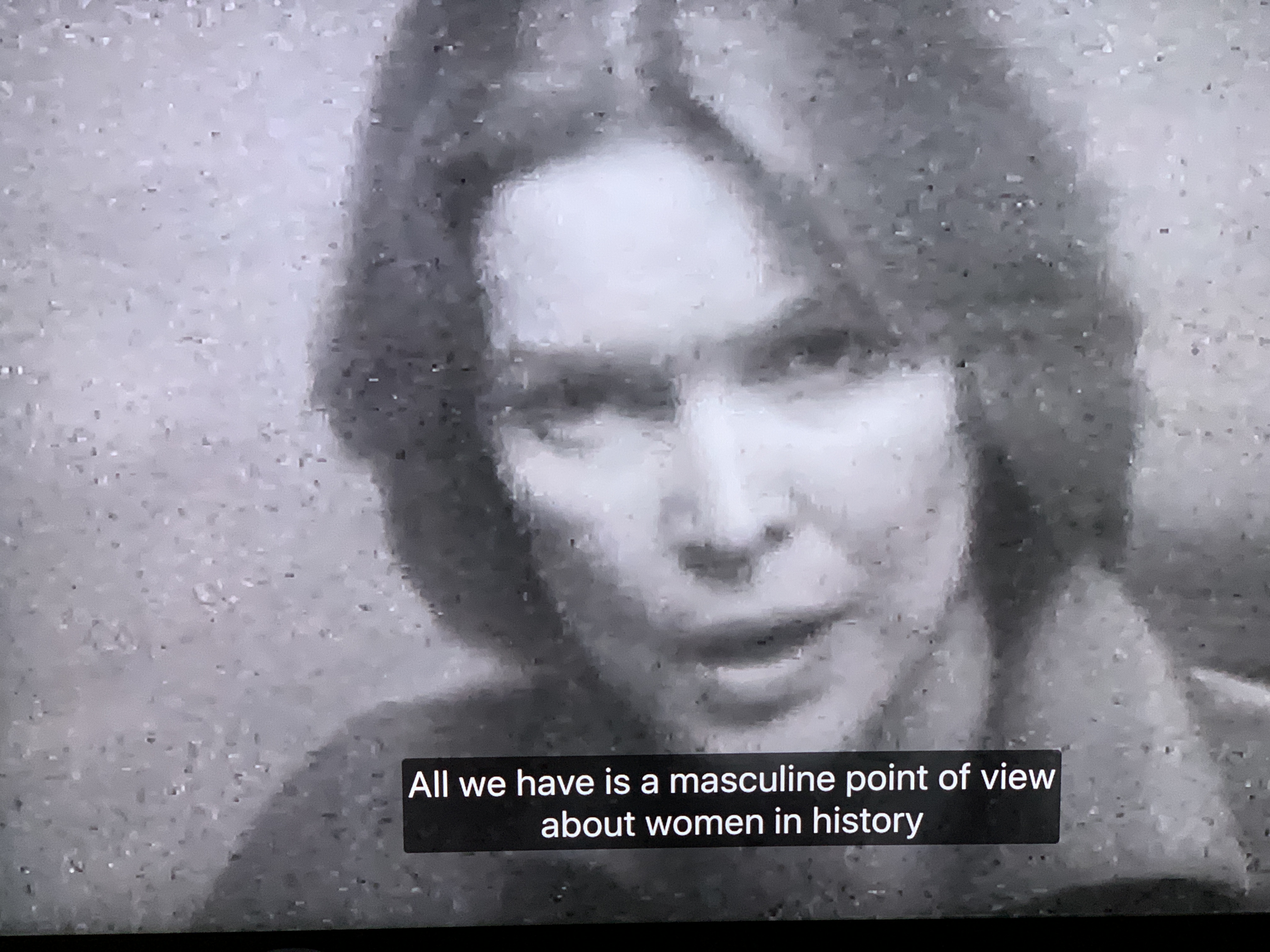
BE PRETTY AND SHUT UP!– Succumbing to some promotional offer, I subscribed to MUBI, which specializes in art cinema and emerging filmmakers even more obscure than what you’ll find in the Criterion Collection. I’ve watched LOST LOST LOST, six reels from Jonas Mekas’s Bolex with stilted voiceover, crude titles, and un-annotated glimpses of NYC in the 1960s (Frank O’Hara and Leroi Jones – later known as Amiri Baraka – at a play reading! Julian Beck and Judith Malina at a street demonstration!), and Alejandro Jodorowsky’s nutty Psychomagic: A Healing Art. There’s currently a whole series called “Sex, Truth, and Videotape: French Feminist Activism.” Who knew that the great Delphine Seyrig had taken it upon herself to do make a simple, one-camera, black-and-white, no-frills talking-heads documentary of her conversations with other women about their experiences acting in films?
Yes, Jane Fonda was married to Roger Vadim and co-starred with Yves Montand in Tout Va Bien but how often have we gotten the chance to hear her speak fluent French in conversation? The crew of interviewees is amazing: Ellen Burstyn, Viva, Shirley MacLaine, Cindy Williams, Maria Schneider, Jill Clayburgh, Louise Fletcher, and more, no makeup, no fancy backdrops. Almost all of them are amazed and thrilled to be asked questions they’ve never addressed before: have you ever been asked to play a scene where two women express friendliness to each other?
CAN YOU BRING IT – Rosalynde Leblanc and Tom Hurwitz’s documentary beautifully conjures the original production of the Bill T. Jones/Arnie Zane Dance Company’s D-Man in the Water while observing Leblanc’s restaging Jones’ choreography on a group of young dancers at Loyola Marymount College in Los Angeles. The Jones/Zane company figured heavily in the pop-dance explosion in NYC in the 1980s; like Twyla Tharp’s and Mark Morris’s, their company was like a favorite rock band. It’s thrilling to see this footage of gigantic Bill, tiny Arnie, chubby Larry Goldhuber, gorgeous Heidi Latsky, impy Sean Curran (below), athletic Arthur Aviles (I’ll never forget his gravity-defying performance in D-Man) – all of them dancing in vintage footage, the survivors speaking with wrenching eloquence.
Zane died of AIDS in 1988; he was 39. Demian Acquavella, the D-man of the title, died in 1990; he was 32. Jones’s status as long-term survivor is etched on his craggy face. The documentary is a tribute to the artists who lived through the worst of the AIDS epidemic and responded to it in their work. The fresh-faced kids in LA know virtually nothing about AIDS, which makes their approach to the production both dewy with innocence and kind of clueless. Jones has done a beautiful job of stepping into the role of community elder, and it’s moving to observe the patience and presence he brings to speaking with the students. (His smooth, avuncular speaking voice uncannily recalls Barack Obama’s.) And even though I don’t think about it that much, he’s literally an icon in my everyday life – a signed print of Keith Haring’s drawing of him (based on a photo by Tseng Kwong-Chi, another shining downtown artist lost to AIDS, like Haring) hangs just inside my front door.
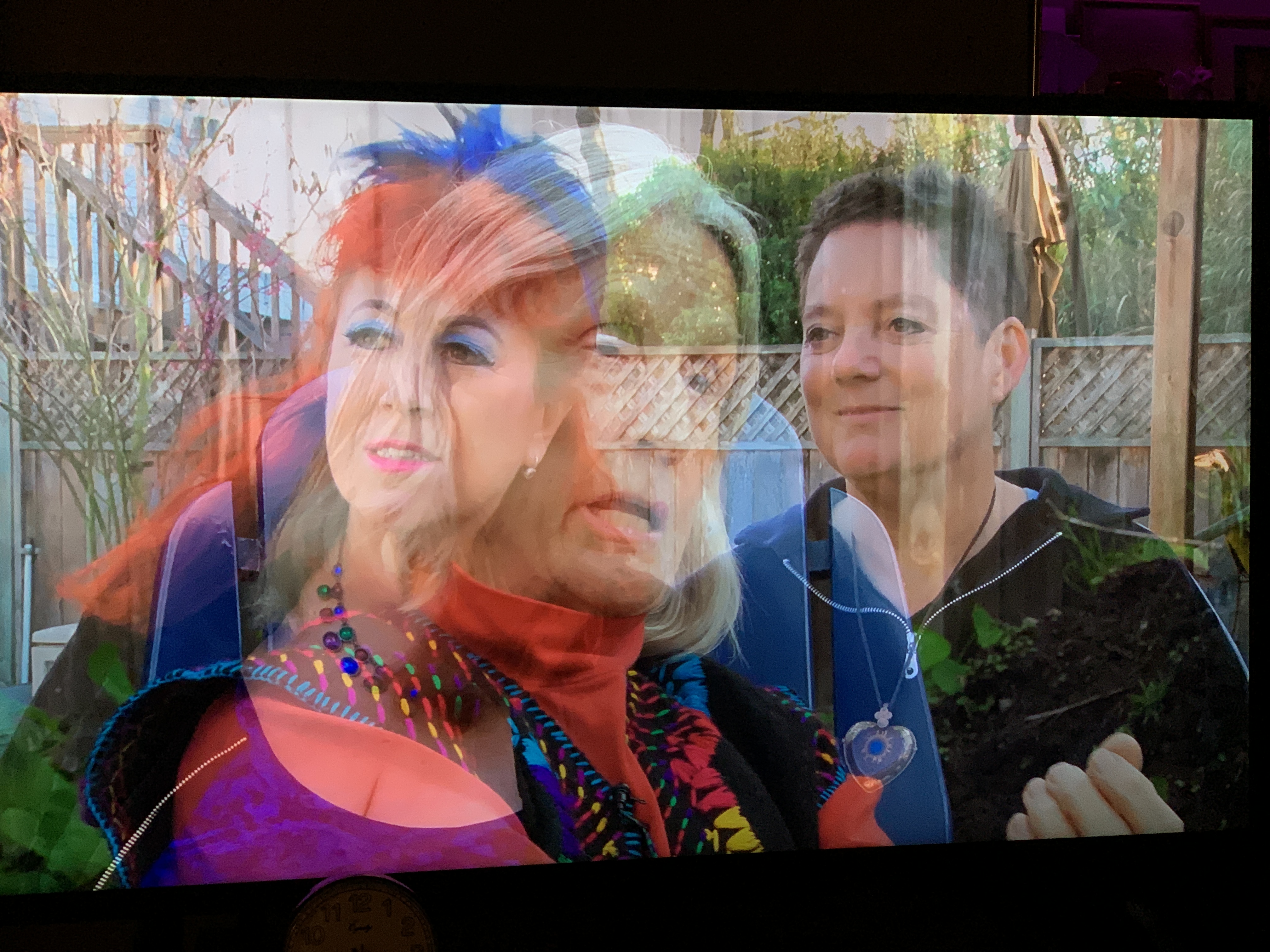
WATER MAKES US WET – Annie Sprinkle and Beth Stephens’ goofy yet informational documentary about the politics of water has made the rounds to festivals for a couple of years, and they’ve made the film available for free on Vimeo through the end of August. Modelling their spiritual practice as “ecosexuals,” they wander up and down the state of California in their RV, visiting wastewater treatment facilities, communing with philosopher Donna Haraway in her back yard (below), and chatting up sewage handlers who have cultivated tremendous tolerance for
the shit jokes that come their way. A program in San Francisco called “Adopt a Drain” enrolls local residents to keep drains swept clear of garbage and debris. Motto: “Your #2 Is Our #1.” Their irrepressible message is “Fight despair with joy!” I love getting access to smart, powerful lesbian couples and the wisdom they generate – see also the “On Being” podcast featuring author Glennon Doyle and world-champion soccer star Abby Wambach, two people I knew nothing about until listening to their funny and savvy chat with Krista Tippett.
PRIDE – “Where there’s a will, there’s a way” is an old saying whose truth has played out in world-changing ways these last couple of years. The U.S. government has plenty of money in reserve to not only vaccinate everyone in the country but to pull American citizens out of poverty with direct payments. Something significant happens when white male supremacy gives way to leadership by women and people of color. The remarkable achievement of the Hulu series Pride is that it doesn’t have to stretch very far to tell the story of the gay liberation movement primarily through black, trans, and female voices. The series makes that look so simple, easy, and obvious, but in reality until the last two years no overview of the gay movement has foregrounded these voices. (Sarah Schulman accomplishes the same corrective in her recently published, invaluable history of ACT UP, Let the Record Show.) The sixth and final episode, for instance, “Y2Gay,” spotlights Margaret Cho, David Wilson, Brontez Purnell, Dean Spade, Chase Strangio, Cece McDonald, Dr. Lourdes Hunter, Raquel Willis (below), and Ceyenne Doroshow. And the decade of the ‘70s, a turning point in gay history, is given a very different and richer spin because of the voices that black lesbian feminist filmmaker Cheryl Dunye chooses to tell the story. The whole series is so beautifully scripted and shot that you (almost) don’t mind the maddening deluge of the same commercials over and over on Hulu.
You believe in God, right? I believe that there’s an intelligence, a spiritual power that I don’t understand. I call it God because I don’t know what else to call this great spiritual power. It gives me strength. I’ve also had amazing times alone in nature when for a moment you forget you’re human. Your humanness goes away, and you’re part of that natural world. It’s the most amazing and wonderful and beautiful feeling.
How do you square things like environmental degradation and war with a belief in that overriding intelligence? Traditional faith will have you believe in a loving God, and when I look at what’s happening on the planet, I think if there is a God like that, is he playing with us? Are we living in some great experiment? How can you believe in a loving God when you see the horrors that are perpetrated against nature, against animals, against each other? I sometimes think it is like an experiment which has culminated in this strange, confused creature that is human beings, and we seem to be lost. Who are we? What are we? Why are we here? I don’t know what the meaning of life is. The meaning of my life is to give people hope because without hope you give up.
–Jane Goodall, interviewed by David Marchese in the New York Times Magazine
I consoled myself for my difficulties with Nichole by keeping company with an Indian woman from the reservation in nearby Yakima. I met her playing pool in La Conner, and although she was pretty drunk, she was deadly at the table. She was exciting and unpredictable, not above winging a pool ball at an idiot who offended her. She looked about thirty-five, and confessed to having a “clutter” of children back in Yakima….
One morning she dropped by as I was cooking, I asked her if she was hungry and she said nothing. When I asked a third time, she said, “Don’t make people *say* that they’re hungry. Put food in front of them. If they’re hungry, they’ll eat.”
This protocol attending the offering of food interested me. It highlighted our culture’s carelessness about food (which has resulted in an obsession with obesity). Living on the road, I’d noticed that you could visit a white person’s home and wait for hours before being offered food or water. This was equally true in many counterculture homes. White people assumed that people are or drank when they *wanted* to; they were not being deliberately rude, they just never had to think about hunger. Travelers in need learn to search out people of color — black people, Chicanos, and Indians — who rarely let you sit long without putting something to eat or drink in front of you.
I have a theory that we will look back on this winter as the hardest time of the pandemic, second only to March and April of last year when it first came crashing down. Starting in November, when the weather started to turn cold, and lasting through whenever spring starts to thaw us out, we’ve been confined to quarters, enduring horrible news, ongoing dreadful death rates, excruciating isolation, mind-numbing boredom, and pretty universal depression. In New York City, Andy and I have been combating that somewhat with weekend art excursions.
We started our Saturday afternoon art adventure by watching the first explicitly erotic gay film – Jean Genet’s Un chant d’amour(1950), a silent film about prisoners and the sadistic guard who spies on them masturbating (an astringent sound score by Simon Fisher Turner was added later) – and ended the evening watching the latest gay erotic show, It’s a Sin, the latest HBO series by Queer As Folk creator Russell T. Davies.
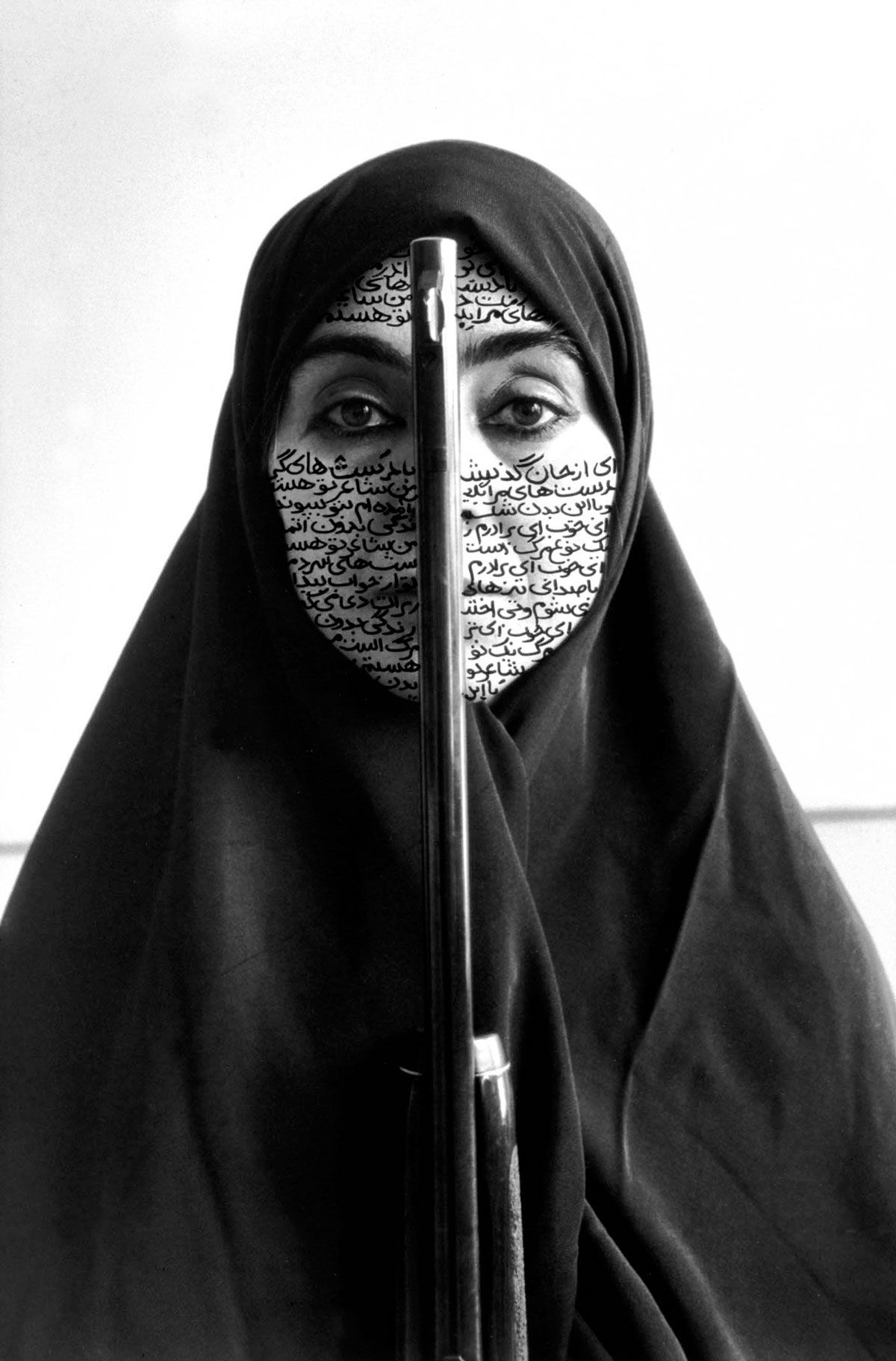
In between we trekked to the Chelsea art district to see Shirin Neshat’s show “Land of Dreams” at the Gladstone Gallery. I’ve been a huge fan of Neshat’s work since I first saw her images combining veiled Muslim women holding weapons and Persian calligraphy. Neshat’s Iranian parents sent her to Los Angeles to attend high school, and she was enrolled at the University of California at Berkeley when the Iranian revolution occurred. She has not been back to Iran since 1996 and currently lives in New York.
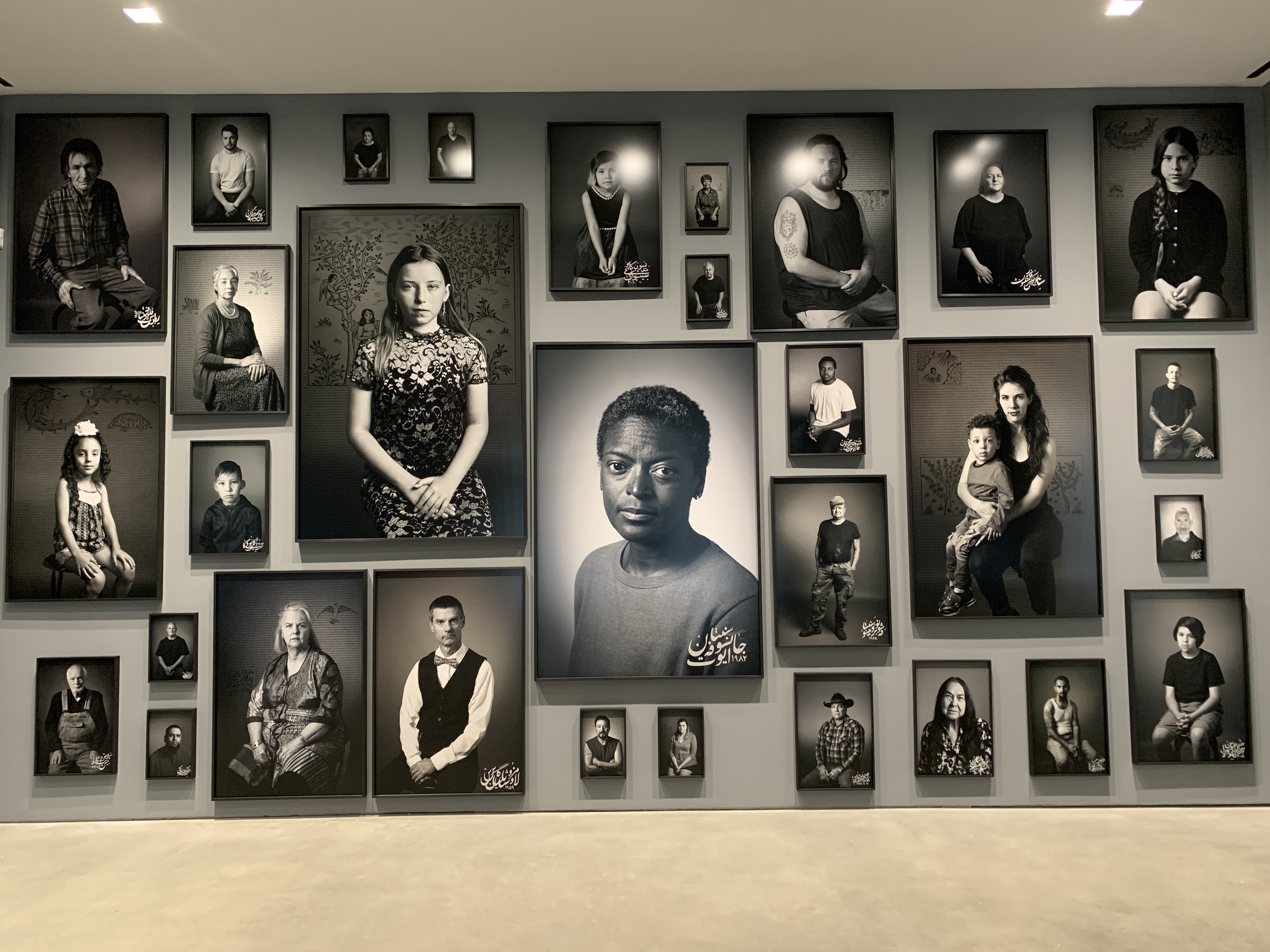
For her latest show, she travelled around New Mexico meeting people, taking their photographic portraits, and asking them to tell her their latest dream. At the gallery 111 of these portraits hang, each of them with calligraphic additions – their names, their birthdates, sometimes the text of their dreams, sometimes images from their dreams.
In an adjacent gallery, Neshat shows a two-channel video installation that is a fictionalized version of her travels through New Mexico, juxtaposed with scenes from a sinister sort of factory employing dozens of lab-coated “dream scientists.”
Shortly after we walked into the gallery, a woman asked Andy to snap a picture of her and a male friend of hers. It turned out to be Neshat, who showed up to rendezvous with her friend and collaborator Youssef Nabil, an Egyptian photographer (above). So we got to meet the artist and chat with her a little bit, which excited the fanboy in me. I can’t remember if she told us this or if we heard her say it in one of the several YouTube videos we watched later, but she doesn’t actually think of herself as a photographer. She said she doesn’t own a camera, and indeed in videos she’s seen directing a cameraman who actually takes the photos. She has made a number of films, most of them – like the one playing in the gallery – pristinely shot in black and white, juxtaposing weathered unusual faces with wide-open stark landscapes. The two-channel video can be viewed on the gallery’s website at certain hours of the week, along with a 25-minute documentary about the making of the show.
While we were in Chelsea, we poked our noses into a couple of other galleries. The Jack Shainman Gallery is hosting “Half and the Whole,” a show by photographer and filmmaker Gordon Parks of images from 1942-1970 that document the civil rights movement, including some beautiful candid shots of Malcolm X. I was struck by this curious, anomalous image from 1962 called “Invisible Man Retreat, Harlem, New York.”
Some dazzling and trippy geometric prints caught our eye at the Dobrinka Salzman Gallery. They turned out to be early works by an Italian artist named Riccardo Vecchio.
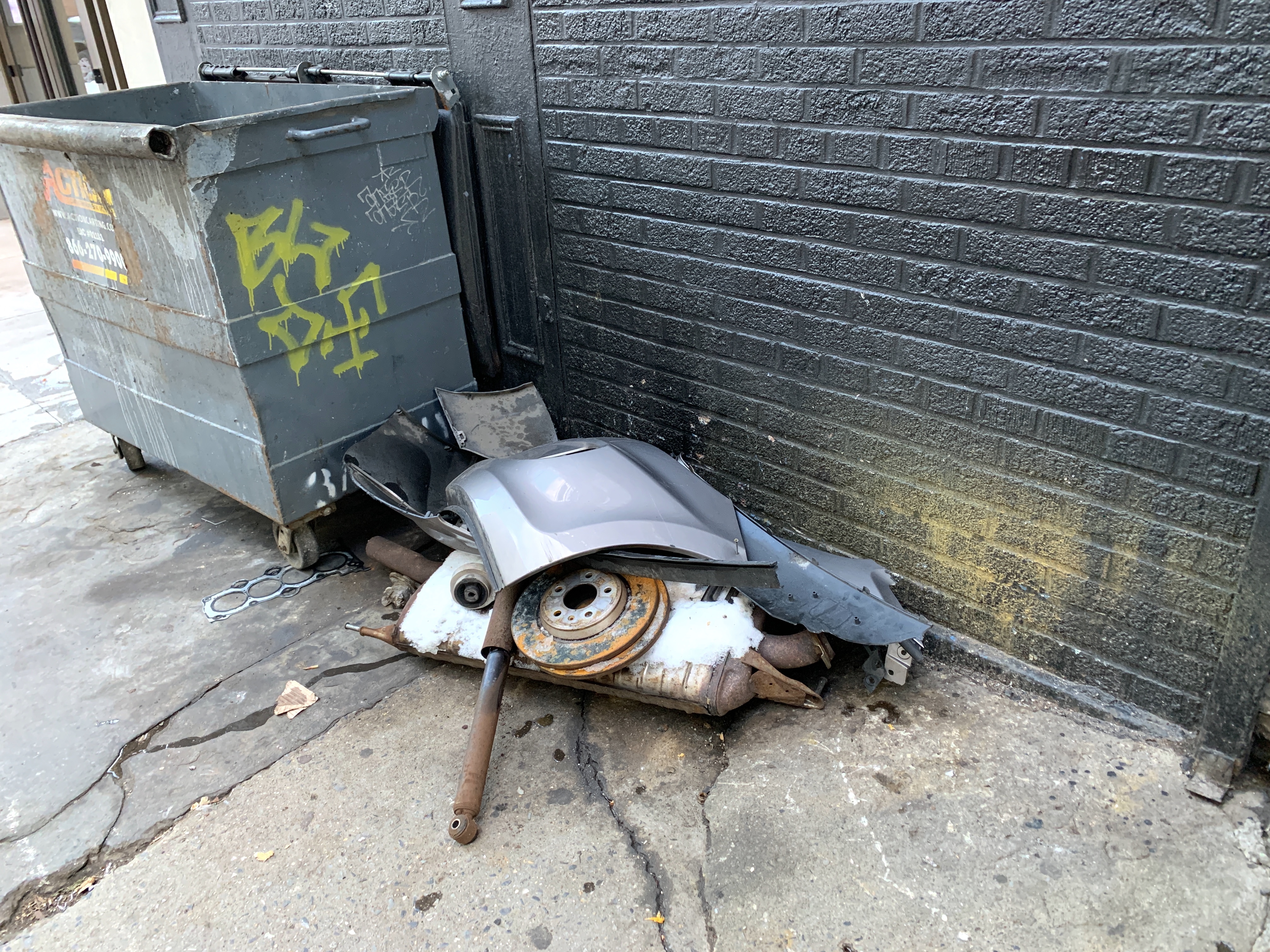
Once you’re in the art trance, even trash on the street starts looking like readymades.
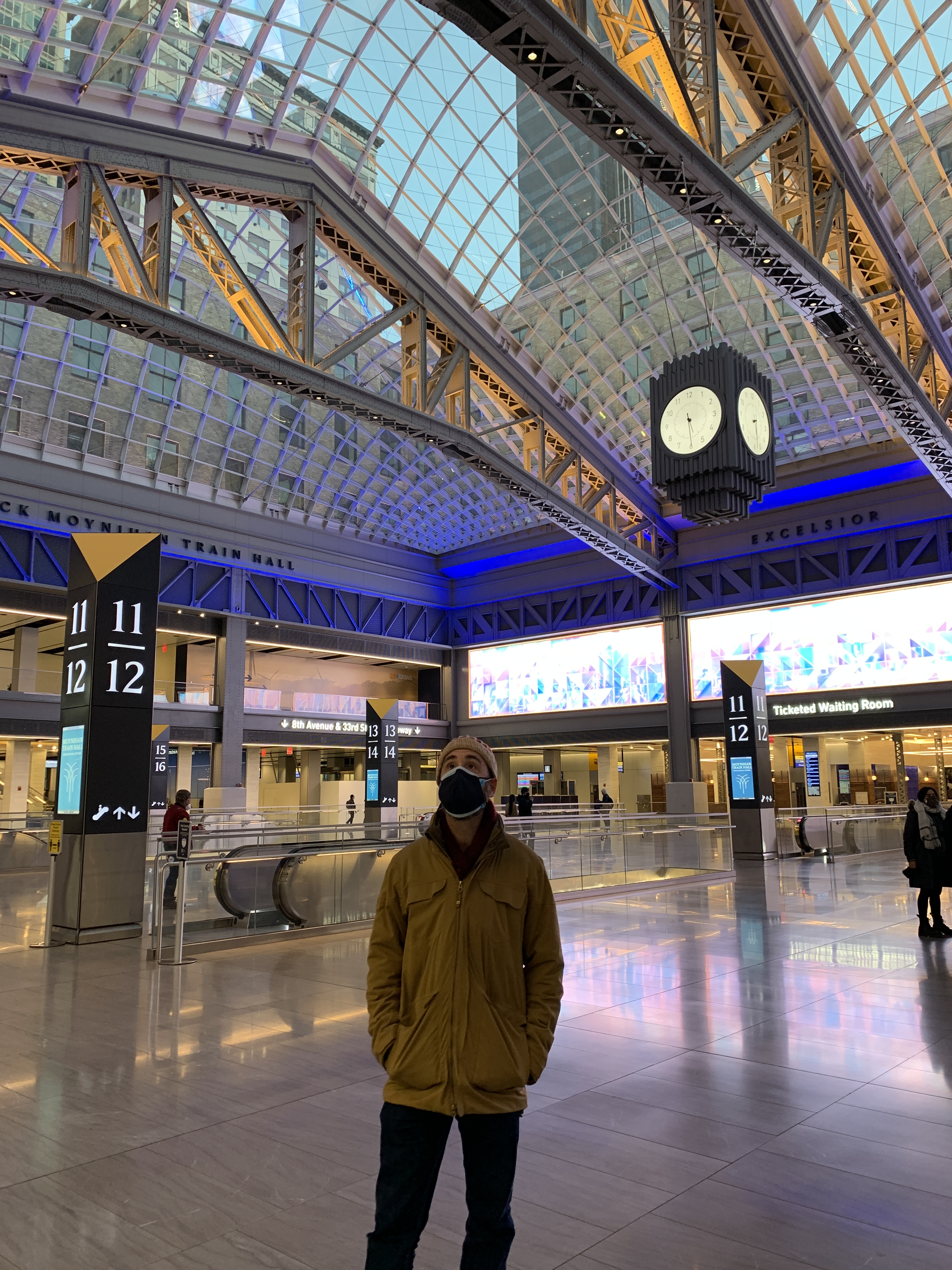
We had two more predetermined destinations. One was the new Daniel Moynihan Train Hall, with its gleaming interiors (currently sparsely populated of course, but envisioned to be teeming with commuters sometime), spectacular skylights, and all kinds of artwork including this colorful three-part stained-glass piece by Kehinde Wiley called “Go” on the ceiling of the 35th Street entrance.
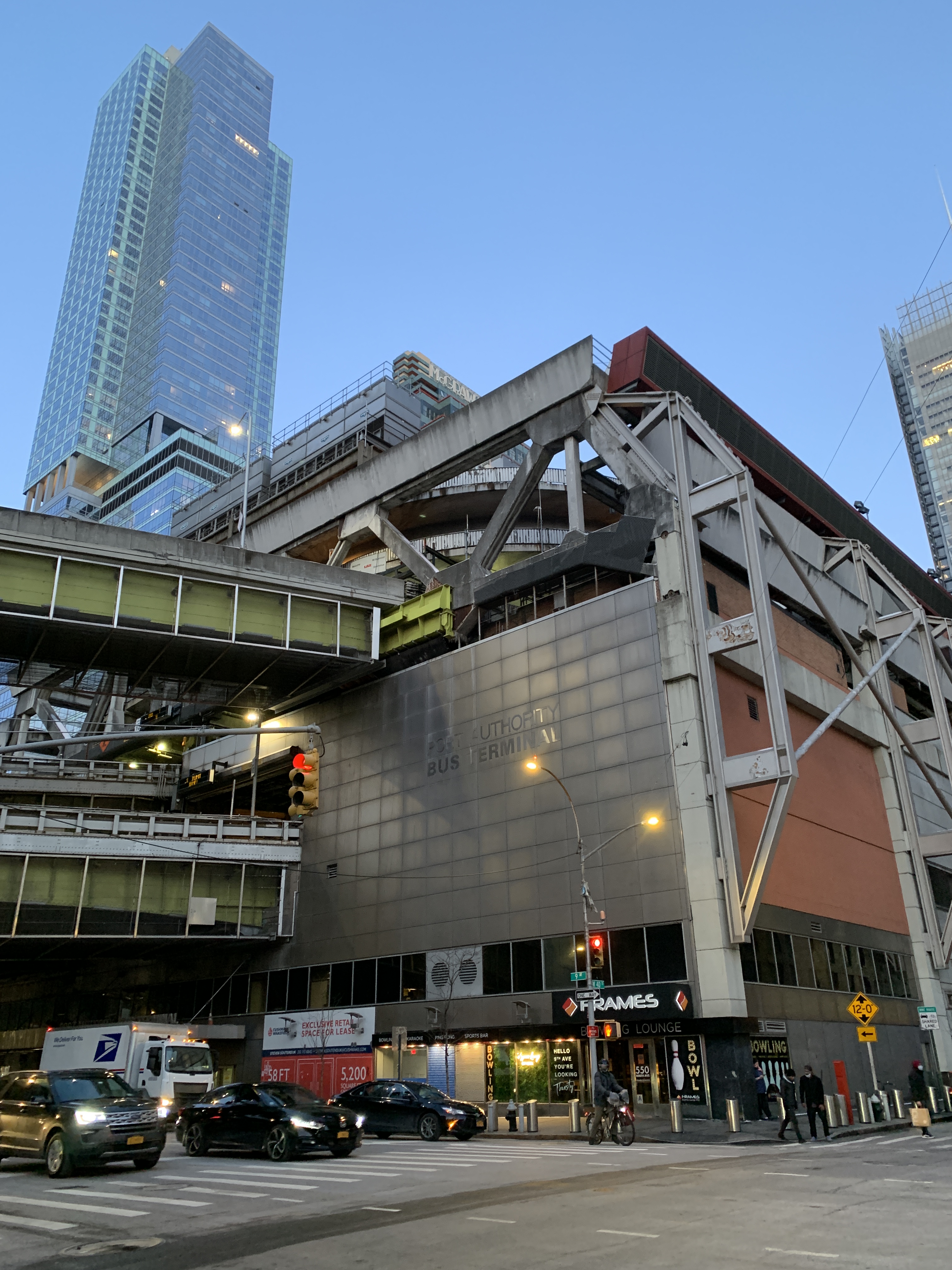
After that spectacle, a walk up Ninth Avenue brought us into the armpit of Times Square, the stunningly ugly backside of the Port Authority Bus Terminal.
In the grimy underpass across the street, one of several vacant storefronts in the neighborhood featured artwork sponsored by Chashama, the public art project enterprising curator Anita Durst operates using disused corners of her family’s vast real estate empire.
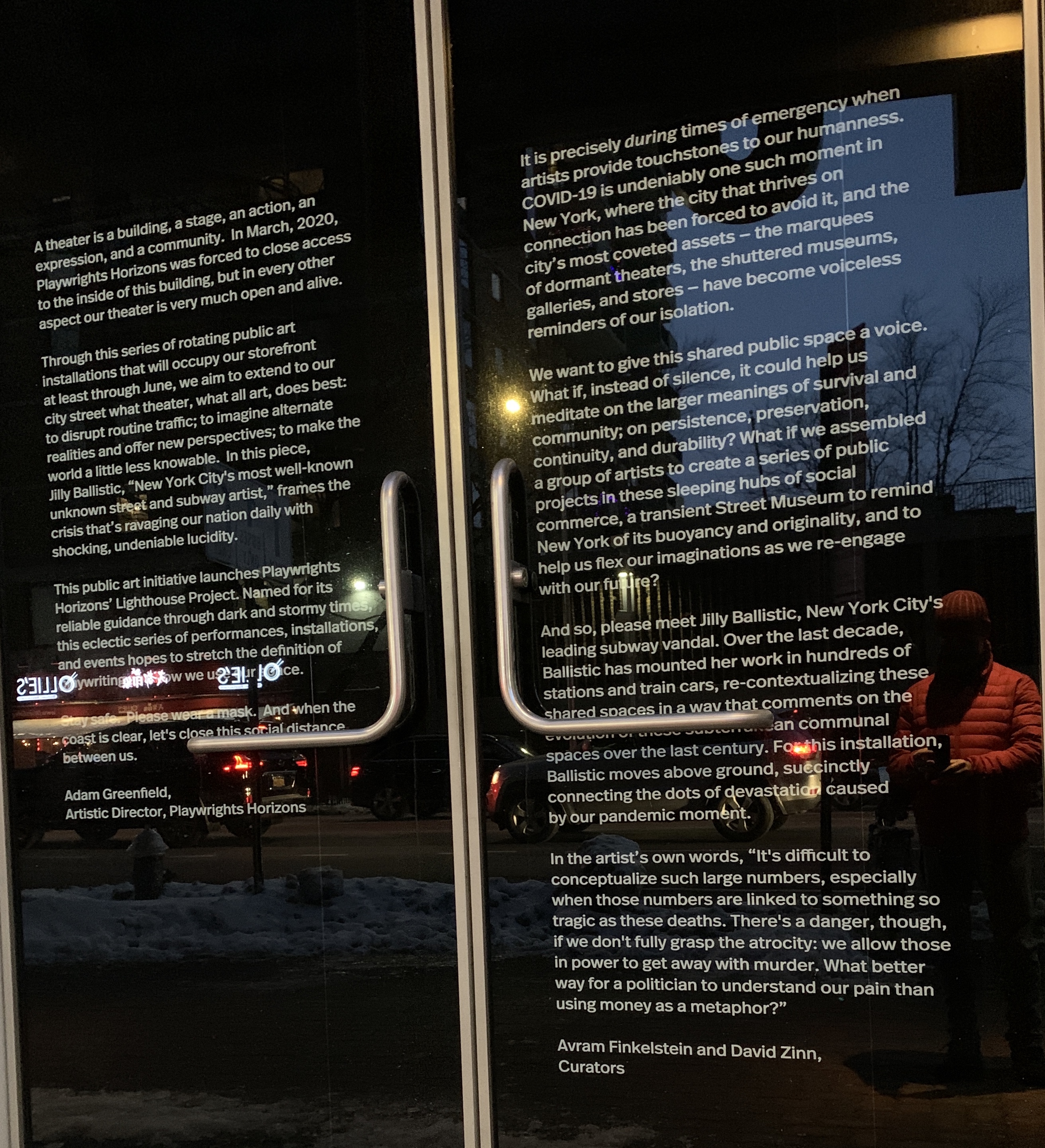
Our final art destination was the storefront for Playwrights Horizons, one of NYC’s great Off-Broadway theaters. It’s been shuttered since last March, like all theaters in the city, but incoming artistic director Adam Greenfield enlisted our friend David Zinn, the Tony Award-winning set and costume designer, and Avram Finkelstein, one of the founders of the AIDS-era art collective Gran Fury, to curate a lively public art project keeping the block activated.
The first artist they commissioned was Jilly Ballistic, who created a gigantic mural in the form of a dollar bill regularly updated with a reference to the number of Americans who have died of covid-19.
Being on Theater Row at dinnertime led us to one of our favorite local restaurants, Mémé Mediterranean on 10th Avenue at 44th Street. They were being scrupulous about allowing indoor dining with a limited capacity; there were only two other tables dining when we sat down for a delicious tagine and a shawarma royale.
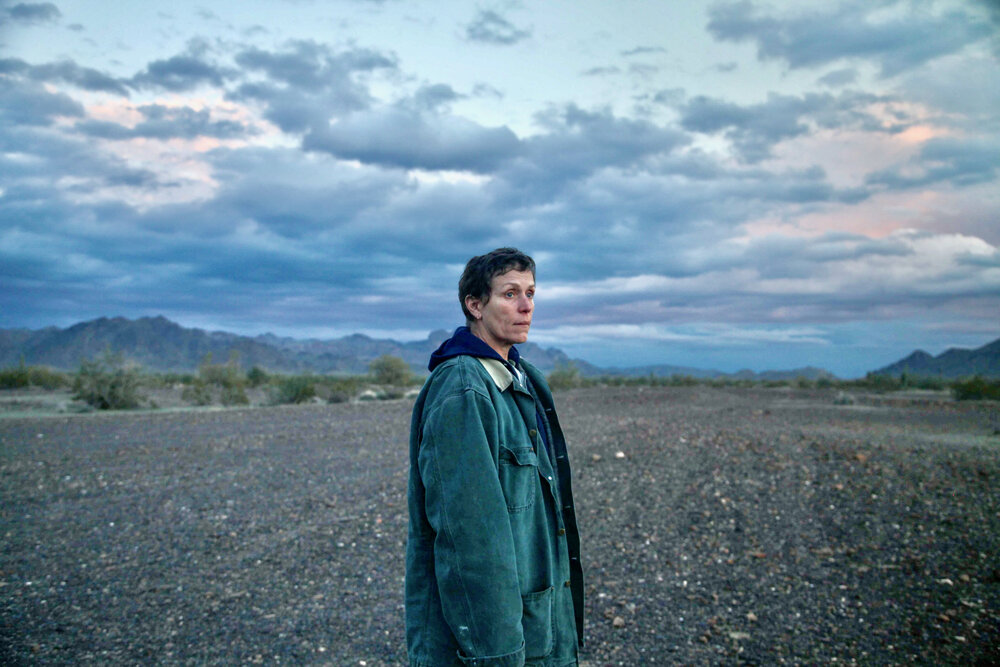
It was a very satisfying expedition. We spent the after-dinner hours with It’s a Sin (just the first episode) and Shirin Neshat interviews on YouTube. Sunday afternoon we watched Chloe Zhao’s new film Nomadlandon Hulu, an extraordinarily beautiful and moving collaboration between the director (I recently saw and loved her Songs My Brother Taught Me) and actress/co-producer Frances McDormand, who gives yet another spectacular, vanity-free performance as a miner’s widow living in her van barely scraping by as a day laborer on a series of hard low-paying jobs. Long wordless scenes of her rolling through Nevada, Arizona, Nebraska, and South Dakota eerily echo the wide-open spaces we saw in Shirin Neshat’s film the day before.
And then, as we generally do, we repaired to our separate abodes to cook food for the week. Andy set about making a big pot of jambalaya, and I applied myself to following Gabrielle Hamilton’s recipe from last week’s New York Times Magazine for Russian salad, which is refrigerating overnight and gave me a chance to sample a new taste treat I discovered at the farmer’s market yesterday – pickled hard-boiled eggs.













 another eye opens