2/2-9:
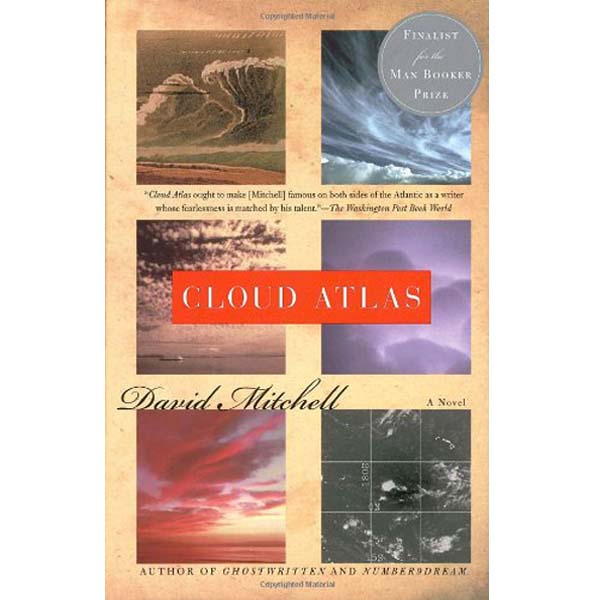
Books: during my week-long vacation in Vieques, I hunkered down with David Mitchell’s Cloud Atlas, a novel friends have been raving about for years. I wanted to read it before seeing the movie.

Because six different stories travel back and forth in time, it takes a certain amount of concentration, perfect for lounging poolside in the sun in February. I liked the book and appreciated Mitchell’s clever narrative structure and imagination, though afterwards it occurred to me that almost all the stories boil down to one chase scene after another. I do look forward to seeing how it translates into a film.
DVD: the week in Vieques also gave me a chance to catch up with a bunch of screeners I’d borrowed from a movie-critic friend:
Brief Reunion – a good small psychological thriller, with a key performance by the great downtown stage actor Scott Shepherd (his first major role, I believe, and an excellent film debut — below with the movie’s central character, played by Joel de la Fuente);

Fairhaven – another small John Sayles-like movie about a bunch of post-collegiate friends drifting through their twenties. Curiously, an actress new to me – Alexie Gilmore – played the lead in both this and Brief Reunion;
Barbara – really smart beautiful film set in East Germany before the wall came down, with an excellent performance in the title role by Nina Hoss, even though she looks quite a bit too glamorous to be playing a small-town doctor (you can’t help seeing her as a young Jeanne Moreau — see below);

Marley – Kevin Macdonald’s documentary gives an impressive overview of Jamaican superstar Bob Marley’s short, eventful life, with a special emphasis on his extremely poor childhood. But there are lots of holes in the narratives, which is one disadvantage to the choice of relying exclusively on talking heads. There are important pieces of Marley’s story that certain people didn’t live to tell or are not willing to tell on camera;
Seven Psychopaths – I saw Martin McDonagh’s second film in the movie theater but it was interesting to watch it on DVD with a group of friends, one of whom bailed out after 15 minutes because he couldn’t handle the violence. Too bad, because the movie doubles back on itself, critiquing itself as it goes along. It’s McDonagh’s philosophical meditation on his simultaneous attraction to and revulsion against violent stories, with game comic performances by Colin Farrell, Christopher Walken, and the fearless Sam Rockwell;
Pitch Perfect – I ordered this from Netflix because Andy’s a capella singer friends recommended it, but after 15 minutes he insisted we take it off because its portrayal of college singing groups was so fake it was fingernails on the chalkboard;
Not Fade Away – David Chase’s debut as film director resonates as a highly autobiographical film about a kid who plays in a rock band in New Jersey just out of high school in the late ‘60s. That era was my childhood, too, and I loved it that all the musical references were spot-on. The movie is quirky and aggressively minor-key, with a key misstep having the main character’s younger sister provide a voiceover narration – we don’t know enough about her to trust her perspective, and it feels kinda tacked on to ward off criticism that the movie is too male-centered.
2.13.13:
TV: Girls. After watching Lena Dunham’s film Tiny Furniture a few weeks ago, I needed to satisfy my curiosity about her TV show. After two marathon evenings with the first season on DVD, I’m hooked. She’s really something – brave, quirky, real, and unafraid to expose herself, her neuroses, her imperfect body, and her generation’s peculiarly tortured dance around intimacy, romance, and casual sex. It’s a mistake to think of Girls only as the antithesis of Sex and the City just because there are four central female characters. Dunham clearly models herself on Woody Allen as writer/director/performer, with a big hit of Louis C.K. It helps to have Judd Apatow as fearless producer. The writing is pretty amazing, the dialogue is super-fast, I could barely keep up. I know we’re supposed to think that Hannah’s boyfriend Adam (played by Adam Driver, just out of Juillard
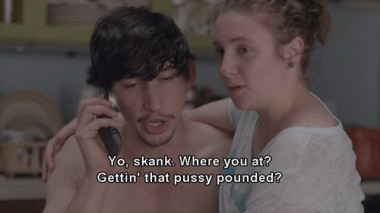
(he’s on the phone with his sister)
with great big ears and a Marine’s washboard abs) is a dick because he pees on her in the shower and jerks off in front of her, but I think he’s an awesome boyfriend. I love any opportunity to watch Chris O’Dowd. And I love seeing David Mamet’s daughter Zosia play the super-young motormouth Shoshonah, especially the episode where she gets high at a party in Williamsburg. “I smoked crack?? Don’t tell my mother! Don’t even tell me!” One advantage to watching the show via Netflix is to gobble up the DVD extras — commentary on three different episodes and a hilarious and illuminating conversation between Dunham and Apatow. Oh, how I love hearing a successful Hollywood writer/director/producer say the word “butthole” aloud in casual conversation!
 2.16.13
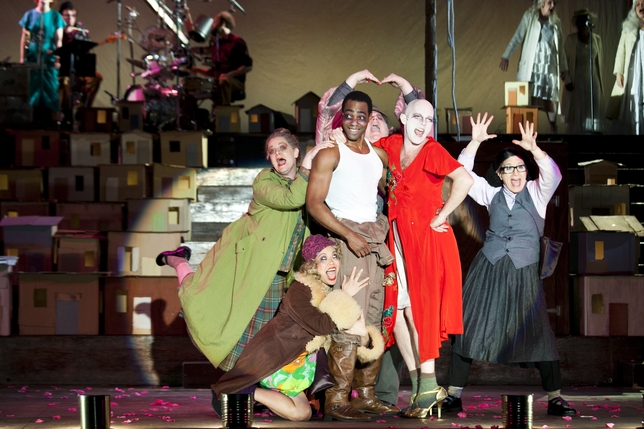
Theater: Good Person of Szechwan is another triumphant production by Melanie Joseph’s Foundry Theatre in collaboration with La Mama ETC. It’s one of Brecht’s essential texts, in which he repeatedly sets up genuine moral dilemmas – good people making bad choices and then trying to manage the consequences – and never gives definitive solutions, throwing back on the audience the responsibility to “Change the world, it needs it!” Lear DeBessonet’s lively production is Brechtian in the best sense: fun, funky, sly, surprising, shot through with music (performed live by a local skiffle band called the Lisps) and excellent comic performances. The title character is a prostitute, Shen Te, who does a kind deed for a trio of Diogenes-like gods passing through town looking for one good person. Her reward is enough money to start a little shop, which brings everyone in town to her doorstep for a handout. She’s too kind-hearted to say no, but she has enough sense to invent a male cousin, Shui Ta, who comes in and establishes order. This role is usually played by a woman who eventually dons male attire. One driving force in this production was the casting of Taylor Mac in the title role, who brings a whole other beautifully theatrical element to the gender-bending. Mac plays Shen Te with his customary bald pate and glittery eye shadow, in a red dress with hairy chest poking through (shout out to Charles Ludlam’s Camille); as Shui Ta, he wears a pinstripe suit, bowler hat, and stick-on handlebar mustache, sometimes changing in front of our eyes. (Clint Ramos’s costumes rock, as does Matt Saunders’s set, a study in the magic of cardboard.) The cast is full of downtown luminaries — Mia Katigbak, Annie Golden, and Vinnie Burrows as the gods, Lisa Kron in two contrasting roles – surrounded by a bunch of excellent game team players (I was especially impressed with David Turner as the improv-ready MC/water-seller, Kate Benson as Mrs. Shin, and Brooke Ishibashi and Darryl Winslow as utility players).

The show got a rave review from Charles Isherwood in the New York Times, so the short run sold out quickly. Luckily, the Foundry added two matinees, which is how I got in. It was nice to see a heavy-duty downtown theater crowd in the audience: Jennifer Miller, Jessica Hagedorn, Mary Louise Wilson, Mac Wellman, Marc Robinson and Erika Rundle. We were handed programs leaving the theater, and my appreciation for the production extended to reading the program notes later. In the spirit of Brecht’s frank matter-of-factness about economics, the program includes a detailed production budget – first time I’ve ever seen that! Melanie Joseph is an amazing producer. Also, this was one of the rare productions where I found myself wondering who the dramaturg was who wrangled this translation (by John Willett) and helped the director keep everything fresh — the answer is Anne Erbe. Good work, Anne!

2.17.13
Film: I guess because I once wrote an admiring article about Christopher Shinn’s first produced play Four, I got multiple invitations to the screening of the film version at BAM’s Rose Cinema, as part of the 3rd Annual New Voices in Black Cinema Festival, from the first-time director Joshua Sanchez and the producer Allen Frame (an old friend and associate from Soho News days). Four tells two parallel stories – on a steamy Fourth of July night, a middle-aged black man named Joe hooks up with June, a white teenaged boy he met online, and his daughter Abigayle slips out from taking care of her sickly mother for a tryst with Dexter, a jivey jock who wishes he were black. The play is a yearning young man’s tale about that time (those times) in your life when people keep asking “What do you want? Where do you want to go?” and the only honest answer is a desolate howl of “I don’t knoooooooooow!” The movie captures all that yearning and awkwardness, with an especially good understated performance by Wendell Pierce in the trickiest part of Joe, the father. The movie felt a little slower and more ponderous than it needed to be. And I have strong memories of the original stage production, in which Dexter was played by a skinny white redhead; E. J. Bonilla in the role doesn’t really read as white, so his wannabe status is muted. Those are small points, though. It’s a nervy little art film that has the courage to zero in on a couple of heated pockets of psycho-sexual ambivalence.









 another eye opens